Wednesday, September 16, 2009

A Novel Daughter-"Man?" of the 1st Century

Thus begins the 1st-century A.D. novel by Chariton, right after my quick parenthetical note below:
(We all know that the novel as it begins is only fiction, but is the author really trying to make his readers believe that his female protagonist is mainly a "man"?  Can his masculine Greek grammar keep her out of the human race of men and women?  Has a god (a male) stopped her from looking like the equally-divine goddesses and gods?
Let's read the original, the transliteration of those Greek letters, an ESV-Bible-like translation, and an Ann-Nyland-like translation.  Then you decide.)
Ἑρμοκράτης ὁ Συρακοσίων στρατηγός, οὗτος ὁ νικήσας Ἀθηναίους, εἶχε θυγατέρα Καλλιρόην τοὔνομα, θαυμαστόν τι χρῆμα παρθένου καὶ ἄγαλμα τῆς ὅλης Σικελίας. ἦν γὰρ τὸ κάλλος οὐκ ἀνθρώπινον ἀλλὰ θεῖον, οὐδὲ Νηρηΐδος ἢ Νύμφης τῶν ὀρειῶν ἀλλ’ αὐτῆς Ἀφροδίτης Παρθένου.
----the "original"

Hermokrátēs ho Syrakosíōn stratēgós, hoṹtos ho nikēsas Ảthēnaíous, eĭche thugatéra Kalliróēn toửnoma, thaumastón ti chrễma parthénou kai ảgalma tēs hólēs Sikelías. ḕn gàr tò kállos oủk ảnthrōpinon ảllả theĭon, oủdè Nērēḯdos ḕ Númphēs tṍn ỏreiṍn ảll' aủtễs Ảphrodítēs Parthénou.
----a transliteration of the sounds of the original

Hermocrates, ruler of Syracuse, victor over the Athenians, had a daughter named Callirhoe, a marvelous virgin and the delight of the whole of Sicily. However, the beauty was not a man's but was a god's, not that of a Nereid or a Nymph on the mountain but of the Virgin Aphrodite herself.
----an ESV-like translation

Hermocrates, ruler of Syracuse, victor over the Athenians, had a daughter named Beauty, an amazingly eligible bachelorette and the delight of the whole of Sicily. Her beauty, in fact, was not merely human but was rather divine; not merely the beauty of a daughter of Nereus or even the beauty of a Nymph on the mountain but rather the beauty of Aphrodite, the Most Marriable Bachelorette Herself.
----an Ann Nyland-like translation
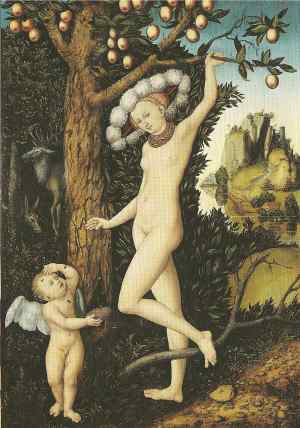

(This image reminds me somehow of the Genesis story of the very human Eve and Adam in the garden.  Of course, it's a painting of the divine Aphrodite and Eros.  I found the image at Nicos Stylianou's igreekmythology.com.  He provides this information.


Name:"Aphrodite and Eros"
Museum:National Gallery, London, England
Artist and Year:Lucas Cranach Sr.,ca. 1430
Theme: Aphrodite talks with her son Eros, who has been stung by bees.)

------

Related posts:

Monday, September 14, 2009

of sheep and men: overlooking wordplay in translation

There's an interesting discussion on translation with respect to gender inclusiveness and the Bible.  First, the background on the problem.  Then a look at a couple of translator's brilliant wordplay in the text in question.

-----

BACKGROUND

In his post "On Translation and Explanation," Joel M. Hoffman takes the TNIV and the Message bible translations to task for "explanation" but "not a translation."  Then Peter Kirk defends the TNIV and takes Joel to task for his explanation about the "original text."

The point of issue is whether Matthew the gospel writer means "a man" (which Joel says is the real "translation") or "a human being" or "people" (which Joel says is the seeming "explanation" of the TNIV and the Message respectively).

Peter suggests that Joel is seeing the original as meaning "only male human beings, not female ones"; Gary Zimmerli had also suggested the gender question in his comment here, saying "I think the [TNIV] translators don’t want to leave the door open to the idea that a woman may be less valuable."

The discussion is around Matthew 12, especially verses 10-12, especially in TNIV.

-------

TWO TRANSLATOR'S BRILLIANT WORDPLAY TRANSLATIONS

Below, you'll see how two brilliant translators work here.  The issues of whether the speakers, writers, translators, listeners, and readers get it should be clear.  What there is to get is how gods and humans are in contrast; and how humans and sheep are in contrast.  The larger context of the wordplay is something that both Joel and Peter have overlooked.  Matthew is emphasizing and is having Jesus emphasize who he is, as a human.

First, Ann Nyland translates [my italics added]:
10 There was a person who had a withered hand!...
11 This was Jesus' response.  
"Let's say one of you [persons] had a sheep.... "
12 "Isn't a person worth more than a sheep?...  "
13 Then he said to the person,...
In a footnote, Nyland also says [her italics below]:
...ἄνθρωπος, anthropos, is the word for human, humanity, person.  Grammatically, it is the common gender and not the masculine.
Both Nyland's translation and her explanation are just fine, don't you think?  [Note: she elides the word in v 11, as my bracket above notes].  Her translation doesn't have to explain, and Matthew's Greek doesn't either.

Second, then, I'm bringing up Matthew here because, very likely, he's also translating.  His Greek plays with words.

The fact is that we do not know what Jesus said in Hebrew Aramaic.  Matthew translates that to Greek.  Our best guess is that Jesus was referring to himself as בר אנש (bar 'anash).  So Matthew, in 12.8, makes that ὁ υἱὸς τοῦ ἀνθρώπου (which gets readers thinking perhaps of the aramaic of Daniel 7.13 or of its Greek translation in the Septuagint or both). 

Matthew wastes little ink before getting right into wordplay as he introduces a story about Jesus and as he translates a story-parable Jesus tells within the story.  You don't even have to read Greek to see the repetition of the word ἄνθρωπος, anthropos:
8 Κύριος γάρ ἐστιν τοῦ σαββάτου ὁ υἱὸς τοῦ ἀνθρώπου. 
9 Καὶ μεταβὰς ἐκεῖθεν ἦλθεν εἰς τὴν συναγωγὴν αὐτῶν. 
10 Καὶ ἰδού, ἄνθρωπος ἦν τὴν χεῖρα ἔχων ξηράν· καὶ ἐπηρώτησαν αὐτόν, λέγοντες, 
Εἰ ἔξεστιν τοῖς σάββασιν θεραπεύειν;
 ἵνα κατηγορήσωσιν αὐτοῦ.
11Ὁ δὲ εἶπεν αὐτοῖς, 
Τίς ἔσται ἐξ ὑμῶν ἄνθρωπος, ὃς ἕξει πρόβατον ἕν, καὶ ἐὰν ἐμπέσῃ τοῦτο τοῖς σάββασιν εἰς βόθυνον, οὐχὶ κρατήσει αὐτὸ καὶ ἐγερεῖ;
12 Πόσῳ οὖν διαφέρει ἄνθρωπος προβάτου. Ὥστε ἔξεστιν τοῖς σάββασιν καλῶς ποιεῖν.
13 Τότε λέγει τῷ ἀνθρώπῳ, 
Ἔκτεινον τὴν χεῖρά σου. Καὶ ἐξέτεινεν, καὶ ἀποκατεστάθη ὑγιὴς ὡς ἡ ἄλλη.
At this point, we're curious to see how Nyland translated verse 8, aren't we?  Well, it's masterful!  She is translating Matthew translating Jesus, as follows:
8 "... The Human Being is the Master of the Sabbath!" 
Nyland also offers a wonderful explanations in a footnote.  Here they are:
ὁ υἱὸς τοῦ ἀνθρώπου, ho huios tou anthropou, meaning a person associated with humanity, a translation of bar nasha, an Aramaic periphrasis for "person," would be read word for word as "one associated with humanity" (as non-gender specific language and "humanity" in the singular.  However, bar nasha means one associated with people", "a person", "the person", "humanity", "the representative person".
υἱὸς, huios, with a noun refers to a member of a class of people, and should not be translated as "son/child of".  The Benai Israel, translated in the KJV as "children/sons of Israel" should be translated as "members of the class of people called Israel" = "Israelites".  The expression is also Greek, and found as early as Homer.  Note also that ἄνθρωπος, anthropos, is the word for human, humanity, person.  Grammatically, it is the common gender and not the masculine.
 What are your thoughts about how Matthew translates Jesus and how Ann Nyland translates Matthew?

Tangled up in blue

We always did feel the same,
We just saw it from a different point of view,
Tangled up in blue.
--Bob Dylan

Blogger friends J.L. and Jay dropped by the last post here to make a couple of great comments.   J.L. says that from some of his friends he's "heard that feminism 'sissifies' men."  And he asks this fantastic question:  "So it is 'pink' to consider women equal?"  Jay adds this wonderful statement:  "Just because someone is bilingual (can speak both pink and blue interchangeably) does not mean they are confused."
(In the post, I was saying how a couple of friends here in Texas were using "blue" for the way men think and talk and "pink" for the way women think and talk - and "feminism" for the problem of men becoming "pink.")

What's funny to me is that we can talk together about "male" language and "female" language and never really examine whether our own conversation is "blue" or "pink."  Our talk is hypocritically immune from any critique while we're questioning - dare I say criticizing? - the talk of others.  Here's the rub:  am I speaking in manly terms (i.e., talking "blue") when talking about how "different" men and women are?
One of my friends says this:  "Men and women have different plumbing AND they have different wiring."  (I'll let you decide whether this friend is a man or a woman, whether the assertions are "blue" or "pink.")  This friend believes that genitalia AND brain functioning constitute a fundamental, inherent, natural set of differences between males and females.  Maybe this is "true" and is "true Truth" too.  (Aristotle certainly set out to prove this sort of Truth.)  The fascinating thing, to me, is how we talk about "difference" and "similarity."

We talk, we categorize.  "feel the same" / "different point of view" / "tangled up in blue" / "blue" / "pink" / "feminism" / "sissified [male]" / "equal [females]" / "man brain" / "woman brain" / "penis" / "vagina"

The conversations, the categories, get all tangled up.  I'm not talking "confused."  Rather, what I mean is that the very labels themselves order our realities as if Mother Nature or Father God were shouting out and yelling down at us.  These things - the very words made real - become threatening.
My eldest daughter, for example, declares she's not a feminist because she's feminine.  And, she quickly adds, "But am equal to any guy when it comes to making money or to intelligence.  In fact, not bragging or anything, but some men are just not as smart as most women." 

I retort that she's just not a first or second wave feminist.  But that she's a fine third-wave feminist!  (As if I have to defend "feminisms.")

We talk (she and I) about Leonard Pitts, Jr.'s daughter.  "So for the record," he announces, "I am a feminist. My daughter is too. She just doesn't know it yet."  But is he a "sissified" sissy, then? we wonder.  What we haven't done yet is read Pitts's debut novel.  The reviews say it's very good. 
And one reviewer says Pitt's first novel, Before I Forget, is actually very "blue" and not necessarily very "pink":
The message manhood: becoming a man; accepting and performing the responsibilities of a man, and teaching our sons what a man does and how a man behaves is refreshing and on point. Oh yeah, it’s that deep. The beauty of the novel is that each of the male characters in the book, not just the Johnson family, displays different levels and aspects, positive and negative, of manhood. I’m kinda stunned at how Pitts was able to accomplish this.
Now, is the reviewer a man or a woman?  Seriously.  Look at his or her language.  Is it more "pink" or "blue" - just judging by the language.  What language!:  "becoming" "accepting" "performing" "refreshing" "deep" "beauty" "displays" "different" "levels" "aspects" "stunned"  One might argue that the words tend to be "pink" more than "blue" even though the novel is about "men" and "males" and "manhood."  (In fact, the reviewer is a man.  Maybe he's just one of those sissyfied sissies.  But I don't think so.)

Black men (now I'm talking about African American males) tend, it seems, to have a particular issue with how they're talked about.  When you add "pink" and "blue" with "black" and "white," the labels get really colorful, don't they?  My wife and I just watched the wonderful Steve Harvey on BET this weekend.  He doesn't hold back with his vulgar hilarious humor, insider jokes in Ebonics!   And he's got so much to say, to his own daughters about his own kind.  There's much wisdom in his book Act Like A Lady, Think Like a Man: What Men Really Think About Love, Relationships, Intimacy, and Commitments.  And he's got a few things to say to young men too, about being "blue."  (One of my blogger-,  Facebook-, reallife friends cracked:  "Isn't he kinda like an Oprah for guyz?")  And yet he actually mentors the boy "in blue" himself.  Here's a video news report on his blog.  Now, I do know people who find Harvey's humor to be racist and his language about men and women to be sexist and stereotypical.  Oprah Winfrey (who is "kinda like an Oprah for girlz?") is, nonetheless, not one who is offended by this (black) man.

Somehow now, I'm brought back to Jay's wonderful comment:  "Just because someone is bilingual (can speak both pink and blue interchangeably) does not mean they are confused."  I like that alot.  Jay's statement is getting at something very personal:  our languageS, our voiceS, and our listening to one another with clarity.  When we're talking about other people, and if we can talk about ourselves too, the gendered labels can actually help.  Help, that is, if we don't get tangled up in blue.

(Now, a quick parenthetical thing:  When Bob Dylan sings Tangled Up in Blue, he's not meaning "blue" is "equal" to "male."  He's not even meaning "blue" is equal to "xanh."  He means "blue" is an emotion, a feeling, a profound "sadness" in this case in a relationship.  And none of us English speakers hearing his song "confuses" these categories.  It is fun to listen to the song, knowing Dylan's a "man" singing about a "woman."  It'd be crazy for us Vietnamese speakers to get tangled up in grue/ bleen "xanh".)