Showing posts with label Greek. Show all posts

Monday, July 25, 2011

Sexing Mortals as Women: a reply

Joel Hoffman has kindly taken time to comment here, to summarize and to set the record straight on his argument about the sex of the referents of the old Greek word, "anthropos."  This post is my reply.
Maybe it's just the sweltering heat that's gripping the country, but this strikes me as a disagreement in search of an opponent.
It really may be, Joel, that there are various causes for our conversation and, as you imply, for my own perspectives (such as the "the sweltering heat that's gripping the country").  However, please know that my first disagreement is with how you frame the discussion.  As Suzanne commented to you, "There is a lot of misunderstanding about these [Greek and English] words."  And, as Kristen pointed out very early, it's "through the lenses of their interpretation" that many will restrict how they view women vs. men in texts, whether the Bible in translation or the Declaration of Independence in the original.

Is anybody here really in search of an adversary? 

See how your comment frames our discussion now.  I don't want to misunderstand or mis-characterize what has been said.  I'm quoting you directly again and linking back to the threaded dialogue where you made your long comment.  Please know I'm not trying to diminish your view!  So it's worth repeating that I don't want to misunderstand or mis-characterize what has been said.  Yes, the point of issue for you is your position.  Perhaps I can reply with some fairness and with much due respect.   Your point of issue (i.e. what your position is) may be, ironically, precisely the point of my previous post:  we men are often so intent on our position that what we overlook is our privilege in it to the excluded point of view or, more to Kristen's point, to the excluded domains (i.e., "functional equality") of women.  Right, you're not wanting to take the conversation to that level.  You're interested in how right, and how rightly understood objectively, your own position must be. 

My position --- and I'm pretty sure I'm right --- has always been that anthropos in Greek is not the exact equivalent of "person" or of "man" in English. In my post from which you selectively quote, I write, "...anthropos in its various forms and contexts means different things, [and] I think we can usually know when it is gender specific and when it is not."
Is there an opponent to this position of yours?   Of course, everybody knows that, at the structuralist level of the word, there are no exact equivalents between languages.  And variant forms and different contexts in an untranslated text yield different meanings, even different and determinable and specific gendered meanings.  We will get to the examples you provide in your comment soon.

I'd like to say that, before we start talking about intra-translation or inter-translation equivalents ("exact" or otherwise), let's talk some about English alone.  Or about a word in any one language untranslated.  The question I was trying to raise is how Thomas Jefferson's "all men" in English could ever rightly be read as "all men and women."  We could flip the question around to talk about how Aristotle's use of a word can split women from men, can exclude the former from the privilege of the latter.  Anne Carson has noticed:
The celebrated Greek virtue of self-control (sophrosyne [σωφροσύνη]) has to be defined differently for men and for women, Aristotle maintains. Masculine sophrosyne is rational self-control and resistance to excess, but for the woman sophrosyne means obedience and consists in submitting herself to the control of others.  [See Aristotle's clear description of this defined division of his, in his Politics, Book I, 1260a]
Notice, then, that whether in English only or in Greek only, with words, different readers can use them to exclude or to include.  And we men tend to use the words we exclude by with privilege.

I may be getting a little ahead of myself.  And certainly I don't want to run ahead of what you've said too much.  Let me just say that I noticed how you didn't answer Mike Aubrey (on September 16, 2009) when he asked you:
Joel, what’s the difference between “human” and “person,” semantically speaking?
Several of us, I'm guessing, were wondering about that.  I'm glad you've brought up your distinctions between "human" and "man" neither of which can, for you, "mean ... person."  Further below, I'll reply to your reassertion of this difference you subscribe to again here.  However, I wanted to touch on it briefly now because I'm trying to make a point about untranslated words.  In your mind, by your own general uses of English, you generalize that some words "cannot mean" what others do.  And without getting into the differences (i.e., Mike's question) just yet, I do want to observe how Thomas Jefferson, in the short context of the Declaration of Independence, seems to equate "human" and "people" and "mankind" with "all men."  Granted, these are not exact equivalents.  But the point I was trying to make in my blogpost is this:  that the male privilege Jefferson enjoys as he pens these words excludes women.  His "all men" refers to men, not to women.  Furthermore, hence, and consequently, his readers (i.e., the King of England and the signers of the document in the colonies, all males we might remember) all read "human" and "people" and "mankind" as functionally male.  This is some Kristen's excellent observation too, as she brings forward the male readers' reading into our 21st century.  Just to be clear:  if we pressed Jefferson, he would insist that "human" and "people" and "mankind" are his words inclusive of women, ontologically speaking.  And yet, he made clear that good women, American women, are to stay home cooking and using their knitting needles.  In other words, they are a different kind of human and people and mankind than are all men.

But let's continue with your examples from the Greek of the Bible:

In Matthew 19:10, for example, I think we all agree that it would be a mistake to translate aitia tou anthropou meta tis gunaikos as "the case of a person with his wife." Far better is "the case of a man with his wife" or maybe "...husband with his wife." Similarly, in I Corinthians 7:1 the point of kalos anthropo guniakos mi aptesthai (for better or worse --- I suppose it's not my place to say) is what a man shouldn't do with a woman, not what a person shouldn't do.

And I think we also all agree that in John 4:28, for example, i guni ... kai legei tois anthropois means "the woman ... told the people," not just the men.
My much more limited point in the same post was that in the LXX and NT when anthropos is singular and specific, it refers to a man:

In other words, anything of the sort "an anthropos was..." refers to a man. If the person is a women, we instead find the word gune. (My search is limited to the OT LXX and the NT, so there may be examples I don't know about. What we're looking for is something like "I saw an anthropos and she said...")

I still believe that's true.
Joel, I hope you won't think I'm trying to talk you out of your beliefs.  Instead, given that you've well established what you believe is true, I'd like to discuss some alternative possibilities.

Let's start with Matthew 19.   First, starting where you want us to end, I'd agree that "...husband with his wife" is the rough meaning of what Matthew is translating what the disciples of Jesus are saying.  We don't have precisely or exactly what these disciples said.  We only have Matthew's Greek translation of what they said.  Matthew's translation is this:

"τοῦ ἀνθρώπου μετὰ τῆς γυναικός [tou anthropou meta tes gunaikos]"

The disciples mean "husband" or "man."  Matthew uses "ἀνθρώπου [anthropou]" to render that.

The big question is why doesn't Matthew use the less ambiguous term "ἀνήρ [aner]" or its variant "ἀνδρός [andros]" for "husband" or "man"?   This is much more likely what the disciples meant, given the context of what they said.

Well, a likely answer is that Matthew is also quoting Jesus.  He's translating what Jesus had said.  And, while doing that, he's quoting the LXX.  That is, Matthew is literally quoting the Greek translation of Hebrew.  We have no precise statement in the text exactly what Jesus's words were as he actually spoke them.

Before we read again what Jesus said, according to Matthew's Greek, let's remember something.  Matthew has not used unambiguous Greek to quote the disciples of Jesus.  In fact, he's paired anthropos with gunaikos but not andros with gunaikos.   Nothing should have prevented Matthew from making very, very clear that he's tightly quoting the disciples as saying, ""husband with his wife," as you translate it loosely.  So why not help the readers understand exactly, without much ambiguity, what the disciples meant precisely.  Why anthropos?  And why does Matthew quote the LXX, although Jesus himself might have been speaking Hebrew, quoting the original text of the Bible?

The bit that Matthew quotes from the LXX is telling.  This bit has anthropos!  This bit has this word with rich ambiguity.  This bit is from Genesis, of course.  This bit is from both creation accounts of Genesis:  first from Gen. 1:27 reiterated also in Gen. 5:2, then from Gen. 2:24.   Although the Septuagint translators are using Greek and are translating Hebrew words on the design of marriage, in the beginning, the translators use "ἀνθρώπου [anthropou]";  they do NOT use the clearer words for "husband"; they do not use "ἀνήρ [aner]" or its variant "ἀνδρός [andros]."

Why anthropos?   Again, we will do well to remember that the LXX translators are translating.  This is exactly what Matthew is doing for the disciples of Jesus.  But they are not using a very precise word.  As you've already confessed, in various contexts, anthropos is not male only.  So, why anthropos?  Why not be clearer?

Could the answer be that the LXX translators know how Aristotle wrote Greek?  Perhaps they knew that he taught his disciples to avoid ambiguities?  As likely, or more likely, the LXX translators knew Aristotle's Politics, in which he refers disparagingly to human ambiguities and subjectivities on their "kind," their "class," their "social categories."  At line 36 of Bekker page 1255a, one can find Aristotle quoting the woman Helen:  "But who would dare to call me menial, The scion of a twofold stock divine?"  (This is H. Rackham's translation.)

Now, females, for Aristotle, are botched males.  And even if Helen is part divine, ambiguously so, then she's still botched; she's of a mixed breed.  Aristotle's reaction to this ambiguity in this woman is clear.  His reaction is to her suggestion that no one should call her menial is to complain that Nature will produce what it will.  He complains that people who boast about the best part of their lineage are not looking at the facts, and are not objectively observing nature, and are merely saying, "ἐξ ἀνθρώπου ἄνθρωπον [ex anthropou anthropon]."  The context, I think you 'd agree, allows for the fact that Aristotle is reading and is writing anthropos here as ambiguously inclusive of males and females, especially Helen.

Generally, the Greek lore for the beginnings of women, as anthropoi, goes way back.  And Helen is often quite frequently in the mix.  This is not lost on the LXX translators.  They are aware of the ambiguities, and they flaunt them.  What are they aware of?

Probably, the LXX translators know Sappho.  Aristotle does.  Plato does.  Socrates does.  Alexandria, where the legend has the translators, does.   Likely, the translators know her Hymn to Aphrodite III, 1 and 2.  Some of it goes like this:

πά]γχυ δ᾽ εὔμαρες σύνετον πόησαι
πά]ντι τ[οῦ]τ᾽. ἀ γὰρ πόλυ περσκόπεισα
κά]λλος ἀνθρώπων Ἐλένα [τὸ]ν ἄνδρα
[κρίννεν ἄρ]ιστον,

Here one hears of, and now only reads of, Helen as an anthropos with an andra.  That is, she's a person, a human, a mortal (not the immortal goddess Aphrodite).  And Helen is a mortal human with a man, with a husband.  To illustrate, here's how Jane McIntosh Snyder translates these lyrics:

It is completely easy to make this
intelligible to everyone; for the woman
who far surpassed all mortals in beauty,
Helen, left her most brave husband

(I've shown how various English translators have rendered these Greek lines of Sappho, here and here.)   What should be completely easy and intelligible to everyone is how Sappho includes Helen, a woman, without the word gune, among all mortal humans, by the word anthropos.

Perhaps the LXX translators didn't really know this Hymn of Sappho.  But very very likely, the LXX translators did know the Theogony of Hesiod:

The LXX translators seem to be working their Genesis translation, with both creation accounts (i.e., in Gen. 1 and in Gen. 2), against Hesiod's Theo-Gony.  Hesiod's account of the beginning, includes the lore of Helen as an anthropos.   But more than that, the Theogony has the creation of "woman" (and of the "female") as an aberration of and a harm to mortals.  Zeus, the chief of the gods, is responsible:
But when he had made the beautiful evil to be the price for the blessing, he brought her out, delighting in the finery which the bright-eyed daughter of a mighty father had given her, to the place where the other gods [θεοὶ theoi] and men [ἄνθρωποι anthropoi] were. And wonder took hold of the deathless gods [ἀθανάτους τε θεοὺς a-thanatous te theou] and mortal men [θνητούς τ' ἀνθρώπους thnetous t' anthropous] when they saw that which was sheer guile, not to be withstood by men.  For from her is the race of women and female kind [ἐκ τῆς γὰρ γένος ἐστὶ γυναικῶν θηλυτεράων, ek tes gar genos esti gunaikon thelyteraon]: of her is the deadly race and tribe of women who live amongst mortal men to their great trouble, no helpmeets in hateful poverty, but only in wealth. And as in thatched hives bees feed the drones whose nature is to do mischief -- by day and throughout the day until the sun goes down the bees are busy and lay the white combs, while the drones stay at home in the covered skeps and reap the toil of others into their own bellies -- even so Zeus who thunders on high made women [γυναῖκας gunaikas] to be an evil to mortal men [ἄνδρεσσι ... θνητοῖσι andressi ... thnetoisi], with a nature to do evil.  [lines 585 - 600, translated by H. G. Evelyn-White]
In stark contrast, there's the Hebrew account of the creation of woman!

And the LXX translators get the contrast between Hesiod's Greek and the Hebrew Bible.  They want to flaunt the ambiguities by their own Greek.  And so they do:
And God made humankind;
   according to divine image he made it;
   male and female he made them.
[translated from the Greek into English
by Robert J. V. Hiebert]
καὶ ἐποίησεν ὁ θεὸς τὸν ἄνθρωπον [anthropon],
κατ' εἰκόνα θεοῦ [theou] ἐποίησεν αὐτόν,
ἄρσεν καὶ θῆλυ [thelu] ἐποίησεν αὐτούς.

Here, there is great wordplay.  There is the acknowledgment and the flaunting of semantic ambiguities by lexical ambiguities and by grammatical ambiguities and by phonological ambiguities.  In other words, the LXX translators are not making the female some aberrant of the class of humans.  The LXX translators are using Greek to include women, females, in the class of all men, all humans.  And following the Hebrew, they attribute this creativity in the beginning to God and according to the ambiguous image of God.

This is one of the bits that Matthew quotes.  Matthew is ostensibly translating Jesus.  Jesus is quoting Genesis.  The point of issue for Matthew, as translator, is that the Greek for translation is ambiguous and gender neutralizing and gender including.  The "beginning," the creation account(s), may be the most important part of all of this:  here's a statement of Nature, of Creation, of the one Divine Creator, imparting the image of the divine as a creative act, as male and female, as humanity plurally sexed.  Any discussion of marriage, Jesus seems to be saying, shouldn't ignore the value of the female.  Any discussion of the beginning, Matthew seems to be emphasizing, shouldn't discount the way the LXX translators consider anthropos as positively inclusive of the female.

When we come to your other two examples, "I Corinthians 7:1" and "John 4:28," we can continue to look at the gender neutral and gender inclusive possibilities.  Paul writes to people in Greece who have Greek-religious and Greek-literary contexts.  And in I Cor. 6:16, as he's coming to the verse you reference, Paul quotes Genesis 2:24, exactly the same bit that Matthew quotes.  The backdrop is that in the beginning, in contrast to Hesiod's creation myth, God's image in creation of humanity includes the female in anthropos.  When Paul then uses the word for husbands in Corinth, there's a richness, an ambiguity, an inclusiveness that the English word husband does not have but that human being does have.  John, as you already explain, is likely not including women in his use of anthropos in 4:28.  In fact, he quotes and translates the woman in 4:29 as appealing to these people she's talking to to come and see a human, a person, who just may be Messiah, or in Greek "Christ."  John the translator is calling the Messiah a mortal human being in a rather gender inclusive if only perhaps a rather gender neutral way, an anthropos.

The LXX and the NT meanings for anthropos seems to be to play on the old Greek contrasts between gods/goddesses and humans, between humans and (their) women/wives.  How the Hebrew God/Creator made female and male in anthropos is the emphasis.

This brings us to your final paragraph in your comment:
And this, from a comment, is still the really interesting theoretical question for me:

I don't know for sure about [NT] Greek, but my best guess is that "Chris
anthropos estin" can mean two things. "Chris is a human" or "Chris is a man." It cannot mean "Chris is a person."

But it seems to me that it will be hard to discuss these interesting nuances unless we can move past the obvious cases. (I also recognize that some translators --- seemingly out of ignorance or dogma --- cling to gendered translations where there is no support for them, but I don't think that I'm one of those people.)

-Joel
My only reply here is just to confess I don't understand what you mean that anthropos can mean either "'... a human' or '... a man'" but that it "cannot mean '... a person'."  (Please let me agree with you that you're not one of those people working seemingly out of ignorance or dogma!)  So let me ask you, Have we in this post of mine, with Sappho and Hesiod and Aristotle and Genesis LXX begun to "move past the obvious cases"?  Don't the Septuagint translators, together with the writers and Greek translators of the New Testament, open up the also-female meanings of anthropos in all of their contexts?  Don't they sex mortals as women too just as the look to the image of the Creator as being male and female?

Monday, May 2, 2011

for nerds: history, punctuation

It's almost as if Chloe Angyal over at feministing.com is afraid of talking seriously about history. Or is it really just "nerdy," for example, to remember (which she does) "the role of Black women activists in the abolition movement" from 1833 to the 1870s (as blogged by historian and professor of English, Carla L. Peterson)?

I did think it was really nerdy for Mike Sangrey over at Better Bibles Blog to go on and on and on about punctuation.  Or was he just trying to get us to notice how wacky his punctuation was while he was making his pronouncements?  He was trying to convince us of clarity and naturalness, saying things like, "So, punctuation is required in the translation, or it wouldn’t be clear and natural—it wouldn’t communicate to an English audience."  I don't really see that as particularly obvious or fair to a writer, and it gives the translator both a lot of latitude and liberty (contra "Nature"), which is how it should be, I believe.

But then who am I?  For family portraits, you may find me wearing such t-shirts:


And sometimes I like blogging on history and on punctuation together, as HISTORYANDPUNCTUATIONTOGETHER.  Sometimes I'll blog on Aristotle.  Wouldn't a dissertation be enough?  Sometimes I'll blog on the Bible.  Wasn't sunday school quite enough?

Well, call me what you like.  I think you're reading this blog post, aren't you?  Maybe you're one of those translation nerds.  If so, then stay tuned for more.

One day, one of Aristotle's students (it could have been Alexander the Great) read this:


If you recognize it, then it's likely that you know it wasn't written for you.  It wasn't.  You know it's a little clip from Aristotle's Rhetoric.  Yep, that's right.  We know it as the book called "The Rhetoric," or as what its most recent translator, George A. Kennedy, calls On Rhetoric: A Theory of Civil Discourse.  And we know that it's really 3 Books, and the little clip above is what has been punctuated as Book 3, Chapter 5, paragraph 6.  Kennedy has entitled the context here as this - "Chapter 5: To Hellēnizein, or Grammatical Correctness" and has put that title, without my quotation marks but with his own white space, as the header on page 206 of his book, the translation of Aristotle's book(s) on rhetoric.

We can also see that paragraph 6 here is how Aristotle rags on the "punctuation" of Heraclitus.  (To be sure, we already know from other things Aristotle wrote how much he disliked Heraclitus, who, for Aristotle, did not write with "Grammatical Correctness," or To Hellēnizein.)  Aristotle is stressing how important it is to be clear and natural with Greek, for his elite Greek all-male students.  (It's sort of like Mike Sangrey's mantra for Bible translators punctuating).

So, some later editor of Aristotle makes these helpful changes in punctuation, helping out Aristotle, not necessarily Heraclitus:
[6] πέμπτον ἐν τῷ τὰ πολλὰ καὶ ὀλίγα καὶ ἓν ὀρθῶς ὀνομάζειν: “οἱ δ᾽ ἐλθόντες ἔτυπτόν με”.  ὅλως δὲ δεῖ εὐανάγνωστον εἶναι τὸ γεγραμμένον καὶ εὔφραστον: ἔστιν δὲ τὸ αὐτό: ὅπερ οἱ πολλοὶ σύνδεσμοι οὐκ ἔχουσιν, οὐδ᾽ ἃ μὴ ῥᾴδιον διαστίξαι, ὥσπερ τὰ Ἡρακλείτου. τὰ γὰρ Ἡρακλείτου διαστίξαι ἔργον διὰ τὸ ἄδηλον εἶναι ποτέρῳ πρόσκειται, τῷ ὕστερον ἢ τῷ πρότερον, οἷον ἐν τῇ ἀρχῇ αὐτῇ τοῦ συγγράμματος: φησὶ γὰρ “τοῦ λόγου τοῦδ᾽ ἐόντος ἀεὶ ἀξύνετοι ἄνθρωποι γίγνονται”: ἄδηλον γὰρ τὸ ἀεί, πρὸς ποτέρῳ δεῖ διαστίξαι.
And that's when the English translators get busy.  Here's the renderings of the top three translators (I guess they're the most-read):

John H. Freese had this in 1926 and his later publisher, for the Harvard Loeb Classical Library, put the revised punctuated Aristotle text right next to Freese's English --
The fifth rule consists in observing number, according as many, few, or one are referred to: “They, having come (pl.), began to beat (pl.) me.”
   Generally speaking, that which is written should be easy to read or easy to utter, which is the same thing. Now, this is not the case when there is a number of connecting particles, or when the punctuation is hard, as in the writings of Heraclitus. For it is hard, since it uncertain to which word another belongs, whether to that which follows or that which precedes; for instance, at the beginning of his composition he says: “Of this reason which exists always men are ignorant,” where it is uncertain whether “always” should go with “which exists” or with “are ignorant.”
Then H. Rhys Roberts, the same year, has this (which was republished also, in 1954), with a few updates in natural and clear punctuation, like so --
(5) A fifth rule is to express plurality, fewness, and unity by the correct wording, e.g. "Having come, they struck me (oi d elthontes etupton me)." It is a general rule that a written composition should be easy to read and therefore easy to deliver. This cannot be so where there are many connecting words or clauses, or where punctuation is hard, as in the writings of Heracleitus. To punctuate Heracleitus is no easy task, because we often cannot tell whether a particular word belongs to what precedes or what follows it. Thus, at the outset of his treatise he says, "Though this truth is always men understand it not," where it is not clear with which of the two clauses the word "always" should be joined by the punctuation.
Much more recently, and to make things more natural and clear for students of rhetoric in 1991 (and then 2007), Kennedy has this --
6. Fifth is the correct naming of plural and singular:  "Having come, they beat me."  What is written should generally be easy to read and easy to speak--which is the same thing.  Use of many connectives64 does not have this quality, nor do phrases not easily punctuated,65 for example, the writings of Heraclitus. To punctuate the writings of Heraclitus is a difficult task because it is unclear what goes with what, whether with what follows or with what precedes. For example, in the very beginning of his treatise he says, "Of this Logos that exists always ignorant are men." It is unclear whether "always" goes with what precedes [or what follows].

64. Polloi syndesmoi, or polysyndeton, regarded by later rhetoricians as a figure of speech involing a surfeit of conjunctions: i.e., A and B and C, etc., rather than A, B, C. . . . .
65. Classical Greek was generally written without punctuation and even without spacing between the words; it thus had to be "punctuated" by the reader.

Now, if you're looking for a point from me, an idea, a belief, a conclusion of sorts, then it's this: there's very little "natural" about language like this. Rules are written by humans, even punctuation rules. And these are often broken. I believe the KJV Bible, and just about every Bible before it and after has broken punctuation rules.  (I wanted to say that today, just because it's a historical one, you know, the KJV birthday.)

So the king of pronunciation is the one who makes up the rules. A creative writer, like Heraclitus, might be difficult or playful or allow too much play. And so somebody like Aristotle will come in to try to shut that down, to attempt to shut him up. It's sort of comical when you look at it, because Aristotle is just as nerdy as Heraclitus before him. And his punctuation is hardly any clearer. It's just different in how it pronounces the need for clarity and for naturalness and for correctness.  What might you think?  Is this nerdy stuff?  Does it have relevance to history for you, to bible, to translation?  Is one of the four translations above (that Greek one and the three Englishes) clearer or more natural or more accurate or correct to the original than the others?

Tuesday, April 6, 2010

"ALL IN ALL": language

[UPDATE: I wrote this post very quickly in a very short amount of time yesterday. This morning, I thought to go back through to correct the typos and to adjust the Greek marginal formatting and to help you readers out with clarity in other editorial ways. But now I'm hoping you'll just make what you can of it. Know that I have been thinking through or at least thinking on some of these things. The conversation at BBB continues, and it's a good discussion, I think, at least an important one for many of us. Perhaps for you, there's something pertinent too.]

Teacher:  A good language must have one and only one meaning for each single word!
Young pupil Kenneth Pike:  But, sir, how then could we learn language?
         --Ken Pike, recollecting to some of us, his linguistics students
The Stranger: ... ποιήσῃ τῶν στοιχείων ἕκαστον πάντων ἐν πάσαις ταῖς συλλαβαῖς τὸ μὲν ἕτερον ὡς τῶν ἄλλων ἕτερον ὄν, ...
Young Socrates:  Παντά-Πασι μὲν οὖν.
         --Plato, The Statesman
I like very much the way the philosopher Goodman has stated (1978:x) that "what emerges can perhaps be described as a radical relativism under rigorous restraints" [emphasis mine, KLP].
         --Kenneth Lee Pike, Talk, Thought, and Thing
Here I go again, starting a blog post with three epigraphs.  So you get what I'm doing by now, don't you?  I'm wanting to use language to reflect on language use.

In particular, I want to start my post by blurring the lines between poetry and prose (or so called "propositional truth language").   Let me first (1) rather rhetorically listen in on the English language dialog between two bloggers.  Then (2) let's consider other English.  We might (3) just return to some Greek.  And then (4) we'll talk about translation.

Here goes:

(1)

John Hobbins of the blog Ancient Hebrew Poetry makes a brilliant comment at Dannii Willis's Better Bibles Blog post.  He starts:

"... my inner poet rebels against the notion that it is possible to translate a phrase like 'all in all' into propositional truth language."

John goes on to show how the phrase "'all in all' is part of a "beautiful song." He's already admitted, nonetheless, and has very clearly stated that it's not just lyrical sung poetry but that "propositional truth is [indeed] communicated" in the original Greek phrase that Dannii is concerned with (i.e., παντα εν πασιν).  And yet, John draws attention away from the propositional nature of this Greek phrase and then towards what he calls "the diction of the original."  John remarks pointedly that - because of the phrase's vagueness or ambiguity ostensibly - "it could be taken" by Greek readers and listeners alike "in the wrong way."  He implies that this problem is overcome by context.

Dannii replies rather curtly that the English phrase "all in all" (i.e., to translate the Greek phrase παντα εν πασιν) is "just a nice sounding Christian catchphrase."  And Dannii adds rather syllogistically that "catchphrases have no place in our Bibles."  This is his firm conclusion, and so far John has said nothing to rebut it.

My analysis of this conversation:

What I want to draw attention to is that John uses prose or, what he calls "propositional truth language" to make his claim and to build his case.  He does not use poetry, even poetry in the limited way he himself so propositionally defines poetry in contemporary English at his prosaic blog he's named Ancient Hebrew Poetry.  John himself quotes the lines from a song, but of course he cannot sing it in his written comment.

Dannii then comes back curtly (as I said already), in quick propositions.  But notice the nice sounds in his sentence, "It’s just a nice sounding Christian catchphrase."  With all that alliteration and all of those sibilants and affricates and voiceless stops, it's almost poetry.  Maybe it's song.  And it's rather puny because "Christian catchphrase" seems to be a "catchphrase" of "Christians."  Here's propositional truth proof, some of it propositional and scientific:  Bible Read Through and Christian Catch Phrases and Scientists Warn of Shortage in Christian Catchphrases.

(2)  Now this part 2 on considering other English isn't all that clever.

I just remember reading Sir Philip Sidney's piece "The Defense of Posey [i.e., Poetry]" and thinking, Hey, he is using prose here to defend poetry.  I think Mary Sidney's one of the best translators of the Bible ever -- just thought I'd through that in to see if you were paying attention.  Thank you, then!  And click on this link if I've gotten too propositional for you (and if you want an image of something cool).  And I also remember watching Dr. Ken Pike do a monolingual demonstration, give a follow up lecture with a bit of Q & A, and then recite poetry.

He told poems
as if
they could not
be
told otherwise

Now, I'm thinking I've just made a capital E out of a bad poem.  Don't know what that means, really.  Maybe you'll make something of it.

(3) Now Greek.  No, not Aristotle's this time.  I'm going to show you Plato's Greek (which had some impact on the young Aristotle, I must add).  Plato's got this Young Socrates character learning from a Stranger (and neither is the real Socrates, who taught Plato, or the Socrates who shows up as the real Socrates in most of Plato's dialogs).  The stranger is teaching his student the Young Socrates about Politics and being a Statesman (and they are all men, you know).  His using examples to explain examples to get to the politics stuff.  So he starts with the alphabet.  Yes, Greek.  And he says this:

Ἀνάγειν πρῶτον ἐπ’ ἐκεῖνα ἐν οἷς ταὐτὰ ταῦτα
ὀρθῶς ἐδόξαζον, ἀναγαγόντας δὲ τιθέναι παρὰ τὰ μήπω
γιγνωσκόμενα, καὶ παραβάλλοντας ἐνδεικνύναι τὴν αὐτὴν 
ὁμοιότητα καὶ φύσιν ἐν ἀμφοτέραις οὖσαν ταῖς συμπλοκαῖς, 
μέχριπερ ἂν πᾶσι τοῖς ἀγνοουμένοις τὰ δοξαζόμενα ἀληθῶς
παρατιθέμενα δειχθῇ, δειχθέντα δέ, παραδείγματα οὕτω γιγ‑ 
νόμενα, ποιήσῃ τῶν στοιχείων ἕκαστον πάντων ἐν πάσαις 
ταῖς συλλαβαῖς τὸ μὲν ἕτερον ὡς τῶν ἄλλων ἕτερον ὄν, τὸ
δὲ ταὐτὸν ὡς ταὐτὸν ἀεὶ κατὰ ταὐτὰ ἑαυτῷ προσαγορεύεσθαι.

Yes, I hear the It's All Greek to Me catchphrase.  What you might see, nonetheless, is how Plato's Stranger is using a favorite Greek catchphrase of the Greek-writing Roman-citizen Christian-Jew Saul-Paul.  It's not exactly poetry, but it's not exactly propositional truth, not just yet.  This is Plato, remember, not yet Aristotle.  So did you see it, right there in the dialog?  Or at least in the monolog bit of the Stranger?  πάντων ἐν πάσαις

All in all.  He's talking (as Plato's writing) about the each and every correspondences of letters to syllables and such.  As an example of something like this example and like politics.  It's a nice way to learn.  Take something similar but different.  Stack it up next to something similar but different.  See what you can make of that.

And what do you make of the Young Socrates's response.  Oh that's right, you need to see it.  He "says":

Παντά-Πασι μὲν οὖν.

Now, I'll bet you a few pennies that most English translators have completely missed the Greek wordplay here.  You, however, can see it can't you?  All those π's and Π's and παν's and πασ's.  What's that mean?  Well, on the propositional level, the Young Socrates says "Certainly" or "That's altogether so."  At least that's what translator Benjamin Jowett and translator Seth Benardete have respectively said he said.  What if they'd said something more poetic?  More playful?  More punny (or is it punier?)?


Truth be told, and all in all, I really haven't seen this Greek catchphrase or the wordplayful response anywhere much at all between Plato and Paul.


(4)  Okay.  Let's talk.  About translation I mean.  What do you think?

Sunday, January 24, 2010

Euripides & St. Peter: Feminist & Weaker Sexist?

In this post, I want to get us examining (re-examining perhaps) a word that Euripides and then St. Peter used in reference to women. First, however, I would like to look at what readers of Euripides have said about him and his "feminism." And then could we conjecture about Peter's view of women?  Finally, shall we compare how the two men use the one word?

Euripides is the Greek playwright. And the Peter I'm interested in is the Jewish disciple of Jesus writing in Greek nearly five hundred years later -- the one who's called Saint Peter.

Of Euripides, much has been written with respect to his views on women.  For example, historian F. A. Wright, in his Feminism in Greek Literature from Homer to Aristotle, says this:
“Euripides and Plato are almost the only [male] authors who show any true appreciation of a woman's real qualities, and to Euripides and Plato, Aristotle, by the whole trend of his [sexist, bigoted] prejudices, was opposed.”
Likewise, English professor Louis Markos, in his From Achilles to Christ: Why Christians Should Read the Pagan Classics, says this:
“The 'sentimental' Euripides is a self-conscious artist who cannot ignore his own age to sweep his reader off to a mythic neverland.  He was keenly aware of the injustices of his day--the brutalities of war, the subjugation of women, the ill treatment of foreigners and illegitimate children--and he projected these contemporary issues and struggles back into the legendary settings of his tragedies, rather as Arthur Miller's The Crucible projects the dangers of McCarthyism back into the 'legendary' days of Puritan New England.  That the plays of Euripides make their points without sinking into polemic or allegory is a tribute to the complex and subtle artistry of their maker.  They are a tribute as well to his insight into human nature and his gift for giving dramatic voice to the mental anguish and internal rage of the dispossessed.”
In addition, Anne Carson, a Greek classicist and translator of several of Euripides's works, says this of the nature of the playwright:
“He was also concerned with people as people--with what it's like to be a human being in a family, in a fantasy, in a longing, in a mistake.”
And Ann Nyland, a Greek classicist and translator of the New Testament, finds the Greek words of Euripides to be helpful in understanding the words of the writers of the gospels, Acts, the epistles, and Revelation -- especially as the words that figure in the often-ignored “case of gender (mis)translation and anything pertaining to women” in much Bible translation.

Now, has anyone said about St. Peter that he showed “true appreciation of a woman's real qualities” and that he “was keenly aware of the injustices of his day--the brutalities of war, the subjugation of women, the ill treatment of foreigners and illegitimate children”?

Well, maybe.

Suzanne McCarthy posted recently that Peter Leithart is suggesting what she calls “an unusual interpretation” of I Peter 3:7 in Leithart's blog post.  The interpretation is that St. Peter is perhaps less sexist than his fellows and his predecessors.  In fact, St Peter may even favor women -- promoting them from a more sexist Judaism to a more feminist Christianity.

The phrase so unusually interpreted is ὡς ἀσθενεστέρῳ σκεύει.  It can be transliterated hos asthenestero skeuei, and it has been often translated as “as weaker vessels.”  St. Peter's word that Leithart keys in on is σκεύει / skeuei /.  Leithart interprets it as “temple” vessels for the “New [Christian Church, not-old-Jewish Tabernacle] Covenant.”  Christian wives, as such “vessels,” are now by St. Peter included in the “service.”

From here, I'd like us to compare how the “feminist” Euripides used the word σκεύει / skeuei / with how the perhaps “weaker-sexist” St. Peter used it.

The main objection in comparing how the two men used the word is their contexts and their time.  Euripides writes during a life time of world war nearly 500 years before St. Peter writes during the days of a fairly stable empire.  So to overcome the objection, I want to look at an author who is a likely contemporary of Peter.  I want to show that Chariton, writing the first-century novel Callirhoe, uses the word in question the way Euripides did some centuries earlier.

Here's from the translation by G. P. Goold:
“That is why I [Callirhoe, the beautiful woman protagonist of the novel] have been handed over like a mere chattel [σκεῦος, / skeuos /] to I know not whom...”
Elsewhere in the novel written in the first century (when St. Peter wrote his letter), there is this:
“...next, a royal abundance of funeral offerings, first the gold and silver of the dowry, a beautiful array of garments [κάλλος καὶ κόσμος / kallos kai kosmos /] (for Hermocrates had contributed much from the spoils of the war), and the gifts of relatives and friends. Last of all followed the wealth of Chaereas...”
What I am trying to show is how the word σκεῦος, / skeuos / relates to women.  It has to do with material goods, which Goold translates “mere chattel.”  The second quote given is to show the war context and specific examples of the sorts of σκεῦος, / skeuos /, imagined by a novel's author and by his readers.

Now, we can turn to Euripides.  In the play, The Suppliant Women, we read the following conversation between two characters.  The English translation is by E. P. Coleridge (and we wish Carson had translated this play too); but watch for the Greek word of Euripides, which is reinserted within the brackets below:
Iphis -- Why do you deck yourself in that apparel?
[σκευῇ / skeue / δὲ τῇδε τοῦ χάριν κοσμεῖς / kosmeis / δέμας]    
[[UPDATE -- I just found Michael Wodhull's 1888 rendering, a more literal translation of this line above as:
"But on what account Thy person with that habit hast thou graced?"]]

Evadne -- This robe conveys a strange meaning, father.

Iphis -- You have no look of mourning for your lord.

Evadne -- No, the reason why I am decked in this way is new, perhaps.

Iphis -- Do you then appear before a funeral-pyre?

Evadne -- Yes, for here it is I come to take the prize of victory.

Iphis -- What victory do you mean? I want to learn this from you.

Evadne -- A victory over all women on whom the sun looks down.
Here, the characters of Euripides understand the word σκευῇ /skeue/ to refer to material goods, and in this case to “apparel.” [[or something like a worn “habit.”]]

In comparing Euripides's (and Chariton's) use of the word σκευῇ /skeue/ with St. Peter's use of it, we are left with questions:
Is St. Peter instructing married men to look at their wives as “weaker vessels” or perhaps as “fragile and feeble material goods”?
And if St. Peter is using the word in the same way other writers have used it, then does this make St. Peter more of a feminist or even some sort of “weaker” sexist?
Or, given the Bible as some "God-inspired" text that surely somehow favors men and women equally and always, should we just stop asking these sorts of questions?

Saturday, December 12, 2009

What Bible Translation Sounds Like

Sometimes Bible translation sounds like gibberish. But gibberish can sound really important, even condescending. Let's look at an example in a moment. Before we listen in on biblistic language, here are a couple of non-biblical true stories of mine.

First Story. Someone really important to me once questioned one of my words. That somebody is Carolyn Osiek, a New Testament scholar who is a feminist who served on my dissertation committee. As we were in the Greek restaurant of all places talking about how I was accusing Aristotle of coining technical-and-abstract words to box in others, she turned the conversation to me (on me?) to ask: "Are you coining the word feministic?" "What word would you use?" I retorted. "Something like, 'in feminist ways' or 'by means that are feminist'," she replied. And she could have explained, "feministic sounds like you're looking down on feminists"; but she didn't need to say anything. I stopped using the word for a while, and when I did use it tried to make sure no one mistook me for Aristotle. A little later, I blogged this post on how rhetorical "-istic" can be. How little parts of words sound like big, condescending stuff.

Second Story. My college roommate from Japan was a helpful tutor when I was taking classes in Japanese language. My private lessons included listening to and trying to say tongue twisters like, "なまむぎ なまごめ なまたまご." Of course, I heard that as, "namamugi namagome namatamago," which hardly rolled off my tongue. This, of course, means 生麦生米生卵. It might be something you hear in a kitchen (if not as a joke on Japanese language learners): "raw wheat, raw rice, raw eggs." Even if I'd wanted to make my roommate-tutor feel my pain, I couldn't. He didn't stumble over my mother tongue the way I tripped over his. He'd grown up bilingual, and he spoke his English Rs and Ls and Ws and Fs as fluently as I did. The lessons were playful ("-mugi, -gome, -mago") but pronounced a difference between us. How little parts of words sound like big, condescending stuff.

So, now, there's this story in the Bible. It's also become a story of bible translation. This is the example of gibberish I was talking about at the beginning of this post. Sounding really important and smart, the translation usually goes like this:
Jephthah captured the shallow crossings of the Jordan River, and whenever a fugitive from Ephraim tried to go back across, the men of Gilead would challenge him. “Are you a member of the tribe of Ephraim?” they would ask. If the man said, “No, I’m not,” they would tell him to say “Shibboleth.” If he was from Ephraim, he would say “Sibboleth,” because people from Ephraim cannot pronounce the word correctly. Then they would take him and kill him at the shallow crossings of the Jordan. In all, 42,000 Ephraimites were killed at that time.
This really is one of the best translations of Judges 12:5-6 in my opinion because it forgoes the really strange English word "fords" and uses the much-clearer phrase "shallow crossings" instead. This is the New Living Translation. But, like every other translation of the Bible I've heard, there's the weird "Shibboleth" / "Sibboleth" thing that seems give us English readers (especially non-Ephramites) some kind of insider track here. We'd more quickly side with the killers than the killed here.

What we don't get by the sounds-only translation is what the Hebrew word שִׁבֹּלֶת means to some of the early readers of the story. Quite literally, it's an ambiguous term that can mean either "corn stalk or grain waves" or "water flood or stream." And the Jews translating this word into Greek (in the Septuagint, "Judges A" AND "Judges B") make the Hebrew mean either σύνθημα or στάχυς [sun-thema OR stachys]. The first Greek word is just a signal to the reader who seems to know the story well:  it means something like a "theme together" or an "inside joke" (or a "password" -- which is how translator Philip E. Satterthwaite moves the Greek into English in the New English Translation of the Septuagint).  The second Greek word, in this context, is sometimes translated into English as "Stachys."  (And that's exactly how English translator Sir Lancelot Brenton translates it while Satterthwaite clarifies the word to mean "Ear-of-Corn"). The Greek word στάχυς, of course, is ambiguous. Greek readers know it means "ear of corn" but it also is used for the "lower part of the abdomen."

So if you read the story in Greek translation from the Hebrew, then it is funny because the Ephramites can't pronounce "corn stalk" and they get stabbed in the point of their body that looks like a corn stalk: they get a sword run through the lower part of their abdomen.  Or if you read the Judges A translation from Hebrew to Greek, then it's more serious because the translator is just reminding Jewish readers how one group used a password (an inside joke) on the other group, deadly serious stuff.  In both Jewish translations (from Hebrew to their Hellene), the reader never hears the Ephramites stumbling over the word (i.e., as if saying "Sibboleth").  The silence is important, I think, because the translators are giving a nod to their readers and not entirely trying to explain what would be understood if listening to the story in Hebrew.  (Sylvie Honigman, the scholar in Jerusalem who's looked at the legend of the Septuagint, says that the Greek here is in the Homeric not the Alexandrian [or Aristotelian] paradigm -- that's important to me as I look at how Aristotle abstracts language and the early Greeks refused to do that.  The Jews, with their scripture, are much more playful than many of our English translations - in Aristotelian fashion - give them credit for).

And if you read the story in Hebrew translated into as playful English, then it goes something like this. And here I give apologies to my good Japanese language tutor:

So they say to him,
"So say 'cornstalk rows like water flows'."
So he says "colnstark lows rike watel hrows."
So he can't rightly get it right.
So they seize him.
So they make his blood flow at the crossing of the Jordan.
So at that time some forty two thousand fall
some forty two thousand of the tribe
                                        of that twice-blessed second born of
fall

Now listen to the Hebrew:

וַיֹּאמְרוּ לֹו אֱמָר־נָא שִׁבֹּלֶת
וַיֹּאמֶר סִבֹּלֶת
וְלֹא יָכִין לְדַבֵּר כֵּן
וַיֹּאחֲזוּ אֹותֹו
וַיִּשְׁחָטוּהוּ אֶל־מַעְבְּרֹות הַיַּרְדֵּן
וַיִּפֹּל בָּעֵת הַהִיא מֵאֶפְרַיִם אַרְבָּעִים וּשְׁנַיִם אָלֶף׃

And hear the Greekistic translations:

Judges A
καὶ εἶπαν αὐτοῖς εἴπατε δὴ σύνθημα
[nothing's needed here]
καὶ οὐ κατηύθυναν τοῦ λαλῆσαι οὕτως
καὶ ἐπελάβοντο αὐτῶν
καὶ ἔσφαξαν αὐτοὺς ἐπὶ τὰς διαβάσεις τοῦ Ιορδάνου
καὶ ἔπεσαν ἐξ Εφραιμ ἐν τῷ καιρῷ ἐκείνῳ δύο τεσσαράκοντα χιλιάδες

Judges B
καὶ εἶπαν αὐτῷ εἰπὸν δὴ στάχυς
[nothing's needed here!]
καὶ οὐ κατεύθυνεν τοῦ λαλῆσαι οὕτως
καὶ ἐπελάβοντο αὐτοῦ
καὶ ἔθυσαν αὐτὸν πρὸς τὰς διαβάσεις τοῦ Ιορδάνου
καὶ ἔπεσαν ἐν τῷ καιρῷ ἐκείνῳ ἀπὸ Εφραιμ τεσσαράκοντα δύο χιλιάδες

Don't you hear how language keeps us out?  If it's "shibboleth" and we can say it, we think we're in.  But the Jews translating from Hebrew to their own Hellene didn't feel the need (in either Greek version) to separate out only the sounds of שִׁבֹּלֶת and σύνθημα or στάχυς.  The Hebrew writer of Judges seems to allow readers to play close attention to the interplay between the water crossing of the Jordan river and the word (i.e., water flowing like grain growing) used to trip up the Ephramites at that cross.  The Jews translating the Hebrew into their Greek, similarly, remind the readers that this is word play.  How it sounds can be fatal.  (In somebody's gibberish, that's just fatalistic?)

Tuesday, October 13, 2009

Mamma Mia! It’s the Abba Daddy debate again

Doug Chaplin posts "Mamma Mia! It’s the Abba Daddy debate again." He points us to Rick Brannan's post, reassures us “Abba” doesn't mean “Daddy” by sending us to Steve Caruso's post, and he makes a couple of astute points himself.

I also like his title but wanted to say a few more things on the subject. Mainly, I'm interested in the literary, rhetorical stuff here. (Maybe my feminist lens is too serious for the big dogs of biblioblogs - so I'll try to avoid the f-word again). There are three things I want to look at.

First, the old Jewish sacred writings have plenty of pre-Jesus allusions and prayers to God as 'Ab (אָבִ). There's Deuteronomy 32:6, where the Jewish translation from Hebrew to Greek is sou patēr (σου πατὴρ); and there's the address to God in Psalm 32:6, where the Hellene rendering is patēr mou (πατήρ μου); and there's Isaiah 9:6, the "everlasting father" part of which the Greek Septuagint does not include; but there's Isaiah 63:16 and Isaiah 64:8 respectively with the Hellene translations of sú kúrie patḕr and kúrie patḕr hēmȭn (σύ κύριε πατὴρ and κύριε πατὴρ ἡμῶν); and there's also God's own endorsement of people calling him 'Ab (אָבִ) in Jeremiah 3:4 and 3:19 -- which is put this way in very Jewish Greek: patéra kaléseté me (πατέρα καλέσετέ με).

I think the fact that the Hebrew God was called 'Ab (אָבִ) and Patēr long before Jesus bolsters Doug's points. Mark's transliteration of Jesus's Aramaic - the Greek sounds Αββα - and Paul's own use of the same would not be especially unusual. The fact that both Mark and Paul seem to use the term "in the context of obedience being difficult, yet having to be accepted" is a point well made, indeed.

But I wonder if there's something more rhetorical here. Aren't Mark and Paul appealing to audiences of Greeks and Jews, or at least Jews who read the Septuagint? Perhaps, the two writers are wanting bilingual redundancy here: abba, ho patḗr (αββα ὁ πατήρ). Perhaps a larger implicit message to listeners and readers is that God is father in any language.

Second, there's more evidence that Abba doesn't mean Daddy. There's BarAbbas, the name of the one Pilate chooses as a possible substitute for Jesus. This person figures in all four canonical gospels and in the Gospel of Peter. Some variant texts of Matthew's gospel actually say that his name is Jesus Barabbas. To the Jew who spoke Jerusalemic Aramaic and who read the Septuagint alongside the Hebrew scriptures, this name would sound something like, "Joshua Son of the Father." In Matthew 27:17, Pilate gives the choice - "Joshua Son of the Father or Joshua who is called Anointed" (Ἰησοῦν τὸν Βαρ-Αββᾶν ἢ Ἰησοῦν τὸν λεγόμενον χριστόν). Matthew later (vv 40, 43, and 54) brings out in Greek the fact that Jesus was seen by many to be the Son of God. The pairing of the two men with the same name is a strong pairing indeed. And yet when Matthew quotes Jesus crying out in Greek-transliterated Aramaic, he has him crying out to God (Ἠλί, Ἠλί), not to Abba. There is no hint of "Daddy" in any of this.

Third, as long as preachers aren't dogmatically preaching that Jesus was the first to pray to God as Father (like Christians must and Jews didn't), there's enough stretch in language that I think it's just fine to translate both abba (αββα) and patḗr (πατήρ) as Daddy. As I work with college level ESL students, we often talk about how words sound in English and in plenty of other languages too. The fact is that words for mother are never "second-language" words, learned when taught. The bilabial sounds /ma/ are often the first consistent, word-like sounds a nursing infant makes. The association with Mama is nearly subconscious and instantaneous. Some linguists have been quite concerned with such things. When we come to the Hebrew Bible, we see similar things. The name Moses, for example, is an Egyptian word easily made Hebrew in a play on Jewish phrases:

משה (Mosheh aka "Moses")
משה (mashah aka "draw out")
מים (mayim aka "[from] water(s)")

The sounds for mother are from mamama. The sounds we make for Papa come later as we're nursing. But even so, the lips are often used in basic primal form, as in abba and pappa. More developed terms for papapa are pater or tata or dada or daddy or father. Hence, abba sounds more basic than father, more like daddy perhaps than Father.
---
Now, around all this talk of Abba, I have some of my own questions. Why is there the asymmetry in the bible with respect to males and females? Why does Paul (to the Colossians and Ephesians) address fathers but not mothers when giving household instructions to parents and children? And is that silence in any way related to what Carolyn Osiek has seen in the bible and in early Christianity? Osiek says, "The silence of most sources about the lives of female slaves in early Christian communities is a magnification of the common phenomenon of the silence of women's voices in general" (page 117 A Woman's Place: House Churches in Earliest Christianity coauthored with Margaret Y. MacDonald and Janet H. Tulloch. See also Early Christian Families in Context: an Interdisciplinary Dialogue with David L. Balch)

Thursday, October 8, 2009

Xenophon & Paul: Strong Rhetoric, So So Translations (repeat: strong, so so)

Earlier in the week, Bill Mounce stated that
διλογος is a rare word occurring only one other time in Greek literature, and that in the second century A.D. where it means “repeating.” Its two closest cognates are equally rare, διλογια meaning “repetition” and διλογεω meaning “to repeat.”
Yesterday, I suggested that Xenophon had used the word in the third century B.C. and that Xenophon's use may have been inspired by the fourth century B.C. Δισσοι Λόγοι / Dissoi Logoi /. So Today, Mounce said
* It is true that Paul may not have coined the word; it may be that we just don't know. However, Paul does this repeatedly throughout his writings, and coining words was as acceptable then as it is today in German or in American educational circles.

* The argument from two early church fathers (i.e., Greek) that they understood it to mean "deceitful" and another as "saying one thing to this man, and another to that" is significant. Greek was their language and their opinion linguistically (as opposed to theologically) is generally seen as important.

* I am unaware of Δισσοι Λόγοι, so I don't really have an opinion. We do know that Paul was very aware of their Greek culture of his day and often find, for example, uses of technical terms in Stoicism but given a Christian meaning.
In this post, I'd like
(1) to show how Xenophon and Paul used the word,
(2) to suggest that their use of the word is strong rhetoric, and
(3) to stress that the translation "repeating" (or variant forms such as "repetition" or "to repeat") is just so so if not just downright lousy as a translation.

In another post sometime then, I'd also like
(4) to see what the early church fathers say
(5) to situate the sophists and their Dissoi Logoi a little more in the discussion (since Mounce has added his comments, as noted above).

(1) How Xenophon and Paul Used Δί·λογος / Dí-logos /

Xenophon writes this:

μώτεροι ἂν δοκοῖεν εἶναι. εἰ δέ τις δι·λογεῖν ἡμᾶς οἴεται, ὅτι περὶ τῶν αὐτῶν λέγομεν νῦν τε καὶ πρόσθεν, οὐ δι·λογία ταῦτ’ ἐστίν.

Paul writes this:

διακόνους ὡσαύτως σεμνούς, μὴ δι·λόγους, μὴ οἴνῳ πολλῷ προσέχοντας, μὴ αἰσχροκερδεῖς

(2) How Their Rhetoric is Strong

We don't really have to understand the "true" meanings of the word in question, and we don't really even need to understand Greek, in order to get much of what's going on here. There are a couple of things, at least, to notice.

First, both Xenophon and Paul use a negative word in the phrases with the word dí-logos. This is to signal to the readers that the writers believe the whole idea of dí-logos is not positive. (To be clear, when he first uses the word dí-logos, Xenophon uses a sort of conjecture with the words εἰ τις to imply the negative: "If someone's thinking I'm doing dí-logos, then they're wrong 'cuz I'm not." And when he uses the word the second time, then he just explicitly negates it with the negative word οὐ. Which brings us to our second thing to notice.)

Second, both Xenophon and Paul use repetition. We should see that whether we're native Greek speakers or are readers of only other languages. It's the Burma Shave signs all over again, and again.


Xenophon and Paul don't want their readers to miss the points that dí-logos is not good. Repeat: dí-logos is not good.

Now if you need a stuffy academic book to convince you further, I'd recommend Paul Gordon's The Critical Double: Figurative Meaning in Aesthetic Discourse. That's Paul Gordon's The Critical Double: Figurative Meaning in Aesthetic Discourse. (Gordon, you'll see, even knows some about Dissoi Logoi, which is an early critical double.)

(3) How "Repetition" is Just a So So (if not a lousy) Translation of Dí-logos

There's only time today to show you what one translator does with this. But as we know, all English translators of Xenophon's wordplay phrase here (so far) have rendered his dí-logos as "repetition." Let me repeat, then: Xenophon's actual repetition of the term is strong rhetoric. But "repetition" as the translation of dí-logos is just so so, and is rather weak. Did you get that? Xenophon's actual repetition of the term dí-logos is strong rhetoric. But "repetition" as the translation of dí-logos is just so so, and is rather weak.

So here's how one translator's rendered it. And below that is a stronger possibility.

"If anyone thinks that we are repeating [??] ourselves, because we are referring to matters already dealt with, this is not repetition [??]."

Here's a stronger translating:

"If someone thinks that I am using sophistic double-speak because I have referred to matters already dealt with, then know this: this is not sophistic double-speak."

A point to note is that Xenophon is clearly interested in repetition, in repeating, in saying things twice. He's not, however, interested in being perceived as using or in actually using "sophistic double-speak."

I'm out of time. So later sometime perhaps, I'll try
(4) to see what the early church fathers say
(5) to situate the sophists and their Dissoi Logoi a little more in the discussion.

Wednesday, October 7, 2009

Double Trouble in Greek Bible Translation

In this post, I'm going to look at three words in the Bible that are only used once. They are two wordplays that Paul uses and one wordplay that James uses. Because each wordplay is used just a single time by the writers, the wordplay spells double double toil and trouble for translators. So we'll look at how some Bible translators have translated the wordplays.

 (Joel M. Hoffman reminds us to call these a "hapax legomenon" which is how to pronounce the Greek, ἅπαξ λεγόμενον, which can mean something like "a statement used once." In contrast, of course, is a "dis legomenon," or δις λεγόμενον, which might be used to suggest a "doubly-made statement." And we could play all day with this, inventing real or imagined words like "tris legomenon" and "tetrakis legomenon" and claim technical or imprecise meanings for them all.)

When a writer plays with a word, then a translator does well to show the wordplay. (The writer might be Xenophon or Aristotle, Paul or James). Too often, however, the translator gets bewildered and flummoxed by the following concern: "We simply do not know what the word truly means." (This is the concern of William D. Mounce as he considers the concerns of Mark L. Strauss). The translator looks around for how other writers used the word or whether anyone ever used the word. The translator looks around at how other translators translated the word. The translator asks again, answers again, and concludes that there are TWO solutions: "can we know—with precision—what it means? Of course not. We just don’t know. And hence we have the two solutions proposed by formal and functional translations."

 (So Mounce says again, "we simply do not know for sure what the word means," and then he wants Strauss, himself, and others "to leave that [word-meaning] debate for the commentaries, pastors, and blogs.")

THE WORDPLAYS AND THE TRANSLATORS

So what're the wordplays?  And who are the translators?

Paul's wordplays are δί·λογος / dí-logos / and λογ·ική / log-ikḗ / (as he writes them respectively in I Timothy 3:8 and in Romans 12:1).

The wordplay by James is δί·ψυχος / dí-psychos / (and he writes it in James 1:8 and in James 4:8; but should we call it a "dis legomenon" because of his double use of a single wordplay?).

The translators are the teams for the ESV and the TNIV (since Mounce and Strauss are playfully arguing over these translations).  And I'm interested in translators Richmond Lattimore, Ann Nyland, and Willis Barnstone - since these three have translated and worked in Greek far beyond the New Testament.  Let me (J. K. Gayle) play with translating too.

Now before we get to the translations, we'll do well to think a bit more about peculiar wordplay. "Double double toil and trouble" is rhetorical, isn't it? Yes, it really is poetical too. But the poetry draws attention to the words, and the words - for a writer like Shakespeare - let three Scottish witches call in demons as they wait for a king, Macbeth, and all his trouble. This lets English listening audiences through years and decades and centuries now consider the powers of incantations and politics. It even lets children tv film makers in America entertain the population of families who are willing to pay for it: yes, the Olsen twins with Cloris Leachman. How would a translator in China translate any of that into Chinese? I mean, "We native English speakers whether in England or in one of its now-predominantly-anglo former colonies simply do not know what these words truly mean."

So we move on to the old Greek wordplays.  Paul's two words δί·λογος / dí-logos / and λογ·ική / log-ikḗ / play on the word λογος / logos /.  The latter is the very common Greek word for "statement."  It was an extremely important word for Greek science and for Greek philosophy and for Greek knowing.  Hence, meaning-wise λογος / logos / became over determined.  By that, I mean, its different meanings were differently determined depending on which different people were using it.  The gospel writer, John,  for example, cleverly uses λογος / logos / to open the very peculiar (i.e. non-synoptic) gospel.  But long before Jews started using Greek for montheistic religious purposes, Greeks were using the word λογος / logos / in ways that were almost mythic.  This seemed to trouble Socrates, then Plato, and then even more Aristotle.  The wordplayful sophists were using the "statement" in all sorts of indeterminate ways.  

In fact, some of the sophists (anonymously it seems) produced a work of radical cultural relativism and pluralism called Δισσοι Λόγοι / Dissoi Logoi /.  That spelled double double toil and trouble for the pan-Hellenists who were trying to unite the Greek city states in a single Republic with a single Politics and a single Ethics.  Somewhat literally the title of the work means something like "Two Statements."  Aristotle's response was to invent an entirely new λογος / logos / which he coined by adding the feminine suffix -ική / ikḗ to form a singularly-determined method of knowing that we now call "logic" or even λογ·ική / log-ikḗ /.  Aristotle didn't much like Xenophon's wordplay when writing about horsemanship either.  The latter had taken the prefix δις / dis / and added it onto λογος / logos / to make δί·λογος / dí-logos / - a wordplay which he used twice to let his readers know that he wasn't just making double-trouble statements when giving them instructions on riding horses up and down hills.

I think Paul was facile enough in Greek to have some familiarity with Xenophon and with Aristotle and with the writings of the sophists.  I think James was just downright playful with his Greek.  (I think the best Bible translators and scholars are those who are facile with the word  λογος / logos / and the wordplays on it, whether the wordplays of the sophists, or of Xenophon, Aristotle, Paul, or James.  Likely they have better facility after reading works such as Edward Schiappa's Protagoras and Logos: A Study in Greek Philosophy and Rhetoric, Ekaterina V. Haskins's Logos and Power in Isocrates and Aristotle, Jeffrey Walker's Rhetoric and Poetics in Antiquity, Richard Leo Enos's Greek Rhetoric Before Aristotle, and Cheryl Glenn's Rhetoric Retold: Regendering the Tradition from Antiquity Through the Renaissance.  Certainly they are facile in their understanding of wordplay after reading primary texts such as the primarily-Greek new testament, Dissoi Logoi [even as translated by Thomas M. Roberston], and the bodies of work by Sappho, Homer, Hesiod, the myriad playwrights, and Plato and Aristotle, at least.  Well, enough of that.)

THE GREEK
AND THE ENGLISH

μὴ δι·λόγους / mḕ di-lógous /  (Paul to Timo-THeos)
not double-tongued (ESV)
sincere (TNIV)
not two-tongued (Lattimore)
not two-faced (Nyland)
not two-tongued (Barnstone)
not making two statements like a wishy-washy sophist (Gayle)

τὴν λογ·ικὴν λατρείαν ὑμῶν / tḕn log-ikḕn latreían hmōn /  (Paul to Greeks and Jews in Rome)
which is your spiritual worship (ESV)
this is true worship (TNIV)
which is your rational worship (Lattimore)
This is your reasonable service (Nyland)
Which is your reasonable temple worship (Barnstone)
which is that aristotle-logical, statement-istical temple service of yours (Gayle)

νὴρ δί·ψυχος / anḕr dí-psychos /  (James 1:8 to Jews in the diaspora of the Greek empire)
he is a double-minded man (ESV)
they are double-minded  (TNIV)
a man who is of two minds (Lattimore)
a double-minded person (Nyland)
one who vacillates (Barnstone)
a two-personality human (Gayle)

δί·ψυχοι / dí-psychoi /  (James 4:8)
you double-minded (ESV)
you double-minded (TNIV)
you doubters (Lattimore)
You double-minded people (Nyland)
You of two minds (Barnstone)
You two-personality ones (Gayle)

OBSERVATIONS
Notice how the translations are all over the place.  Double double toil and trouble.  What's that mean?  Sometimes two is one, and mostly it's wordplay for rhetorical effect, for the effect of statements.

Friday, September 18, 2009

Mother Mary, Anthropos

Luke's Greek gospel offers compelling evidence that Mary, the mother of Jesus, is an anthropos

(John Radcliffe inspires me to look at Mary by pointing us to that saying of Mary's son, a saying about mothers and their anthropos offspring.  Take a look here, scrolling down to what Radcliffe calls "Off topic somewhat.")

Now we can look at Luke's introduction of Mary and then his conclusion where he continues to figure her prominently.  Below is Luke's chapter 1 and his chapter 24.  I've included the Greek (and Hebrew names) after the English translation.  (Since John Radcliffe notes how the NKJV "gets it right" in John's gospel, let's stay in the same translation and even show the NKJV mechanics, such as italics). 

What should be obvious are these facts: 

1) when Luke introduces Mary, there are several other males also introduced, but none of these individuals is described as anthropos

2) when Luke is towards the end of his story, Mary is there the anthropos.
26 Now in the sixth month the angel Gabriel was sent by God to a city of Galilee named Nazareth, 27 to a virgin betrothed to a man whose name was Joseph, of the house of David. The virgin’s name was Mary. 28 And having come in, the angel said to her, “Rejoice, highly favored one, the Lord is with you; blessed are you among women!”  29 But when she saw him, she was troubled at his saying, and considered what manner of greeting this was. 30 Then the angel said to her, “Do not be afraid, Mary, for you have found favor with God. 31 And behold, you will conceive in your womb and bring forth a Son, and shall call His name JESUS. 32 He will be great, and will be called the Son of the Highest; and the Lord God will give Him the throne of His father David. 33 And He will reign over the house of Jacob forever, and of His kingdom there will be no end.”   34 Then Mary said to the angel, “How can this be, since I do not know a man?”
Luke's first description of Mary includes his use of these words:

παρθένος [parthénos, aka "marriable girl," NKJV "virgin"];
Μαριάμ [Mariám, aka מִרְיָם, "Miriam," NKJV "Mary"];
ἐν γυναιξίν [ẻn gunaizín, aka "within (married) women," NKJV "among women"].

In the same context (vv 27, 34), Luke's words for "man" are ἀνδρί, ἄνδρα [andri, andra].  Her baby, incidentally, is to be named Ἰησοῦν [Iesoun, aka יְהוֹשֻׁעַ , "Joshua," NKJV "JESUS"]

When one fast-forwards to the end, Luke has another angel speaking to other women, some married, some mothers, some Marys.  The angel quotes the son of Mary.  But the NKJV here does not get things quite right this time.  Here's a bit:
6 He is not here, but is risen! Remember how He spoke to you when He was still in Galilee, 7 saying, ‘The Son of Man must be delivered into the hands of sinful men, and be crucified, and the third day rise again.’”  8 And they remembered His words. 9 Then they returned from the tomb and told all these things to the eleven and to all the rest. 10 It was Mary Magdalene, Joanna, Mary the mother of James, and the other women with them, who told these things to the apostles.
Luke never says here andri or andra for the men.  Rather he writes, καὶ πᾶσιν τοῖς λοιποῖς [kai pasin tois loipois] which NKJV renders "and to all the rest."

Likewise, Luke doesn't say gune for the (married) women.  Instead he offers καὶ αἱ λοιπαὶ σὺν αὐταῖς [kai hai loipai sun autais] which NKJV makes "and the other women with them."

But Luke does have τὸν υἱὸν τοῦ ἀνθρώπου [ton huion tou anthropou].  And to this Joshua (aka Jesus) there must have been in his own nickname for himself a fondness for his mother.  Because - despite NKJV's "The Son of Man" - he is reminding the other Marys and other women to tell the eleven disciples and the other men that he is the son of the anthropos.  And she is the anthropos, according to Luke's account, who knew no "man" and yet conceived and gave birth to her own anthropos.  Mother Mary, Anthropos.

Wednesday, September 16, 2009

A Novel Daughter-"Man?" of the 1st Century

Thus begins the 1st-century A.D. novel by Chariton, right after my quick parenthetical note below:
(We all know that the novel as it begins is only fiction, but is the author really trying to make his readers believe that his female protagonist is mainly a "man"?  Can his masculine Greek grammar keep her out of the human race of men and women?  Has a god (a male) stopped her from looking like the equally-divine goddesses and gods?
Let's read the original, the transliteration of those Greek letters, an ESV-Bible-like translation, and an Ann-Nyland-like translation.  Then you decide.)
Ἑρμοκράτης ὁ Συρακοσίων στρατηγός, οὗτος ὁ νικήσας Ἀθηναίους, εἶχε θυγατέρα Καλλιρόην τοὔνομα, θαυμαστόν τι χρῆμα παρθένου καὶ ἄγαλμα τῆς ὅλης Σικελίας. ἦν γὰρ τὸ κάλλος οὐκ ἀνθρώπινον ἀλλὰ θεῖον, οὐδὲ Νηρηΐδος ἢ Νύμφης τῶν ὀρειῶν ἀλλ’ αὐτῆς Ἀφροδίτης Παρθένου.
----the "original"

Hermokrátēs ho Syrakosíōn stratēgós, hoṹtos ho nikēsas Ảthēnaíous, eĭche thugatéra Kalliróēn toửnoma, thaumastón ti chrễma parthénou kai ảgalma tēs hólēs Sikelías. ḕn gàr tò kállos oủk ảnthrōpinon ảllả theĭon, oủdè Nērēḯdos ḕ Númphēs tṍn ỏreiṍn ảll' aủtễs Ảphrodítēs Parthénou.
----a transliteration of the sounds of the original

Hermocrates, ruler of Syracuse, victor over the Athenians, had a daughter named Callirhoe, a marvelous virgin and the delight of the whole of Sicily. However, the beauty was not a man's but was a god's, not that of a Nereid or a Nymph on the mountain but of the Virgin Aphrodite herself.
----an ESV-like translation

Hermocrates, ruler of Syracuse, victor over the Athenians, had a daughter named Beauty, an amazingly eligible bachelorette and the delight of the whole of Sicily. Her beauty, in fact, was not merely human but was rather divine; not merely the beauty of a daughter of Nereus or even the beauty of a Nymph on the mountain but rather the beauty of Aphrodite, the Most Marriable Bachelorette Herself.
----an Ann Nyland-like translation


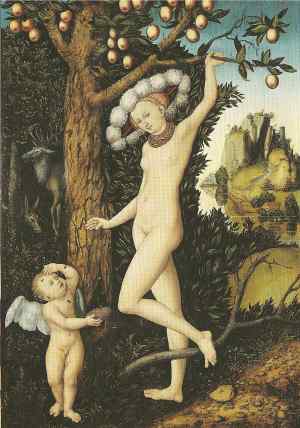
(This image reminds me somehow of the Genesis story of the very human Eve and Adam in the garden.  Of course, it's a painting of the divine Aphrodite and Eros.  I found the image at Nicos Stylianou's igreekmythology.com.  He provides this information.


Name:"Aphrodite and Eros"
Museum:National Gallery, London, England
Artist and Year:Lucas Cranach Sr.,ca. 1430
Theme: Aphrodite talks with her son Eros, who has been stung by bees.)

------

Related posts: