It's rare to find a book on translation that gets at many different issues. Some of my favorite books on the topic are these:
The Routledge Encyclopedia of Translation Studies, (2nd ed), edited by Mona Baker and Gabriela Saldanha
The Poetics of Translation: History, Theory, Practice, by Willis Barnstone
Faithful Renderings: Jewish-Christian Difference and the Politics of Translation (Afterlives of the Bible), by Naomi Seidman
Gender in Translation: Cultural Identity and the Politics of Transmission, by Sherry Simon
After Babel: Aspects of Language and Translation, by George Steiner
The Translation Studies Reader, (2nd ed), by Lawrence Venuti
Language in Relation to a Unified Theory of the Structure of Human Behavior by Kenneth L. Pike
And now
Is That a Fish in Your Ear?: Translation and the Meaning of Everything, by David Bellos
At BLT, I've written a review of the Bellos book. He kindly replied there to acknowledge he'd given Olympe de Gouges the short shrift and to promise that he was correcting that in the French edition due out in January and in the English paperback version to become available eventually.
Also at BLT, quoting Bellos, I've added to the series on Eugene Nida that I began here, and here, here, and here.
Showing posts with label translation. Show all posts
Showing posts with label translation. Show all posts
Tuesday, October 25, 2011


Friday, September 9, 2011
to hear Arcangela Tarabotti
Arcangela Tarabotti was a feminist ahead of her time. Though forced into a convent in 17th century Venice, she wrote blistering attacks on patriarchal repressiveness in the family, the state and even the Church....Today, Levertov announces a new edition:
Tarabotti's story, and in large measure her daring, may have been exceptional in European Christendom (until the 14th century, generally only nuns were taught reading and writing ). However, the Renaissance era was marked by additional female - and also male - voices that rebelled against the conventions and sought to prove that women were not, as described in the Italian translation of Aristotle, "defective males." The female writers were from the upper-middle class - aristocrats, nuns and courtesans. They wrote fiction, poetry, philosophy and satire, and availed themselves of every literary style of the time. In Venice, too, Tarabotti was not the only defiant - and successful - female writer. Already in 1600, four years before she was born, two books were published there which are still considered milestones among women's works on gender issues. They are "The Worth of Women," by Moderata Fonte, who died eight years earlier in childbirth; and "The Nobility and Excellence of Women and the Defects and Vices of Men," by Lucrezia Marinella, a contemporary of Tarabotti's who was a prolific and very popular writer.
[Tarabotti's] family was of Jewish origin, and had resided around Modena before coming to Venice as "conversos." (Jews who were forced to convert to Christianity during the Inquisition).
--- Michal Levertov, "Get thee to a nunnery," haaretz.com
The new annotated English version of "Convent Life as Inferno" is the work of two Italian-born scholars who teach in England: Dr. Francesca Medioli (introduction and notes ) and Dr. Letizia Panizza (translation ). Medioli, director of the Center for Italian Women's Studies at the University of Reading, rescued Tarabotti's manuscript in 1990 and brought about its publication in Italy. Panizza lectures in the Department of Italian at Royal Holloway College, University of London. Her annotated translation of Tarabotti's "Paternal Tyranny" was published in 2004 in a University of Chicago Press series about women's writing in the Renaissance called "The Other Voice in Early Modern Europe." The series now appears under the imprint of the University of Toronto Press, which will publish "Convent Life as Inferno" in 2012.From it, you'll be able to read Panizza's translation and to hear Tarabotti's insight. Listen to her a bit now, from her Paternal Tyranny:
After the Lord had created the universe and all the animals - as I have just said - it is written, "And God saw all the things that He had made, and they were very good" (Gn 1:31). He then set about shaping the proudest animal of all; but when He had finished, He did not deem His work perfect and so did not recognize it as good. For this reason, Genesis does not add the same words as before; but foreseeing that without woman man would be the compendium of all imperfections, God said after some thought, "It is not good for man to be alone, let us make him a help like unto himself" (Gn 2:18). Thus He willed to bring forth a companion for man, who would enrich him with merits and be the universal glory of the human race (46).[sources:
As soon as His Majesty said the word "help," He immediately added, "like unto himself," implying that woman is of just as much value as man (50).
If he alone had the grace of free will and was superior to Eve, she would not have sinned at all, despite the serpent's promptings and insinuations, for the simple reason that she could not have made choices without her husband's consent (51).
Eve is deceived by the serpent's cunning, and you place all the blame on her. Adam falls for a charming request, and you excuse him. He knew he was offending God; he was not deceived by cunning, but beseeched by an innocent and sincere creature. Have you ever heard of greater wickedness than shielding yourself against your own faults with another's innocence (52)?
Our ancient mother set us a true example: as soon as she was created, she used her free will given by God; her first act was to gaze upon the tree that would bear the fruit of knowledge. Desire pursued her eye; overcome, she aroused the same desire in Adam. It was his excessive gullibility that deprived the whole human race of the happy state of innocence (109).
Adam alone, not Eve, was commanded not to eat the forbidden fruit - which means that his sin, not hers, brought ruin to the world. [...] and for that reason the apostle Paul says, "Through one man sin entered the world [...] (122)."
http://www.haaretz.com/weekend/magazine/get-thee-to-a-nunnery-1.383496
http://sojourness.blogspot.com/2005/04/not-guilty.html
http://www.press.uchicago.edu/ucp/books/book/chicago/P/bo3625872.html
http://crrs.utoronto.ca/pdf/pubs/OVpromo.pdf ]
Sunday, September 4, 2011
BLT: a new blog on the Bible, Literature, and Translation
- Racism in TranslationThat's just a foretaste of what you're to find at BLTnotjustasandwich.com, a new blog on the Bible, Literature, and Translation.
- an announcement of The Jewish Annotated New Testament coming soon from Oxford University Press
The most informed and informative literary blogger, Theophrastus, is the one starting the blog. (He's also the best biblioblogger with a pseudonym, although the Biblioblogger Library has yet to include him or his blog. Likewise, he has more insight on translation theory and translation practice with respect to the Bible and other literature than many of us.) He announces the formation of the blog, here and also here, where you are welcomed!
Welcome to the blog named BLT. It is not just a sandwich. It stands for a set of topics that we hope to discuss: Bible, Literature, and Translation. We’ll talk about the Bible as literature and the literature of translation and the translation of Bibles and the translation of literature and literature of translation and Bible as a translation and literary translations of Bibles and so on. And we are certain to throw in the arts, the sciences, philosophy, mysticism, religion, and pretty much everything else.Notice that Suzanne McCarthy, whom Theophrastus mentions, is the most current top and #1 Biblioblogger in the Top 10 Biblioblogs by the most recent vote among all bibliobloggers in the world, the most democratic measure of the Top. Her blog, Suzanne's Bookshelf, is also #37, in the most current top 40 of the Top 50.
The initial crew of bloggers represents a diverse set of viewpoints but one that is unified in our openness to new ideas and a fundamental belief in the dignity of all humans. This blog is open to all: Jews, Catholics, Mainliners, Evangelicals, Eastern Christians, Atheists, Theists outside the Judeo-Christian tradition, etc. For me a strong underlying theme of this blog is that everyone has a voice — especially people that have been traditionally marginalized.
I’ll let my co-bloggers (currently J. K. Gayle, Suzanne McCarthy, and Craig Smith) introduce themselves, but I’ll simply mention that I am a professor at a US university with strong interests in applied issues in linguistics.
There won’t be any bacon or other treif meat in my posts, but there will be lots of substance. I look forward to hearing from you.
Notice that Craig Smith, whom Theophrastus mentions, blogs at Notes from the Dreamtime and is the only biblioblogger to have produced an entire translation of all the Hebrew and the Greek of the whole Bible, actually The First Egalitarian Translation ever, although he also is yet to be included in the Biblioblogger Library.
And Theophrastus mentions me. But you already know me. More importantly, you are invited to BLT! Feel free to get the word out.
Tuesday, August 30, 2011
Dynamic un-Equivalence: Nida v. Pike
This post may be the beginning of a series. Mainly, I'm wanting to show that not all Bible translators are equal, that not even all of the Wycliffe Bible Translation / SIL translators of the bible are equal. Hopefully, you'll be able to see that not all are nearly as reductive about the Bible, language, literature, linguistics, and translation as was Eugene Nida.
Nida passed away last week, and his simple now-famous notion of Dynamic Equivalence is getting revisited as it's getting blogged about this week.
Somebody else passed away last week also, and I want to blog about her this week. In this post, I'd like to blog about her understandings of translating too. What Nida wrote and propagated, so reductively, worked against her practices some. So please stay tuned for more on this person and her translation work after we review Nida.
In the interests of trying to keep this post as brief as possible, let me just focus on "reductive" with respect to "translation." Nida wrote,

The figure, ironically enough, is Nida's symbol or set of pure symbols by which he's explaining, again reductively, how language is "more than the meanings of the symbols and the combinations of the symbols." Nida is reducing language to a very reductive model of "communication." And this is his main point. This is his main need: to get rid of and to provide an alternative for what he calls "formal equivalence." His main point is that the Bible can be reduced to a message and that all the rest, the symbols and their combinations and their meanings, is just fluff. A message, dynamically, then is equivalent to "The Communique of God." The Communique of God should come to you, whatever language you read, with "complete naturalness of expression," with "modes of behavior relevant within the context of [your] own culture," and without requiring "that [you] understand the cultural patterns of the source-language context in order to comprehend the message." It's as if Nida is saying, Forget the context of the Jews and their source languages; in your own natural expressions in the context of your own culture, then, comprehend the message.
Now, I already mentioned that somebody else died last week. Her name is Eunice Victoria Pike. She was an R.N., a Registered Nurse by professional training. She was also a linguist, a literary one, who loved the Bible and worked on its translation. She wrote a biography of her much more famous brother, Kenneth Lee Pike, and maybe that's how you might of heard of them. Together, they co-authored a book on translation and on language entitled, Live Issues in Descriptive Linguistics. Here's their pictures (the two youngest on the left with their other siblings, and then the two together a few years later) from Eunice's biography of Ken:


Ken would talk about how much in debt he was to Eunice, how much he learned from her (I know, because I heard him so talk in his home, when she was there, and in the classroom, talking about his theory of language and of translation, when she was not present). I learned from her too in the lecture halls, while doing an M.A. in Linguistics at the University of Texas at Arlington but going to the SIL campus in Dallas from time to time. Last week, there was a sweet memorial service for her, not many attending at all, just Eunie's closest friends and her sister-in-law Evelyn. The obituary has still not been published for her, and there won't be any mention of her on the websites of the United Bible Society or of Christianity Today. Bloggers won't be remembering her influence on them or won't be arguing that her work is to be regarded as important.
You can find online how Valentina Pavlovna Wassona and R. Gordon Wasson published one of Eunice Pike's helpful letters to them in their book Mushrooms, Russia, and History: Volume II. If you read it for yourself, you'll read how much they learned from Pike about mushrooms, about how she herself learned from others by listening and by interacting. This reminded me of what she wrote for a larger audience in her book, An Uttermost Part, in the chapter, "Jehovah," in which she tells the story of letting the new testament, as a boy was reading it (right at I John 4:1), explain "that visions received through the hallucinatory mushroom were not messages from Christ" even though "[m]ost Mazatecs assumed [through syncretistic lore] that they were" (page 105).
Now that I've started you listening to some of the stories, why not listen to a few more "lived issues" in the descriptive linguistics and translation work of Pike? She writes, in her book Words Wanted, of actually working with Nida to check her translation from Greek into Mazatec.
As evidence of how much more astute Pike was about language than Nida, let's look at other things she observed. She learned from her Mazatec-speaking friends that men, not women, will "whistle-talk." This whistle-talk was not with speech, not with words, but was with the "symbols" of pitch. The whistle-talk, moreover, was not a whistled song. "A whistled song was smooth, almost continuous, whereas whistle-talk was punctuated with pauses [with pitches that] were limited [and was] slower and more stately than music." She bemoaned the fact that she herself had never learned to whistle, not even a song. But she laughed that being a woman gave her a pass:
Lest we get so formulaic with these enumerations, let me give just one more story from Pike (and there are, oh, so many in the books I've already mentioned by her). Here's the one in which she pays attention to learning and to teaching and to collaborative learning in Mazatec and its translation. Listen, enjoy:
Nida passed away last week, and his simple now-famous notion of Dynamic Equivalence is getting revisited as it's getting blogged about this week.
Somebody else passed away last week also, and I want to blog about her this week. In this post, I'd like to blog about her understandings of translating too. What Nida wrote and propagated, so reductively, worked against her practices some. So please stay tuned for more on this person and her translation work after we review Nida.
In the interests of trying to keep this post as brief as possible, let me just focus on "reductive" with respect to "translation." Nida wrote,
"[T]here are fundamentally two different types of equivalence [in translation]: one which may be called formal and another which is primarily dynamic."Nida is writing as if there is, fundamentally, reductively, just one choice. Notice the "either / or" binary:
EITHER (A) translation is a "formal equivalence . . . concerned with such correspondences as poetry to poetry, sentence to sentence, concept to concept," and "[t]he type of translation which most completely typifies this structural equivalence might be called 'a gloss translation,' in which the translator attempts to reproduce as literally and meaningfully as possible the form and content of the original."This is from Nida's book, Toward a Science of Translating with Special Reference to Principles and Procedures involved in Bible Translating, in his chapter "Principles of Correspondence," where he writes a section he entitles "Two Basic Orientations in Translating," on page 159. Earlier in the book, Nida had already begun to develop his now-famous theory as the opposite of "formal equivalence." Here is the title and first paragraph and first "toward-a-science-of-translating" figure of this chapter (on pages 120-21):
OR (B) there is, "[i]n contrast, a translation which attempts to produce a dynamic rather than a formal equivalence [which] is based upon 'the principle of equivalent effect' (Rieu and Phillips, 1954) . . . and aims at complete naturalness of expression, . . . tries to relate the receptor to modes of behavior relevant within the context of his own culture[, and] . . . does not insist that he understand the cultural patterns of the source-language context in order to comprehend the message."
"THE DYNAMIC DIMENSION IN COMMUNICATION
Language consists of more than the meanings of the symbols and the combinations of symbols; it is essentially a code in operation, or, in other words, a code functioning for a specific purpose or purposes. Thus we must analyze the transmission of a message in terms of a dynamic dimension. This analysis is especially important for translating, since the production of equvalent messages is a process, not merely of matching the parts of utterances, but also of reproducing the total dynamic character of the communication. Without both elements the results can scarcely be regarded, in any real sense, as equivalent."

The figure, ironically enough, is Nida's symbol or set of pure symbols by which he's explaining, again reductively, how language is "more than the meanings of the symbols and the combinations of the symbols." Nida is reducing language to a very reductive model of "communication." And this is his main point. This is his main need: to get rid of and to provide an alternative for what he calls "formal equivalence." His main point is that the Bible can be reduced to a message and that all the rest, the symbols and their combinations and their meanings, is just fluff. A message, dynamically, then is equivalent to "The Communique of God." The Communique of God should come to you, whatever language you read, with "complete naturalness of expression," with "modes of behavior relevant within the context of [your] own culture," and without requiring "that [you] understand the cultural patterns of the source-language context in order to comprehend the message." It's as if Nida is saying, Forget the context of the Jews and their source languages; in your own natural expressions in the context of your own culture, then, comprehend the message.
Now, I already mentioned that somebody else died last week. Her name is Eunice Victoria Pike. She was an R.N., a Registered Nurse by professional training. She was also a linguist, a literary one, who loved the Bible and worked on its translation. She wrote a biography of her much more famous brother, Kenneth Lee Pike, and maybe that's how you might of heard of them. Together, they co-authored a book on translation and on language entitled, Live Issues in Descriptive Linguistics. Here's their pictures (the two youngest on the left with their other siblings, and then the two together a few years later) from Eunice's biography of Ken:


Ken would talk about how much in debt he was to Eunice, how much he learned from her (I know, because I heard him so talk in his home, when she was there, and in the classroom, talking about his theory of language and of translation, when she was not present). I learned from her too in the lecture halls, while doing an M.A. in Linguistics at the University of Texas at Arlington but going to the SIL campus in Dallas from time to time. Last week, there was a sweet memorial service for her, not many attending at all, just Eunie's closest friends and her sister-in-law Evelyn. The obituary has still not been published for her, and there won't be any mention of her on the websites of the United Bible Society or of Christianity Today. Bloggers won't be remembering her influence on them or won't be arguing that her work is to be regarded as important.
You can find online how Valentina Pavlovna Wassona and R. Gordon Wasson published one of Eunice Pike's helpful letters to them in their book Mushrooms, Russia, and History: Volume II. If you read it for yourself, you'll read how much they learned from Pike about mushrooms, about how she herself learned from others by listening and by interacting. This reminded me of what she wrote for a larger audience in her book, An Uttermost Part, in the chapter, "Jehovah," in which she tells the story of letting the new testament, as a boy was reading it (right at I John 4:1), explain "that visions received through the hallucinatory mushroom were not messages from Christ" even though "[m]ost Mazatecs assumed [through syncretistic lore] that they were" (page 105).
Now that I've started you listening to some of the stories, why not listen to a few more "lived issues" in the descriptive linguistics and translation work of Pike? She writes, in her book Words Wanted, of actually working with Nida to check her translation from Greek into Mazatec.
"Dr. Nida sat with the Greek and the Spanish New Testament in front of him, and I with the Mazatec. My job was to look at the Mazatec and give him a quick literal translation into English. He compared what I said with the Greek, asked questions, and agreed or disagreed.It may sound as if Nida's corrective of Pike was one that she followed absolutely and without questioning. However, if you keep reading, then you do hear in her story some of her reluctance on the very next page:
Among other things he pointed out that we had translated a number of Greek metaphors rather than the specific words. One example was found in Acts 14:8. 'Being a cripple from his mother's womb' was the Greek expression, but no Mazatec ever says that. 'Ever since he was born,' Dr. Nida suggested. He emphasized the fact that it was the message we were supposed to get across, not just words" (page 96).
"We could even apply the suggestions Dr. Nida had made for the Book of Acts. Well -- (sigh) -- O.K. We would change [to make some revisions]" (page 96)Her view of language, of translation, is far more robust than his reductive notion is. She saw the Greek in the book of Acts as meaningful, as important to learn from, even for an English reader. Could the Greek letters and words and phrases be reduced to a message? Did it have to merely and so baldly mean simply and only this message: "Ever since he was born"? Doesn't this translating rob the mother of her biology, of her womb, of her body? And should the Mazatec then literally now equal the English, which only dynamically equaled then the Greek? Do you see the problems that Nida's reductive either/ or approach causes?
As evidence of how much more astute Pike was about language than Nida, let's look at other things she observed. She learned from her Mazatec-speaking friends that men, not women, will "whistle-talk." This whistle-talk was not with speech, not with words, but was with the "symbols" of pitch. The whistle-talk, moreover, was not a whistled song. "A whistled song was smooth, almost continuous, whereas whistle-talk was punctuated with pauses [with pitches that] were limited [and was] slower and more stately than music." She bemoaned the fact that she herself had never learned to whistle, not even a song. But she laughed that being a woman gave her a pass:
"The only thing that saved me from being completely outclassed was the fact that in Mazatec culture women were not supposed to whistle. They understood the men's whistle-talk, but unless they were tomboys they responded verbally [i.e., with spoken words, phrases, clauses, and sentences]" (page 30).And Pike, a woman, learned whistle-talk, from a woman, no less:
"Ida was a tomboy, and she was not the least bit ashamed of whistling. With her help we learned to recognize and approximate, 'Come here,' 'What do you want?', and a few other frequently used expressions. Much of her teaching was done while we were walking, and I did pretty well on the level part of the trail, but after we had climbed a little while, I quit trying. Ever-impatient Ida wanted to know why. I told her that I had not any breath. She chuckled and turned to her friend, 'Poor thing. She left her breath down the path. God down and get it for her" (page 30).Notice several things from this story about Pike and her robust, non-reductive view of language and of translation:
- She acknowledged sociolinguistic differences between men and women in speech acts.
- She did not require women to obey the men's rules for whether woman could whistle-talk or not.
- As a woman, she learned from another women to do only what men were to do.
- The whistle-talk was full of discernible emic (insider) symbols and form and forms.
- A merely dynamic equivalence of whistle-talk as only a message to be communicated would lose much meaning and much social interaction.
- Communication, a message, was important in whistle-talk, but it wasn't the only important thing to be learned, performed, or translated.
- She was humble, a learner, and relied on friendly people to teach her the significances of language.
- She laughed and enjoyed word play and engaged in humor through puns and indirect and robust messages that were infinitely dimensioned.
- She appreciated language as translatable, as messageS, as multi-modal, as varied within any given mode, as social, as gendered, as feminist-resistances, and on and on.
Lest we get so formulaic with these enumerations, let me give just one more story from Pike (and there are, oh, so many in the books I've already mentioned by her). Here's the one in which she pays attention to learning and to teaching and to collaborative learning in Mazatec and its translation. Listen, enjoy:
"[T]he subject [among us women] changed to the apron I was wearing. It was a plastic apron, and one of the women asked me what it was called. I was always startled when they asked me the name for something in Mazatec. I was the one who was trying to learn their language, and it had not occurred to me that I could teach them any of it. I answered with a word I thought appropriate, [the Mazatec phrase for] apron.So what did she learn? How did she theorize language and practice translation? And what do you learn from Pike that Nida's reductive model would not allow?
'Is that cloth?' asked one of the women and felt it. Then I remembered that the parts that made up the [the Mazatec] word apron meant, 'cloth-put-against.' No, it was not cloth -- so what should it be called? The women discussed the problem. First they wanted to know what it was actually made of. They did not have a word for plastic, so the best I could dos was to tell them that it was something like rubber -- the word they used when describing any waterproof material. The women tried out the combination 'rubber-put-against' but they rejected it. Finally, a bit hesitatingly, they agreed on 'cloth-put-against-which-is-rubber,' that is, a 'rubber apron.' That little incident helped me to see that the original meaning of word parts (like cloth) can be lost when the broader meaning of the compound has become well established. Little hint like that helped me to be patient with visitors -- I was constantly learning from them -- and encouraged me to go calling" (page 33).
Wednesday, August 24, 2011
A Bible Translator Uses Bad Words ("Ass, Fart, Whore, Piss, Shit")
Well, you're going to protest again maybe. Here I go quoting a Bible translator's translation that makes you read bad words. To be exact, ass, fart, whore, piss, and shit.
So would it make any difference to you if I told you that the published translation helped win this particular translator the "PEN American Center / Book of the Month Club Translation Award"? Would you give the translator a break if one notable critic said that this is the translator's "most remarkable translation thus far" and that "it is, in fact, more an act of wizardry than of translation"? What if you knew that the translator was also a poet, who was "[t]wice nominated for the Pulitzer Prize in poetry"?
What else might matter to you? That the translator is not a woman, but a man? Does he need to be a theologian? A linguist? If he's translated the New Testament, does he need to be a Greek scholar? A Christian? Part of a team of men scholars of theology and of Greek language and of translation science? Would those things then make it okay for him to use ass, fart, whore, piss, and shit in his translation?
What I'm trying to get at is what counts for you.
Yesterday, I started in on a post by quoting a feminist, a woman feminist saying "pissed off." But I said that this was Jesus speaking. Immediately, you began to protest. "Gloria Steinem is no Jesus." And some of you were thinking, "Cuss words are not the Word of God."
What I'm trying to get at is how the Bible can immediately make seemingly unequal things equal.
What I'm trying to get at is how translation, likewise, makes things that don't at first seem to count as the same really, nonetheless, the same.
What I'm trying to get at is how literature, even a poem, a sonnet for instance, makes seemingly unequal things equal.
"Now, just wait a minute," some of you are saying. "The Bible in the original language(s) is not translation. And a translation is not the original by any stretch. Don't you know much gets lost in translation? And, since you're bringing up literature, and poetry, don't you even remember how Poet Robert Frost wisely noted that 'Poetry is what gets lost in translation'?"
What I'm trying to get at is how you can make things you think are unequal equal. Men and women? Yes, equal. Jesus and a feminist? Yes, equal again. The original spoken word of Jesus and it's written translation by someone claiming to be his student named John? Right, equal. A bit of history and a possibly fictional, late-added episode of narrative complexity? Of course. Equals.
What I'm trying to get at is how the Western mode of thinking that is binary really is what scholars Andrea Lunsford and Lisa Ede rightly refer to as the "logic-chopping automaton."
But none of us has to be that much of a scholar to see this. Let me just turn things around and come at it from another direction. What if you yourself are not really making unequal things -- say, males and females -- equal? What if they really are equal but it's just your use of Western, Aristotelian logic that makes them un-equal? What if the Bible, translation, and literature in general really free you to reconsider difference?
Okay. I suppose you're dying to know. Who is this Bible translator mentioned at the beginning of the post? It's Willis Barnstone. "What?!" some of you are exclaiming. "He's not a real translator of the Bible. He's only translated the New Testament and not anything else. Well, okay. He's translated the New Testament, but not the one I grew up with. He's not gotten to any of the Hebrew books, or any of what may be called the Old Testament. And he's thrown in a whole bunch of Greek books that are not canonical. The best and top-most-ranked Bible bloggers didn't know much about him until you started mentioning him here. Yes, we know you mentioned him yesterday in a post. Yes, we saw how you quoted from his translation. But where did he use the bad words, the unbiblical English, that you quote in this post today?"
Please let me answer. What I'm trying to get at is that Barnstone is the equal of any other Bible translator, dead or alive. He's a poet, a historian, a theoretician, and a practitioner of translation. Here's his complete, to date, bibliography. If that's not impressive enough, then do know that he does have his critics. Even literary types are good critics, somewhat severely critical critics, of his New Testament translation. And those who know some of the original languages better than Barnstone does perhaps, even though these might still be students, can be good critics, somewhat severely critical critics.
Now if you've stayed with me this far, anticipating Willis Barnstone's translation that uses those words I mentioned earlier, then do know you're going to get to read it (and them). I'm not going to say a thing really about the passage that Barnstone has translated other than this: it really is an award winning translation, but it really isn't from the Bible. It really is a sonnet, perhaps equal to the Spanish sonnet Barnstone is rendering. Thus, if you believe me that Barnstone is equal to a translator of the Bible, then here's a translation of something else by "a Bible translator who uses these "bad words":

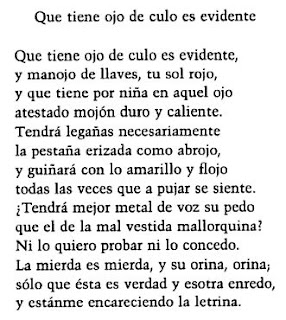
from Six Masters of the Spanish Sonnet
So would it make any difference to you if I told you that the published translation helped win this particular translator the "PEN American Center / Book of the Month Club Translation Award"? Would you give the translator a break if one notable critic said that this is the translator's "most remarkable translation thus far" and that "it is, in fact, more an act of wizardry than of translation"? What if you knew that the translator was also a poet, who was "[t]wice nominated for the Pulitzer Prize in poetry"?
What else might matter to you? That the translator is not a woman, but a man? Does he need to be a theologian? A linguist? If he's translated the New Testament, does he need to be a Greek scholar? A Christian? Part of a team of men scholars of theology and of Greek language and of translation science? Would those things then make it okay for him to use ass, fart, whore, piss, and shit in his translation?
What I'm trying to get at is what counts for you.
Yesterday, I started in on a post by quoting a feminist, a woman feminist saying "pissed off." But I said that this was Jesus speaking. Immediately, you began to protest. "Gloria Steinem is no Jesus." And some of you were thinking, "Cuss words are not the Word of God."
What I'm trying to get at is how the Bible can immediately make seemingly unequal things equal.
What I'm trying to get at is how translation, likewise, makes things that don't at first seem to count as the same really, nonetheless, the same.
What I'm trying to get at is how literature, even a poem, a sonnet for instance, makes seemingly unequal things equal.
"Now, just wait a minute," some of you are saying. "The Bible in the original language(s) is not translation. And a translation is not the original by any stretch. Don't you know much gets lost in translation? And, since you're bringing up literature, and poetry, don't you even remember how Poet Robert Frost wisely noted that 'Poetry is what gets lost in translation'?"
What I'm trying to get at is how you can make things you think are unequal equal. Men and women? Yes, equal. Jesus and a feminist? Yes, equal again. The original spoken word of Jesus and it's written translation by someone claiming to be his student named John? Right, equal. A bit of history and a possibly fictional, late-added episode of narrative complexity? Of course. Equals.
What I'm trying to get at is how the Western mode of thinking that is binary really is what scholars Andrea Lunsford and Lisa Ede rightly refer to as the "logic-chopping automaton."
But none of us has to be that much of a scholar to see this. Let me just turn things around and come at it from another direction. What if you yourself are not really making unequal things -- say, males and females -- equal? What if they really are equal but it's just your use of Western, Aristotelian logic that makes them un-equal? What if the Bible, translation, and literature in general really free you to reconsider difference?
Okay. I suppose you're dying to know. Who is this Bible translator mentioned at the beginning of the post? It's Willis Barnstone. "What?!" some of you are exclaiming. "He's not a real translator of the Bible. He's only translated the New Testament and not anything else. Well, okay. He's translated the New Testament, but not the one I grew up with. He's not gotten to any of the Hebrew books, or any of what may be called the Old Testament. And he's thrown in a whole bunch of Greek books that are not canonical. The best and top-most-ranked Bible bloggers didn't know much about him until you started mentioning him here. Yes, we know you mentioned him yesterday in a post. Yes, we saw how you quoted from his translation. But where did he use the bad words, the unbiblical English, that you quote in this post today?"
Please let me answer. What I'm trying to get at is that Barnstone is the equal of any other Bible translator, dead or alive. He's a poet, a historian, a theoretician, and a practitioner of translation. Here's his complete, to date, bibliography. If that's not impressive enough, then do know that he does have his critics. Even literary types are good critics, somewhat severely critical critics, of his New Testament translation. And those who know some of the original languages better than Barnstone does perhaps, even though these might still be students, can be good critics, somewhat severely critical critics.
Now if you've stayed with me this far, anticipating Willis Barnstone's translation that uses those words I mentioned earlier, then do know you're going to get to read it (and them). I'm not going to say a thing really about the passage that Barnstone has translated other than this: it really is an award winning translation, but it really isn't from the Bible. It really is a sonnet, perhaps equal to the Spanish sonnet Barnstone is rendering. Thus, if you believe me that Barnstone is equal to a translator of the Bible, then here's a translation of something else by "a Bible translator who uses these "bad words":


from Six Masters of the Spanish Sonnet
Monday, July 25, 2011
Sexing Mortals as Women: a reply
Joel Hoffman has kindly taken time to comment here, to summarize and to set the record straight on his argument about the sex of the referents of the old Greek word, "anthropos." This post is my reply.
Is anybody here really in search of an adversary?
See how your comment frames our discussion now. I don't want to misunderstand or mis-characterize what has been said. I'm quoting you directly again and linking back to the threaded dialogue where you made your long comment. Please know I'm not trying to diminish your view! So it's worth repeating that I don't want to misunderstand or mis-characterize what has been said. Yes, the point of issue for you is your position. Perhaps I can reply with some fairness and with much due respect. Your point of issue (i.e. what your position is) may be, ironically, precisely the point of my previous post: we men are often so intent on our position that what we overlook is our privilege in it to the excluded point of view or, more to Kristen's point, to the excluded domains (i.e., "functional equality") of women. Right, you're not wanting to take the conversation to that level. You're interested in how right, and how rightly understood objectively, your own position must be.
I'd like to say that, before we start talking about intra-translation or inter-translation equivalents ("exact" or otherwise), let's talk some about English alone. Or about a word in any one language untranslated. The question I was trying to raise is how Thomas Jefferson's "all men" in English could ever rightly be read as "all men and women." We could flip the question around to talk about how Aristotle's use of a word can split women from men, can exclude the former from the privilege of the latter. Anne Carson has noticed:
I may be getting a little ahead of myself. And certainly I don't want to run ahead of what you've said too much. Let me just say that I noticed how you didn't answer Mike Aubrey (on September 16, 2009) when he asked you:
But let's continue with your examples from the Greek of the Bible:
Let's start with Matthew 19. First, starting where you want us to end, I'd agree that "...husband with his wife" is the rough meaning of what Matthew is translating what the disciples of Jesus are saying. We don't have precisely or exactly what these disciples said. We only have Matthew's Greek translation of what they said. Matthew's translation is this:
"τοῦ ἀνθρώπου μετὰ τῆς γυναικός [tou anthropou meta tes gunaikos]"
The disciples mean "husband" or "man." Matthew uses "ἀνθρώπου [anthropou]" to render that.
The big question is why doesn't Matthew use the less ambiguous term "ἀνήρ [aner]" or its variant "ἀνδρός [andros]" for "husband" or "man"? This is much more likely what the disciples meant, given the context of what they said.
Well, a likely answer is that Matthew is also quoting Jesus. He's translating what Jesus had said. And, while doing that, he's quoting the LXX. That is, Matthew is literally quoting the Greek translation of Hebrew. We have no precise statement in the text exactly what Jesus's words were as he actually spoke them.
Before we read again what Jesus said, according to Matthew's Greek, let's remember something. Matthew has not used unambiguous Greek to quote the disciples of Jesus. In fact, he's paired anthropos with gunaikos but not andros with gunaikos. Nothing should have prevented Matthew from making very, very clear that he's tightly quoting the disciples as saying, ""husband with his wife," as you translate it loosely. So why not help the readers understand exactly, without much ambiguity, what the disciples meant precisely. Why anthropos? And why does Matthew quote the LXX, although Jesus himself might have been speaking Hebrew, quoting the original text of the Bible?
The bit that Matthew quotes from the LXX is telling. This bit has anthropos! This bit has this word with rich ambiguity. This bit is from Genesis, of course. This bit is from both creation accounts of Genesis: first from Gen. 1:27 reiterated also in Gen. 5:2, then from Gen. 2:24. Although the Septuagint translators are using Greek and are translating Hebrew words on the design of marriage, in the beginning, the translators use "ἀνθρώπου [anthropou]"; they do NOT use the clearer words for "husband"; they do not use "ἀνήρ [aner]" or its variant "ἀνδρός [andros]."
Why anthropos? Again, we will do well to remember that the LXX translators are translating. This is exactly what Matthew is doing for the disciples of Jesus. But they are not using a very precise word. As you've already confessed, in various contexts, anthropos is not male only. So, why anthropos? Why not be clearer?
Could the answer be that the LXX translators know how Aristotle wrote Greek? Perhaps they knew that he taught his disciples to avoid ambiguities? As likely, or more likely, the LXX translators knew Aristotle's Politics, in which he refers disparagingly to human ambiguities and subjectivities on their "kind," their "class," their "social categories." At line 36 of Bekker page 1255a, one can find Aristotle quoting the woman Helen: "But who would dare to call me menial, The scion of a twofold stock divine?" (This is H. Rackham's translation.)
Now, females, for Aristotle, are botched males. And even if Helen is part divine, ambiguously so, then she's still botched; she's of a mixed breed. Aristotle's reaction to this ambiguity in this woman is clear. His reaction is to her suggestion that no one should call her menial is to complain that Nature will produce what it will. He complains that people who boast about the best part of their lineage are not looking at the facts, and are not objectively observing nature, and are merely saying, "ἐξ ἀνθρώπου ἄνθρωπον [ex anthropou anthropon]." The context, I think you 'd agree, allows for the fact that Aristotle is reading and is writing anthropos here as ambiguously inclusive of males and females, especially Helen.
Generally, the Greek lore for the beginnings of women, as anthropoi, goes way back. And Helen is often quite frequently in the mix. This is not lost on the LXX translators. They are aware of the ambiguities, and they flaunt them. What are they aware of?
Probably, the LXX translators know Sappho. Aristotle does. Plato does. Socrates does. Alexandria, where the legend has the translators, does. Likely, the translators know her Hymn to Aphrodite III, 1 and 2. Some of it goes like this:
πά]γχυ δ᾽ εὔμαρες σύνετον πόησαι
πά]ντι τ[οῦ]τ᾽. ἀ γὰρ πόλυ περσκόπεισα
κά]λλος ἀνθρώπων Ἐλένα [τὸ]ν ἄνδρα
[κρίννεν ἄρ]ιστον,
Here one hears of, and now only reads of, Helen as an anthropos with an andra. That is, she's a person, a human, a mortal (not the immortal goddess Aphrodite). And Helen is a mortal human with a man, with a husband. To illustrate, here's how Jane McIntosh Snyder translates these lyrics:
It is completely easy to make this
intelligible to everyone; for the woman
who far surpassed all mortals in beauty,
Helen, left her most brave husband
(I've shown how various English translators have rendered these Greek lines of Sappho, here and here.) What should be completely easy and intelligible to everyone is how Sappho includes Helen, a woman, without the word gune, among all mortal humans, by the word anthropos.
Perhaps the LXX translators didn't really know this Hymn of Sappho. But very very likely, the LXX translators did know the Theogony of Hesiod:
The LXX translators seem to be working their Genesis translation, with both creation accounts (i.e., in Gen. 1 and in Gen. 2), against Hesiod's Theo-Gony. Hesiod's account of the beginning, includes the lore of Helen as an anthropos. But more than that, the Theogony has the creation of "woman" (and of the "female") as an aberration of and a harm to mortals. Zeus, the chief of the gods, is responsible:
And the LXX translators get the contrast between Hesiod's Greek and the Hebrew Bible. They want to flaunt the ambiguities by their own Greek. And so they do:
κατ' εἰκόνα θεοῦ [theou] ἐποίησεν αὐτόν,
ἄρσεν καὶ θῆλυ [thelu] ἐποίησεν αὐτούς.
Here, there is great wordplay. There is the acknowledgment and the flaunting of semantic ambiguities by lexical ambiguities and by grammatical ambiguities and by phonological ambiguities. In other words, the LXX translators are not making the female some aberrant of the class of humans. The LXX translators are using Greek to include women, females, in the class of all men, all humans. And following the Hebrew, they attribute this creativity in the beginning to God and according to the ambiguous image of God.
This is one of the bits that Matthew quotes. Matthew is ostensibly translating Jesus. Jesus is quoting Genesis. The point of issue for Matthew, as translator, is that the Greek for translation is ambiguous and gender neutralizing and gender including. The "beginning," the creation account(s), may be the most important part of all of this: here's a statement of Nature, of Creation, of the one Divine Creator, imparting the image of the divine as a creative act, as male and female, as humanity plurally sexed. Any discussion of marriage, Jesus seems to be saying, shouldn't ignore the value of the female. Any discussion of the beginning, Matthew seems to be emphasizing, shouldn't discount the way the LXX translators consider anthropos as positively inclusive of the female.
When we come to your other two examples, "I Corinthians 7:1" and "John 4:28," we can continue to look at the gender neutral and gender inclusive possibilities. Paul writes to people in Greece who have Greek-religious and Greek-literary contexts. And in I Cor. 6:16, as he's coming to the verse you reference, Paul quotes Genesis 2:24, exactly the same bit that Matthew quotes. The backdrop is that in the beginning, in contrast to Hesiod's creation myth, God's image in creation of humanity includes the female in anthropos. When Paul then uses the word for husbands in Corinth, there's a richness, an ambiguity, an inclusiveness that the English word husband does not have but that human being does have. John, as you already explain, is likely not including women in his use of anthropos in 4:28. In fact, he quotes and translates the woman in 4:29 as appealing to these people she's talking to to come and see a human, a person, who just may be Messiah, or in Greek "Christ." John the translator is calling the Messiah a mortal human being in a rather gender inclusive if only perhaps a rather gender neutral way, an anthropos.
The LXX and the NT meanings for anthropos seems to be to play on the old Greek contrasts between gods/goddesses and humans, between humans and (their) women/wives. How the Hebrew God/Creator made female and male in anthropos is the emphasis.
This brings us to your final paragraph in your comment:
Maybe it's just the sweltering heat that's gripping the country, but this strikes me as a disagreement in search of an opponent.It really may be, Joel, that there are various causes for our conversation and, as you imply, for my own perspectives (such as the "the sweltering heat that's gripping the country"). However, please know that my first disagreement is with how you frame the discussion. As Suzanne commented to you, "There is a lot of misunderstanding about these [Greek and English] words." And, as Kristen pointed out very early, it's "through the lenses of their interpretation" that many will restrict how they view women vs. men in texts, whether the Bible in translation or the Declaration of Independence in the original.
Is anybody here really in search of an adversary?
See how your comment frames our discussion now. I don't want to misunderstand or mis-characterize what has been said. I'm quoting you directly again and linking back to the threaded dialogue where you made your long comment. Please know I'm not trying to diminish your view! So it's worth repeating that I don't want to misunderstand or mis-characterize what has been said. Yes, the point of issue for you is your position. Perhaps I can reply with some fairness and with much due respect. Your point of issue (i.e. what your position is) may be, ironically, precisely the point of my previous post: we men are often so intent on our position that what we overlook is our privilege in it to the excluded point of view or, more to Kristen's point, to the excluded domains (i.e., "functional equality") of women. Right, you're not wanting to take the conversation to that level. You're interested in how right, and how rightly understood objectively, your own position must be.
My position --- and I'm pretty sure I'm right --- has always been that anthropos in Greek is not the exact equivalent of "person" or of "man" in English. In my post from which you selectively quote, I write, "...anthropos in its various forms and contexts means different things, [and] I think we can usually know when it is gender specific and when it is not."Is there an opponent to this position of yours? Of course, everybody knows that, at the structuralist level of the word, there are no exact equivalents between languages. And variant forms and different contexts in an untranslated text yield different meanings, even different and determinable and specific gendered meanings. We will get to the examples you provide in your comment soon.
I'd like to say that, before we start talking about intra-translation or inter-translation equivalents ("exact" or otherwise), let's talk some about English alone. Or about a word in any one language untranslated. The question I was trying to raise is how Thomas Jefferson's "all men" in English could ever rightly be read as "all men and women." We could flip the question around to talk about how Aristotle's use of a word can split women from men, can exclude the former from the privilege of the latter. Anne Carson has noticed:
The celebrated Greek virtue of self-control (sophrosyne [σωφροσύνη]) has to be defined differently for men and for women, Aristotle maintains. Masculine sophrosyne is rational self-control and resistance to excess, but for the woman sophrosyne means obedience and consists in submitting herself to the control of others. [See Aristotle's clear description of this defined division of his, in his Politics, Book I, 1260a]Notice, then, that whether in English only or in Greek only, with words, different readers can use them to exclude or to include. And we men tend to use the words we exclude by with privilege.
I may be getting a little ahead of myself. And certainly I don't want to run ahead of what you've said too much. Let me just say that I noticed how you didn't answer Mike Aubrey (on September 16, 2009) when he asked you:
Joel, what’s the difference between “human” and “person,” semantically speaking?Several of us, I'm guessing, were wondering about that. I'm glad you've brought up your distinctions between "human" and "man" neither of which can, for you, "mean ... person." Further below, I'll reply to your reassertion of this difference you subscribe to again here. However, I wanted to touch on it briefly now because I'm trying to make a point about untranslated words. In your mind, by your own general uses of English, you generalize that some words "cannot mean" what others do. And without getting into the differences (i.e., Mike's question) just yet, I do want to observe how Thomas Jefferson, in the short context of the Declaration of Independence, seems to equate "human" and "people" and "mankind" with "all men." Granted, these are not exact equivalents. But the point I was trying to make in my blogpost is this: that the male privilege Jefferson enjoys as he pens these words excludes women. His "all men" refers to men, not to women. Furthermore, hence, and consequently, his readers (i.e., the King of England and the signers of the document in the colonies, all males we might remember) all read "human" and "people" and "mankind" as functionally male. This is some Kristen's excellent observation too, as she brings forward the male readers' reading into our 21st century. Just to be clear: if we pressed Jefferson, he would insist that "human" and "people" and "mankind" are his words inclusive of women, ontologically speaking. And yet, he made clear that good women, American women, are to stay home cooking and using their knitting needles. In other words, they are a different kind of human and people and mankind than are all men.
But let's continue with your examples from the Greek of the Bible:
In Matthew 19:10, for example, I think we all agree that it would be a mistake to translate aitia tou anthropou meta tis gunaikos as "the case of a person with his wife." Far better is "the case of a man with his wife" or maybe "...husband with his wife." Similarly, in I Corinthians 7:1 the point of kalos anthropo guniakos mi aptesthai (for better or worse --- I suppose it's not my place to say) is what a man shouldn't do with a woman, not what a person shouldn't do.
And I think we also all agree that in John 4:28, for example, i guni ... kai legei tois anthropois means "the woman ... told the people," not just the men.
My much more limited point in the same post was that in the LXX and NT when anthropos is singular and specific, it refers to a man:Joel, I hope you won't think I'm trying to talk you out of your beliefs. Instead, given that you've well established what you believe is true, I'd like to discuss some alternative possibilities.
In other words, anything of the sort "an anthropos was..." refers to a man. If the person is a women, we instead find the word gune. (My search is limited to the OT LXX and the NT, so there may be examples I don't know about. What we're looking for is something like "I saw an anthropos and she said...")
I still believe that's true.
Let's start with Matthew 19. First, starting where you want us to end, I'd agree that "...husband with his wife" is the rough meaning of what Matthew is translating what the disciples of Jesus are saying. We don't have precisely or exactly what these disciples said. We only have Matthew's Greek translation of what they said. Matthew's translation is this:
"τοῦ ἀνθρώπου μετὰ τῆς γυναικός [tou anthropou meta tes gunaikos]"
The disciples mean "husband" or "man." Matthew uses "ἀνθρώπου [anthropou]" to render that.
The big question is why doesn't Matthew use the less ambiguous term "ἀνήρ [aner]" or its variant "ἀνδρός [andros]" for "husband" or "man"? This is much more likely what the disciples meant, given the context of what they said.
Well, a likely answer is that Matthew is also quoting Jesus. He's translating what Jesus had said. And, while doing that, he's quoting the LXX. That is, Matthew is literally quoting the Greek translation of Hebrew. We have no precise statement in the text exactly what Jesus's words were as he actually spoke them.
Before we read again what Jesus said, according to Matthew's Greek, let's remember something. Matthew has not used unambiguous Greek to quote the disciples of Jesus. In fact, he's paired anthropos with gunaikos but not andros with gunaikos. Nothing should have prevented Matthew from making very, very clear that he's tightly quoting the disciples as saying, ""husband with his wife," as you translate it loosely. So why not help the readers understand exactly, without much ambiguity, what the disciples meant precisely. Why anthropos? And why does Matthew quote the LXX, although Jesus himself might have been speaking Hebrew, quoting the original text of the Bible?
The bit that Matthew quotes from the LXX is telling. This bit has anthropos! This bit has this word with rich ambiguity. This bit is from Genesis, of course. This bit is from both creation accounts of Genesis: first from Gen. 1:27 reiterated also in Gen. 5:2, then from Gen. 2:24. Although the Septuagint translators are using Greek and are translating Hebrew words on the design of marriage, in the beginning, the translators use "ἀνθρώπου [anthropou]"; they do NOT use the clearer words for "husband"; they do not use "ἀνήρ [aner]" or its variant "ἀνδρός [andros]."
Why anthropos? Again, we will do well to remember that the LXX translators are translating. This is exactly what Matthew is doing for the disciples of Jesus. But they are not using a very precise word. As you've already confessed, in various contexts, anthropos is not male only. So, why anthropos? Why not be clearer?
Could the answer be that the LXX translators know how Aristotle wrote Greek? Perhaps they knew that he taught his disciples to avoid ambiguities? As likely, or more likely, the LXX translators knew Aristotle's Politics, in which he refers disparagingly to human ambiguities and subjectivities on their "kind," their "class," their "social categories." At line 36 of Bekker page 1255a, one can find Aristotle quoting the woman Helen: "But who would dare to call me menial, The scion of a twofold stock divine?" (This is H. Rackham's translation.)
Now, females, for Aristotle, are botched males. And even if Helen is part divine, ambiguously so, then she's still botched; she's of a mixed breed. Aristotle's reaction to this ambiguity in this woman is clear. His reaction is to her suggestion that no one should call her menial is to complain that Nature will produce what it will. He complains that people who boast about the best part of their lineage are not looking at the facts, and are not objectively observing nature, and are merely saying, "ἐξ ἀνθρώπου ἄνθρωπον [ex anthropou anthropon]." The context, I think you 'd agree, allows for the fact that Aristotle is reading and is writing anthropos here as ambiguously inclusive of males and females, especially Helen.
Generally, the Greek lore for the beginnings of women, as anthropoi, goes way back. And Helen is often quite frequently in the mix. This is not lost on the LXX translators. They are aware of the ambiguities, and they flaunt them. What are they aware of?
Probably, the LXX translators know Sappho. Aristotle does. Plato does. Socrates does. Alexandria, where the legend has the translators, does. Likely, the translators know her Hymn to Aphrodite III, 1 and 2. Some of it goes like this:
πά]γχυ δ᾽ εὔμαρες σύνετον πόησαι
πά]ντι τ[οῦ]τ᾽. ἀ γὰρ πόλυ περσκόπεισα
κά]λλος ἀνθρώπων Ἐλένα [τὸ]ν ἄνδρα
[κρίννεν ἄρ]ιστον,
Here one hears of, and now only reads of, Helen as an anthropos with an andra. That is, she's a person, a human, a mortal (not the immortal goddess Aphrodite). And Helen is a mortal human with a man, with a husband. To illustrate, here's how Jane McIntosh Snyder translates these lyrics:
It is completely easy to make this
intelligible to everyone; for the woman
who far surpassed all mortals in beauty,
Helen, left her most brave husband
(I've shown how various English translators have rendered these Greek lines of Sappho, here and here.) What should be completely easy and intelligible to everyone is how Sappho includes Helen, a woman, without the word gune, among all mortal humans, by the word anthropos.
Perhaps the LXX translators didn't really know this Hymn of Sappho. But very very likely, the LXX translators did know the Theogony of Hesiod:
The LXX translators seem to be working their Genesis translation, with both creation accounts (i.e., in Gen. 1 and in Gen. 2), against Hesiod's Theo-Gony. Hesiod's account of the beginning, includes the lore of Helen as an anthropos. But more than that, the Theogony has the creation of "woman" (and of the "female") as an aberration of and a harm to mortals. Zeus, the chief of the gods, is responsible:
But when he had made the beautiful evil to be the price for the blessing, he brought her out, delighting in the finery which the bright-eyed daughter of a mighty father had given her, to the place where the other gods [θεοὶ theoi] and men [ἄνθρωποι anthropoi] were. And wonder took hold of the deathless gods [ἀθανάτους τε θεοὺς a-thanatous te theou] and mortal men [θνητούς τ' ἀνθρώπους thnetous t' anthropous] when they saw that which was sheer guile, not to be withstood by men. For from her is the race of women and female kind [ἐκ τῆς γὰρ γένος ἐστὶ γυναικῶν θηλυτεράων, ek tes gar genos esti gunaikon thelyteraon]: of her is the deadly race and tribe of women who live amongst mortal men to their great trouble, no helpmeets in hateful poverty, but only in wealth. And as in thatched hives bees feed the drones whose nature is to do mischief -- by day and throughout the day until the sun goes down the bees are busy and lay the white combs, while the drones stay at home in the covered skeps and reap the toil of others into their own bellies -- even so Zeus who thunders on high made women [γυναῖκας gunaikas] to be an evil to mortal men [ἄνδρεσσι ... θνητοῖσι andressi ... thnetoisi], with a nature to do evil. [lines 585 - 600, translated by H. G. Evelyn-White]In stark contrast, there's the Hebrew account of the creation of woman!
And the LXX translators get the contrast between Hesiod's Greek and the Hebrew Bible. They want to flaunt the ambiguities by their own Greek. And so they do:
And God made humankind;καὶ ἐποίησεν ὁ θεὸς τὸν ἄνθρωπον [anthropon],
according to divine image he made it;
male and female he made them.
[translated from the Greek into English
by Robert J. V. Hiebert]
κατ' εἰκόνα θεοῦ [theou] ἐποίησεν αὐτόν,
ἄρσεν καὶ θῆλυ [thelu] ἐποίησεν αὐτούς.
Here, there is great wordplay. There is the acknowledgment and the flaunting of semantic ambiguities by lexical ambiguities and by grammatical ambiguities and by phonological ambiguities. In other words, the LXX translators are not making the female some aberrant of the class of humans. The LXX translators are using Greek to include women, females, in the class of all men, all humans. And following the Hebrew, they attribute this creativity in the beginning to God and according to the ambiguous image of God.
This is one of the bits that Matthew quotes. Matthew is ostensibly translating Jesus. Jesus is quoting Genesis. The point of issue for Matthew, as translator, is that the Greek for translation is ambiguous and gender neutralizing and gender including. The "beginning," the creation account(s), may be the most important part of all of this: here's a statement of Nature, of Creation, of the one Divine Creator, imparting the image of the divine as a creative act, as male and female, as humanity plurally sexed. Any discussion of marriage, Jesus seems to be saying, shouldn't ignore the value of the female. Any discussion of the beginning, Matthew seems to be emphasizing, shouldn't discount the way the LXX translators consider anthropos as positively inclusive of the female.
When we come to your other two examples, "I Corinthians 7:1" and "John 4:28," we can continue to look at the gender neutral and gender inclusive possibilities. Paul writes to people in Greece who have Greek-religious and Greek-literary contexts. And in I Cor. 6:16, as he's coming to the verse you reference, Paul quotes Genesis 2:24, exactly the same bit that Matthew quotes. The backdrop is that in the beginning, in contrast to Hesiod's creation myth, God's image in creation of humanity includes the female in anthropos. When Paul then uses the word for husbands in Corinth, there's a richness, an ambiguity, an inclusiveness that the English word husband does not have but that human being does have. John, as you already explain, is likely not including women in his use of anthropos in 4:28. In fact, he quotes and translates the woman in 4:29 as appealing to these people she's talking to to come and see a human, a person, who just may be Messiah, or in Greek "Christ." John the translator is calling the Messiah a mortal human being in a rather gender inclusive if only perhaps a rather gender neutral way, an anthropos.
The LXX and the NT meanings for anthropos seems to be to play on the old Greek contrasts between gods/goddesses and humans, between humans and (their) women/wives. How the Hebrew God/Creator made female and male in anthropos is the emphasis.
This brings us to your final paragraph in your comment:
And this, from a comment, is still the really interesting theoretical question for me:My only reply here is just to confess I don't understand what you mean that anthropos can mean either "'... a human' or '... a man'" but that it "cannot mean '... a person'." (Please let me agree with you that you're not one of those people working seemingly out of ignorance or dogma!) So let me ask you, Have we in this post of mine, with Sappho and Hesiod and Aristotle and Genesis LXX begun to "move past the obvious cases"? Don't the Septuagint translators, together with the writers and Greek translators of the New Testament, open up the also-female meanings of anthropos in all of their contexts? Don't they sex mortals as women too just as the look to the image of the Creator as being male and female?
I don't know for sure about [NT] Greek, but my best guess is that "Chris anthropos estin" can mean two things. "Chris is a human" or "Chris is a man." It cannot mean "Chris is a person."
But it seems to me that it will be hard to discuss these interesting nuances unless we can move past the obvious cases. (I also recognize that some translators --- seemingly out of ignorance or dogma --- cling to gendered translations where there is no support for them, but I don't think that I'm one of those people.)
-Joel
Wednesday, July 13, 2011
The Canon as You Read It
Dogma is what you have to believe, whether you believe it or not. And law is what you must do, whether it is good for you or not.
- Dallas Willard
One of the most subversive institutions in the United States is the public library.
- bell hooks
And he said to him,
What is written in the law of the Torah?
How do you read it?
- Jesus (as translated by Luke, as translated by Willis Barnstone)
Lynn Z. Bloom is pretty smart. And so are bloggers Henry Neufeld and
Neufeld is interested in the canon of Bible versions. And personally he notes:
Lynn Z. Bloom and bloggers Henry Neufeld and
- Dallas Willard
One of the most subversive institutions in the United States is the public library.
- bell hooks
And he said to him,
What is written in the law of the Torah?
How do you read it?
- Jesus (as translated by Luke, as translated by Willis Barnstone)
Lynn Z. Bloom is pretty smart. And so are bloggers Henry Neufeld and
I've just now quoted her own essays, or articles, entitled respectively, "Once More to the Essay: The Essay Canon and Textbook Anthologies" and "The Essay Canon." In her anthology co-edited with Louise Z. Smith, Bloom builds her own essay canon for her own students. As The Arlington Reader: Canons and Contexts, their publisher Bedford/ St. Martin's makes this available to any of us and all of us teaching. In the Introduction, they write: "A canon is a list or other compilation of the most important members of a particular group or category, developed through agreement -- either implied or explicit -- by people who know the subject." And they go on to give examples: "the biblical canon," and "the canon of rock musicians" and other "canons that reflect taste, influence, and popularity -- those applying to music, books, art, or cars...."
Neufeld is interested in the canon of Bible versions. And personally he notes:
"[S]omething is always present in translation as well. The question is just what you’re looking for. For example, I prefer the more formal style of the Revised English Bible. I even like its Anglicisms. I spent much of my teens in a former British colony (Guyana), and I was born in Canada. Those things are comfortable for me and they give me a familiar feel.Do you see what he's done? Neufeld has let you decide just has he has decided, rather subjectively and individually, what is best in a version, an English translation, of the Bible.
Should I therefore recommend that everyone read the REB? Hardly! For others, features that make it work for me may be a hindrance to understanding. Then there’s the question of just what it is that I want to understand, or more importantly that you want to understand.
What seems to escape so many people who prescribe what a translation must and must not do is that it matters not what is there if the reader doesn’t understand. Admonitions to 'get a dictionary' are both pointless, and in my opinion, arrogant. This kind of talk suggests to people that if they would just put in enough work, they’d be able to understand–well–what the talker believes they should want to understand."
A couple of years ago I shared a chart that compares the biblical canon according to the following forms: Samaritan, Hebrew/Jewish, Orthodox, Roman Catholic, Syriac, Ethiopian, and Protestant (see here). If you are part of one of these groups you likely adhere to the canon as understood in that tradition. Yet practice is often a more trustworthy sign of what you believe than mere confession, so even though I am an evangelical it would be a bit disingenuous for me to act as if the canon influences me equally.
Lynn Z. Bloom and bloggers Henry Neufeld and
Sunday, July 10, 2011
Lydia He Liu: translation perspectives, Chinese women, and feminisms
David Frank at BBB has written a post that is getting a lot of attention. He's asking, "What is Your Translation Metaphor?" And he's referenced, and he credits me elsewhere for referencing, "a Chinese perspective [by which] translation involves 'host' and 'guest' languages. Another metaphor."
I'd like to give credit where credit is due. Lydia H. Liu is the one who's articulated this perspective. She's a scholar, Chinese, a woman, feminist. Here are some of the things she's said:
As I [Lydia H. Liu] have argued elsewhere, one does not translate between equivalents; rather, one creates tropes of equivalence in the middle zone of translation between the host and guest languages. This middle zone of hypothetical equivalence, which is occupied by neologistic imagination, becomes the very ground for change. (Tokens of Exchange: The Problem of Translation in Global Circulations: Post-Contemporary Interventions, 137)
I am interested in theoretical problems that lead up to an investigation of the condition of translation and of discursive practices that ensue from initial interlingual contacts between languages. Broadly defined, the study of translingual practice examines the process by which new words, meanings, discourses, and modes of representation arise, circulate, and acquire legitimacy within the host language due to, or in spite of, the latter’s contact/collision with the guest language. Meanings, therefore, are not so much “transformed” when concepts pass from the guest language to the host language as invented within the local environment of the latter. In that sense, translation is no longer a neutral even untouched by the contending interests of political and ideological struggles. Instead, it becomes the very site of such struggles where the guest language is forced to encounter the host language, where the irreducible differences between them are fought out, authorities invoked or challenged, ambiguities dissolved or created, and so forth, until new words and meaning emerge in the host language itself. I hope the notion of translingual practice will eventually lead to a theoretical vocabulary that helps account for the process of adaptation, translation, introduction, and domestication of words, categories, discourses, and modes of representation from one language to another and, furthermore, helps explain the modes of transmission, manipulation, deployment, and domination within the power structure of the host language. (Translingual Practice: Literature, National Culture, and Translated Modernity-China, 1900-1937, 26)
If it is always true that the translator or some other agent in the host language always initiates the linguistic transaction by inviting, selecting, combining, and reinventing words and texts from the guest language and, moreover, if the needs of the translator and his/her audience together determine and negotiate the meaning (i.e., usefulness) of the text taken from the guest language, then the terms traditional theorists of translation use to designate the languages involved in translation, such as “source” and “target/receptor,” are not only inappropriate but misleading. The idea of source language often relies on concepts of authenticity, origin, influence, and so on, and has the disadvantage of re-introducing the age-old problematic of translatability/un translatability in the discussion. On the other hand, the notion of target language implies a teleological goal, a distance to be crossed in order to reach the plentitude of meaning; it thus misrepresents the ways in which the trope of equivalence is conceived in the host language, relegating its agency to secondary importance. Instead of continuing to subscribe to such metaphysical concerns perpetuated by the naming of a source and a target, I adopt the notions “host language” and “guest language” . . . (. . . radically alter[ing] the relationship between the original and translation) , which should allow me to place more emphasis on the host language than it has heretofore received. (Translingual Practice: Literature, National Culture, and Translated Modernity-China, 1900-1937, 27)
The unmarking of the male gender as a gendered position… has the function of masking the true condition of gender politics in the universalizing discourse of modern literary criticism. This is the condition that concerns me most as I continue to ponder the meaning of national literature from a gendered point of view.... Her observation [Ms. Rey Chow’s observation] is timely and important, because it shows us that feminist gender criticism is not just about real women and sexuality – critics whose work is not theoretically informed by feminist gender criticism invariably express an interest in the so-called images of women or women writers – but rather, as Joan W. Scott, whom Chow quotes here, would put it, it is a way of reading and intervention into the dominant theoretical and critical practices.
(Translingual Practice: Literature, National Culture, and Translated Modernity-China, 1900-1937, 195)
Is there a female tradition in modern Chinese literature? By asking this question, I intend to bring to critical attention a number of interesting claims put forth by women....
("Invention and Intervention: The Female Tradition in Modern Chinese Literature," in Gender Politics in Modern China: Writing and Feminism, 36, edited by Tani E. Barlow)
I'd like to give credit where credit is due. Lydia H. Liu is the one who's articulated this perspective. She's a scholar, Chinese, a woman, feminist. Here are some of the things she's said:
As I [Lydia H. Liu] have argued elsewhere, one does not translate between equivalents; rather, one creates tropes of equivalence in the middle zone of translation between the host and guest languages. This middle zone of hypothetical equivalence, which is occupied by neologistic imagination, becomes the very ground for change. (Tokens of Exchange: The Problem of Translation in Global Circulations: Post-Contemporary Interventions, 137)
I am interested in theoretical problems that lead up to an investigation of the condition of translation and of discursive practices that ensue from initial interlingual contacts between languages. Broadly defined, the study of translingual practice examines the process by which new words, meanings, discourses, and modes of representation arise, circulate, and acquire legitimacy within the host language due to, or in spite of, the latter’s contact/collision with the guest language. Meanings, therefore, are not so much “transformed” when concepts pass from the guest language to the host language as invented within the local environment of the latter. In that sense, translation is no longer a neutral even untouched by the contending interests of political and ideological struggles. Instead, it becomes the very site of such struggles where the guest language is forced to encounter the host language, where the irreducible differences between them are fought out, authorities invoked or challenged, ambiguities dissolved or created, and so forth, until new words and meaning emerge in the host language itself. I hope the notion of translingual practice will eventually lead to a theoretical vocabulary that helps account for the process of adaptation, translation, introduction, and domestication of words, categories, discourses, and modes of representation from one language to another and, furthermore, helps explain the modes of transmission, manipulation, deployment, and domination within the power structure of the host language. (Translingual Practice: Literature, National Culture, and Translated Modernity-China, 1900-1937, 26)
If it is always true that the translator or some other agent in the host language always initiates the linguistic transaction by inviting, selecting, combining, and reinventing words and texts from the guest language and, moreover, if the needs of the translator and his/her audience together determine and negotiate the meaning (i.e., usefulness) of the text taken from the guest language, then the terms traditional theorists of translation use to designate the languages involved in translation, such as “source” and “target/receptor,” are not only inappropriate but misleading. The idea of source language often relies on concepts of authenticity, origin, influence, and so on, and has the disadvantage of re-introducing the age-old problematic of translatability/un translatability in the discussion. On the other hand, the notion of target language implies a teleological goal, a distance to be crossed in order to reach the plentitude of meaning; it thus misrepresents the ways in which the trope of equivalence is conceived in the host language, relegating its agency to secondary importance. Instead of continuing to subscribe to such metaphysical concerns perpetuated by the naming of a source and a target, I adopt the notions “host language” and “guest language” . . . (. . . radically alter[ing] the relationship between the original and translation) , which should allow me to place more emphasis on the host language than it has heretofore received. (Translingual Practice: Literature, National Culture, and Translated Modernity-China, 1900-1937, 27)
The unmarking of the male gender as a gendered position… has the function of masking the true condition of gender politics in the universalizing discourse of modern literary criticism. This is the condition that concerns me most as I continue to ponder the meaning of national literature from a gendered point of view.... Her observation [Ms. Rey Chow’s observation] is timely and important, because it shows us that feminist gender criticism is not just about real women and sexuality – critics whose work is not theoretically informed by feminist gender criticism invariably express an interest in the so-called images of women or women writers – but rather, as Joan W. Scott, whom Chow quotes here, would put it, it is a way of reading and intervention into the dominant theoretical and critical practices.
(Translingual Practice: Literature, National Culture, and Translated Modernity-China, 1900-1937, 195)
Is there a female tradition in modern Chinese literature? By asking this question, I intend to bring to critical attention a number of interesting claims put forth by women....
("Invention and Intervention: The Female Tradition in Modern Chinese Literature," in Gender Politics in Modern China: Writing and Feminism, 36, edited by Tani E. Barlow)
Thursday, May 5, 2011
Weird, Womanly Words of Obama
In this post, I'd like us to consider President Obama's words as womanly and also as weird. But can we also talk about how a translator may and "ought not" translate these words of his?
(This has implications for translation theory and practice as related to what's better for the bible. So maybe we can get to that some too.)
First, I'm not the only one to say Barack Obama's words are womanly. Second, I am going to call these words "weird." Third, would you look at and listen to them with me. Finally, let's talk translation.
Mr. Obama's speech tends to be rich and nuanced and different from the stereotypical speech of a man. (The stereotypes were created by Aristotle or were reinforced by him in many cases. Aristotle made a big big deal out of the differences between male and female speech; Anne Carson, a careful reader and wonderful translator of ancient Greek has noted many of these differences; and Nancy Mairs makes a big deal out of these differences too.) Deborah Siegel of girlwpen.com posted how some of us have observed the stereotypically womanly characteristics of Mr. Obama's words in answering the question, "Is Obama Leading Like a Woman?"
At the beginning, President Obama hearkens to history and quotes what others before him have said, including a former president and a civil rights leader. He identifies with both men quoted. But to quote the civil rights leader (with whom he identifies, by race, at least in other contexts), Mr. Obama first quotes a woman:
In the middle of his Proclamation, President Obama uses gendered language that is inclusive. He says:
At then end of his Presidential Proclamation, the President writes the following:
In 2. his speech announcing the killing of Osama bin Ladin, President Obama uses womanly and weird and foreign-sounding words too. You can read the speech here at Unsettled Christianity. You can listen to it and watch it again here at feministing.com.
First of all, he's mentioning with men, again, "women, and children." And with "their father," also "their mother." (Of course, I'm being a little silly to point out his gender inclusiveness, again.) Secondly, the President is way too subjective. He's getting way too personal. He's used first person personal pronouns, "I" and "we" and "I" and "we" all over the place. He's named groups "my team," and "their Pakistani counterparts"; he's identified individuals by name, insinuating how they deserve a share of the credit, "Leon Panetta," and "President Bush," and "President Zardari." (Yes, I know. He's taken some political partisan flack for that and has been cynically suspected of being a slimy woman-like sophist trying to garner his own political capital from the electorate and the populous and even the world audience.) Thirdly, he says "may God bless" at least twice. (And we all know that in natural field-tested English this shouldn't be used for common-man language but for helping someone out after they sneeze. "God bless you." A perfect, non-literal and dynamic equivalent to that is "Gesundheit." What the President should have said, what he really intended is this: "Thank you. Don't Worry; be happy. And that goes for the United States of America too." In colloquial, natural German it's Danke. Keine Sorge, glücklich zu sein. Und das gilt für die Vereinigten Staaten von Amerika zu.) And yet, doesn't the better German translator keep Obama's language just a marked and as weird as it is in English? Well, yes.
In 3. his recent book, President Obama again uses womanly and weird and foreign-sounding language.
Well, we just have time to consider the title. But if you read it all for yourself, you'll get it. The title alone is Of Thee I Sing: A Letter to My Daughters. Well, okay, peek in for a bit. It's dedicated:
To Michelle -- whose fierce love and daily good sense
have nourished such wonderful daughters
--B.O.
And the book's about 13 Americans, not all of whom are men. That's right. Some are also African Americans, some are even African American women. The audacity. Is this weird hope again?
Now, I said we only have time for the title. So let's get back to it. "Of Thee I Sing"? Doesn't the President know how antiquated this phrase is? Doesn't the President care how ambiguous this phrase is? How will the readers know what he means? Who can tell us what he surely must intend singularly intend as writer? Well, the translator can.
The translator won't confuse us with the fact of the deep cultural significances of this phrase for African Americans closer to the onset of the Civil War and beyond. No, surely Obama is being more American than that.
The translator won't bother us (unless in an endnote) with the fact that this particular phrase has had earlier and more enduring historical significance for women in America working for their rights. So let's just take time to read a page real quickly from that history (from Sweet Freedom's Song: "My Country 'Tis of Thee" and Democracy in America) -

Those women's rights songs riffed off of "Of Thee I Sing":
Let your joy be unconfined.
Let it speak so clearly that its echo will be
heard around the world.
[Let] it find its way into the soul of every woman
who is longing for the opportunity and liberty still denied her.
Let your voices ring out the gladness in your hearts! . . .
Let us sing, together,
"My Country, 'Tis of Thee . . .
Sweet Land of Liberty,
Of Thee I Sing.
Thee means what? That weird womanly foreign-sounding language is written to whom? To two young people, English readers. Both black. Both female. Both growing up in America when it's still 2011. The audacity.
The other day, I read that there's a Korean translator who's translated this book into Korean for Korean readers. Although I haven't seen it yet, I wonder if she or he has kept in the womanliness, the weirdness, and the foreign-sounding tone of President Obama's words. Would that be a better thing than not to do? Well, yes.

(This has implications for translation theory and practice as related to what's better for the bible. So maybe we can get to that some too.)
First, I'm not the only one to say Barack Obama's words are womanly. Second, I am going to call these words "weird." Third, would you look at and listen to them with me. Finally, let's talk translation.
First
Mr. Obama's speech tends to be rich and nuanced and different from the stereotypical speech of a man. (The stereotypes were created by Aristotle or were reinforced by him in many cases. Aristotle made a big big deal out of the differences between male and female speech; Anne Carson, a careful reader and wonderful translator of ancient Greek has noted many of these differences; and Nancy Mairs makes a big deal out of these differences too.) Deborah Siegel of girlwpen.com posted how some of us have observed the stereotypically womanly characteristics of Mr. Obama's words in answering the question, "Is Obama Leading Like a Woman?"
Second
I'm calling Obama's speech womanly. But let me also qualify much of it as "weird." Now let me go a step further and say it's not only womanly and weird but also "foreign." (Aristotle would have called it absolutely barbaric or barbarous or something like that.) Please know that I'm now using the words weird and foreign in the way that two of the Better Bibles Blog bloggers are using those words this week. I don't at all agree with their arguments yet (i.e., that the Bible doesn't have weird or foreign language and/ or that even if it did a translation of the Bible shouldn't have weird or foreign language); I'm only using the words they way they do: "We may have to learn many more new things all at the one time when we read the Bible, but that doesn’t require weird language" and "It may be inevitable that sometimes the message sounds foreign, but there is nothing about this that suggests that the [English Bible] translation should sound foreign, generally speaking."
What I'm saying is that Obama's language is weird and might sound foreign and that better translators of his language do even better when they translate it that way.
Third
Want some evidence? Okay then. Here's some recent stuff from President Obama:
- his Presidential Proclamation for the National Day of Prayer (which happens to be today)
- his speech announcing the killing of Osama bin Ladin (which most of the world has heard now)
- his recent book (which is the only children's book any US president in office has ever written)
At the beginning, President Obama hearkens to history and quotes what others before him have said, including a former president and a civil rights leader. He identifies with both men quoted. But to quote the civil rights leader (with whom he identifies, by race, at least in other contexts), Mr. Obama first quotes a woman:
The late Coretta Scott King recounted a particularly difficult night, during the Montgomery bus boycott, when her husband, the Reverend Dr. Martin Luther King, Jr., received a threatening phone call and prayed at the kitchen table, saying, "Lord, I have nothing left. I have nothing left. I have come to the point where I can't face it alone."Here, the President's words are rather nuanced. He's not giving the source for his first quotation. But when quoting the African American leader, he does. And he goes on at length. And his readers see how important it is to him that a woman, this particular woman, has recounted with some considerable pathos (i.e., remembering "a particularly difficult night") some danger and much desperation beyond all human limits. If this were translated into, say, Arabic language, then wouldn't the better translator try to account for the English language nuance here, for the digressions that back up the story and put it back into the memory of a woman who is not really the central one being talked about in the first place? Well, yes.
In the middle of his Proclamation, President Obama uses gendered language that is inclusive. He says:
Let us pray for the men and women of our Armed Forces and the many selfless sacrifices they and their families make on behalf of our Nation. Let us pray for the police officers, firefighters, and other first responders....Notice the language that many say is awkward and just politically correct. It's awkward to specify men "and women" and it's even more awkward to use two words and five syllables (i.e., "police officers") instead of more directly "policemen" and to use three syllables (i.e., "firefighters") for the clear two in "firemen," and so forth. The translator should not bother readers with literal forms. The dynamic-equivalence translator would be kind to let the readers know that were talking about mostly men anyway. However, wouldn't the better translator of Chinese language do well to take the time to render the President's female-equal and woman-inclusive words as 男人女人 even though that can also simply and clearly communicate 人? And how about his woman-inclusive words? Wouldn't she or he (the translator into Chinese) find 消防队员 more descriptive of what the President wrote than 救火队员 , the former phrase literally meaning something like Fire-Rescue Team-Member for "firefighter" and the latter phrase meaning literally something like Warrior-of-Fire Team-Member and referring exclusively to males? Well, yes and yes.
At then end of his Presidential Proclamation, the President writes the following:
NOW, THEREFORE, I, BARACK OBAMA, President of the United States of America, do hereby proclaim May 5, 2011, as a National Day of Prayer. I invite all citizens of our Nation, as their own faith or conscience directs them, to join me in giving thanks for the many blessings we enjoy, and I ask all people of faith to join me in asking God for guidance, mercy, and protection for our Nation.Now, that's just weird. I'm talking about the President's words here. If a team of linguists were to field test this among native speakers of natural American English in 2011, then they'd say, "Not my heart language." And if some other linguist in, say, Mozambique were to try to take this into African Portuguese, then he or she would likely want to rid the language of its strange and foreign sounding high register. Otherwise, who knows what President Obama really meant? But the better translator into Portuguese would translate it as weird and foreign-sounding un-natural and un-contemporary Portuguese just as it's weird and foreign-sounding un-natural and un-contemporary English on May 5, 2011, right? Well, yes. Here's the Proclamation.
IN WITNESS WHEREOF, I have hereunto set my hand this twenty-ninth day of April, in the year of our Lord two thousand eleven, and of the Independence of the United States of America the two hundred and thirty-fifth.
BARACK OBAMA
In 2. his speech announcing the killing of Osama bin Ladin, President Obama uses womanly and weird and foreign-sounding words too. You can read the speech here at Unsettled Christianity. You can listen to it and watch it again here at feministing.com.
First of all, he's mentioning with men, again, "women, and children." And with "their father," also "their mother." (Of course, I'm being a little silly to point out his gender inclusiveness, again.) Secondly, the President is way too subjective. He's getting way too personal. He's used first person personal pronouns, "I" and "we" and "I" and "we" all over the place. He's named groups "my team," and "their Pakistani counterparts"; he's identified individuals by name, insinuating how they deserve a share of the credit, "Leon Panetta," and "President Bush," and "President Zardari." (Yes, I know. He's taken some political partisan flack for that and has been cynically suspected of being a slimy woman-like sophist trying to garner his own political capital from the electorate and the populous and even the world audience.) Thirdly, he says "may God bless" at least twice. (And we all know that in natural field-tested English this shouldn't be used for common-man language but for helping someone out after they sneeze. "God bless you." A perfect, non-literal and dynamic equivalent to that is "Gesundheit." What the President should have said, what he really intended is this: "Thank you. Don't Worry; be happy. And that goes for the United States of America too." In colloquial, natural German it's Danke. Keine Sorge, glücklich zu sein. Und das gilt für die Vereinigten Staaten von Amerika zu.) And yet, doesn't the better German translator keep Obama's language just a marked and as weird as it is in English? Well, yes.
In 3. his recent book, President Obama again uses womanly and weird and foreign-sounding language.
Well, we just have time to consider the title. But if you read it all for yourself, you'll get it. The title alone is Of Thee I Sing: A Letter to My Daughters. Well, okay, peek in for a bit. It's dedicated:
To Michelle -- whose fierce love and daily good sense
have nourished such wonderful daughters
--B.O.
And the book's about 13 Americans, not all of whom are men. That's right. Some are also African Americans, some are even African American women. The audacity. Is this weird hope again?
Now, I said we only have time for the title. So let's get back to it. "Of Thee I Sing"? Doesn't the President know how antiquated this phrase is? Doesn't the President care how ambiguous this phrase is? How will the readers know what he means? Who can tell us what he surely must intend singularly intend as writer? Well, the translator can.
The translator won't confuse us with the fact of the deep cultural significances of this phrase for African Americans closer to the onset of the Civil War and beyond. No, surely Obama is being more American than that.
The translator won't bother us (unless in an endnote) with the fact that this particular phrase has had earlier and more enduring historical significance for women in America working for their rights. So let's just take time to read a page real quickly from that history (from Sweet Freedom's Song: "My Country 'Tis of Thee" and Democracy in America) -

Those women's rights songs riffed off of "Of Thee I Sing":
Let your joy be unconfined.
Let it speak so clearly that its echo will be
heard around the world.
[Let] it find its way into the soul of every woman
who is longing for the opportunity and liberty still denied her.
Let your voices ring out the gladness in your hearts! . . .
Let us sing, together,
"My Country, 'Tis of Thee . . .
Sweet Land of Liberty,
Of Thee I Sing.
Thee means what? That weird womanly foreign-sounding language is written to whom? To two young people, English readers. Both black. Both female. Both growing up in America when it's still 2011. The audacity.
The other day, I read that there's a Korean translator who's translated this book into Korean for Korean readers. Although I haven't seen it yet, I wonder if she or he has kept in the womanliness, the weirdness, and the foreign-sounding tone of President Obama's words. Would that be a better thing than not to do? Well, yes.

Finally
let's talk translation. how do you think a translator may (and "ought not") translate these words of Barack Obama, these weird, womanly words of his?
Wednesday, April 13, 2011
Literally Using vs Misusing "Literally"
Henry Neufeld has up an interesting post, worth more discussion: "A Misuse of the Word LITERAL." I remember once he said at one of my posts on a similar issue, "I'm surprised you haven't gotten any comments yet on this one."
The initial discussion gets us remembering that old construct among translation enthusiasts: literal vs. figurative, or form equivalence vs. dynamic equivalence. We're also talking about uses of words in critical writing commenting on the translation of the Bible vs. uses of the same words in fiction and in translated fiction. Feel free to join in with your thoughts, if you like.
The initial discussion gets us remembering that old construct among translation enthusiasts: literal vs. figurative, or form equivalence vs. dynamic equivalence. We're also talking about uses of words in critical writing commenting on the translation of the Bible vs. uses of the same words in fiction and in translated fiction. Feel free to join in with your thoughts, if you like.
Sunday, April 25, 2010
Our World Without Translation: or alternatives
“Translation not only plays its important traditional role as the means that allows us access to literature originally written in one of the countless languages we cannot read, but it also represents a concrete literary presence with the crucial capacity to ease and make more meaningful our relationships to those with whom we may not have had a connection before. Translation always helps us to know, to see from a different angle, to attribute new value to what once may have been unfamiliar. As nations and as individuals, we have a critical need for that kind of understanding and insight. The alternative is unthinkable.”
-- Edith Grossman
"Despite these imperfections, the Septuagint is a watershed in Jewish history. More than any other event in Jewish history, this translation would make the Hebrew religion into a world religion. It would otherwise have faded from memory like the infinity of Semitic religions that have been lost to us."
-- Richard Hooker
"[R]eading literature from other countries is vital to maintaining a vibrant book culture and to increasing the exchange of ideas among cultures. In this age of globalization, one of the best ways to preserve the uniqueness of cultures is through the translation and appreciation of international literary works.... Unfortunately, only about 3% of all books published in the United States are works in translation."
-- Three Percent
"Each generation needs its own translators. While a fine work of literature never needs updating, a translation, however wonderful, gathers dust. Reading Pope's Homer, we hear Pope more than Homer. Reading Constance Garnett's Tolstoy, we hear the voice of late-19th-century England. We need to go back to the great works and bring them into our own idiom. To do that we need fresh minds and voices. For a few minutes every year we really must acknowledge that translators are important, and make sure we get the best."
-- Tim Parks
"[W]riters in the Renaissance were acutely aware of the debt they owed translators. It was a great age of international literary cross-fertilization, thanks to English translators of Petrarch’s sonnets and Montaigne’s essays, and the work of innumerable other continental poets and sages. In comparison, readers in Canada and the United States today are strikingly insular. In the United States, only 2% to 3% of books published each year are literary translations. (In Western Europe and Latin America, that number is anywhere from 25% to 40%.)"
-- Philip Marchand
" Attention is a task we share, you and I. To keep attention strong means to keep it from settling. Partly for this reason I have chosen to talk about two men at once [i.e., Simonides of Keos and Paul Celan]. They keep each other from settling. Moving and not settling, they are side by side in a conversation and yet no conversation takes place. Face to face, yet they do not know one another, did not live in the same era, never spoke the same language. With and against, aligned and adverse, each is placed like a surface on which the other may come into focus. Sometimes you can see a celestial object better by looking at something else, with it, in the sky.
Think of the Greek preposition πρός. When used with the accusative case, this preposition means 'toward, upon, against, with, ready for, face to face, engaging, concerning, touching, in reply to, in respect of, compared with, according to, as accompaniment for.' It is the preposition chosen by John the Evangelist to describe the relationship between God and The Word in the first verse of the first chapter of his Revelation [i.e., his Gospel revealing the Word in translation]:
πρὸς θεόν
'And The Word was with God' is how the usual translation goes. What kind of withness is it?
I am writing this on the train to Milan. We flash past towers and factories, stations, yards, then a field where a herd of black horses is just turning to race uphill. 'Attempts at description are stupid,' George Eliot says, yet one may encounter a fragment of unexhausted time. Who can name its transactions, the sense that fell through us of untouchable wind, unknown effort--one black mane?"
-- Anne Carson
-- Edith Grossman
"Despite these imperfections, the Septuagint is a watershed in Jewish history. More than any other event in Jewish history, this translation would make the Hebrew religion into a world religion. It would otherwise have faded from memory like the infinity of Semitic religions that have been lost to us."
-- Richard Hooker
"[R]eading literature from other countries is vital to maintaining a vibrant book culture and to increasing the exchange of ideas among cultures. In this age of globalization, one of the best ways to preserve the uniqueness of cultures is through the translation and appreciation of international literary works.... Unfortunately, only about 3% of all books published in the United States are works in translation."
-- Three Percent
"Each generation needs its own translators. While a fine work of literature never needs updating, a translation, however wonderful, gathers dust. Reading Pope's Homer, we hear Pope more than Homer. Reading Constance Garnett's Tolstoy, we hear the voice of late-19th-century England. We need to go back to the great works and bring them into our own idiom. To do that we need fresh minds and voices. For a few minutes every year we really must acknowledge that translators are important, and make sure we get the best."
-- Tim Parks
"[W]riters in the Renaissance were acutely aware of the debt they owed translators. It was a great age of international literary cross-fertilization, thanks to English translators of Petrarch’s sonnets and Montaigne’s essays, and the work of innumerable other continental poets and sages. In comparison, readers in Canada and the United States today are strikingly insular. In the United States, only 2% to 3% of books published each year are literary translations. (In Western Europe and Latin America, that number is anywhere from 25% to 40%.)"
-- Philip Marchand
" Attention is a task we share, you and I. To keep attention strong means to keep it from settling. Partly for this reason I have chosen to talk about two men at once [i.e., Simonides of Keos and Paul Celan]. They keep each other from settling. Moving and not settling, they are side by side in a conversation and yet no conversation takes place. Face to face, yet they do not know one another, did not live in the same era, never spoke the same language. With and against, aligned and adverse, each is placed like a surface on which the other may come into focus. Sometimes you can see a celestial object better by looking at something else, with it, in the sky.
Think of the Greek preposition πρός. When used with the accusative case, this preposition means 'toward, upon, against, with, ready for, face to face, engaging, concerning, touching, in reply to, in respect of, compared with, according to, as accompaniment for.' It is the preposition chosen by John the Evangelist to describe the relationship between God and The Word in the first verse of the first chapter of his Revelation [i.e., his Gospel revealing the Word in translation]:
πρὸς θεόν
'And The Word was with God' is how the usual translation goes. What kind of withness is it?
I am writing this on the train to Milan. We flash past towers and factories, stations, yards, then a field where a herd of black horses is just turning to race uphill. 'Attempts at description are stupid,' George Eliot says, yet one may encounter a fragment of unexhausted time. Who can name its transactions, the sense that fell through us of untouchable wind, unknown effort--one black mane?"
-- Anne Carson
Monday, April 19, 2010

Thursday, April 15, 2010
Quizical Q: in Chinese (translation)
qasida, like a quale
I'm not going to spoil it, but the answers in the post all come down to this sentence:Is Q a Chinese Character?
"If anyone should try to outlaw Q from all Chinese writing, then there would be no way to talk about the most famous work of modern Chinese fiction or the best-selling Chinese mini-car, and one would not be able to describe the texture of mochi, gummy bears, and lots of other delectables, nor would one be able to ask one's friend to Q him on QQ, and you'd never be able to get out of Warcraft II."(Yes, that makes us think about what Lydia He Liu and Tony Barnstone say, respectively, about Chinese translation. The former says "the host language always initiates the linguistic transaction by inviting, selecting, combining, and reinventing words and texts from the guest language." And the latter says a translation can be "like a stolen car sent to a 'chop shop' to be stripped, disassembled, fitted with other parts, and presented to the consumer public with a new coat of paint.")
Subscribe to:
Posts (Atom)