Showing posts with label The Help. Show all posts

Monday, August 22, 2011

Seeing "The Help" and "The Passion of the Christ"

It's been a week now since we went to the theater and saw the film, "The Help." This is my review for what it's worth. Suzanne says the movie is enjoyable if you suspend your disbelief, and she links to a couple of other reviews that point out worthwhile things about the pictureshow. 

It's been a week now.  Since our seeing "The Help," the anniversary of the 19th Amendment to the U.S. Constitution came and went.  I'm just bringing this up to get in a quotation by Anna Julia Haywood Cooper, who said for herself the following as a woman and as a colored as a representative of the World's Congress of Representative Women, some 27 years before the 19th Amendment and the equal right of women to vote with men in the United States:
The colored woman feels that woman's cause is one and universal; and that not till the image of God, whether in parian or ebony, is sacred and inviolable; not till race, color, sex, and condition are seen as the accidents, and not the substance of life; not till the universal title of humanity to life, liberty, and the pursuit of happiness is conceded to be inalienable to all; not till then is woman's lesson taught and woman's cause won—not the white woman's, nor the black woman's, not the red woman's, but the cause of every man and of every woman who has writhed silently under a mighty wrong.
In the film, "The Help," one of the first things you hear, and something you hear repeated, is the main character, Aibileen, saying the following to a young white girl under her care, as a black woman, as one of the help some forty years or so after women in the United States were finally granted the vote:
You is smart, you is kind, you is important.
This is the voice of the black woman, of black women, teaching other women as daughters who some day will later employ their own daughters when both grow up.  We wondered what the young and old African American women in the theater with us in Fort Worth, Texas, USA were thinking.  And there were many, relatively speaking.  At the end of the movie, there was light and not unanimous applause.  One African American couple headed straight to the door before the credits started rolling.

The representations and the misrepresentations got us wondering about the stereotyping.  (Karlyn Kohrs Campbell, not a black woman herself, has helped us wonder much; and here's how she has changed her mind and the sensitive and rhetorical questions she's asked.)  How do we want our black women to represent themselves?  How if we're a white woman novelist or her chosen white male screenplay writer, both from Mississippi?  I'm reading The Immortal Life of Henrietta Lacks by Rebecca Skloot, who self identifies as white, agnostic, half New York Jewish, half MidWestern Protestant, to show how different she is from Ms. Lacks and especially from her daughter Deborah, to whom this writer gives voice.  There's much much care and concern for right representation, for historical accuracy, for the issues at stake.  I highly recommend Skloot's book but hardly recommend the movie, The Help.  Oprah Winfrey has discussed with Skloot making her book into an HBO film, and she's hired Alan Ball to write the screenplay.  Ball is a man, a white person, who has proven how important it is to represent women fairly, and not just white women, for example in his writing of the screenplay "Towelhead," based on the book by Alicia Erian, who writes as an Egyptian-Polish American young woman.

Now, I'm not saying to anyone that they must boycott "The Help."  It is important to see the film the way it was important to see "The Passion of the Christ," written and directed and produced by a known anti-Semite and misogynist.  It was first written in English and then translated into Aramaic and into Latin, not any Greek.  The Latin was not the Latin of the characters in the film but is ecclesiastical Latin.  Who makes such films and how their characters speak does matter.  The backstory of the person telling somebody else's story does matter.  The "original" tellings of the story portrayed were translations from Aramaic and from Latin and from high Hebrew into goyish Greek turned Hebraic Hellene.  Now that's real important.  You understand the reactions of the different audience members, and you must freely have your own responses, when you get the story behind the telling of the story.

I know I'm not giving you much of a review of a movie.  I hope you'll hear and see for yourself some of the issues when someone is denied her voice or when a voice is represented and misrepresented.

Friday, August 12, 2011

Will You see "The Help"? (How?)

We don't usually boycott films or books.  But this morning "J" tells me she's not sure about "The Help."  Maybe she'll go with our daughters and use it as a teaching moment.  She'd seen Melissa Harris-Perry's review.  I'd told her what "V," our friend, had shouted out to me last night as her husband, their son, our son, and I jumped in the car to go to the T. D. Jakes "man" conference.  "The book is good," V said. "But not the movie."  That's Oprah's assessment too, my spouse reminded me.  And Oprah's question to all of us is, "So what do you think?"  And Martha Southgate's evaluation - "The Help is only a symptom, not the disease" - almost gives the book and the film a pass.  However, there's still the question,

"Will you see the film 'The Help'?"

Whether you do or not, whether you consider a movie viewable because it's only a symptom, then can we see the disease?

Southgate points it out the disease of remembering and figuring white people as necessary but black people as always just merely only in the shadows, as marginal, even in their own histories.  She concludes:
Suffice it to say that these stories are more likely to get the green light and to have more popular appeal (and often acclaim) if they have white characters up front. That's a shame. The continued impulse to reduce the black women and men of the civil rights movement to bit players in the most extraordinary step toward justice that this nation has ever known is infuriating, to say the least. Minny and Aibileen are heroines, but they didn't need Skeeter to guide them to the light. They fought their way out of the darkness on their own — and they brought the nation with them.
And this history is still being written.  We may be part of the contagion, of the spread of the disease today.

If we ourselves are not, then at the very very least, the movie industry that we support by our movie watching is.  For example, just a few months ago this year, the day after the Oscars were handed out earlier this year, Kevin Eason stated the obvious:
"As controversial as the Oscar nominations usually are, there is one issue that stands out more than most. Namely, why are there no black Oscar nominees this year?"
Then Easton concludes, as with some hope:
"It also seems that there may not be that many opportunities this year for African-American actors to make the shortlist either. Two big films that might change the situation are The Help, about the lives of housemaids during the segregation of the Civil War-era, and Winnie, a biopic of Winnie Mandela starring Jennifer Hudson...."
Of course, Easton might have seen the disease, with both of his hopeful films this year being symptoms.  Nonetheless, it seems he didn't anticipate the controversies surrounding either film.

The film "Winnie" was written by white South African filmmaker, Darrell Roodt.


And it's based on the book Winnie Mandela: a Life, by white South African, Anné Mariè du Preez Bezdrob, the former UN peacekeeper and radio reporter, who also wrote The Nelson Mandela Story, about Winnie's ex-husband of course.  But neither du Preez Bezdrob nor Roodt consulted either of the Mandelas for the books or the film.

The book by du Preez Bezdrob didn't fairly represent Ms. Mandela's experience, according to some.  For example, the Nigerian-Jewish British actor, Sophie Okonedo, who played Winnie Mandela for the tv film "Mrs. Mandela," said this about the book:
[I had to do my research] about five weeks before filming. So I started reading. I read the Anthony Samson book, which gave me a pretty good overview; the Emma Gilbey book, which is more judgmental I think. I started the one which is quite famous, Winnie Mandela: A Life [Anné Mariè du Preez Bezdrob], but I just thought she kept assuming things about Winnie. There was lots of, "No one knows what happened in that cell but we can imagine"… then a whole chapter of imaginings. I just put that book down.
The film by Roodt is one that Winne Mandela herself has publicly criticized:
"I have absolutely nothing against Jennifer [Hudson, who was cast to play me], but I have everything against the movie itself," she told CNN.  "I am still alive and I think it is total disrespect to come to South Africa, make a movie about my struggle and call that movie some translation of a romantic life of Winnie Mandela. I think it is an insult."
Of course, "Winnie" may earn Jennifer Hudson an Oscar nomination.  Likewise, "The Help" may provide Viola Davis or Octavia Spencer an Academy Award nomination as well.

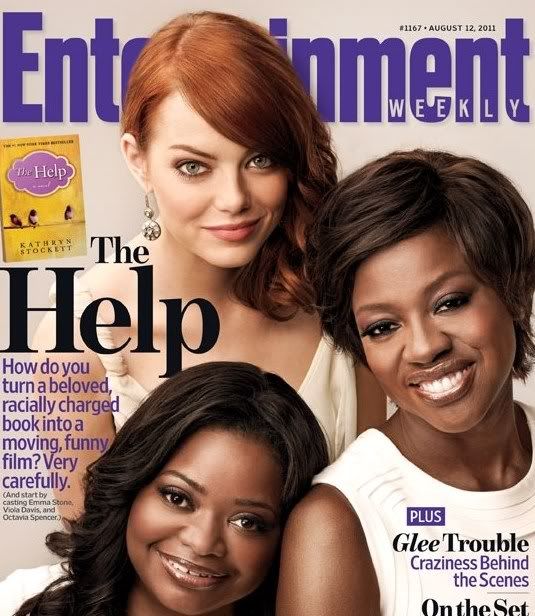
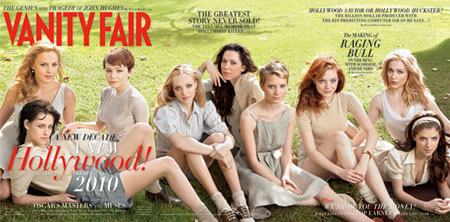
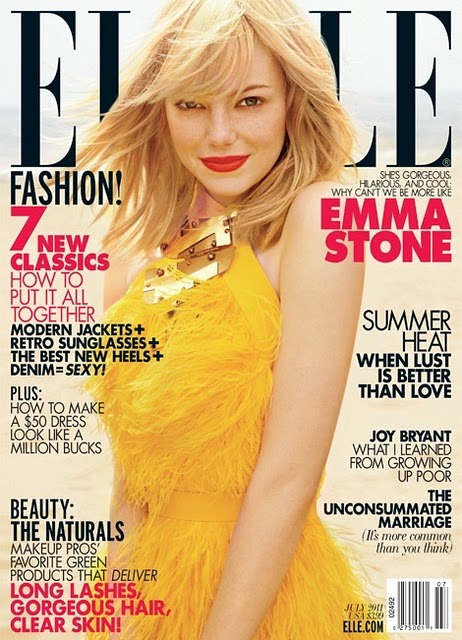
Any yet, we may well note already how differently the main black actress(es) of "The Help" are being portrayed in the media compared with the main white actress.  As you decide whether to go see "The Help," notice just the magazine cover differences.  Notice which magazines Emma Stone is the cover girl for.  Notice which ones for Viola Davis and for Octavia Spencer.  Already our daughters (and sons) are getting an education in the representation of women, and of white and black women differently:


So (how) will you see "The Help"?

Thursday, August 11, 2011

The Help reviewed: bell hooks, Oprah, and Melissa Harris-Perry

In the previous post, I gave you homework to read The Help and to see the film.  Let me now confess I haven't finished the book.  My spouse did, and she gave it, some reluctantly, to a former neighbor, our friend before I had a chance to read it all.  I say "some reluctantly" because our friend, our former neighbor, is AfricanAmerican and we're not.  We're EuroAmericans.  And we'd read the reviews by bell hooks and by Oprah Winfrey.  And if you haven't yet seen the reviews, then I'll share them here, including the very important one also by Melissa Harris-Perry.

Anyway, our friend's spouse called me last night.  It was the first time we've spoken since we moved nearer where I work, away from the former neighborhood.  He's also AfricanAmerican.  He called to invite me to attend a "man" conference at The Potter's House tonight in Dallas, a conference led by T. D. Jakes.  So in just a bit, I'll drive up to our friends' home and go with him.  If we dare, we might discuss men and women and black and white, and The Help, written not by an AfricanAmerican although a portrayal of AfricanAmerican women through the telling by a character not an AfricanAmerican woman.  bell hooks may or may not be someone we discuss tonight, although I'd like to ask my friend taking me to the T. D. Jakes conference on manhood how she might critique what we're doing. 

When my spouse first brought home The Help to read, my first question was, "I wonder what bell hooks says about this book?"  I knew what hooks had said about "Homeplace: a Site of Resistance."  She said:
Throughout our history, African-Americans have recognized the subversive value of homeplace, of having access to private space where we do not directly encounter white racist agression. Whatever the shape and direction of black liberation struggle (civil rights reform or black power movement), domestic space has been a crucial site for organizing, for forming political solidarity....(page 47, Yearning: Race, Gender, and Cultural Politics)
When I was a young girl the journey across town to my grandmother's house was one of the most intriguing experiences... there ... all that loud talk, the talk that was usually about the old days ... but also how we lived and survived as black people, how the white folks treated us.  I remember this jouney not just because of the stories I would hear... because we would have to pass that terrifying whiteness -- those white faces on the porches staring us down with hate....  Such a contrast, that feeling of arrival, of homecoming, this sweetness and the bitterness of that journey, that constant reminder of white power and control.
I speak of this jouney as leading to my grandmother's house, even though our grandfather lived there too.  In our young minds houses belonged to women, were their special domain, not as property, but as places where all that truly mattered in life took place—the warmth and comfort of shelter, the feeding of our bodies, the nurturing of our souls. There we learned dignity, integrity of being; there we learned to have faith. The folks who made this life possible, who were our primary guides and teachers, were black women. 
Their lives were not easy.  Their lives were hard.  They were black women who for the most part worked outside the home serving white folks, cleaning their houses, washing their clothes, tending their children -- black women who worked ..., whatever they could do to make ends meent, whatever was necessary.  Then they returned to their homes to make life happen there.  This tension between service outside one's home, family, and kin network, service provided to white folks which took time and energy, and the effort of black women to conserve enough of themselves to provide service (care and nurturance) within their own families and communities is one of the many factors that has historically distinguished the lot of black women in patrcarchal white supremacist society form that of black men.  Contemporary black struggle must honor this history of service just as it must critque the sexist definition of service as women's "natural" role.
. . . [they fostered] a radical political dimension . . . [and created] a site of resistance and liberation struggle (page 41, Yearning: Race, Gender, and Cultural Politics)
I shall never forget the sense of shared history, of common anguish, I felt when first reading about the plight of black women domestic servants in South Africa, black women laboring in white homes. Their stories evoked vivid memories of our African-American past....
I want to remember these black women today. The act of remembrance is a conscious gesture honoring their struggle, their effort to keep something for their own. I want us to respect and understand that this effort has been and continues to be a radically subversive political gesture. For those who dominate and oppress us benefit most when we have nothing to give our own, when they have so taken from us our dignity, our humaness that we have nothing left, no “homeplace” where we can recover ourselves. I want us to remember these black women today, both past and present. (Yearning: Race, Gender, and Cultural Politics pages 42-43).
hooks got me remembering Nancy.  Nancy was The Help for my white family when I was a little boy in Corsicana, Texas USA during the Jim Crow era.  Did Nancy or her daughters and sons fear when they passed into our neighborhood and into our home?  And what subversion of the segregation in very very profound ways.  What feminism.  What love in contrast to hate.  What a critique of the status quo, of the power, of the white supremacy, of the patriarchy.  I've asked my dad and mom if they know where she is today.  What is she doing?  No, they tell me- they don't know.

So how does bell hooks critique The Help?  Isn't it about black women, the very ones she remembers and wants historically to be remembered?  Here's her fair and good and just assessment:
“Here, I’m going to be mean,” she said, noting that the books she would mention are beloved by many, including The Divine Secrets of the Ya-Ya Sisterhood, The Help, and The Secret Life of Bees. “These books are seen as showing the organic, fun time we can have together,” she said. “Regardless of race, we can be light, sentimental, we don’t have to be political.” Then she called this avoidant perspective for what it is: “… bullshit.”
Stockett, who wrote this book because she was inspired by her own perceived experience, is seen by hooks as “slobbering” all over her nanny, who Stockett admittedly hadn’t seen since she was 16. “She didn’t know what happened to her,” hooks said. “How does she know this black woman forgave her? She doesn’t tell us where she got her information from, but she doesn’t have to, because that wasn’t the point of the book.”
hooks addressed this thread as well: that these books want to perpetuate the outright mythology (my word, not hooks’) that women of multiple races and ethnicities are not really separated by anything after all: “we’re just two people with nothing standing between us,” hooks said. But there is a difference, and it’s that “white folks are not called to extreme choices.” And it is often those who have the luxury to decline to be political, because they can be, who oppose Marxist, feminist, and post-colonial readings of texts, who like to say things like “let’s not get all political about this,” who prefer to approach “the text on its own terms,” who are perpetuating the fiction that social equality has been achieved: “by centering on the lives of women” in these books, hooks said, “the anti-feminist, pro-racist idea is pushed that the patriarchy has been dismantled, that it has ended, that there is no need for feminism, and that society is now post-racial.”
“Bonds of affection?” hooks asked. “Why not also show the rage, the anger, the hatred, as well as the bonds of affection?”

Applying frank, powerful and controversial racial analysis to leading theories has been the intellectual duty that hooks has fulfilled for decades, and hearing her speak on such terms was remarkably refreshing and inspirational. At IC on Tuesday, she used her hallmark description of the American political system, imperialist white supremacist capitalist patriarchy, over and over again, and she sounded at once dated and invigorating, both antiquated and completely fresh. The black feminist perspective that she fashioned is threatened by an encroaching social and political fascism that she mentioned toward the end of the talk. But she emphasized Pema Chodron in her approach to “start people where they are” and to find the “openings” in seemingly airtight systems: “what I learned from Foucault is that there are no closed systems,” she said. “All systems have openings. You have to find the openings.”
For hooks, that opening was in writing. Once she started writing, she said, “suddenly there was room for me in a system that doesn’t want me and doesn’t pay me well.”
In response to the person who asked about giving up privilege, and in response to someone else who suggested that demolishing the class system must precede any kind of social equality, hooks emphasized that the formation of strong and healthy self esteem is crucial to what she called “mutuality:” equality might be beyond the scope of what is immediately realistic, but no matter how much privilege you have, you don’t need to dominate others, she said, and for this, “the challenge is to be engaged where we are, loving ourselves and others, where we are. This is crucial to our struggles.”
The above is a report by Danielle Winterton, who heard bell hooks when she appeared at Ithaca College Tuesday, Oct. 5, 2010.

Now, here's Oprah, from O Magazine:
Then: The Help
By Kathryn Stockett
464 pages; Amy Einhorn/Putnam

Practically from the moment it was published in 2009, the reading world embraced Kathryn Stockett's The Help, a debut novel about black maids who finally speak up about their white employers during the civil rights movement. A fixture at the top of most best-seller lists, it became the feel-good book of the year.

Now: Glorious
By Bernice L. McFadden
250 pages; Akashic

Bernice L. McFadden's riveting novel, Glorious, starts in the Jim Crow South and moves to the Harlem Renaissance, and finally to the same civil rights era Stockett chronicled, but it's a grittier, more brutal tale. Easter Bartlett, a young black woman, flees Georgia after seeing too much, including a mob lynching of a pregnant woman. Easter is no victim, though. In Harlem she encounters a world where crowds gather to cheer the "Black Moses" Marcus Garvey and publishers enthuse about the exotic genius of "Negro" writers. Still, it's hardly a postracial paradise. McFadden—in vivid vernacular—brilliantly skewers the vanity of self-congratulatory liberals. A white woman returning from Paris with her black lover gushes, "Before our encounter, I had never even spoken to a Negro. They were invisible to me and now I see them everywhere!" Easter achieves some brief literary fame, but by 1961, she is tired, and battered by stubborn racial attitudes. In confronting one final injustice, she doesn't just survive; she triumphs—gloriously. — Karen Holt
And Oprah is listening, liking the book but wanting to hear what others say and think about the movie.  She's publicly called for our opinions.

And then, finally, here's Melissa Harris-Perry noting how the film based on the novel neglects the history that “it was rape, it was lynching, it was the burning of communities”:


So now I'm off to hear T. D. Jakes.   I wonder if he's seen or read The Help, what he thinks.  Maybe tomorrow I'll have opportunity to say more.