Saturday, August 13, 2011

S-U-B-M-I-T, find out what it means to her

In public, Michele Bachmann, candidate for the Chief Executive of the world's largest superpower, says that she will continue to submit to her husband.  However, this submission, she says, is respect.  And this submission, she explains, is mutual.   Here's exactly how she put it last night answering why she did something her husband told her she must do even though she hated doing it:
“Marcus and I will be married for 33 years this September 10. I’m in love with him. I’m so proud of him. What submission means to us, it means respect. I respect my husband. He’s a wonderful godly man and great father.
“He respects me as his wife; that’s how we operate our marriage,” she continued. “We respect each other; we love each other. I’ve been so grateful we’ve been able to build a home together. We have wonderful children and 20 foster children. We’ve built a business and life together, and I’m very proud of him.”
If Ms. Bachmann becomes President, then her relationship together with Marcus should not change.  He may tell her to do some things that she hates, and she will obey; she must do it.  This also came up last evening:
During last night's Fox News debate, moderator Byron York questioned Rep. Michele Bachmann about her 2006 remark that her "husband said you should study for a degree in tax law. You said you hated the idea. And then you explained, 'But the Lord said, 'Be submissive. Wives, you are to be submissive to your husbands.'" York asked Bachmann, "As president, would you be submissive to your husband?" The question received loud boos from the audience, and was the subject of attention in write-ups of the debate.
York, after hearing Bachmann's answer, was pleased.  He said:  "I personally thought she handled it very well. She handled it much more human -- it was like a very human moment for her."   So what does York mean by "human"?  Not mousey and wifey and womanly?  Rather mutual and sharing and two-way respectful?

We get the idea, then, that a President Michele Bachmann would have her cabinet submit to her.  In a human sense, therefore, they would love her and would work together to build with her and would mutually respect her.  The question remains where that would leave First Gentleman (not First Lady) Marcus Bachmann.  If he told his wife to do something she hated, then would he get obedience?  And what would be the chain of command for the Commander in Chief?

Now Wayne Leman at BBB blogged on this.  He says "we at BBB" (meaning the all-men team of bloggers at BBB) want to know:
Does the Greek word ὑποτασσω in Ephesians 5:21–and assumed by almost all Bible translators to be implied in the next verse–mean ‘respect’ or something else?
 Yesterday, I linked to an essay, a post, by Wayne Grudem in which he says that "submission is a respectful affirmation" but that submission must only go one way in a marriage.  Submission, he explains, is not "mutual."  Marcus Bachmann is not to submit to his wife Michele Bachmann.  As the husband, he is not to give her "respectful affirmation" in the sense that he is under her.  Rather, she is under him because she is a woman, because she is his wife.  She must respectfully follow his leadership even if he tells her to do something that she hates.

The BBB all-male blogger team want to know what this means.  If you are a woman, then do know that there is a special practice by this team for moderating the comments of females.  The way blogger Theophrastus has tracked this is as follows:
The situation over that the BBB is that all male-blogging team has decided on a secret rule that issues of gender cannot be discussed in blog posts.  However, this rule is inconsistently enforced – it is particularly enforced on women who try to comment on that blog.
If you'd like to comment freely, whether you are a woman or a man, then always feel free to do so at this blog.  Or, if you really want to reply to the BBB questions but find yourself moderated in any particular way by the all-male BBB team, then feel free to do so at the BBBB.  The BBB all-male no-woman team has promised that everybody gets automatically moderated in reply to Wayne Leman's recent post.  The BBBB, however, will allow you to make your comments openly on this same topic or on any topic you somehow want to bring up there.

Now, before we leave the topic of ὑποτασσω as Paul wrote it to Greek readers in Ephesus, I thought we might listen to how his first Greek readers, those Ephesians, may have heard this word.  There's no reason to believe that these Ephesians in Ephesus were uncultured.  There's no reason to think that the husbands and wives to whom Paul addressed his letter would not have attended the local plays.  There's no reason to suggest that they might not have gone to watch the plays by Euripides or even his play that we know today as The Bacchae.

As we all know, the Bacchae were women, not men.  


They were also called maenads, those females who followed and nursed and submitted to the god Dionysus.  The Bacchae or Maenads were "Raving Women."

If you've watched the play by Euripides or have read it, then you know how these raving women murdered a human king for banning their worship of the god.  If it's significant, this particular god, Dionysus, had a human mother.  At any rate, we all know how the Bacchae or Maenads or Raving Females broke the law of the king and killed him.  They did not submit.  They did not like this chain of command, this male hierarchy from the king.  In fact, the mother of this king usurped the male authority and led the raving women.


Here's a memorable moment from the play in which this king, before he gets assasinated, is getting a report on these women and on his own mother (as translated from the Greek of Euripides into English, by George Theodoridis):
But just then she [your mother] shouted, “Hey, my speedy bitches, there are some men here who are hunting us.  They want our submission. Come, run with me.  Arm yourselves with your thyrsus and come with me! Let’s get them”

We just managed to run away and escape the slaughter but they threw themselves, with no spear nor sword, at the calves that were quietly grazing nearby.  One of those women tore a poor, tiny calf away from its mother’s udder and others ripped calves to bloody pieces with their bare hands and then they began eating them raw.

My Lord, you could see bits of flesh strewn all around the place. Whole sides of animals, legs, other chunks of animal flesh hanging from the fir trees, dripping blood.  Huge bulls, my Lord which only a few minutes earlier stood tall and proud, the sort that if one got them angry they’d tear everything apart with their massive horns, well, now they dropped their bodies to the ground and straightaway countless girls dragged them about with their bare hands and… and by the time you blinked your royal eye, my Lord, they’d have the skin torn off those massive carcasses of them bulls.

And then they went flying about like the wild birds that ruin the proud wheat stalks of Thebes, the ones that fly low next to the rushing waters of Asopos river.  Then off them women rushed to the villages of Erythres, near Ysies, at the foot of Mount Kitheron and just like an invading army they turned everything upside down, ripping children out of their houses and taking all sorts of goods from there, which they just threw carelessly over their shoulder without tying anything together; still nothing fell to the dark soil, not even bronze or iron, my Lord!

And, o, my Lord Pentheus [the king], around their hair there was this brilliant fire that had no effect on them. Didn’t burn them one bit.

Then all the men came out fuming with anger and fully armed, wanting to bring these Bacchants into submission [ὑποτάσεις], but then, my Lord, if only you could have seen this most awesome thing!  Most terrible thing to see.
So the Ephesians would get that submission was not mutual in some contexts, that the king was to be obeyed, that women especially raving females should be under male gods and male leaders.  This was a gendered thing.  A one-way sexist thing.  Or was Paul suggesting mutual submission of all one to another also?

Friday, August 12, 2011

Wayne Grudem issues an apology

In an almost unpredented move, Wayne Grudem followed the lead of Don Miller.  Grudem has deleted a post and issued an apology for what he wrote about men and women.  And now, I am impressed. Today Grudem wrote,
If anything I said personally offended you, will you accept my deepest and most sincere apology?
The post was deleted from both the website of the Gospel Coalition and the website of the Council on Biblical Manhood and Womanhood.  But it remains on the bible.org website at http://bible.org/seriespage/wives-sarah-and-husbands-who-honor-them-1-peter-31-7.  Therefore, Grudem contacted J. K. Gayle of Aristotle's Feminist Subject, asking Gayle to post his apology there.  Grudem also wanted to add a few comments of recantation given that bible.org wouldn't let him take the post down there.  Gayle is calling it a guest post.

Grudem added this, the guest post:
Please know that I'm not some emergent church uncredentialed writer like the pop Christian author Donald Miller.  And please don't let anyone think I'm going soft on the Bible, on biblical doctrine, or on systematic theology, or anything like that.  I'm not.  I'm still the manliest of men God ever made.  I still believe in the femininity of women too.

Here's the thing.  I've been thinking hard about what Suzanne McCarthy wrote:  "If we feel that the scriptures are turning hierarchy upside down, let us follow suit."  Now, mind you, I'm not backing down on logic or on reason.  However, I've been out of touch with my real feelings lately, as if emotions are only for women.  They are not.  I can feel as a man.  Jesus wept.  And Jesus said again and again, "You have heard that it was said to those of old, .... But I say to you that everyone ...."  He said that in accurate ESV Bible English.  Yes, and I know that everyone now notices that he's included women in his "everyone."  So I started thinking (I mean) feeling that words really do matter and that all of the sudden what Jesus was saying is part of the scriptures. No scratch that too. What Jesus said really must be now called the scriptures, the very scriptures which are turning hierarchy upside down.

Yes, I know the objections.  Paul wrote AFTER Jesus spoke.  So Paul trumps Jesus, at least chronologically.  And Peter validates that too, even if he complains that Paul is too hard to read; Paul wrote the scriptures too.  Paul surely trumps Jesus, and so does Peter who validates Paul.  Are you following my logic here?   Any reconciliation of Jesus's words with the epistles of Peter and of Paul must be a fitting of the Paradox of how Jesus may have contradicted the Law and may even SEEM to have contradicted both Peter and Paul, who trump Moses too.  Are you tracking with my thinking, my reasoning, my ivory tower proofs?  Yes, I know these objections very well.


Let's follow Peter and Paul very closely at little more.  With logic.  And then I feel I need to recant some things.  To turn some things upside down.  To meta-noia.  To re-think.  To really feel.  To weep.


Peter and Paul were hard on the evangelical feminists.  And please don't mistake me for one of them.  I mean don't ever call me a "feminist."  In that post I deleted, I had to show how "evangelical feminists must take two steps in the interpretation of Scripture that are simply incorrect and that show their position to be contrary to Scripture.said how the evangelical feminists."  Talking of Peter and Paul, I wrote this first:  "In fact, it is very significant that the New Testament authors never explicitly tell husbands to submit to their wives."  And then I referenced the most authoritative scriptures written Peter and Paul (and Luke a little too) to show that "evangelical feminists take another illegitimate step in Bible interpretation when they change the meaning of the word hupotasso ('submit to,' 'be subject to'), giving it a meaning that it nowhere requires, something like 'be thoughtful and considerate; act in love' (toward another), without any sense of obedience to an authority."  Peter and Paul win.  Evangelical feminists lose.  And I really like to win.  So I was on what I knew what the winning team:  Peter's and Paul's.  I like to be on the winning team today.  So I do remember using the English word "today" some 15 times in that blogpost I regret writing today; that blogpost I deleted today.  The whole point was to have Peter and Paul make sense for women today, to get them to submit today.  To take away any notion of feminist or egalitarian "mutuality" of the sexes today.  Submission was to go one way today.  But my "today" is now yesterday.  Jesus Christ, I remember the scriptures saying, is the same yesterday and today and forever.  This may even be something Paul wrote after Jesus if he wrote Hebrews.  Even if he didn't, whoever did wrote it after Jesus.  But now somehow my logic fails.  Jesus comes back, from yesterday, past Moses and the Torah and the Law and Peter and even Paul, to today.  He's forever.  Which means if he overturns the hierarchy, then any contradictions get overturned too.  Or at the very least we sweep them under the logic preserving rug we call paradox.  Did you see how my friend Raymond Ortlund, Jr. and my other friend Denny Burk and I did that with the seeming contradiction between woman's equality with man (ontologically) and woman's inferiority to man (functionally, in roles in the home and in the church)?  Paradox is a cool tool.  And it works both ways.  I'd just never thought, um, felt it could be used to overturn Paul, who comes after Jesus.

So I must confess.  When Paula (not Paul) wrote something (albeit neither purely scriptural nor academical), I think the Holy Spirit began to deal in my heart.  She said, "It was always about privilege."  What I'm beginning to see -- and it's still kind of foggy -- sort of like Paul's scales coming off his eyes just at first -- is this.  I'm starting to get the fact that we men who use the scriptures, whether Genesis 1, 2, and 3 in harmonized paradox or Ephesians 5 or the household codes of Peter, will insist that they privilege them.  We won't let Jesus take it back to Genesis in a different way, saying, "Have you not read that he who created them from the beginning made them male and female, and said, 'Therefore a man shall leave his father and his mother and hold fast to his wife, and the two shall become one flesh'? So they are no longer two but one flesh. What therefore God has joined together, let not man separate."  We have to say, yes, but Paul adds the other side of the Paradox.  And so does Peter.  The no longer two but one must become two again:  the male over the female.  The female sub-missive to the male.  And if God's image is male and female, then in God his female side must submit functionally to his male side.  And the one side then must obey the authority of the other side.  Paul and Peter never say any different.  But look.  This is exactly what Paula is saying.  It was always about privilege, this argument of us men.  And I now don't for the life of me feel that God has privilege in half of himself.   So I'm recanting.  I'm letting Paul and Peter's silence on the husband needing to hupotasso his wife just be first century silence.  Jesus, forever, yesterday and still today, didn't seem to assert this one-sided-ness, that one-up-man-ship.  So I'll just follow the scriptures.  I'm following Jesus.

If anything I said personally offended you, will you accept my deepest and most sincere apology?

Will You see "The Help"? (How?)

We don't usually boycott films or books.  But this morning "J" tells me she's not sure about "The Help."  Maybe she'll go with our daughters and use it as a teaching moment.  She'd seen Melissa Harris-Perry's review.  I'd told her what "V," our friend, had shouted out to me last night as her husband, their son, our son, and I jumped in the car to go to the T. D. Jakes "man" conference.  "The book is good," V said. "But not the movie."  That's Oprah's assessment too, my spouse reminded me.  And Oprah's question to all of us is, "So what do you think?"  And Martha Southgate's evaluation - "The Help is only a symptom, not the disease" - almost gives the book and the film a pass.  However, there's still the question,

"Will you see the film 'The Help'?"

Whether you do or not, whether you consider a movie viewable because it's only a symptom, then can we see the disease?

Southgate points it out the disease of remembering and figuring white people as necessary but black people as always just merely only in the shadows, as marginal, even in their own histories.  She concludes:
Suffice it to say that these stories are more likely to get the green light and to have more popular appeal (and often acclaim) if they have white characters up front. That's a shame. The continued impulse to reduce the black women and men of the civil rights movement to bit players in the most extraordinary step toward justice that this nation has ever known is infuriating, to say the least. Minny and Aibileen are heroines, but they didn't need Skeeter to guide them to the light. They fought their way out of the darkness on their own — and they brought the nation with them.
And this history is still being written.  We may be part of the contagion, of the spread of the disease today.

If we ourselves are not, then at the very very least, the movie industry that we support by our movie watching is.  For example, just a few months ago this year, the day after the Oscars were handed out earlier this year, Kevin Eason stated the obvious:
"As controversial as the Oscar nominations usually are, there is one issue that stands out more than most. Namely, why are there no black Oscar nominees this year?"
Then Easton concludes, as with some hope:
"It also seems that there may not be that many opportunities this year for African-American actors to make the shortlist either. Two big films that might change the situation are The Help, about the lives of housemaids during the segregation of the Civil War-era, and Winnie, a biopic of Winnie Mandela starring Jennifer Hudson...."
Of course, Easton might have seen the disease, with both of his hopeful films this year being symptoms.  Nonetheless, it seems he didn't anticipate the controversies surrounding either film.

The film "Winnie" was written by white South African filmmaker, Darrell Roodt.


And it's based on the book Winnie Mandela: a Life, by white South African, Anné Mariè du Preez Bezdrob, the former UN peacekeeper and radio reporter, who also wrote The Nelson Mandela Story, about Winnie's ex-husband of course.  But neither du Preez Bezdrob nor Roodt consulted either of the Mandelas for the books or the film.

The book by du Preez Bezdrob didn't fairly represent Ms. Mandela's experience, according to some.  For example, the Nigerian-Jewish British actor, Sophie Okonedo, who played Winnie Mandela for the tv film "Mrs. Mandela," said this about the book:
[I had to do my research] about five weeks before filming. So I started reading. I read the Anthony Samson book, which gave me a pretty good overview; the Emma Gilbey book, which is more judgmental I think. I started the one which is quite famous, Winnie Mandela: A Life [Anné Mariè du Preez Bezdrob], but I just thought she kept assuming things about Winnie. There was lots of, "No one knows what happened in that cell but we can imagine"… then a whole chapter of imaginings. I just put that book down.
The film by Roodt is one that Winne Mandela herself has publicly criticized:
"I have absolutely nothing against Jennifer [Hudson, who was cast to play me], but I have everything against the movie itself," she told CNN.  "I am still alive and I think it is total disrespect to come to South Africa, make a movie about my struggle and call that movie some translation of a romantic life of Winnie Mandela. I think it is an insult."
Of course, "Winnie" may earn Jennifer Hudson an Oscar nomination.  Likewise, "The Help" may provide Viola Davis or Octavia Spencer an Academy Award nomination as well.

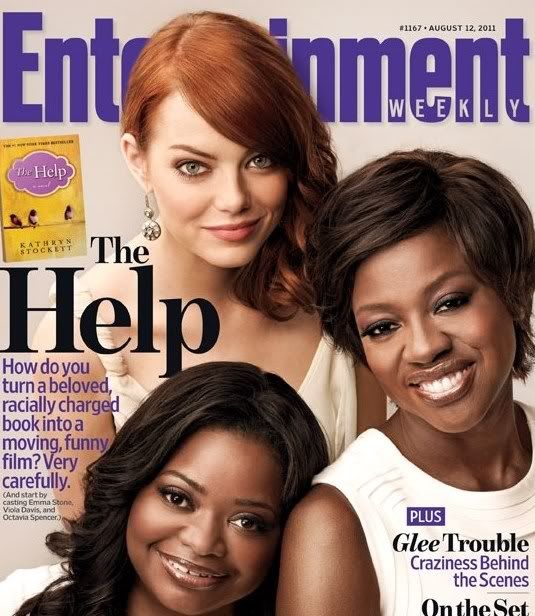
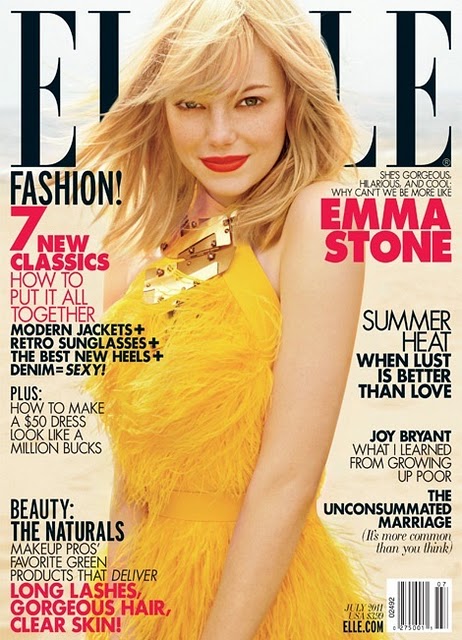
Any yet, we may well note already how differently the main black actress(es) of "The Help" are being portrayed in the media compared with the main white actress.  As you decide whether to go see "The Help," notice just the magazine cover differences.  Notice which magazines Emma Stone is the cover girl for.  Notice which ones for Viola Davis and for Octavia Spencer.  Already our daughters (and sons) are getting an education in the representation of women, and of white and black women differently:


So (how) will you see "The Help"?