Showing posts with label (women's) rhetorics. Show all posts

Wednesday, September 28, 2011

sexist Roman slogan (and what Paul may do with it)

Kay Bonikowsky has a post up in which she suggests that "Paul was quoting a slogan" when writing in Greek to men and women in Korinth, Greece.  Translator Ann Nyland, likewise, says the following, right in the middle of her translation of what we call Chapter 14 of Paul's letter; Nyland says: "Paul now quotes from the letter sent to him by the Corinthian assembly."

The Corinthian men had quoted the Law of the Roman empire at Paul.  So how did that go?  Well, in a bit, I'll show you.  First, I want to let Cheryl Glenn remind us about that Roman law:
A particular point of Roman male pride seems to have been the deliberate exclusion of women from civil and public duties; and in the first centuries of its history, Roman law reflected rigid legal inequalities between males and females.  Cicero reportedly contemplated with utter dismay a society which "included women in assemblies" and which allowed women "soldiery and magistracies and commands."  "How great will be the misfortune of that city, in which women will assume the public duties of men" (Lactantius, Epitomes 33.[38.]1-5, ascribed to De re publica 4-5, qtd. in Hallett, Fathers 8)....  Over centuries, Roman law constructed and guaranteed the sexual distinction -- and division -- between males and females.  The differential between the legal status of women and that of men was justified by the natural inferiority of women:  their congenital weakness, limited intellectual faculties, and ignorance of law....  Roman women were perpetually restrained by law. [ Rhetoric Retold: Regendering the Tradition from Antiquity Through the Renaissance, pages 61-62, emphases mine: the red font the Roman exclusions, the blue the more liberal inclusions elsewhere.]
Glenn goes on from her research to discuss at great length the effects of the Law.  The legal constraints applied to women more severely under Roman rule even more than they had under the old laws and customs of the Greek empire.  The oppressive Law worked to silence women in Rome, in Athens, in Jerusalem and in Korinth:
Like the Greek matron, then, the Roman woman was oppressively busy managing her household and family [i.e., the Roman Domum as the counterpart of the Greek οἰκοδομή -- the OIKO-DOMĒ -- the domain of the home].... Because the Romans clung to the ideal of the domina, of the strong privatized woman, they [i.e., the Roman men] often reacted with perplexity or disgust at the women who pursued intellectual or political aspirations. Unlike the very few Greek women who found acceptance and admiration in the public domain, no Roman woman seems to have succeeded in establishing herself as a public figure in her own right....  The Greeks and Romans [i.e., the men] regarded most women as ciphers, whose worth varied according to the property and family connections accompanying them.  Women were to be traded among men.  And historians -- from the first -- have had little more to say about these women, who were always, particularly in their exceptions, defined by the private, feminine sphere.  The women in my study who passed into the public sphere, even if only temporarily, found themselves vulnerable to assaults on their families, their honor, their sexuality, their "feminine" influence.  These women endured the closest of inspections and critiques by males and females alike, usually being disarmed of their influence and respect in the process.  [ Rhetoric Retold, pages 63, 72-73, emphases mine: the red font the Roman exclusions, the blue the more liberal inclusions elsewhere.]
Okay, so what was the slogan, the Roman law, that the men of Korinth wrote to Paul?  And how did he reply?  Let's look, first at their Greek, then at our English.  (What my translation attempts is to show Paul's play with "feminine" words, with HOME-DOMAIN and with SILENCE and with ALL-inclusion in the ASSEMBLY and with the creative, maternal words of BIRTH.)  Here, hear:

Τί οὖν ἐστίν, ἀδελφοί;
Ὅταν συνέρχησθε ἕκαστος
ψαλμὸν ἔχει,
διδαχὴν ἔχει,
ἀποκάλυψιν ἔχει,
γλῶσσαν ἔχει,
ἑρμηνείαν ἔχει.
Πάντα πρὸς οἰκοδομὴν γινέσθω.

Εἴτε γλώσσῃ τις λαλεῖ,
κατὰ δύο ἢ τὸ πλεῖστον τρεῖς,
καὶ ἀνὰ μέρος,
καὶ εἷς διερμηνευέτω·
ἐὰν δὲ μὴ ᾖ διερμηνευτής,
σιγάτω ἐν ἐκκλησίᾳ·
ἑαυτῷ δὲ λαλείτω καὶ τῷ θεῷ.

Προφῆται δὲ δύο ἢ τρεῖς λαλείτωσαν,
καὶ οἱ ἄλλοι διακρινέτωσαν.
Ἐὰν δὲ ἄλλῳ ἀποκαλυφθῇ καθημένῳ,
ὁ πρῶτος σιγάτω.

Δύνασθε γὰρ καθ’ 
ἕνα πάντες προφητεύειν,
ἵνα πάντες μανθάνωσιν,
καὶ πάντες παρακαλῶνται·
καὶ πνεύματα προφητῶν
προφήταις ὑποτάσσεται.
Οὐ γάρ ἐστιν ἀκαταστασίας ὁ θεός,
ἀλλὰ εἰρήνης,
ὡς ἐν πάσαις ταῖς ἐκκλησίαις τῶν ἁγίων.
Αἱ γυναῖκες ὑμῶν ἐν ταῖς ἐκκλησίαις σιγάτωσαν·
οὐ γὰρ ἐπιτρέπεται αὐταῖς λαλεῖν,
ἀλλὰ ὑποτασσέσθωσαν,
καθὼς καὶ ὁ νόμος λέγει.
Εἰ δέ τι μαθεῖν θέλουσιν,
ἐν οἴκῳ τοὺς ἰδίους ἄνδρας ἐπερωτάτωσαν·
αἰσχρὸν γάρ ἐστιν γυναικὶ λαλεῖν ἐν ἐκκλησίᾳ.

ἀφ’ ὑμῶν ὁ λόγος τοῦ θεοῦ ἐξῆλθεν;

εἰς ὑμᾶς μόνους κατήντησεν;

Εἴ τις δοκεῖ προφήτης εἶναι ἢ πνευματικός,
ἐπιγινωσκέτω ἃ γράφω ὑμῖν,
ὅτι κυρίου ἐστὶν ἐντολή
Εἰ δέ τις ἀγνοεῖ, ἀγνοεῖται.
Ὥστε, ἀδελφοί μου, ζηλοῦτε τὸ προφητεύειν,
καὶ τὸ λαλεῖν μὴ κωλύετε γλώσσαις·
πάντα δὲ εὐσχημόνως
καὶ κατὰ τάξιν γινέσθω.

In English, that goes something like this:

What is it, then, brothers?
When you meet together, each one may
have a Psalm,
have an Instruction,
have a Revelation,
have a Tongue,
have a Translation.
All gives birth to the Domain of the Home:

Whether it's a Tongue that is uttered,
by two or at the most three,
both a Top Part,
and through to a Translation.

Should there, however, not be the Translation, then: 
Silence in the Assembly!
To oneself, nonetheless, is an Utterance, and to God.

Prophesy, nonetheless, by two or three Utterances,
And the others through to a Judgement. 

Should there come, in fact, some Revelation to another seated, then:
For the first one, Silence!

You all, in fact, are quite able:
One and all may Prophesy
So that all may be Apprenticed
And all may be Called to Encouragement.
And may the Spirit of a Prophecy
Be given Order Under Prophets.
There's not, in fact, a God of Disruption,
but rather of Peace,
which is in all, in the Assembly, of the Holy ones. 
Your women, in the Assembly, are to be Silent! 
Give, in fact, to them no Turn to Utter anything there,
but rather give them their Order Under. 
just as the Law also states
If, however, some wish to be Apprenticed,
Then it's in the Home where their own men are that these may Question.
It is shameful, in fact, for women to Utter anything in the Assembly.
What?!
Is that from you all, The Statement of God springing out like your baby?
What?!
Is this your special delivery?

If someone opines that they have so Prophesied, or are so Spiritual,
then let him understand what I have written to you all:
our Master is giving Commandments.
If, nonetheless, someone is without understanding, then he lacks understanding. 
Therefore, my brothers, yearn to Prophesy,
and to Utter (don't forbid it) a Tongue.
All, nonetheless, with Blessed Form
and according to Arrangement be birthed! 

Saturday, June 4, 2011

Electrified Fences and Conversation Hopefully to Remove Them

In a single sentence [my book critic] reimposed the very dichotomies I had constructed the book in order to call into question, putting electrified fences around the categories “academy,” “criticism,” and “writing” to keep the various critters from intermingling, maybe interbreeding to create some nameless monster very like the one I aspire to be.
--Nancy Mairs

Thanks to Kristen, Suzanne, and Theophrastus for joining in conversation yesterday around three posts here, each related to Shawna R. B. Atteberry's helpful and hopeful new book, What You Didn't Learn in Sunday School, Women Who Didn't Sit Down and Shut Up.

Suzanne says, most recently:  "Okay. I have to admit that this conversation has me completely baffled."  Kristen writes again, "Switching gears here to talk more about the actual blog post."  Theophrastus, still in high gear, signs off as "Emmanuel Goldstein" after confessing first, "I haven't read Shawna's book (and I'm not likely to ...), and then further complaining, "I think that weak arguments benefit the oppressor....But most of all, I think her 'Godde' and 'Christa' are gimmicky and reminiscent of Newspeak."

I myself am feeling again what Tonya and Daniel have kindly acknowledged: "Conversations in person are rarely this stressful."  And now I'm afraid that this weekend I'm not going to have much time to add anything, hoping that the conversation, nonetheless, will continue on without me as it is important, to me, and to the conversants here so far.  I know it's important to Shawna and the readers of her book.  Please feel free to join in, as you would.  If things get (more) heated and out of hand, then please do watch your own boundaries of protection for yourself.  (Remain anonymous or pseudonymous even, as you wish.)  The space of a blog can be hurtful.  The personal is, nevertheless, important.  So is, I think, your voice.  Please don't sit down or shut up; this is Shawna's point.

I'm going to use my remaining few minutes on the blog today to quote one of my favorite writers from one of my favorite books of hers.  She does expose the sorts of judgmentalism that would seek not to listen but to silence others.  This writer expresses resistance to binary thinking of the sort that would force a neologism, such as Godde, into a pure and one-gendered category (i.e., as if it must always and only be the exact opposite of the "divine masculine," somehow obviously just "feminine," and clearly, theologically heretical).  I'm hoping the writer I'm quoting below here will encourage us to keep talking and to consider more what Shawna is saying, what women of the Bible are saying.  Here's the quotation; its from pages 3 and 4 of the book Voice Lessons: On Becoming a (Woman) Writer, by Nancy Mairs:
     An anonymous reader of an early version of this book, about whom I only know that “she” is “an academic,” concluded:  “It is obvious from her criticism that she wasn't meant to be an academic, from her encounter with French feminist theory, that she wasn't cut out for a career as a critic.  What is obvious is that she is a real writer.”  I could have wept, if frustration any longer had the power to elicit the tears reserved now for anguish unspeakably deeper.  In a single sentence she reimposed the very dichotomies I had constructed the book in order to call into question, putting electrified fences around the categories “academy,” “criticism,” and “writing” to keep the various critters from intermingling, maybe interbreeding to create some nameless monster very like the one I aspire to be.
    And what queer syntax. “Meant” by whom?  “Cut out” by whom?  Is there a God in the Academy creating academics in His own image and dispensing careers according to some holy plan?  If I'm the product of intention, I'd like to know who intended me.  And how is a “real” writer distinguished from other sorts (what sorts?) of writers?  These are not idle questions.  And they do not have merely private significance. The capacity -- the drive -- to segregate and hierarchize intellectual pursuits, to speak of them in the passive voice as though they were ordained by some anonymous agency, and to envision “real”as a discrete state distinguishable (by the rigorous critical mind) from some other way of being infects otherwise fluid and flexible intelligences with a kind of cerebral tetanus that inhibits jouissance before the first lovely ripple of pleasure has fairly begun.
     I am a not a “real writer.”  I am a writer.  Without modification.

Monday, May 30, 2011

rhetoric of Ruth

Spread your wings over me, I reply
and his cloak billows high.


Now he clasps my foreign hand
and kisses the tips of my fingers
now skin glides against skin
and the seed of salvation grows in me
the outsider, the forbidden

With these lines, Rachel Barenblat helps her readers hear the poetry in the voice of someone called

רות המואביה
Ρουθ ἡ Μωαβῖτις
"Ruth, the Moabite."

Just after the Bible introduces her to readers as such, and just before it introduces her to a real insider (the more familiar man who discovers her), it complicates with race, class, and gender a considerably difficult rhetorical situation:

So Naomi returned, 
and Ruth the Mo-Abit-ess, 
her daughter-in-law, with her, 
who returned out of the field of Moab
--and they came to Beth-lehem in the beginning of barley harvest.

---------------
names and significances:

Naomi, "Delight of Mine," calling herself "Mara" or "Bitterness"

Ruth, "Friend"

Mo Abite ess, "Father? what father does this female have?"

Mo Ab, "Father? what father?"

Beth-lehem, "Bread-house"

Saturday, May 7, 2011

Women Who Don't Shut Up

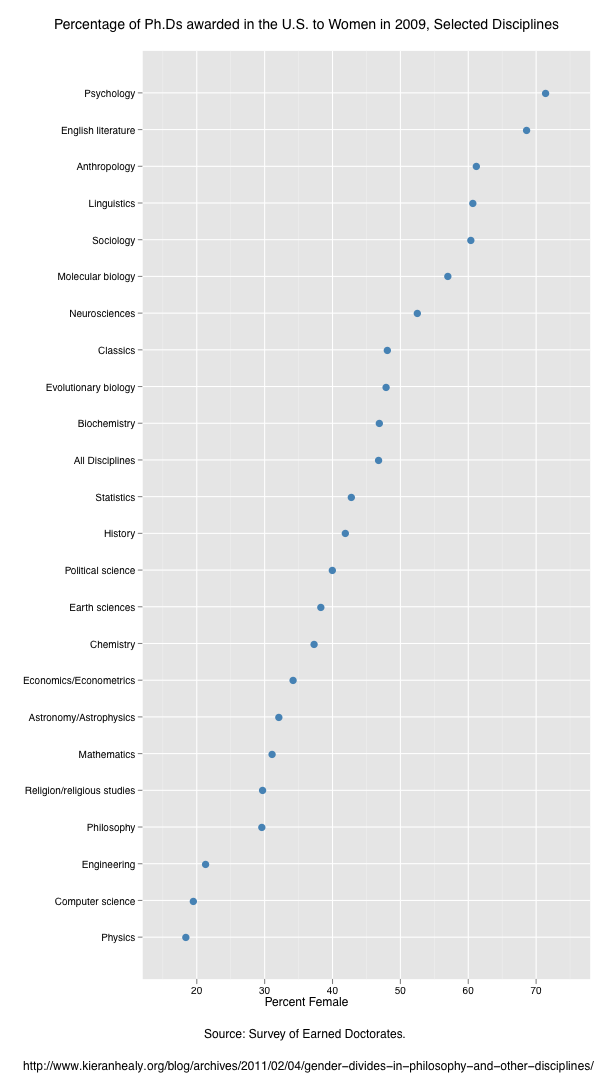
I spent the weekend at Princeton, listening to distinguished alumni talk about a number of issues, mostly about their career paths and their efforts to balance their work lives and their personal lives. In a discussion of work-life balance led by New York Times writer Lisa Belkin, class of 1982, a young woman stood up and explained that she was a graduate student in molecular science, and that she was pregnant. She said she had no idea how to manage being a graduate student in such a rigorous field with being a mother. She asked, with an unmistakable tinge of desperation in her voice, if Belkin or anyone else in the room had any advice for her. A woman at least fifteen years her senior stood up and said, “I’m a scientist and a mother of three; you can do it.”


When I saw this graph, I thought about that woman. In addition to facing the challenge of balancing a demanding career with motherhood, she also has to contend with being one of the few women in her lab or in her department.
--Chloe Angyal, "... Women in Science"


I have joined the author team over at Biblioblogs and hope to increase the number of British contributors. But the biggest call is to increase the number of women who blog on the Bible. If I can make the top 50, you can. I have only been blogging three years, the same number of years I have had puzzles about faith and the Bible to work through. I am not an academic theologian. 

You need to log your blog with Alexa which gives you exposure and tracks your hits. 

You need to let me know here that you are blogging. There will be a new feature at the top where I can store links to women's faith and bible blogs and then we can send recommendations over to Biblioblogs. 

Seminaries and theological colleges are chock-full of male lecturers, lovely as they are, bible-related scholarship is also under-represented on the female-front. We might begin by increasing women's contributions to this growing forum - please let me know what you think. It's time to 'open up the floor' .... I'm saying nothing about dinosaurs.
--Rachel Marszalek, "Biblioblogs and ...


Wow. I guess these guys' athletic prowess and the money/name they could make for the university was more important than the safety of the other students. Nobody in authority apparently thought it important to take any precautions or keep tabs on young men entering the university with criminal records. And this was supposed to be a "Christian" university!

The only thing TCU can say is that the woman's claims [that she was drugged and raped in a campus dormitory by two TCU basketball players and a member of the football team] were "blown out of proportion"? Wow.
--Kristen, speaking up again (at) "After Women's History Month"


I am so sorry to read these things. I am so sorry that young women are being taught such doctrines. My heart goes out to readers of this teaching. The Bible does not attribute strength or the ability to provide to men over women. This is not to be found in the Bible. On the contrary, in Proverbs 31 we read of the eshet chayil, which literally translated is the "mighty woman." I don't think a literal Bible translation actually exists. It is too bad.
--Suzanne McCarthy, "Women were created to imitate who?"


What are these eight little verses that control how women through 5,000 years of Jewish and Christian history are portrayed? What are these eight little verses that are used to keep women in their proper silent and submissive place in both The Hebrew Scriptures and the New Testament? Here they are:
1 Corinthians 14:33b-35....  1 Timothy 2:11-15.
If you just went “Huh?” (or even WTF?!?), don’t worry, you’re not the only one. It’s shameful for a woman to speak in church? A woman has to keep silent because of Eve? And my personal favorite: Women “will be saved through childbearing.” (This is my favorite because my husband and I have chosen not to have children. Guess I’m unsaveable.)

So, what are we in the 21st century supposed to think about this? Do Christians (particularly Christian women) have to be held in rigid gender roles based on these verses? Do women have no choice but to sit down and shut up because these eight verses are used to marginalize and negate any Scripture regarding women working, women making their own decisions, and women in authority? That’s the way these eight verses have been used through the 2,000 years of the Christian Church. But I’ve learned that just because something in the Bible has been interpreted in a certain way for millennia doesn’t that interpretation is right. Look at slavery. Over 100 years ago Christians were using passages in the Bible to justify slavery. Now no American is going to use those passages in Scripture to justify slavery today. We recognize, that even though endorsed in the Bible, slavery is wrong. It’s unethical. We’ve changed how we interpret the slavery passages in the Bible. Why can’t we change how we interpret the passages about women? ....  I’m going to show the different ways these verses can be translated.
-- Shawna R. B. Atteberry, "Women Who Didn't Shut Up ... Why"


Let Obama be "weird" and "foreign" and "womanly." And also let Paul. And let their words be accurately translated to convey the sense they intended. With regards to Paul-- it's high time.
--Kristen, still not shutting up (now on) "Weird, Womanly Words of Obama"


Modern Women, Old Testament: A Jewish-Christian Conversation with Rabbi Rachel Barenblat, author of "70 Faces: Torah Poems," and Elizabeth Adams, author and publisher. On Sunday, May 8, Christ Church Cathedral will host a book discussion with Rabbi Rachel Barenblat, author of a recently-published and highly-praised book of poems which approach the five books of Moses from a questioning, modern perspective.

As a longtime poet and writer, newly-ordained rabbi, and recent mother, Rachel's work helps us look at these texts from new and personal perspectives. How can modern women and men engage actively with these early Hebrew scriptures, while still loving and respecting the Bible and remaining faithful Christians and Jews? What does the tradition of midrash have to offer to Christians? How can poetry -- a tradition deeply embodied in the Hebrew Scriptures -  free us to think and feel creatively about the human issues the Bible addresses in these stories?

-- Rabbi Rachel Barenblat (the Velveteen Rabbi), "... tour ... "


What I've come to, after a lifetime 
of wondering, 
of working through the biblical evidence for and against, 
of reading widely on both sides of the 
whole male/female thing,
of arguing with others and with myself and even with God - what I've come to is this: 
the thing I'm called to do is,
to live the other truth.
As a trusted counselor said to me this morning,
"That is the revolutionary act."
....
And I've stood astounded,
mentally open-mouthed,
when men (and women) whom I love and respect 
say and do things that are stunningly at odds 
with what they say they believe.
Because, as I have learned to my chagrin 
and sometimes very deep personal pain,
 giving mental assent to an idea, to a doctrine, to a denominational stance ...
and living that truth in day-to-day practice are 
two very different things.
....
Anger was not going to do a thing to bring change.
 But living that change just might make a beginning.

So that's what I've tried to do - 
to live the change I hope for, I pray for, I long for.
I've been a woman in ministry for 17 years, 
serving the church in a denomination 
that has been ordaining women since 1974.
But that same church has not been proactively engaged in making that act a reality in the day-in and day-out life of the local church until fairly recent years.   
I thank God for my denomination.
I love who we are and who we are becoming.
But getting here has been tough sledding.
Real progress is being made, now on an almost daily basis.


Thursday, May 5, 2011

Weird, Womanly Words of Obama

In this post, I'd like us to consider President Obama's words as womanly and also as weird.  But can we also talk about how a translator may and "ought not" translate these words of his?

(This has implications for translation theory and practice as related to what's better for the bible.  So maybe we can get to that some too.)

First, I'm not the only one to say Barack Obama's words are womanly.  Second, I am going to call these words "weird."  Third, would you look at and listen to them with me.  Finally, let's talk translation.

First

Mr. Obama's speech tends to be rich and nuanced and different from the stereotypical speech of a man.  (The stereotypes were created by Aristotle or were reinforced by him in many cases.  Aristotle made a big big deal out of the differences between male and female speech; Anne Carson, a careful reader and wonderful translator of ancient Greek has noted many of these differences; and Nancy Mairs makes a big deal out of these differences too.)  Deborah Siegel of girlwpen.com posted how some of us have observed the stereotypically womanly characteristics of Mr. Obama's words in answering the question, "Is Obama Leading Like a Woman?"

Second

I'm calling Obama's speech womanly.  But let me also qualify much of it as "weird."  Now let me go a step further and say it's not only womanly and weird but also "foreign."  (Aristotle would have called it absolutely barbaric or barbarous or something like that.)  Please know that I'm now using the words weird and foreign in the way that two of the Better Bibles Blog bloggers are using those words this week.  I don't at all agree with their arguments yet (i.e., that the Bible doesn't have weird or foreign language and/ or that even if it did a translation of the Bible shouldn't have weird or foreign language); I'm only using the words they way they do:  "We may have to learn many more new things all at the one time when we read the Bible, but that doesn’t require weird language" and "It may be inevitable that sometimes the message sounds foreign, but there is nothing about this that suggests that the [English Bible] translation should sound foreign, generally speaking."  

What I'm saying is that Obama's language is weird and might sound foreign and that better translators of his language do even better when they translate it that way.  

Third

Want some evidence?  Okay then.  Here's some recent stuff from President Obama:
  1. his Presidential Proclamation for the National Day of Prayer (which happens to be today)
  2. his speech announcing the killing of Osama bin Ladin (which most of the world has heard now)
  3. his recent book (which is the only children's book any US president in office has ever written)
In 1. his President Proclamation, he uses interesting language at least at the beginning, in the middle, and at the end of the pronouncement.

At the beginning, President Obama hearkens to history and quotes what others before him have said, including a former president and a civil rights leader.  He identifies with both men quoted.  But to quote the civil rights leader (with whom he identifies, by race, at least in other contexts), Mr. Obama first quotes a woman:
The late Coretta Scott King recounted a particularly difficult night, during the Montgomery bus boycott, when her husband, the Reverend Dr. Martin Luther King, Jr., received a threatening phone call and prayed at the kitchen table, saying, "Lord, I have nothing left.  I have nothing left.  I have come to the point where I can't face it alone." 
Here, the President's words are rather nuanced.  He's not giving the source for his first quotation.  But when quoting the African American leader, he does.  And he goes on at length.  And his readers see how important it is to him that a woman, this particular woman, has recounted with some considerable pathos (i.e., remembering "a particularly difficult night") some danger and much desperation beyond all human limits.  If this were translated into, say, Arabic language, then wouldn't the better translator try to account for the English language nuance here, for the digressions that back up the story and put it back into the memory of a woman who is not really the central one being talked about in the first place?  Well, yes.

In the middle of his Proclamation, President Obama uses gendered language that is inclusive.  He says:
Let us pray for the men and women of our Armed Forces and the many selfless sacrifices they and their families make on behalf of our Nation.  Let us pray for the police officers, firefighters, and other first responders....
Notice the language that many say is awkward and just politically correct.  It's awkward to specify men "and women" and it's even more awkward to use two words and five syllables (i.e., "police officers") instead of more directly "policemen" and to use three syllables (i.e., "firefighters") for the clear two in "firemen," and so forth.  The translator should not bother readers with literal forms.  The dynamic-equivalence translator would be kind to let the readers know that were talking about mostly men anyway.  However, wouldn't the better translator of Chinese language do well to take the time to render the President's female-equal and woman-inclusive words as 男人女人 even though that can also simply and clearly communicate 人?  And how about his woman-inclusive words?  Wouldn't she or he (the translator into Chinese) find 消防队员 more descriptive of what the President wrote than 救火队员 , the former phrase literally meaning something like Fire-Rescue Team-Member for "firefighter" and the latter phrase meaning literally something like Warrior-of-Fire Team-Member and referring exclusively to males? Well, yes and yes.

At then end of his Presidential Proclamation, the President writes the following:
NOW, THEREFORE, I, BARACK OBAMA, President of the United States of America, do hereby proclaim May 5, 2011, as a National Day of Prayer.  I invite all citizens of our Nation, as their own faith or conscience directs them, to join me in giving thanks for the many blessings we enjoy, and I ask all people of faith to join me in asking God for guidance, mercy, and protection for our Nation.
      IN WITNESS WHEREOF, I have hereunto set my hand this twenty-ninth day of April, in the year of our Lord two thousand eleven, and of the Independence of the United States of America the two hundred and thirty-fifth.

          BARACK OBAMA
Now, that's just weird.  I'm talking about the President's words here.  If a team of linguists were to field test this among native speakers of natural American English in 2011, then they'd say, "Not my heart language."  And if some other linguist in, say, Mozambique were to try to take this into African Portuguese, then he or she would likely want to rid the language of its strange and foreign sounding high register.  Otherwise, who knows what President Obama really meant?  But the better translator into Portuguese would translate it as weird and foreign-sounding un-natural and un-contemporary Portuguese just as it's weird and foreign-sounding un-natural and un-contemporary English on May 5, 2011, right?  Well, yes.  Here's the Proclamation.

In 2. his speech announcing the killing of Osama bin Ladin, President Obama uses womanly and weird and foreign-sounding words too.  You can read the speech here at Unsettled Christianity.  You can listen to it and watch it again here at feministing.com.

First of all, he's mentioning with men, again, "women, and children."  And with "their father," also "their mother."  (Of course, I'm being a little silly to point out his gender inclusiveness, again.)  Secondly, the President is way too subjective.  He's getting way too personal.  He's used first person personal pronouns, "I" and "we" and "I" and "we" all over the place.  He's named groups "my team," and "their Pakistani counterparts"; he's identified individuals by name, insinuating how they deserve a share of the credit, "Leon Panetta," and "President Bush," and "President Zardari."  (Yes, I know.  He's taken some political partisan flack for that and has been cynically suspected of being a slimy woman-like sophist trying to garner his own political capital from the electorate and the populous and even the world audience.)  Thirdly, he says "may God bless" at least twice.  (And we all know that in natural field-tested English this shouldn't be used for common-man language but for helping someone out after they sneeze.  "God bless you."  A perfect, non-literal and dynamic equivalent to that is "Gesundheit."  What the President should have said, what he really intended is this:  "Thank you. Don't Worry; be happy. And that goes for the United States of America too."  In colloquial, natural German it's Danke. Keine Sorge, glücklich zu sein. Und das gilt für die Vereinigten Staaten von Amerika zu.)  And yet, doesn't the better German translator keep Obama's language just a marked and as weird as it is in English?  Well, yes.

In 3. his recent book, President Obama again uses womanly and weird and foreign-sounding language.

Well, we just have time to consider the title.  But if you read it all for yourself, you'll get it.  The title alone is Of Thee I Sing: A Letter to My Daughters.   Well, okay, peek in for a bit.  It's dedicated:

To Michelle -- whose fierce love and daily good sense
have nourished such wonderful daughters
--B.O.

And the book's about 13 Americans, not all of whom are men.  That's right.  Some are also African Americans, some are even African American women.  The audacity.  Is this weird hope again?

Now, I said we only have time for the title.  So let's get back to it.  "Of Thee I Sing"?  Doesn't the President know how antiquated this phrase is?  Doesn't the President care how ambiguous this phrase is?  How will the readers know what he means?  Who can tell us what he surely must intend singularly intend as writer?  Well, the translator can.

The translator won't confuse us with the fact of the deep cultural significances of this phrase for African Americans closer to the onset of the Civil War and beyond.  No, surely Obama is being more American than that.

The translator won't bother us (unless in an endnote) with the fact that this particular phrase has had earlier and more enduring historical significance for women in America working for their rights.  So let's just take time to read a page real quickly from that history (from Sweet Freedom's Song: "My Country 'Tis of Thee" and Democracy in America) -


Those women's rights songs riffed off of "Of Thee I Sing":

Let your joy be unconfined. 
Let it speak so clearly that its echo will be 
heard around the world.
[Let] it find its way into the soul of every woman

who is longing for the opportunity and liberty still denied her.
Let your voices ring out the gladness in your hearts! . . .
Let us sing, together, 

"My Country, 'Tis of Thee . . .
Sweet Land of Liberty,
Of Thee I Sing.


Thee means what?  That weird womanly foreign-sounding language is written to whom?  To two young people, English readers.  Both black.  Both female.  Both growing up in America when it's still 2011.  The audacity.

The other day, I read that there's a Korean translator who's translated this book into Korean for Korean readers.  Although I haven't seen it yet, I wonder if she or he has kept in the womanliness, the weirdness, and the foreign-sounding tone of President Obama's words.  Would that be a better thing than not to do?  Well, yes.


Finally

let's talk translation.  how do you think a translator may (and "ought not") translate these words of Barack Obama, these weird, womanly words of his?

Monday, May 2, 2011

Enemy Death

After President Obama announced that Osama bin Laden was dead, I was glad to see that Rod of Alexandria and Joel Watts directed us to the words of certain Jews:

one young rabbi said:
43 ‘You have heard that it was said, “You shall love your neighbour and hate your enemy.” 44 But I say to you, Love your enemies and pray for those who persecute you, 45 so that you may be children of your Father in heaven; for he makes his sun rise on the evil and on the good, and sends rain on the righteous and on the unrighteous. 46 For if you love those who love you, what reward do you have? Do not even the [imperial] tax-collectors do the same?
and one wise king had already said:
17 Do not rejoice when your enemies fall,
and do not let your heart be glad when they stumble
And in quoting Matthew 5:43-46 and then Proverbs 24:17, Joel and Rod might have also quoted many, many others (i.e., 2 Samuel 3:32, Job 31:29, Psalm 35:15, Psalm 35:19, Proverbs 17:5, Proverbs 24:18, Obadiah 1:12, Micah 7:8). 

The history of the Jews is replete with enemies and responses.  In September of last year, Rachel Barenblat was re-learning and teaching the history and posted on "The early history of Jews in Muslim lands"; in October she noted "Jews in medieval Christendom" and a few of their "dreadful enemies" back then and over there.  And, on the day when much of the the world watched the wedding of a future king perhaps and his bride, the history of the marriage of enemy Adolf Hitler to his bride was overshadowed for a moment; and who then celebrated the next day remembering that racist, sexist, evil enemy's death?  I'm sure there were some but we were quieter, weren't we?

I think a lot about enemies, and about this very Jewish concept of loving enemies, or of praying for them, or at least of forgiving them at some point.  How does that happen?  I have enemies.  Hitler, Osama bin Laden, and some who are still very much alive.  The goal for me is not to get rid of enemies.  I just can't do it, often for very real and practical reasons.  "Vengence is mine" is one of those scriptures quoted around me when I was little, and often it seemed very sour-grapes and was mostly helpful because it helps you imagine God as your hit man. 

But I think that there's more to it than just hanging around waiting for the one and only God (who happens to be on my side) to take out my enemy, to kill him.

There is much to learn from the abused and from the oppressed here that echoes the real Jewish sentiments of enemy love.

And reading Anne Lamott, when President George W. Bush was in office taking out all of our enemies, I used to laugh at how she'd work out forgiveness of him, because God commanded her to do so, because this was a scriptural thing to do. She learned not to grit her teeth and not to drink the poison of resentments.

And reading bell hooks, I learn about "definition."  How Aristotle, the enemy of females, taught definition was to avoid ambiguities, to define precisely, to "objectively" put your enemies into little and much lower boxes so as to keep yourself free and above and alive; I think I blogged at least once about his strategy.  But hooks has a better way of defining.  Here's one of her definitions that includes the word enemy, and that acknowledges with some force who that must be:
Simply put, feminism is a movement to end sexism, sexist exploitation, and oppression. This was a definition of feminism I offered in Feminist Theory: From Margin to Center more than 10 years ago [in 1985]. It was my hope that at that time that it would become a common definition everyone would use. I liked this definition because it did not imply that men were the enemy. By naming sexism as the problem it went directly to the heart of the matter. Practically, it is a definition which implies that all sexist thinking and action is the problem, whether those who perpetuate it are female or male, child or adult. It is also broad enough to include an understanding of systemic institutionalized sexism. As a definition it is open-ended. To understand feminism it implies one has to necessarily understand sexism.
("Feminist Politics: Where We Stand," Feminism is For Everyone: Passionate Politics, page 1)
Notice her phrases "my hope" and "broad enough" and "to include" and "open-ended" and the repeated, "to understand."   This is key to loving one's enemy, to real understanding, I believe.  Notice who this woman's enemy is, although she suffered much because of men:  "[one does not need to] imply that men were the enemy."  This in not mere rhetoric.

This is a way of opening up the possibilities.  It's akin to what Sappho does, to what Anne Carson helping us read and translate Sappho does (from her book, Eros: the Bittersweet).  It speaks to love, to hate, to how we divide unto death, or pray and forgive.  Yes, it's that Jewish idea, but here's from a Greek, from an English poet's perspectives that might help:
It was Sappho who first called eros "bittersweet." No one who has been in love disputes her. What does the word mean?....  Here is contradiction and perhaps paradox. To perceive this eros can split the mind in two. Why? The components of the contradiction may seem, at first glance, obvious. We take for granted, as did Sappho, the sweetness of erotic desire; its pleasurability smiles out at us. But the bitterness is less obvious. There might be several reasons why what is sweet should also be bitter. There may be various relations between the two savors.  Poets have sorted the matter out in different ways. Sappho's own formulation is a good place to begin tracing the possibilities. The relevant fragment runs:
ρος δατ μ λυσιμλες δνει,
γλυκπικρον μχανον ρπετον
Eros once again limb-loosener whirls me
sweetbitter, impossible to fight off, creature stealing up
_____________________________(LP, fr. 130)
It is hard to translate. "Sweetbitter" sounds wrong, and yet our standard English rendering "bittersweet" inverts the actual terms of Sappho's compound glukupikron. Should that concern us? If her ordering has a descriptive intention, eros is here being said to bring sweetness, then bitterness in sequence: she is sorting the possibilities chronologically....  But it is unlikely that this is what Sappho means....  Love and hate bifurcate Eros....  Paradox is what takes shape on the sensitized plate of the poem, a negative image from which positive pictures can be created. Whether apprehended as a dilemma of sensation, action or value, eros prints as the same contradictory fact: love and hate converge within erotic desire.
____Why?
Notice how Anne notices how "Love and hate bifurcate Eros" but also how "love and hate converge within erotic desire."  This isn't mere rhetoric.  This isn't just poetry.  This isn't at all how an extremist like Osama bin Laden or Adolf Hitler or an elitist like Aristotle would do things.  Yes, I know they're all men.  But who is implying the nature of the enemy?  My enemies?  Love our enemies?  Pray for those who hate us?  What kind of contradictory poetry or rhetoric or Bible teaching is that?

My wife and I once attended a conference on Love and on loving enemies; it was led by a counseling psychologist whose area of research was sexual abuse, on dealing with the trauma afterwards, on confronting the abusers.  His best friend, he said, was a scholar on the Hebrew Bible.  They advised, he told us, to define our enemies, "but to use a pencil with an eraser."  He then gave several categories for abusers of others so as to begin to have strategies and boundaries for moving forward with them in life.  "But," he reminded, "as you define the people in your life, write with that pencil and be ready to use the eraser to make changes."  I like that.  It seems Jewish in some ways, Bible-like in some ways, feminist in some ways, poetic and Sappho-like and literary-with-real-life in some ways.  As I think about what Joel and Rod posted as they thought about the death of Osama bin Lin, killed by the United States of America as announced by its president, it's useful.  I have living enemies today.  And if I pray for my enemies, then how does that change them and me?  It does.  Rather than causing enemy death, it tends to make me question why they are my enemy, death deserving.  These sorts of words, then, and practices, are helpful.

Sunday, April 17, 2011

residue

I was trained to strive for exactness and to believe that rigorous knowledge of the world without any residue is possible for us.
--Anne Carson, poet, translator, woman

The men of the Better Bibles Blog are in a long conversation with John Hobbins, and now Joel Hoffman has entered.  This is going on in comments of the BBB post by David Ker on his blog-book on how to read the Bible:  “Christianly,” he says.  And so, these men are arguing over which Christian-male-committee-produced translations is better than the others.  The fellas have agreed on using the binary:  "First Covenant first" vs. "Old Testament plus Christianity"; "Exegetical" vs. "Communicative"; "literal" vs. "functional"; and so forth and so on.  They've even made up categorical boxes in which to classify the Bible translations and by which to draw their best conclusions.  In some cases, they are linking to other posts with other categorical boxes.  In many cases, they're linking and now cross-posting some a few blogposts from their own blogs.  So they're of the same culture.  They are agreeing on the sort of language and logic to use.  But however and nevertheless, they are in divided disagreements about their conclusions of exactness.  Sharply.  And this is important.  Anyway, it's a long discussion, as I mentioned. 

And we might note that there's residue.  In the talk of these men, there's some residual silence.  In their strife for exactness, for knowledge of the world of the English Bible, there's rigor but there's silence, residue.  How silent?  What residue?

Well, John has invoked Wayne Leman, who does eventually show up and speak up with some precision.  But so far nobody's invited the "late" BBB contributor Suzanne McCarthy.  No woman yet at all has either been invited to the table nor has seen fit herself to join (although John uses marked language to try to startle David, as if his only readers for his book, his collection of blogposts for his book, are women:  "What I like best about this collection is the fluster and bluster of your style; it moves the reader and forces her to take sides").  And it's pretty public knowledge now that Suzanne has left BBB for her own reasons and that she's perpetually monitored and censored over at John's blog.  So there's the silence of women in this long, binarying BBB discussion about David's blog-book, a sharp discussion about the Bible, an exacting arguing conversation of men. 

But there's methodological silence and methodological residue too. 

The little quotation of Anne Carson, the epigraph to start this post of mine, gets to this.  We could've, instead of Anne, quoted Suzanne.  My favorite BBB post by Suzanne was the one in which she said: 
"The psalms are uniquely suited for the study of commentary through the centuries, for seeing how diversely and personally the Hebrew has been translated by one generation after another, for simply surrendering the rational mind to an acceptance of ambiguity in the original text....  I regret that there is no recent Bible version which reflects this pattern of multiple meaning in the way the KJV does. Leland Ryken makes a good point with respect to ambiguity and literary quality. However, I am slowly coming to the realization that the Christian scriptures are not represented in any modern translation in a manner which does justice to the literary style, the ambiguities and multiple meanings of the original. Have we 'lost our humility' vis-á-vis the text?"   
And instead of Anne and Suzanne, we might have quoted Catherine Z. Elgin, who provides alternatives in philosophy, in epistemology -- alternatives to the long male-dominant tradition; alternatives such as put forward in her book, Between the Absolute and the Arbitrary, as if there's only either the absolute vs. the arbitrary.  And, instead of Anne and and Suzanne and Catherine, we could have quoted Nancy Mairs.  Nancy would quote Julia Kristeva, discussing how her language was not merely binary but was talk, "Possessing an 'irreducible identity, without equal in the opposite sex and, as such, exploded, plural, fluid,' [by which] a woman [talking or writing] may be driven 'to break the [binary] code, to shatter [male pre-dominant] language, to find a specific discourse closer to the body and the emotions, to the unnamable repressed by the social contract.'" 

Perhaps I'm just being arbitrary today.  I just chose Anne.  So can we listen to her a little more, a little more closely?  Here's from her talk on "The Question of Translation", her conclusion:
One of Francis Bacon's favorite paintings is a self-portrait by Rembrandt. He mentions it in several interviews. What he says he likes about this portrait is that when you go close to it you notice the eyes have no sockets. Let us place this explanation alongside a sentence of Hölderlin's that haunts me and I can't say quite why. On the right-hand margin of a page on which he had already drafted a poem, Hölderlin at a later date began to write an essay. It contains this strange remark:

Öfters hab'ich die Sprache, öfters hab'ich Gesang versucht, aber sie hörten dich nicht.

Often enough I tried language, often enough I tried song, but they didn't hear you.
Something about the way the pronouns in this sentence come face to face with themselves reminds me of Rembrandt's eyes. Those socketless eyes are certainly not blind. They are engaged in a forceful looking, but it is not a look organized in the normal way. Seeing is going on but (is it possible that) seeing is entering Rembrandt's eyes from the back. What his look sends forward, in our direction, is deep silence. Perhaps rather like the silence that followed Joan of Arc's response to her judges when they asked her, "In what language do your voices speak to you?" and she answered: "Better language than yours."


I was trained to strive for exactness and to believe that rigorous knowledge of the world without any residue is possible for us.

This residue, which does not exist—just to think of it refreshes me. To think of its position, how it shares its position with drenched layers of nothing, to think of its motion, how it can never stop moving because I am in motion with it, to think of its tone of voice, which is casual (in fact it forgets my existence almost immediately) but every so often betrays a sort of raw pity I don't understand, to think of its shadow, which is cast by nothing and so has no death in it (or very little)—to think of these things is like a crack of light showing under the door of a room where I've been locked for years.
Notice how Anne Carson here quotes men, but particularly the man Francis Bacon.  Now, I know there are at least two Francis Bacons, and Anne is talking about the painter, about someone who cares about representation.  And from there, as we see, she makes analogies to something she cares about:  translation.  It's silence in translation, silence in the language being translated from and being translated to that is what Anne cares about here. 

And this makes us think of Kenneth Pike, Evelyn Pike, and Eunice Pike, and their forgotten care about the n-Dimensionality of language (pre translation and post translation and in translation).  I'm nearly out of time, but let me say these things quickly.
  • Kenneth Pike was once a leading theorist in Bible translation among the organization that most of the BBB boys are somehow a part of.
  • Ken was one of my professors as I was getting a degree in linguistics, the linguist who influenced my work in another degree of mine in rhetoric.
  • Ken, for Suzanne too, is one who has "had the most immediate and lasting influence on how [she] read[s] the Bible."
  • Ken is no longer an influence in the aforementioned organization.
  • Ken's view of language, as n-dimensional, is very like Anne's, Joan's, Suzanne's, Catherine's, Nancy's and Julia's.
Kenneth Pike in “Why Poetry?” in his book Stir-Change-Create says something similar to what they've said:
“Simultaneity, not sheer linearity, may be the goal. By all these devices [i.e., "crucial words with multiple meanings, lexical devices, grammatical balance"] multiple experience is elicited, to be relived by the reader. Since life itself is n-dimensional, some [language]–for some people–seems astonishingly closer to life than [other language] can be. Just as the child is not the scholar, but surpasses him in learning to speak the multiple dimensions of a new language, so [some language] can mirror the n-dimensions of experience in a compact packet…. Except we become as little children, we can neither learn a new language without a bad accent, nor become charter citizens of heaven–nor experience that multiple fullness of the n-dimensional experience, which poetry tries to help us capture. Poetry compacts life in language–as an oak forces all its eternal blueprints into one nutshell.” (page 108).
That's language.  But, with respect to translation, by and large, the work that Ken developed and was so a part of has now sadly been abandoned his teachings.  Even in translation, Ken recognized the N-Dimensionality of language. Where N = Infinity.  Ken, when discussing “substantial ambiguity (or range of meaning)” in language, notes that “[m]ultiple alternative translations are possible from one language to another, with different emphases.” Accuracy, he seems to suggest, “is not dependent upon the exact degree of precision obtained if the generalizations are acceptable (Pike 1961:3f) [... i.e., general] coherence with background pattern expressed, implicit or intended….” (Talk, Thought, and Thing pages 11-13).

This borders, as binary linguists fear, on absolute relativism and sounds an awful lot like postmodernism with its deconstructivism.  However, as much as Ken had his own struggles with deconstructivists, he wasn’t worried and never reduced his theory of language (aka, Tagmemics - i.e., language in relation to a unified theory of human behavior) to the binary.

Ken approached language the way Einstein approached physics: particle and/or wave and/or field. More than that, he approached translation the way Heisenburg approached physics: “person above logic” and “the observer not only changes the observed data but is also change by the observing.” I remember Ken Pike telling the story of when he was a student; he heard his teacher saying, “Language ideally has one and only one meaning per word.” The young pupil replied, “But, sir, how would we learn language.” Ken understood that the multiple perspectives on language (or “talked about reality”) led to learning and to change. His most famous rhetoric and composition textbook was entitled, Rhetoric: Discovery and Change. Pike would love to quote Nelson Goodman, saying “What we need is ‘Radical relativism within rigid restraints.” Notice how Catherine Elgin, like Ken Pike, learned so very much from Nelson!  (To be sure, however, some of Ken’s most serious followers would focus all too often on those rigid restraints. They would chart everything into tagmemic boxes.  The would employ the either/ or binary.  Looks like that's still going on.  Alas.)

To those who don't know Ken's work, probably the place to start for some good Pike in good context is his Linguistic Concepts: An Introduction to Tagmemics. An initial one-sentence paragraph starts much: “In this volume person (and relation between persons) is given theoretical priority above formalism, above pure mathematics, above idealized abstractions” (page xi). One reason language is viewed as N-dimensional is because of the personal. Ken, just a few lines later, gives one of his nods to Heisenberg saying, “A particular language, of a particular culture, in relation to a particular person with [her or] his particular history constitutes an implicit theory for that person . . . . [T]he observer [whether a cultural insider or an outsider] universally affects the data and becomes part of the data.” Ken goes on to discuss the various (traditional) linguistic vectors of language that humans do and can choose to observe from any number of perspectives.

One of Ken Pike’s first published uses of “n-dimensional” in reference to language is Stir, Change, Create, a 1967 book for missionary linguists, for himself perhaps, with rather wordplayful writings and musings. We've already read a quote from it above.  Does knowing it was for fellow missionaries make you like that quote more, or less?  Ken in this book baldly confesses what he much later was very quiet about (in research, publication, and teaching anyways):
“The greatest proportion of my time is devoted to scholarship. I am a Christian. I am devoted to Christ, risen from the dead, my Lord. Is it strange to hybridize these two roles of mine?”
If you know the historical context, then you know he was the first in his organization to achieve the Ph.D. and was an avid promoter of academics as a means to enrich theoretical-practical linguistics.  Like Anne, he loved poetry, saying:  “poetic writing can be called anti-redundant because of its n-dimensionality.”

Ken's audience for such statements was the not-yet-academic (remember, he was the first to get the Ph.D. among his fellow Bible translators); and yet, academic linguist Deborah Tannen quotes from Ken's book for laymen in her wonderfully edited volume, Linguistics in Context : Connecting Observation and Understanding : Lectures from the 1985 LSA/TESOL and NEH Institutes. One of Pike’s later works to include discussions of the n-dimensionality of language is his 1993 Talk, Thought, and Thing: the Emic Road Toward Conscious Knowledge; but he published an essay that year which explicitly references the notion: “Matrix formatives in N-dimensional linguistics” which built on earlier co-researched, co-written 1980 article, “Constraints on complexity seen via fused vectors of an n-dimensional semantic space (Sarangani Manobo, Philippines)”.  I'm bringing all of this up because, once upon a time, men were more willing to consider talking outside the box when it came to language, to translation, to Bible translation, and even to Christian Bible translation.

It's the residue and the silence that Anne is willing to speak of that I'm interested in. 

Thursday, April 22, 2010

A Speech on Earth Day, from Aspasia

While it's still Earth Day, maybe you'll be interested in reading what Aspasia said. 

Here is some of what Aspasia said in a speech she wrote.  It's translated by Walter R. M. Lamb in 1925 AD, after it's translated by Benjamin Jowett in 1914 AD, after it's written by Plato in 386 BC, as if Socrates is reading it after Aspasia wrote it some time earlier.  It's in Plato's dialogue Menexenus, which ends with a dispute over whether a woman could really speak so eloquently (or could compose a speech so eloquent).  Much of the point I'm making here is that you have to wade through a lot of stuff men say to hear her.  And none of them gets her earthy mother wordplay (which is highlighted for us below), which I do think the first bible translators of the first book of the bible do get very very well.

(Lamb's version:)

Socrates
There, Menexenus, you have the oration of Aspasia,

Menexenus
And by Zeus, Socrates, Aspasia, by your account, deserves to be congratulated if she is really capable of composing a speech like that, woman though she is.

Socrates
Nay, then, if you are incredulous, come along with me and listen to a speech from her own lips.

Menexenus
I have met with Aspasia many a time, Socrates, and I know well what she is like.

Socrates
Well, then, don't you admire her, and are you not grateful to her now for her oration?

Menexenus
Yes, I am exceedingly grateful, Socrates, for the oration to her or to him—whoever it was that repeated it to you; and what is more, I owe many other debts of gratitude to him that repeated it.

Socrates
That will be fine! Only be careful not to give me away, so that I may report to you later on many other fine political speeches of hers.

Menexenus
Have no fear: I won't give you away; only do you report them.

Socrates
Well, it shall be done.

(Jowett's version:)

SOCRATES: You have heard, Menexenus, the oration of Aspasia the Milesian.

MENEXENUS: Truly, Socrates, I marvel that Aspasia, who is only a woman, should be able to compose such a speech; she must be a rare one.

SOCRATES: Well, if you are incredulous, you may come with me and hear her.

MENEXENUS: I have often met Aspasia, Socrates, and know what she is like.

SOCRATES: Well, and do you not admire her, and are you not grateful for her speech?

MENEXENUS: Yes, Socrates, I am very grateful to her or to him who told you, and still more to you who have told me.

SOCRATES: Very good. But you must take care not to tell of me, and then at some future time I will repeat to you many other excellent political speeches of hers.

MENEXENUS: Fear not, only let me hear them, and I will keep the secret.

SOCRATES: Then I will keep my promise.


(Lamb's version of a bit of Aspasia's speech:)

For every creature that brings forth possesses a suitable supply of nourishment for its offspring; and by this test it is manifest also whether a woman be truly a mother or no, if she possesses no founts of nourishment for her child. Now our land, which is also our mother, furnishes to the full this proof of her having brought forth men; for, of all the lands that then existed, she was the first and the only one to produce human nourishment, namely the grain of wheat and barley, whereby the race of mankind is most richly and well nourished, inasmuch as she herself was the true mother of this creature. And proofs such as this one ought to accept more readily on behalf of a country than on behalf of a woman; for it is not the country that imitates the woman in the matter of conception and birth, but the woman the country. But this her produce of grain she did not begrudge to the rest of men, but dispensed it to them also. And after it she brought to birth for her children the olive, sore labor's balm. And when she had nurtured and reared them up to man's estate, she introduced gods to be their governors and tutors; the names of whom it behoves us to pass over in this discourse, since we know them; and they set in order our mode of life, not only in respect of daily business, by instructing us before all others in the arts, but also in respect of the guardianship of our country, by teaching us how to acquire and handle arms.

(Jowett's version of that same bit of Aspasia's speech:)

For as a woman proves her motherhood by giving milk to her young ones (and she who has no fountain of milk is not a mother), so did this our land prove that she was the mother of men, for in those days she alone and first of all brought forth wheat and barley for human food, which is the best and noblest sustenance for man, whom she regarded as her true offspring. And these are truer proofs of motherhood in a country than in a woman, for the woman in her conception and generation is but the imitation of the earth, and not the earth of the woman. And of the fruit of the earth she gave a plenteous supply, not only to her own, but to others also; and afterwards she made the olive to spring up to be a boon to her children, and to help them in their toils. And when she had herself nursed them and brought them up to
manhood, she gave them Gods to be their rulers and teachers, whose names are well known, and need not now be repeated. They are the Gods who first ordered our lives, and instructed us in the arts for the supply of our daily needs, and taught us the acquisition and use of arms for the defence of the country.

(Plato's version of what Socrates read, the wordplayful bit of earthy Aspasia's speech:)

πᾶν γὰρ τὸ τεκὸν τροφὴν ἔχει ἐπιτηδείαν ᾧ ἂν τέκῃ, ᾧ καὶ γυνὴ δήλη τεκοῦσά τε ἀληθῶς καὶ μή, ἀλλ’ ὑποβαλλομένη, ἐὰν μὴ ἔχῃ πηγὰς τροφῆς τῷ γεννωμένῳ. ὃ δὴ καὶ ἡ ἡμετέρα γῆ τε καὶ μήτηρ ἱκανὸν τεκμήριον παρέχεται ὡς ἀνθρώπους γεννησαμένη· μόνη γὰρ ἐν τῷ τότε καὶ πρώτη τροφὴν ἀνθρωπείαν ἤνεγκεν τὸν τῶν πυρῶν καὶ κριθῶν καρπόν, ᾧ κάλλιστα καὶ ἄριστα τρέφεται τὸ ἀνθρώπειον γένος, ὡς τῷ ὄντι τοῦτο τὸ ζῷον αὐτὴ γεννησαμένη. μᾶλλον δὲ ὑπὲρ γῆςγυναικὸς προσήκει δέχεσθαι τοιαῦτα τεκμήρια· οὐ γὰρ γῆ γυναῖκα μεμίμηται κυήσει καὶ γεννήσει, ἀλλὰ γυνγῆν. τούτου δὲ τοῦ καρποῦ οὐκ ἐφθόνησεν, ἀλλ’ ἔνειμεν καὶ τοῖς ἄλλοις.  μετὰ δὲ τοῦτο ἐλαίου γένεσιν, πόνων ἀρωγήν, ἀνῆκεν τοῖς ἐκγόνοις· θρεψαμένη δὲ καὶ αὐξήσασα πρὸς ἥβην ἄρχοντας καὶ διδασκάλους αὐτῶν θεοὺς ἐπηγάγετο· ὧν τὰ μὲν ὀνόματα πρέπει ἐν τῷ τοιῷδε ἐᾶν—ἴσμεν γάρ—οἳ τὸν βίον ἡμῶν κατεσκεύασαν πρός τε τὴν καθ’ ἡμέραν δίαιταν, τέχνας πρώτους παιδευσάμενοι, καὶ πρὸς τὴν ὑπὲρ τῆς χώρας φυλακὴν ὅπλων κτῆσίν τε καὶ χρῆσιν διδαξάμενοι.

Saturday, April 10, 2010

Women Writer Bans, but where you can still go to read them

"I’m happy to unblock you for the occasion. I would only ask that you keep to the subject."
--a prominent biblioblogger consistently in the Top 50 (do I have to tell you he's a man?), addressing a woman publicly

"The difficulty is that ANY conversation can end up including gender issues. For example, if a man expresses disbelief in a woman having read the Illiad, that might trigger me to respond that I have read it in Greek, and that this notion that some men have of women not being truly literate, is a block to full fellowship between men and women....  The last time you blocked me for “vitriol” I emailed the young man that I was in conversation with – you often tend to block me mid-thread and do not indicate to the other participants on the blog that I cannot answer them.  He said that he was unaware of anything that I had said that caused me to be blocked or called names, and expressed his regrets, and we continued our conversation by email. But usually I am not able to do that, not knowing the email. Since I am unaware of teh exact boundaries that will trigger you to block me mid-thread, I would still prefer for conversations here not to be tracked over to your blog."
--that woman blogger, and a couple of her banned comments at Better Bibles Blog

I think it was the day after my Ph.D. graduation that my post entitled "Miss Piss Tiss" got overwhelmed with comments.  When I decided to retire from blogging not long afterward, I agreed to delete some of the thread because of some of the public and disparaging comments of one male blogger about one female blogger, who is rightly concerned with bans of women from various domains of public discourse.  It was her request.  I still find - through RSS feeds - comments made and later deleted from public view.  And I'm always committed to showing such comments here at this blog, as and when the commenters want them shown; likewise, I'm always happy to hide the record at the request of those most injured.  This has happened more than once.

Now, on a happier note, there are many places where we readers - women and men - can still read women writers freely.

Judy Redman, bible scholar and blogger and woman, for example, has posted where she and others are being published: 


Suzanne McCarthy, linguist and teacher, has posted where "women are blogging about what life was like under patriarchy":
  

April D. DeConick, Professor of Biblical Studies, Director of Graduate Studies in Religion, and author, has published a very active "Women and Religion Blog Roll."  Reproduced here are the bloggers' blogsite titles, and the titles of their most recent blogposts: