Showing posts with label (women's) voices. Show all posts

Wednesday, September 28, 2011

sexist Roman slogan (and what Paul may do with it)

Kay Bonikowsky has a post up in which she suggests that "Paul was quoting a slogan" when writing in Greek to men and women in Korinth, Greece.  Translator Ann Nyland, likewise, says the following, right in the middle of her translation of what we call Chapter 14 of Paul's letter; Nyland says: "Paul now quotes from the letter sent to him by the Corinthian assembly."

The Corinthian men had quoted the Law of the Roman empire at Paul.  So how did that go?  Well, in a bit, I'll show you.  First, I want to let Cheryl Glenn remind us about that Roman law:
A particular point of Roman male pride seems to have been the deliberate exclusion of women from civil and public duties; and in the first centuries of its history, Roman law reflected rigid legal inequalities between males and females.  Cicero reportedly contemplated with utter dismay a society which "included women in assemblies" and which allowed women "soldiery and magistracies and commands."  "How great will be the misfortune of that city, in which women will assume the public duties of men" (Lactantius, Epitomes 33.[38.]1-5, ascribed to De re publica 4-5, qtd. in Hallett, Fathers 8)....  Over centuries, Roman law constructed and guaranteed the sexual distinction -- and division -- between males and females.  The differential between the legal status of women and that of men was justified by the natural inferiority of women:  their congenital weakness, limited intellectual faculties, and ignorance of law....  Roman women were perpetually restrained by law. [ Rhetoric Retold: Regendering the Tradition from Antiquity Through the Renaissance, pages 61-62, emphases mine: the red font the Roman exclusions, the blue the more liberal inclusions elsewhere.]
Glenn goes on from her research to discuss at great length the effects of the Law.  The legal constraints applied to women more severely under Roman rule even more than they had under the old laws and customs of the Greek empire.  The oppressive Law worked to silence women in Rome, in Athens, in Jerusalem and in Korinth:
Like the Greek matron, then, the Roman woman was oppressively busy managing her household and family [i.e., the Roman Domum as the counterpart of the Greek οἰκοδομή -- the OIKO-DOMĒ -- the domain of the home].... Because the Romans clung to the ideal of the domina, of the strong privatized woman, they [i.e., the Roman men] often reacted with perplexity or disgust at the women who pursued intellectual or political aspirations. Unlike the very few Greek women who found acceptance and admiration in the public domain, no Roman woman seems to have succeeded in establishing herself as a public figure in her own right....  The Greeks and Romans [i.e., the men] regarded most women as ciphers, whose worth varied according to the property and family connections accompanying them.  Women were to be traded among men.  And historians -- from the first -- have had little more to say about these women, who were always, particularly in their exceptions, defined by the private, feminine sphere.  The women in my study who passed into the public sphere, even if only temporarily, found themselves vulnerable to assaults on their families, their honor, their sexuality, their "feminine" influence.  These women endured the closest of inspections and critiques by males and females alike, usually being disarmed of their influence and respect in the process.  [ Rhetoric Retold, pages 63, 72-73, emphases mine: the red font the Roman exclusions, the blue the more liberal inclusions elsewhere.]
Okay, so what was the slogan, the Roman law, that the men of Korinth wrote to Paul?  And how did he reply?  Let's look, first at their Greek, then at our English.  (What my translation attempts is to show Paul's play with "feminine" words, with HOME-DOMAIN and with SILENCE and with ALL-inclusion in the ASSEMBLY and with the creative, maternal words of BIRTH.)  Here, hear:

Τί οὖν ἐστίν, ἀδελφοί;
Ὅταν συνέρχησθε ἕκαστος
ψαλμὸν ἔχει,
διδαχὴν ἔχει,
ἀποκάλυψιν ἔχει,
γλῶσσαν ἔχει,
ἑρμηνείαν ἔχει.
Πάντα πρὸς οἰκοδομὴν γινέσθω.

Εἴτε γλώσσῃ τις λαλεῖ,
κατὰ δύο ἢ τὸ πλεῖστον τρεῖς,
καὶ ἀνὰ μέρος,
καὶ εἷς διερμηνευέτω·
ἐὰν δὲ μὴ ᾖ διερμηνευτής,
σιγάτω ἐν ἐκκλησίᾳ·
ἑαυτῷ δὲ λαλείτω καὶ τῷ θεῷ.

Προφῆται δὲ δύο ἢ τρεῖς λαλείτωσαν,
καὶ οἱ ἄλλοι διακρινέτωσαν.
Ἐὰν δὲ ἄλλῳ ἀποκαλυφθῇ καθημένῳ,
ὁ πρῶτος σιγάτω.

Δύνασθε γὰρ καθ’ 
ἕνα πάντες προφητεύειν,
ἵνα πάντες μανθάνωσιν,
καὶ πάντες παρακαλῶνται·
καὶ πνεύματα προφητῶν
προφήταις ὑποτάσσεται.
Οὐ γάρ ἐστιν ἀκαταστασίας ὁ θεός,
ἀλλὰ εἰρήνης,
ὡς ἐν πάσαις ταῖς ἐκκλησίαις τῶν ἁγίων.
Αἱ γυναῖκες ὑμῶν ἐν ταῖς ἐκκλησίαις σιγάτωσαν·
οὐ γὰρ ἐπιτρέπεται αὐταῖς λαλεῖν,
ἀλλὰ ὑποτασσέσθωσαν,
καθὼς καὶ ὁ νόμος λέγει.
Εἰ δέ τι μαθεῖν θέλουσιν,
ἐν οἴκῳ τοὺς ἰδίους ἄνδρας ἐπερωτάτωσαν·
αἰσχρὸν γάρ ἐστιν γυναικὶ λαλεῖν ἐν ἐκκλησίᾳ.

ἀφ’ ὑμῶν ὁ λόγος τοῦ θεοῦ ἐξῆλθεν;

εἰς ὑμᾶς μόνους κατήντησεν;

Εἴ τις δοκεῖ προφήτης εἶναι ἢ πνευματικός,
ἐπιγινωσκέτω ἃ γράφω ὑμῖν,
ὅτι κυρίου ἐστὶν ἐντολή
Εἰ δέ τις ἀγνοεῖ, ἀγνοεῖται.
Ὥστε, ἀδελφοί μου, ζηλοῦτε τὸ προφητεύειν,
καὶ τὸ λαλεῖν μὴ κωλύετε γλώσσαις·
πάντα δὲ εὐσχημόνως
καὶ κατὰ τάξιν γινέσθω.

In English, that goes something like this:

What is it, then, brothers?
When you meet together, each one may
have a Psalm,
have an Instruction,
have a Revelation,
have a Tongue,
have a Translation.
All gives birth to the Domain of the Home:

Whether it's a Tongue that is uttered,
by two or at the most three,
both a Top Part,
and through to a Translation.

Should there, however, not be the Translation, then: 
Silence in the Assembly!
To oneself, nonetheless, is an Utterance, and to God.

Prophesy, nonetheless, by two or three Utterances,
And the others through to a Judgement. 

Should there come, in fact, some Revelation to another seated, then:
For the first one, Silence!

You all, in fact, are quite able:
One and all may Prophesy
So that all may be Apprenticed
And all may be Called to Encouragement.
And may the Spirit of a Prophecy
Be given Order Under Prophets.
There's not, in fact, a God of Disruption,
but rather of Peace,
which is in all, in the Assembly, of the Holy ones. 
Your women, in the Assembly, are to be Silent! 
Give, in fact, to them no Turn to Utter anything there,
but rather give them their Order Under. 
just as the Law also states
If, however, some wish to be Apprenticed,
Then it's in the Home where their own men are that these may Question.
It is shameful, in fact, for women to Utter anything in the Assembly.
What?!
Is that from you all, The Statement of God springing out like your baby?
What?!
Is this your special delivery?

If someone opines that they have so Prophesied, or are so Spiritual,
then let him understand what I have written to you all:
our Master is giving Commandments.
If, nonetheless, someone is without understanding, then he lacks understanding. 
Therefore, my brothers, yearn to Prophesy,
and to Utter (don't forbid it) a Tongue.
All, nonetheless, with Blessed Form
and according to Arrangement be birthed! 

Saturday, June 4, 2011

Electrified Fences and Conversation Hopefully to Remove Them

In a single sentence [my book critic] reimposed the very dichotomies I had constructed the book in order to call into question, putting electrified fences around the categories “academy,” “criticism,” and “writing” to keep the various critters from intermingling, maybe interbreeding to create some nameless monster very like the one I aspire to be.
--Nancy Mairs

Thanks to Kristen, Suzanne, and Theophrastus for joining in conversation yesterday around three posts here, each related to Shawna R. B. Atteberry's helpful and hopeful new book, What You Didn't Learn in Sunday School, Women Who Didn't Sit Down and Shut Up.

Suzanne says, most recently:  "Okay. I have to admit that this conversation has me completely baffled."  Kristen writes again, "Switching gears here to talk more about the actual blog post."  Theophrastus, still in high gear, signs off as "Emmanuel Goldstein" after confessing first, "I haven't read Shawna's book (and I'm not likely to ...), and then further complaining, "I think that weak arguments benefit the oppressor....But most of all, I think her 'Godde' and 'Christa' are gimmicky and reminiscent of Newspeak."

I myself am feeling again what Tonya and Daniel have kindly acknowledged: "Conversations in person are rarely this stressful."  And now I'm afraid that this weekend I'm not going to have much time to add anything, hoping that the conversation, nonetheless, will continue on without me as it is important, to me, and to the conversants here so far.  I know it's important to Shawna and the readers of her book.  Please feel free to join in, as you would.  If things get (more) heated and out of hand, then please do watch your own boundaries of protection for yourself.  (Remain anonymous or pseudonymous even, as you wish.)  The space of a blog can be hurtful.  The personal is, nevertheless, important.  So is, I think, your voice.  Please don't sit down or shut up; this is Shawna's point.

I'm going to use my remaining few minutes on the blog today to quote one of my favorite writers from one of my favorite books of hers.  She does expose the sorts of judgmentalism that would seek not to listen but to silence others.  This writer expresses resistance to binary thinking of the sort that would force a neologism, such as Godde, into a pure and one-gendered category (i.e., as if it must always and only be the exact opposite of the "divine masculine," somehow obviously just "feminine," and clearly, theologically heretical).  I'm hoping the writer I'm quoting below here will encourage us to keep talking and to consider more what Shawna is saying, what women of the Bible are saying.  Here's the quotation; its from pages 3 and 4 of the book Voice Lessons: On Becoming a (Woman) Writer, by Nancy Mairs:
     An anonymous reader of an early version of this book, about whom I only know that “she” is “an academic,” concluded:  “It is obvious from her criticism that she wasn't meant to be an academic, from her encounter with French feminist theory, that she wasn't cut out for a career as a critic.  What is obvious is that she is a real writer.”  I could have wept, if frustration any longer had the power to elicit the tears reserved now for anguish unspeakably deeper.  In a single sentence she reimposed the very dichotomies I had constructed the book in order to call into question, putting electrified fences around the categories “academy,” “criticism,” and “writing” to keep the various critters from intermingling, maybe interbreeding to create some nameless monster very like the one I aspire to be.
    And what queer syntax. “Meant” by whom?  “Cut out” by whom?  Is there a God in the Academy creating academics in His own image and dispensing careers according to some holy plan?  If I'm the product of intention, I'd like to know who intended me.  And how is a “real” writer distinguished from other sorts (what sorts?) of writers?  These are not idle questions.  And they do not have merely private significance. The capacity -- the drive -- to segregate and hierarchize intellectual pursuits, to speak of them in the passive voice as though they were ordained by some anonymous agency, and to envision “real”as a discrete state distinguishable (by the rigorous critical mind) from some other way of being infects otherwise fluid and flexible intelligences with a kind of cerebral tetanus that inhibits jouissance before the first lovely ripple of pleasure has fairly begun.
     I am a not a “real writer.”  I am a writer.  Without modification.

Saturday, May 7, 2011

Women Who Don't Shut Up

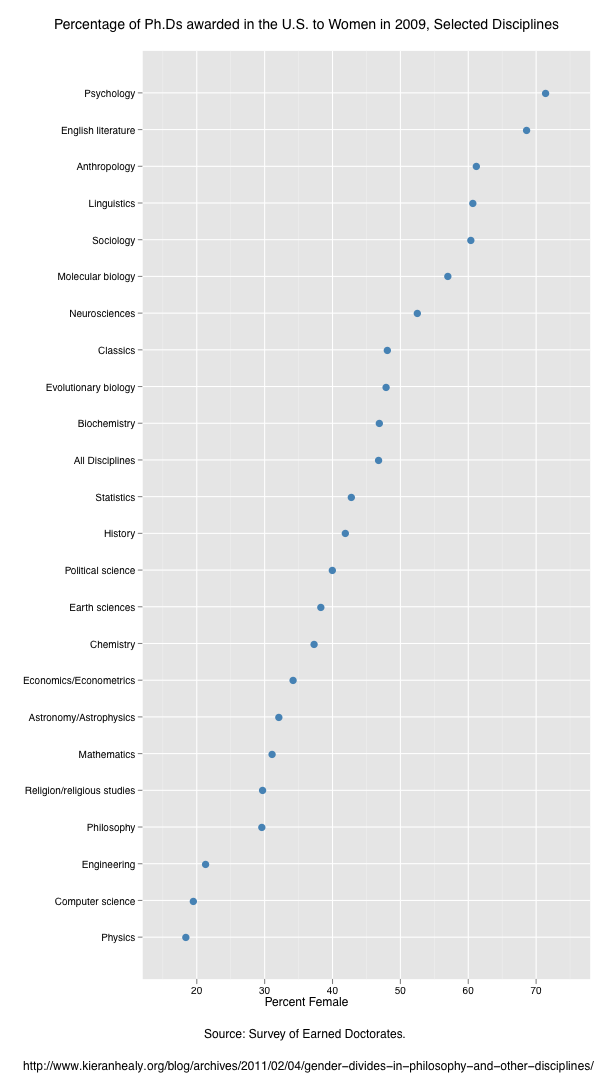
I spent the weekend at Princeton, listening to distinguished alumni talk about a number of issues, mostly about their career paths and their efforts to balance their work lives and their personal lives. In a discussion of work-life balance led by New York Times writer Lisa Belkin, class of 1982, a young woman stood up and explained that she was a graduate student in molecular science, and that she was pregnant. She said she had no idea how to manage being a graduate student in such a rigorous field with being a mother. She asked, with an unmistakable tinge of desperation in her voice, if Belkin or anyone else in the room had any advice for her. A woman at least fifteen years her senior stood up and said, “I’m a scientist and a mother of three; you can do it.”


When I saw this graph, I thought about that woman. In addition to facing the challenge of balancing a demanding career with motherhood, she also has to contend with being one of the few women in her lab or in her department.
--Chloe Angyal, "... Women in Science"


I have joined the author team over at Biblioblogs and hope to increase the number of British contributors. But the biggest call is to increase the number of women who blog on the Bible. If I can make the top 50, you can. I have only been blogging three years, the same number of years I have had puzzles about faith and the Bible to work through. I am not an academic theologian. 

You need to log your blog with Alexa which gives you exposure and tracks your hits. 

You need to let me know here that you are blogging. There will be a new feature at the top where I can store links to women's faith and bible blogs and then we can send recommendations over to Biblioblogs. 

Seminaries and theological colleges are chock-full of male lecturers, lovely as they are, bible-related scholarship is also under-represented on the female-front. We might begin by increasing women's contributions to this growing forum - please let me know what you think. It's time to 'open up the floor' .... I'm saying nothing about dinosaurs.
--Rachel Marszalek, "Biblioblogs and ...


Wow. I guess these guys' athletic prowess and the money/name they could make for the university was more important than the safety of the other students. Nobody in authority apparently thought it important to take any precautions or keep tabs on young men entering the university with criminal records. And this was supposed to be a "Christian" university!

The only thing TCU can say is that the woman's claims [that she was drugged and raped in a campus dormitory by two TCU basketball players and a member of the football team] were "blown out of proportion"? Wow.
--Kristen, speaking up again (at) "After Women's History Month"


I am so sorry to read these things. I am so sorry that young women are being taught such doctrines. My heart goes out to readers of this teaching. The Bible does not attribute strength or the ability to provide to men over women. This is not to be found in the Bible. On the contrary, in Proverbs 31 we read of the eshet chayil, which literally translated is the "mighty woman." I don't think a literal Bible translation actually exists. It is too bad.
--Suzanne McCarthy, "Women were created to imitate who?"


What are these eight little verses that control how women through 5,000 years of Jewish and Christian history are portrayed? What are these eight little verses that are used to keep women in their proper silent and submissive place in both The Hebrew Scriptures and the New Testament? Here they are:
1 Corinthians 14:33b-35....  1 Timothy 2:11-15.
If you just went “Huh?” (or even WTF?!?), don’t worry, you’re not the only one. It’s shameful for a woman to speak in church? A woman has to keep silent because of Eve? And my personal favorite: Women “will be saved through childbearing.” (This is my favorite because my husband and I have chosen not to have children. Guess I’m unsaveable.)

So, what are we in the 21st century supposed to think about this? Do Christians (particularly Christian women) have to be held in rigid gender roles based on these verses? Do women have no choice but to sit down and shut up because these eight verses are used to marginalize and negate any Scripture regarding women working, women making their own decisions, and women in authority? That’s the way these eight verses have been used through the 2,000 years of the Christian Church. But I’ve learned that just because something in the Bible has been interpreted in a certain way for millennia doesn’t that interpretation is right. Look at slavery. Over 100 years ago Christians were using passages in the Bible to justify slavery. Now no American is going to use those passages in Scripture to justify slavery today. We recognize, that even though endorsed in the Bible, slavery is wrong. It’s unethical. We’ve changed how we interpret the slavery passages in the Bible. Why can’t we change how we interpret the passages about women? ....  I’m going to show the different ways these verses can be translated.
-- Shawna R. B. Atteberry, "Women Who Didn't Shut Up ... Why"


Let Obama be "weird" and "foreign" and "womanly." And also let Paul. And let their words be accurately translated to convey the sense they intended. With regards to Paul-- it's high time.
--Kristen, still not shutting up (now on) "Weird, Womanly Words of Obama"


Modern Women, Old Testament: A Jewish-Christian Conversation with Rabbi Rachel Barenblat, author of "70 Faces: Torah Poems," and Elizabeth Adams, author and publisher. On Sunday, May 8, Christ Church Cathedral will host a book discussion with Rabbi Rachel Barenblat, author of a recently-published and highly-praised book of poems which approach the five books of Moses from a questioning, modern perspective.

As a longtime poet and writer, newly-ordained rabbi, and recent mother, Rachel's work helps us look at these texts from new and personal perspectives. How can modern women and men engage actively with these early Hebrew scriptures, while still loving and respecting the Bible and remaining faithful Christians and Jews? What does the tradition of midrash have to offer to Christians? How can poetry -- a tradition deeply embodied in the Hebrew Scriptures -  free us to think and feel creatively about the human issues the Bible addresses in these stories?

-- Rabbi Rachel Barenblat (the Velveteen Rabbi), "... tour ... "


What I've come to, after a lifetime 
of wondering, 
of working through the biblical evidence for and against, 
of reading widely on both sides of the 
whole male/female thing,
of arguing with others and with myself and even with God - what I've come to is this: 
the thing I'm called to do is,
to live the other truth.
As a trusted counselor said to me this morning,
"That is the revolutionary act."
....
And I've stood astounded,
mentally open-mouthed,
when men (and women) whom I love and respect 
say and do things that are stunningly at odds 
with what they say they believe.
Because, as I have learned to my chagrin 
and sometimes very deep personal pain,
 giving mental assent to an idea, to a doctrine, to a denominational stance ...
and living that truth in day-to-day practice are 
two very different things.
....
Anger was not going to do a thing to bring change.
 But living that change just might make a beginning.

So that's what I've tried to do - 
to live the change I hope for, I pray for, I long for.
I've been a woman in ministry for 17 years, 
serving the church in a denomination 
that has been ordaining women since 1974.
But that same church has not been proactively engaged in making that act a reality in the day-in and day-out life of the local church until fairly recent years.   
I thank God for my denomination.
I love who we are and who we are becoming.
But getting here has been tough sledding.
Real progress is being made, now on an almost daily basis.