Showing posts with label gender. Show all posts

Sunday, July 3, 2011

Gender Dividing: Women, NIV 2011, the SBC

What's the most important thing to notice about Moe Gerkins and about Selma Wilson? It's that they're women, right? I mean, why would Moe say the following if she were not a she?
"Whatever its strengths were, the TNIV divided the evangelical Christian community," said Zondervan president Moe Girkins. "So as we launch this new NIV, we will discontinue putting out new products with the TNIV."

Girkins expects the TNIV and the existing edition of the NIV to phase out over two years or so as products are replaced. "It will be several years before you won't be able to buy the TNIV off a bookshelf," she said.

"We are correcting the mistakes in the past," Girkins said. "Being as transparent as possible is part of that. This decision was made by the board in the last 10 days." She said the transparency is part of an effort to overhaul the NIV "in a way that unifies Christian evangelicalism."
And why would Selma write the following with her husband if she were not a she?
Teaching Spiritual Truth as You Go

The greatest celebration centers on God's love for us....  As you go, remind your child:
  • She was created in God's image!
So God created man in His own image;
He created him in the image of God;
He created them male and female. (Gen. 1:27)
Moe, of course, said what she said when CEO of the publishing house that was trying to bridge the divide among evangelical Christians.  And Selma wrote what she wrote when she was still just the Vice President of the publishing house that is an arm of the Southern Baptist Convention (SBC), establishing the women's ministry at Lifeway.

That these two women are women and not men, are females and not males, is the most important thing.  Right?  Their gender affects and infects their perspectives and their speech and their writing.  Right?

But look how funny this is, and how strange!  Did Selma get a say when the men of the SBC recently resolved not to sell the newest Bible published by the company Moe was Chief of?

I do want you to notice how funny and how strange it is that Selma chose to use the language of her publishing company's Bible above.  Selma and her husband used the Holman Christian Standard Bible.  Notice their use of the gender-neutral word, "child"!  And notice their use of "she" next to the Bible's use of "He" and "He."

But what if they'd done the evangelical Christian divisive thing of writing this for daughters and for sons?  What if Selma and her husband, female and male, had used the controversial Today's New International Version?  It would have been written this way:
Teaching Spiritual Truth as You Go

The greatest celebration centers on God's love for us....  As you go, remind your child:
  • She was created in God's image!
So God created human beings in his own image,
in the image of God he created them;
male and female he created them. (Gen. 1:27) [TNIV]
Notice how gender-blind and gender-neutralizing this very offensive language is!  Oh, never mind.  Yes, right, right.  I see it now.  The TNIV actually still called God "he" and "he."  Well, give me this then:  look how small the "h" in "his" "he"!!  And look how the gender-neutralizing TNIV has the audacity of putting "God" before "he" and "male and female" before "he" too!!  How dare they not start the clauses with "He"!   How dare they not start the sentences with capital "H" "He"!

So notice now the NIV 2011, the one no longer sold in Selma's company's stores.  Notice how it fails to make good on Moe's promises on behalf of her company to overhaul that gender-neutralizing-horrible TNIV.  If Selma and her husband could have used the NIV 2011 to revise their male-and-female parenting book for sons-and-daughters, then just look at how it'd be:
Teaching Spiritual Truth as You Go

The greatest celebration centers on God's love for us....  As you go, remind your child:
  • She was created in God's image!
So God created mankind in his own image,
in the image of God he created them;
male and female he created them. (Gen. 1:27) [NIV 2011]
---

I'm being a little silly.  Just a little.  But I was noticing what Al Moehler, President and spokesman for Southern Baptist Theological Seminary, had said when the announcement came out from Moe's publishing house that it was going to try to bridge the divide.  I was also noticing what Suzanne McCarthy had said.

Al said:
Maureen (Moe) Gerkins, president of Zondervan, along with representatives of Biblica and the Committee on Bible Translation, have approached this new project and update with the stated determination to revisit controversial translation issues related to the TNIV and to consider all the concerns raised in that process. She has demonstrated integrity in discussing these issues openly and honestly. She, along with Zondervan’s partners, has promised an openness to these concerns. They have not promised to change their translation philosophy. Their straightforwardness on this is commendable, even where we may find ourselves in disagreement over these decisions and the underlying translation philosophy....
In the end, the update of the NIV to be released in 2011 will have to stand on its own. Those of us who have had significant concerns with the TNIV should communicate these concerns respectfully, candidly, and directly to the Committee on Bible Translation, to Zondervan, and to Biblica. When released, the updated NIV will deserve and require the attentive study and review of all committed evangelicals. We must hope and pray that this updated NIV will be found both faithful and useful. For now, the decisions that will determine the faithfulness and usefulness of this updated edition are in the hands of the Committee on Bible Translation. We must all pray that their work will produce an updated translation we can greet with appreciation and trust. We must take the members of the Committee on Bible Translation at their word that they will consider these concerns. To fail to pray and to act in this way will be to fail at a basic Christian commitment. The issue is not only the integrity of a Bible translation, but our integrity as Christians.
That was September 2009.  But in June 2011, Al said this:
Mohler said he thought the Resolutions Committee and messengers were both right.

"The [SBC] Committee on Resolutions had good reason for deciding that this was not the most timely opportunity to bring a resolution on the NIV," Mohler told Baptist Press. "I would not second guess the Resolutions Committee, and I certainly know their conviction on these issues. But once that resolution was brought to the floor, Southern Baptists simply had to support it, and support it overwhelmingly, on the basis of the fact that what it said was patently true and did reflect the established concerns of Southern Baptists."
The question is did the male-only Resolutions Committee communicate [their] concerns respectfully, candidly, and directly to the Committee on Bible Translation, to Zondervan, and to Biblica or give the updated NIV ... deserve[d] and require[d] ... attentive study and review [on behalf of any and] of all committed evangelicals?  Did these men, as Al called for, pray and ... act in this way [to give their] basic Christian commitment?  But does it matter now?  Al is not going to "second guess the Resolutions Committee."

Suzanne said:
I predict that complementarians will completely reject the new NIV because of 1 Tim. 2:12, 1 Cor. 11:10, the paragraphing of Eph. 5:21-22, and Romans 16:7. John Piper has already spoken vociferously against the NIV 1984, perhaps to pave the way for a full rejection of the NIV 2011.
That was November 2011.  Today (in July 2011) she said:
Enough time had not passed. The steam was building. The negative responses came and keep on coming. I was especially disappointed to find the Biblical Studies Carnival link favourably to a negative post on the NIV 2011. Notably that post included this passage,

In Roman Catholic and Southern Baptist contexts – the largest church polities in the US – a reaction against gender-sensitive translation has set in. Both faith traditions seek to retain a degree of independence from prevailing cultural trends. This is no doubt salutary.
I believe that it needs to be said, that not all women find the ways in which the RC and SBC counter cultural trends to be salutory. In the past, it was slavery, now it is the rights of women to be treated as equals. What is salutory about that?
Who's dividing by gender now?  Is it Moe or Selma or Suzanne or any other woman who is reading the Bible with her "child"?

Tuesday, March 16, 2010

a bit of history of the Greek phrase en gastri, for “in the womb”

Joel Hoffman posted yesterday that "the Greek phrase en gastri" means "in the womb."  (He was looking at how Matthew used it with another Greek word "echousa" that Hoffman says means "holding."  Hoffman is wanting to suggest that, for this phrase, Bible translators tend not to produce a "myopic translation" that would reproduce each Greek word -- i.e.,  myopic with "the English words 'in' and 'womb'" or myopic as "Holding in the womb."  Matthew's phrase, Hoffman explains, "is Greek for 'pregnant,' or — as used to be common — 'with child'.")

But would anyone care to know that Homer, Hesiod, Sophocles, Euripides, Aristophanes, and Xenophon did not ever use the phrase with specific reference to a woman or a woman's conception of a baby?  Rather, for these writers and storytellers, ἐν γαστρὶ referred to something in or around the "belly," "stomach," "paunch," and "[gluttonous] appetite."

And would anyone care to know that there was a metaphorical shift in how this word was used that seems to be traceable to Plato?  Plato, who railed against the poets, the sophists, and playwrights and their use of language, was the first to use this Greek phrase (i.e., ἐν γαστρὶ) for a pregnant woman.  In our extant texts of his, Plato only did this once, in his very last work, Laws, 792.e.3, where he puts the words in the mouth of the Athenian Stranger.

And would you be surprised that Aristotle, Plato's student, uses the phrase numerous times in his Generation of Animals and his History of Animals to refer (not metaphorically but rather scientifically) to the state of a female in conception or pregnancy?  In fact, Aristotle rarely uses the phrase in any other way.

And Greek writers thereafter nearly exclusively use the phrase in reference to a conception in or the very womb of a woman.

--

update:  As if you might care, here's a bit of Homer and then the bit of Matthew, both translated by Richmond Lattimore:

νειαίρῃ δ' ἐν γαστρὶ πάγη δολιχόσκιον ἔγχος,

and the far-shadowing spear was fixed in the lower belly,

--Iliad 5.616

Τοῦ δὲ Ἰησοῦ χριστοῦ ἡ γέννησις οὕτως ἦν.
Μνηστευθείσης τῆς μητρὸς αὐτοῦ Μαρίας τῷ Ἰωσήφ,
πρὶν ἢ συνελθεῖν αὐτούς,
εὑρέθη ἐν γαστρὶ ἔχουσα
ἐκ πνεύματος ἁγίου.

The birth of Jesus Christ came in this way:
Mary his mother was engaged to Joseph,
but before they came together
she was found to be with child,
by the Holy Spirit.

--Matthew 1:18

Monday, March 15, 2010

the Evangelical Caste System

The "evangelical caste system" is what Jocelyn Andersen calls an ecclesiastical and household construct based on "old arguments traditionally used to keep men and women enslaved in illegitimate bondage based on sex." After conducting "extensive personal research into the Patriarchy movement" and after reading the Bible carefully for herself with respect to the Patriarchy, Andersen is coming out with a book entitled Woman this is WAR! Gender, Slavery, and the Evangelical Caste System.

The last time I heard anyone use the word caste to refer to any part of the Christian church was toward the end of last year.  This raised an eyebrow, I imagine, but was hardly the passionate, provocative declaration that Andersen is making, and that she has to make, because she's a woman, a woman with an all too common story this late in human history.

In November last year, blogger Peter Kirk called the historical teaching that has promoted "Church leadership by a special caste of pastors or priests" a "deeply de-Christian doctrine."  In other words, the notion and practice of a caste system is not to be seen as Christian at all.  Kirk, an Anglican, doesn't look at the systematic construct of an ecclesiastical caste in relation to gender so much, and he casts blame for such a doctrine on the Christian appropriation of "the values of the world." Nonetheless, he sees as another "deeply de-Christian doctrine" the idea that "Leadership is male"; that's a "concept," he says, "which also seems to have been imported into the church from the surrounding culture." One of Kirk's responders, Gary Simmons, commented to speculate that pragmatism and not the assimilation of culture values is the source: "I agree there should be no formal 'caste,' but as an American of Protestant background from the Bible Belt, I will tell you that having no clear authority structure (like a caste) has its drawbacks and frustrations."  They, and none of Kirk's other responders with him, further discussed male leadership as part of the caste and how that, as biblical teaching, might be outdated or de-christian or damaging to women, men, and children.  Perhaps other things were more interesting to them in the conversation because they are not women and are men.

In a recent related post at another blog, John Hobbins defends Christians in general and bashes what he calls "standard-issue feminists" in particular (as if there's a necessary divide between the two beyond his own thinking); the former but not the latter, he says, have reduced the global gendercide reported by the Economist.  Hobbins asserts that "Korean Christianity remains strongly complementarian [i.e. the male is the leader] in the pulpit and the home" to suggest that such teaching and practice "stands in contradiction to femicide" but that, in contrast, "democratic capitalists and feminists ... have failed" [in opposing male-over-female hierarchies] to so stand against gendercide.  Hobbins is "an ordained pastor in the Waldensian Church" and a prolific blogger.

In a responsive post today at yet another blog, Suzanne McCarthy points out that male bible-bloggers who are the most read, Hobbins included, create a very odd position for female bible-bloggers.  It's not just the strong assertions, like Hobbins's, that complementarianism (i.e. the caste-like teaching and practice) is actually helping women in the church around the world but it's also the censorship that a powerful male bible-blogger engages in (albeit at his own well-read blog) that limits women in the conversation about the very caste system that silences many.

However, perhaps Andersen's new book will get more of us talking and will allow women to talk with men and with one another.  The comparisons of a caste with some domains of evangelicalism (along the lines of gender and slavery) should have more of us considering whether and how we rank.

Tuesday, February 2, 2010

focus on the family: Africana history, Gender, Bible Translation

CREATION OF HUMAN BEINGS:
GENDER EQUALITY AND CO-REGENCY

Adam is . . . [t]he first man that was what.
Not the first man.  They say nobody so crazy they think
they can say who was the first man.  But every body notice
the first white man cause he was white.
 ([Alice] Walker [The Color Purple] 1982: [page] 139)

The narrative of the creation of the world find its climactic moment in the creation of human beings.  The term occasionally translated "human beings" in the NRSV and generally as "man" in most other English version is 'adam or ha'adam.  Now this clearly is not a personal name (that is, Adam) as the KJV ill-advisedly begins to indicate at about Gen. 2:10.  A better translation of this term, however, would be 'the earthling" since the term is derived from the term 'adama, meaning "land" or "earth."  Such a translation clarifies better than "man" or even "human being" that the original intent of the author is to emphasize that God made "earthlings" as a whole, not just males, in God's image.  As such, a better translation of verses 27-28 would be:
     And God created the earthling in God's image, in the image of God God created it, male and female God created them.
     And God blessed them and God said to them, "(y'all) be fruitful and multiply and fill the earth and subdue it, and exercise dominion over the fish of the sea and the foul of the heavens and over all the living beings that teem upon the earth."
Such a translation takes into consecration that the term 'adam is meant to function as a collective term referring to both the male and the female.  Thus, we should note that 'adam is here not a name or an ascription of gender but a collective term for "earthlings" in general; this is emphasized by the author's choice of the plural pronoun 'otham, and the use of the plural verbs geyirddu and urdu, meaning in 1:26 and 1:28 "let them have dominion," further reiterates the inclusive nature of the term 'adam.  In the Creation account in Genesis 1:1--2:4a, both genders are vested with authority as stewards over the earth and all that is in it.  It is in this way that the family begins, with this functional procreative unit:  two beings reflecting God's glory in human form and united in common cause.
     This is an important theme because Africana families continue to struggle with the dysfunction of androcentrism and misogyny.  If we are to overcome this tendency, we have to acknowledge that Creation offers no biblical precedent to the notion that we are created qualitatively differently as males and females; in Genesis 1 and 2, both genders were created with equal authority over the earth, and equal value as human beings.  Herein is the basis of a functional union from which the human family arises in all of its forms.
----

above, the section in the chapter "Genesis," by Rodney S. Sadler, Jr., in The Africana Bible: Reading Israel's Scriptures from Africa and the African Diaspora

HT David Ker, (again, See:  more translating Phillis Wheatley)

Friday, September 18, 2009

Mother Mary, Anthropos

Luke's Greek gospel offers compelling evidence that Mary, the mother of Jesus, is an anthropos

(John Radcliffe inspires me to look at Mary by pointing us to that saying of Mary's son, a saying about mothers and their anthropos offspring.  Take a look here, scrolling down to what Radcliffe calls "Off topic somewhat.")

Now we can look at Luke's introduction of Mary and then his conclusion where he continues to figure her prominently.  Below is Luke's chapter 1 and his chapter 24.  I've included the Greek (and Hebrew names) after the English translation.  (Since John Radcliffe notes how the NKJV "gets it right" in John's gospel, let's stay in the same translation and even show the NKJV mechanics, such as italics). 

What should be obvious are these facts: 

1) when Luke introduces Mary, there are several other males also introduced, but none of these individuals is described as anthropos

2) when Luke is towards the end of his story, Mary is there the anthropos.
26 Now in the sixth month the angel Gabriel was sent by God to a city of Galilee named Nazareth, 27 to a virgin betrothed to a man whose name was Joseph, of the house of David. The virgin’s name was Mary. 28 And having come in, the angel said to her, “Rejoice, highly favored one, the Lord is with you; blessed are you among women!”  29 But when she saw him, she was troubled at his saying, and considered what manner of greeting this was. 30 Then the angel said to her, “Do not be afraid, Mary, for you have found favor with God. 31 And behold, you will conceive in your womb and bring forth a Son, and shall call His name JESUS. 32 He will be great, and will be called the Son of the Highest; and the Lord God will give Him the throne of His father David. 33 And He will reign over the house of Jacob forever, and of His kingdom there will be no end.”   34 Then Mary said to the angel, “How can this be, since I do not know a man?”
Luke's first description of Mary includes his use of these words:

παρθένος [parthénos, aka "marriable girl," NKJV "virgin"];
Μαριάμ [Mariám, aka מִרְיָם, "Miriam," NKJV "Mary"];
ἐν γυναιξίν [ẻn gunaizín, aka "within (married) women," NKJV "among women"].

In the same context (vv 27, 34), Luke's words for "man" are ἀνδρί, ἄνδρα [andri, andra].  Her baby, incidentally, is to be named Ἰησοῦν [Iesoun, aka יְהוֹשֻׁעַ , "Joshua," NKJV "JESUS"]

When one fast-forwards to the end, Luke has another angel speaking to other women, some married, some mothers, some Marys.  The angel quotes the son of Mary.  But the NKJV here does not get things quite right this time.  Here's a bit:
6 He is not here, but is risen! Remember how He spoke to you when He was still in Galilee, 7 saying, ‘The Son of Man must be delivered into the hands of sinful men, and be crucified, and the third day rise again.’”  8 And they remembered His words. 9 Then they returned from the tomb and told all these things to the eleven and to all the rest. 10 It was Mary Magdalene, Joanna, Mary the mother of James, and the other women with them, who told these things to the apostles.
Luke never says here andri or andra for the men.  Rather he writes, καὶ πᾶσιν τοῖς λοιποῖς [kai pasin tois loipois] which NKJV renders "and to all the rest."

Likewise, Luke doesn't say gune for the (married) women.  Instead he offers καὶ αἱ λοιπαὶ σὺν αὐταῖς [kai hai loipai sun autais] which NKJV makes "and the other women with them."

But Luke does have τὸν υἱὸν τοῦ ἀνθρώπου [ton huion tou anthropou].  And to this Joshua (aka Jesus) there must have been in his own nickname for himself a fondness for his mother.  Because - despite NKJV's "The Son of Man" - he is reminding the other Marys and other women to tell the eleven disciples and the other men that he is the son of the anthropos.  And she is the anthropos, according to Luke's account, who knew no "man" and yet conceived and gave birth to her own anthropos.  Mother Mary, Anthropos.

Thursday, September 17, 2009

When Sheep Don't Need Sex: More Wordplay in Matthew

Below is my translating of Matthew's storytelling and translating.  I've put in brackets the original Greek words that translate some of the original Hebrew words along with those even more original Hebrew words.  Of course, the spoken language Matthew translates mostly was probably Hebrew Aramaic; and yet not all of this story is spoken language, is it?  (Suzanne gets us listening to the words of Syriac Aramaic in a related post.)

The protagonist of Matthew's Greek story and translation is the protagonist who questions the readings of his antagonists.  There is text in this oral story, then.  The word for "reading" in Greek, of course, is a play on the word for "knowing"; it literally means to "know from above."  The protagonist knows some of the high holy Hebrew scriptures from God above, and he quotes a bit of it back to the antagonists.  They seem hung up on how he reads the Torah Law, and how it relates to the healing of a mortal human being.

With my translating, what I'm trying to show is Matthew's clever wordplay, his poetry perhaps, and his rhetoric really.  Observe the contrasts and interplay between the words for God, for mortal humans, and for sheep.  This wordplay starts in verse 3 perhaps and really in verse 8.

Observe:   we get from Matthew neither the sex of the sheep nor the gender of the mortal human whose hand is healed.

This post is following on a few others earlier, which I've linked here.  Unfortunately, most of the discussion around Matthew 12 so far has ignored the beginning of Matthew's story and the start of his wordplay there.

Here goes:

---------

1  At that time, during Sabbath [Σάββατόν / שַׁבָּתֹ], Joshua [Ἰησοῦς / יְהוֹשֻׁעַ ] went through the grainfields.

Then, his apprentices were hungry and were beginning to pluck and to eat the stalks.  2 Then, the observing Separtists [Φαρισαῖοι /פרושים ] said to him:
Look at what your apprentices are doing.
This is not to be done during Sabbath [Σάββατόν / שַׁבָּתֹ].
3 Then, he said to them:
This is not known by your reading [ἀν-έγνωτε], is it?  What you’re saying is not known by your reading of what David [Δαυίδ / דָּוִיד] did when he was hungry, is it?  4  Or how he, and those with him too, went into the house of God [οἶκον τοῦ θεοῦ /בֵּית אֱלֹהִים], and ate the showbread of the presence [ἄρτους τῆς προθέσεως /לֶחֶם]?  This is not to be done by him?  Nor by those with him?  This is not to be done if not by the Priests [ἱερεῖς / הַכֹּהֲנִים] alone?
5 What you’re saying is not known by your reading [ἀν-έγνωτε] of Torah Law [Νόμος / תֹּורָה] either, is it?  During Sabbath [Σάββατόν / שַׁבָּתֹ] the Priests [ἱερεῖς / הַכֹּהֲנִים] in the Temple [ἱερος / הֵיכַל] defile Sabbath [Σάββατόν / שַׁבָּתֹ] and are innocent [ἀναίτιος /נָקִי], right?
Here, then, is a statement for you all:
6 “What’s greater than the Temple [ἱερος / הֵיכַל] is here.”
7 If you, then, had known [ἐγνώκειτε] what this is --
“It’s mercy I wish for and not sacrifice.”
[Ἔλεος θέλω καὶ οὐ θυσίαν
/ כִּי חֶסֶד חָפַצְתִּי וְלֹא־זָבַח]
If you, then, had known [ἐγνώκειτε] what this is -- then there should not have you’re your judging condemnation [κατε-δικάσατε] of the innocent [ἀναίτιος /נָקִי].
8 The Master of Sabbath … is the offspring of a mortal human
[τοῦ Σαββάτου … ὁ υἱὸς τοῦ ἀνθρώπου
/ אֱנָש.ׁבַר … שַׁבָּתֹ]
9 Afterwards, he went from there into their Synagogue [συν·αγωγή / עֵדָֽה].

10 So observe:

There was a mortal human [ἄνθρωπος] who had a mangled hand.

They asked him about it - making this statement -
Is it to be done? 
to heal during Sabbath [Σάββατόν / שַׁבָּתֹ]?
They asked him this in order to accuse him.

11 Then he said to them:
Among all you mortal humans [ἄνθρωπος] there is someone who has just one sheep [πρόβατον ἕν / כִּבְשָׂה אַחַת קְטַנָּה].  Should it fall during Sabbath [Σάββατόν / שַׁבָּתֹ] into a pit, would that someone not grab it and lift it out?
12 How much more, then, would you carry a mortal human [ἄνθρωπος] than you would a sheep?
Thus, it is good [καλῶς / טֹוב] during Sabbath [Σάββατόν / שַׁבָּתֹ] to do this.
13 That’s when he made this statement to the mortal human [ἄνθρωπος]:
Put out you hand
 [Ἔκτεινον τὴν χεῖρά σου / שְׁלַח יָֽדְךָ]

And the hand was put out there, and it was restored, healthy as the other one.

14 So, the Separtists [Φαρισαῖοι /פרושים ] left and took council together to destroy him.

Wednesday, September 16, 2009

A Novel Daughter-"Man?" of the 1st Century

Thus begins the 1st-century A.D. novel by Chariton, right after my quick parenthetical note below:
(We all know that the novel as it begins is only fiction, but is the author really trying to make his readers believe that his female protagonist is mainly a "man"?  Can his masculine Greek grammar keep her out of the human race of men and women?  Has a god (a male) stopped her from looking like the equally-divine goddesses and gods?
Let's read the original, the transliteration of those Greek letters, an ESV-Bible-like translation, and an Ann-Nyland-like translation.  Then you decide.)
Ἑρμοκράτης ὁ Συρακοσίων στρατηγός, οὗτος ὁ νικήσας Ἀθηναίους, εἶχε θυγατέρα Καλλιρόην τοὔνομα, θαυμαστόν τι χρῆμα παρθένου καὶ ἄγαλμα τῆς ὅλης Σικελίας. ἦν γὰρ τὸ κάλλος οὐκ ἀνθρώπινον ἀλλὰ θεῖον, οὐδὲ Νηρηΐδος ἢ Νύμφης τῶν ὀρειῶν ἀλλ’ αὐτῆς Ἀφροδίτης Παρθένου.
----the "original"

Hermokrátēs ho Syrakosíōn stratēgós, hoṹtos ho nikēsas Ảthēnaíous, eĭche thugatéra Kalliróēn toửnoma, thaumastón ti chrễma parthénou kai ảgalma tēs hólēs Sikelías. ḕn gàr tò kállos oủk ảnthrōpinon ảllả theĭon, oủdè Nērēḯdos ḕ Númphēs tṍn ỏreiṍn ảll' aủtễs Ảphrodítēs Parthénou.
----a transliteration of the sounds of the original

Hermocrates, ruler of Syracuse, victor over the Athenians, had a daughter named Callirhoe, a marvelous virgin and the delight of the whole of Sicily. However, the beauty was not a man's but was a god's, not that of a Nereid or a Nymph on the mountain but of the Virgin Aphrodite herself.
----an ESV-like translation

Hermocrates, ruler of Syracuse, victor over the Athenians, had a daughter named Beauty, an amazingly eligible bachelorette and the delight of the whole of Sicily. Her beauty, in fact, was not merely human but was rather divine; not merely the beauty of a daughter of Nereus or even the beauty of a Nymph on the mountain but rather the beauty of Aphrodite, the Most Marriable Bachelorette Herself.
----an Ann Nyland-like translation


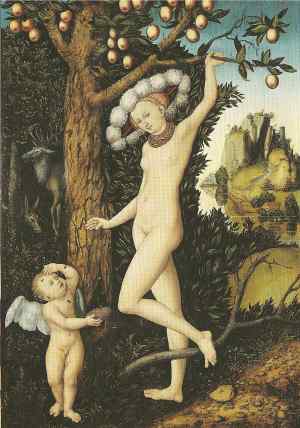
(This image reminds me somehow of the Genesis story of the very human Eve and Adam in the garden.  Of course, it's a painting of the divine Aphrodite and Eros.  I found the image at Nicos Stylianou's igreekmythology.com.  He provides this information.


Name:"Aphrodite and Eros"
Museum:National Gallery, London, England
Artist and Year:Lucas Cranach Sr.,ca. 1430
Theme: Aphrodite talks with her son Eros, who has been stung by bees.)

------

Related posts:

Saturday, June 6, 2009

John's Greek Rhetorical Prologue: My Rhetorical English

In light of discussions about the pronoun gender of the Prologue of the gospel of John, I thought I'd translate it. And I've left it "it." But I want us to notice how rhetorical John's word choice is in Greek.

Socrates says the following when talking with his disciple Polus. The passage is from the "Gorgias" by Plato, who coins the word "rhetoric" in the dramatic dialogue. Here's some of what Socrates says, and do note the Greek in this English translation by Benjamin Jowett. It's the rhetorical, case-building Greek of John's Prologue:
O Polus, I am not a public man, and only last year, when my tribe were serving as Prytanes, and it became my duty as their president to take the votes, there was a laugh at me, because I was unable to take them. And as I failed then, you must not ask me to count the suffrages of the company now; but if, as I was saying, you have no better argument than numbers, let me have a turn, and do you make trial of the sort of proof which, as I think, is required; for I shall produce one witness [μάρτυρα, martura, testifier] only of the truth of my words, and he is the person with whom I am arguing [ὁ λόγος, ho logos, i.e., making "the statement"]; his suffrage I know how to take; but with the many I have nothing to do, and do not even address myself to them. May I ask then whether you will answer in turn and have your words put to the proof? For I certainly think that I and you and every man [ἀνθρώπους, anthropous, human] do really believe [ἐπίσταμαι, epistamai, believe], that to do is a greater evil than to suffer injustice: and not to be punished than to be punished.
John uses many of the words of Greek rhetoric, and of Plato's sophistic caricature, in combination with the Jewish notion of The Beginning. He's also following the LXX translators' rhetorical choice of naming the Beginning Book as "Genesis" or "Birthings." (Birthings is a greeky pun on the word for "woman," a word which can also mean "wife.") John's identification of the male parent (i.e., father) is often typically only associated in English translation with "The Father, God." Certainly John disambiguates plenty at later points in his gospel just which Father he and Jesus are talking about; however, John's Greek word for father in the prologue can also apply to any parent who is the male in the birthing process, to any "father." (I'm sure there's a case to be made to translate that Greek word, likewise, as "parent" or even as "a mother and a father" - but in translating today, I'm not stretching the word possibility so far.)

Now, here's my English translation of John's Greek:

Friday, June 5, 2009

par elle, et elle a habité parmi nous, et nous avons contemplé sa gloire

Suzanne's Bookshelf offers "one example" of a Greek text that "demonstrates the enormous fallacy and extremely limited scope of any discussion of pronoun gender in translation."

The one example illustrates how,
English readers are cut off from the diverse ways that this passage could be read at the time it was written. We are cut off from how this passage is read in other modern European languages. The English translations are also committed to an interpretation which is foreign to a Jewish understanding of the text.
Read more in the post, "All things were made by her ..."

Tuesday, June 2, 2009

New Testament Translation Question

(Let's not use the word "feminist" today.) Let's (instead) focus precisely on the Greek text of the New Testament. Let me make a suggestion that I've made before, and then ask a question. Here's that suggestion:
that Mark is translating Jesus to give a pluralistic hermeneutic when he has him saying and asking:
Καὶ λέγει αὐτοῖς, Οὐκ οἴδατε τὴν παραβολὴν ταύτην; Καὶ πῶς πάσας τὰς παραβολὰς γνώσεσθε;

And he said unto them, Know ye not this parable? and how then will ye know all parables?
The entire parable and this whole pericopic episode seem to get at interpretive difficulties and ways of being and repentance and subjectivities against pretended objectivity and the like. Yes, I know I'm exegeting isogetically - but isn't that some the point here in Mark 4? To keep outsiders out and insiders in and to multiply statements and so forth?
So the question:
How differently would you read this story of this parable if it started, really and textually, in Mark 3:31? With Jesus being challenged about his ostensible inattention to his mother and his brothers. Yes, I know the manuscripts and therefore the text critics go bananas here in verse 33. But Mark has Jesus turning the whole question of precise definition back to those challenging him:
Καὶ ἀπεκρίθη αὐτοῖς λέγων [ἀποκριθεὶς αὐτοῖς λέγει], Τίς ἐστιν ἡ μήτηρ μου [ἢ οἱ] [καὶ οἱ] [ἀδελφοί μου] ἀδελφοί [μου].

And he answered them, saying, Who is my mother, or my brethren?
Then he goes even further, and Mark does as well with his Greek:
34 Καὶ περιβλεψάμενος κύκλῳ τοὺς περὶ αὐτὸν [τοὺς περὶ αὐτὸν κύκλῳ] καθημένους, λέγει, Ἴδε, ἡ μήτηρ μου καὶ οἱ ἀδελφοί μου

Ὃς γὰρ ἂν ποιήσῃ τὸ θέλημα τοῦ θεοῦ, οὗτος ἀδελφός μου καὶ ἀδελφή [μου] καὶ μήτηρ ἐστίν.

34 And he looked round about on them which sat about him, and said, Behold my mother and my brethren!

35 For whosoever shall do the will of God, the same is my brother, and my sister, and mother.
Do you see how bold this interpretation? How additional to the text this marked detail? Is this a set up for the story of a sower sowing? Does gender matter? Embodiment in interpretationS? Wordplay in Texts?
In the words of Jesus: What does the text say? How do you read it?

Wednesday, October 24, 2007

Aristotle & Baron-Cohen & Summers & Sommers: On Difference

A good friend of mine (an academic, a literary scholar, a rhetorician, not a feminist) wrote me last Friday (to share with me Christina Hoff Sommers’s op-ed piece “Academic Inquisitors”). He said:

I wanted to share with you a very interesting, if divisive and perplexing, article from today's Wall Street Journal. The article makes me wonder, don't feminist scholars want to show that women have a different perspective and epistemology? Or does that thesis depend on whether one finds herself (or himself) in the humanities or in science?

Others of you more qualified than I and more personally vested in the rhetoric here should have good answers to these questions. Please feel free to comment! But because my friend asks me, and because I can’t sit quiet when I think (with the mother of my children) about our first-born (our son) in the academy and our other children (our daughters) not far behind, here’s what I say:

Yes, women and men are different and have valuable differences. You and I are different (whoever we are). Gender makes different; race makes different; class makes different; place makes different; disability makes different.
No, finding myself in the humanities or in science does not erase the difference of one human body from another. Or the difference of one human brain from the next (whether autistic, if that’s the “far end of the male norm -- the ‘extreme male brain,’ all systematizing and no empathizing” or “wired to be . . . better empathizers” if that’s the other extreme in the female norm, as per scientist Simon Baron-Cohen, as per journalist Sommers.)

So, I ask:
Aren’t all men and women created equal (if we are different in body and brain and perspective and epistemology and rhetoric)?
And is Aristotle a humanitarian or a scientist when he declares that
Greeks are different from (and therefore superior to) Barbarians;
natural born masters are different from (and therefore superior to) natural born slaves;
males are different from (and therefore superior to) females, who are merely

males botched in the biology of conception by the mother’s mal-functioning;

and males are different from (and therefore superior to) females, because males have more teeth and males have heads full of sperm and have backbones that de-seminate the powerful fluid from the brain to the testicles, the natural receptacles for in-semination (if the females serving as mothers would just get the procreation process right)?