Showing posts with label Adolf Hitler. Show all posts

Friday, June 10, 2011

Mary, mother of Jesus, Jewish feminist

"Mary, mother of Jesus, Jewish feminist"

Well, doesn't that just grab your attention, your imagination?  In her comment to a blogpost earlier this week, Kristen started me imagining but also remembering.  She said:
... so it is natural that we [women] should have developed non-hierarchical ways of thinking, in contrast to Aristotle's and Hitler's. I find the ways of thinking Jesus displayed in the Gospel accounts to be distinctly non-Aristotelian and non-hierarchical (and female-inclusive) as well.  I imagine that Mary must have been a powerful voice in his early life. 
Earlier this week, I quoted several Jewish feminists who spoke of G-d's presence in Auschwitz.  Some of them were speaking of their mothers and grandmothers.  And it appears that Hitler, as early as 1919 by his "Gimlich letter," was targeting these women of "Mosaic faith," although both what he wrote and how he reasoned is starkly "in contrast to" how these women write and speak and live, who they are.

So today in this blogpost I just want to make clear four things.  First (1), the roots of this lineage of women really do grow deep.  Second (2), the womanly resistances to masculinist logic (i.e., that uber-male reasoning of Adolf Hitler) really are exceptional in just extraordinary ways.  Third (3), it would be useful to recover the historical Miriam (or Mary) as the mother not only of Jesus but also as a mother and daughter of Jewish feminisms.  Mary was a Jew.  Mary was a woman.  Mary was of faith.  Mary was a feminist.  Mary did not limit herself to binary logic but expressed other ways of knowing, of being.  Fourth (4), our paying attention to Hitler's rigid logic allows us, ironically, to focus on her and her methods of speaking and of knowing and of being.  Given that this is just a blogpost (and not a dissertation) I'm going to have to keep it short, to draw sharp conclusions only indirectly, to invite you yourself to make some of the connections.

"(1) Deep Roots and (2) Extraordinary Resistances"

Outside of Auschwitz, non-Jewish women in Germany were resistant to the Nazi conceptions of Mary and of religion.  They were drawing profoundly on a lineage of womanly thinking that goes back, at least, to the Jewish woman, Mary.  They could easily see through the duplicity that Hitler attempted to hide.  It wasn't just his closest followers who saw how politically two-faced the Führer was; nonetheless, to be clear, his male fellows were able to see the intended deceptions of this man.  "Amid his political associates in Berlin," Albert Speer recalls, "Hitler made harsh pronouncements against the church, but in the presence of the women he adopted a milder tone -- one of the instances where he adapted his remarks to his surroundings" (page 95, Inside the Third Reich).  Speer goes on to say how Hitler ordered his "chief associates ... to remain members of the church" even though "vast numbers of his followers had left the church."  And Hitler "too would remain a member of the Catholic Church, he [himself] said, although he had no real attachment to it," although he would continue to make those private "harsh pronouncements against the church." He knew that publicly he needed to impress women.  However, women could see through what he was doing and how he was trying to do it.

German women saw through Hitler's veneer of acted religiosity.  Lillian Leigh Westerfield in her wonderful book, "This Anguish, Like a Kind of Intimate Song": Resistance in Women's Literature of World War II, notes how they recognized and resisted.  "German women resisted," she notes, "when they spoke out against the [Nazi] regime's official view of womanhood."  And continuing from page 49 (through page 51), Westerfield explains how religious women protested:
Some Protestant women chose resistance in conjunction with the Bekennende Kirche, which made extensive use of women behind the scenes.... [The] women took over the bulk of the illegal Church's routine work....  Female curates were permitted [by the Church] to assume ministerial functions ... and they kept the Church in operation by doing such routine tasks as duplicating politically dangerous liturgies or lists of intercession.... [even] falsifying the records of the collection money for the previous twelve months because the Church was trying to prevent the Gestapo from seizing the funds it used to finance its work....
      ... Catholic women [were] more sceptical [sic] than the Protestants of the Nazi ideology of womanhood. The Roman Catholic tradition of the Virgin Mary stood in direct contrast to the regime's portrayal of women as the biological provider of children who would strengthen the race.... Catholic women found themselves unable to honour the Church's ideal of virginity and at the same time fulfil [sic] their duty to the nation and the 'Aryan' race as child bearers. Already reluctant to embrace the dictatorship's image of womanhood, Catholic women were further alienated by the Third Reich's interference in the private, Catholic-run schools.... Women cooperated with Catholic bishops.... Catholic women have been credited with helping to bring an end to Hitler's euthanasia program.... The issue that became a lightning rod for Catholic women's anger and dissent... was the regime's demand for the removal of crucifixes from schools in 1936.
In the short space of this blogpost, I'd like to suggest that there was a sisterhood in Germany among Protestant women (in the illegal Bekennende Kirche and in other congregations) and Catholic women and observant Jewish women.

In Germany (15 years before Adolf Hitler typed up and signed his racist, sexist, religionist, "reasonable" letter to Adolf Gimlich) the deep roots and extraordinary resistances of feminism were showing and growing among Jewish Germans of Mosaic faith. We can look back to pre-Hitler Germany with biographers Elisa Klapheck and Lara Daemmig, who look forward to and particpate in "Jewish Feminism in Post-Holocaust Germany."  Klapheck and Daemmig recall:
In 1904 Bertha Pappenheim had established the Jüdischer Frauenbund. Together with like-minded fellow militants, she fought for equal status for women in the Jewish community, for the right to vote and be elected and for women’s right to professionalize their abilities. For Pappenheim, all these constituted no deviations from Jewish tradition.
Pappenheim did inspire observant Jewish feminists in Nazi Germany, women such as Regina Jonas:
In 1930 Regina Jonas, the first woman rabbi in the world, completed her studies at the Hochschule für die Wissenschaft des Judentums (Academy for the Science of Judaism) in Berlin with a halakhic thesis entitled “Can Women Serve as Rabbis?”
And yet Pappenheim and Jonas would both recognize their foremothers.  Pappenheim worked, for example, to recover what Glückel von Hameln, a German, a Jew, a woman, a person of faith, a feminist, had written by hand in Yiddish as preserved by her daughters and then her granddaughters after she died in 1724.  In 1910, in her preface to her translation, Pappenheim wrote:
Die Übertragung des Textes in gemeinverständliche Sprache und Schriftzeichen hat den Zweck, das Bild einer Frau neu zu beleben, die, tief in ihrer Zeit wurzelnd, durch ungewöhnliche Geistesgaben hervorragte, die treu war ihrem Glauben, treu ihrem Volke, treu ihrer Familie und treu sich selbst.

Translating the text [from handwritten Yiddish] into generally-understood speech and print has the effect of recovering anew the image of a woman, deeply rooted in time, exceptionally extraordinary by intellect, and genuinely true to her faith, true to her people, true to her family, true to her herself. 
[her German, my English translation]
To be sure, there is much to remember of Pappenheim.  She is one of the Jewish intellectuals that Hitler was likely referring to when he warned other women in Germany that "slogan 'Emancipation of Women' was invented by Jewish intellectuals."  But Pappenheim was aware of a deeper, wider sisterhood; Marion Kaplan observes:  "Aware that Protestant and Catholic women had their own national organizations, Pappenheim believed Jewish women also needed a national organization to represent their needs."  And she went on to found that organization and to do much recovery work, much work of translation and of writing, sometimes using the pen name Paul Berthold, but often now buried, only referred to by the history of, and the name, Anna O.  And now Kristen started me thinking of Bertha Pappenheim as someone like Mary, or Miriam, of the gospels.

"(3) the quest for the historical Mary
and (4) the recovery of her Jewish religious feminist rhetorical translational methods"
My name is Shosanna Dreyfus and THIS is the face... of Jewish vengeance!  I am going to burn down the cinema on Nazi night.  And if I'm going to burn down the cinema, which I am, we both know you're not going to let me do it by myself.... But that's not all we're going to do....  Marcel, my sweet, we're going to make a film.  Just for the Nazis....  I have a message for Germany.  That you [Nazis] are all going to die.  And I want you to look deep into the face of the Jew that is going to do it!  Marcel... burn it down.  -- Shosanna
Well, doesn't that just grab your attention, your imagination?  In contrast to those Inglourious Basterds in Quentin Tarantino's film by the same name, is the imagination of what it might be like to reverse Hitler's methods, to use his duplicitous, masculinist propaganda against him.  To recover what has been covered over.  And I'm intentionally taking a bit of a digressive path here from my subtitle, "(3) the quest for the historical Mary."  But what if it takes this kind of imagination to get at, to start to use, some of "(4) her Jewish religious feminist rhetorical translational methods"?  What does it take, what must it take, for women and men to get back what's been lost in our creative, egalitarian God-Created image?

Let's, for now, just listen in on the child of Mary speaking?  What did he recall?  And how?  Here, hear for yourself:
And you have heard in Deuteronomy,
If a man sends his wife away,
Give her a proper bill of divorce,
But I also tell you that any man divorcing and sending his
    wife away,
Except for dirty harlotry,
Makes her the victim of adultery;
And any man who marries a woman divorced and sent away
Is himself an adulterer.

Ἐρρέθη δὲ [ὅτι]
Ὃς ἂν ἀπολύσῃ τὴν γυναῖκα αὐτοῦ,
δότω αὐτῇ ἀποστάσιον·
ἐγὼ δὲ λέγω ὑμῖν, ὅτι
ὃς ἂν ἀπολύσῃ [/πᾶς ὁ ἀπολύων] τὴν γυναῖκα αὐτοῦ,
παρεκτὸς λόγου πορνείας,
ποιεῖ αὐτὴν μοιχᾶσθαι [/μοιχευθῆναι]
καὶ ὃς ἐὰν ἀπολελυμένην γαμήσῃ
μοιχᾶται.

  --Jesus, aka Yeshua (Willis Barnstone's English translation of Matthew's Greek translation of Mary's son's Hebrew Aramaic and perhaps of the Hebrew of Devarim.)
And now (y)our turn.  This is not a dissertation but is something inspired by Kristen's blogpost comment.  What do we remember?  What did Miriam say?  And how?

Wednesday, June 8, 2011

How Hitler Thought of Women, Who Were Jews, and Observant

If you're in Los Angeles on or after July 11, 2011, then you will want to read it for yourself. I'm talking about Adolf Hitler's original letter in which he publicizes his thinking about observant Jewish women. The original letter will be housed in the Museum of Tolerance, where you'll be sure to see this second page, signed by Hitler:

In this blogpost, I want us to consider how Hitler thought of women, women who were Jews and who were observant Jews.  Hitler's letter is revealing.  To its readers, the letter shows what he was thinking.  That's important.  I'm going to ask that we also "read between the lines," that we also try to get at how Hitler thought what he thought.  Let me just assert this as a bit of a start:  how Hitler reasoned about religious Jewish women was not at all based on "mosaische Glaube" or "Mosaic faith," a phrase that he writes earlier in the letter.  No.  Hitler's clear logic and his constructed rhetoric about females of the Jewish religion and race was based in and derived from something else, some other ideal authority.  We'll come back, in a bit, to how he thought.  So we will come back to that letter typed and signed by this man on September 16, 1919.

But let's fast-forward from that date to see what Hitler, the Führer or "Leader," and his followers in Nazi Germany actually thought about Jews, who were women, women who believed in G-d. What the Nazis reasoned is that they should work toward "the irrevocable removal of" the women.  (Hitler's actual, original words in September 1919 were:  "Sein letztes Ziel aber muß unverrückbar die Entfernung der Juden überhaupt sein" or "The ultimate objective must, however, be the irrevocable removal of the Jews in general."  This is what he wrote and what he and his eventual followers thought.)  What Hitler and his Nazi followers did with what they thought was to put the religious Jewish women in concentration camps in order to murder them all.  This is actually what the Nazis and Hitler, their Leader, intended to do with "the Jews in general."

But the Jewish women in the concentration camps who were religious were a real problem for Hitler.

To be sure, Jewish women "in general" were a real problem for him.  What Hitler wrote in September 1919 was that Jewish women were the cause of "tausendjährige Innzucht, häufig vorgenommen in engstem Kreise" or "thousands of years of the closest kind of inbreeding."  And if we fast forward again, what Hitler and his Nazi followers reasoned about women "in general," even German women, especially Aryan women, especially the mothers of the Nazis, is that they should breed purely.  Much of this is very well documented in history.

Virginia Woolf, for example, wrote the following in June 1938:
The nature of manhood and the nature of womanhood are frequently defined both by Italian and German dictators. Both repeatedly insist that it is the nature of man and indeed the essence of manhood to fight. [Adolf] Hitler, for example, draws a distinction between "a nation of pacifists and a nation of men." Both repeatedly insist that it is the nature of womanhood to heal the wounds of the fighter.
Nearly four years earlier, in September 1934, Hitler had made clear in a speech to the NS-Frauenschaft, or the Nazi Women's Organization, just what he thought: that a German woman's “world is her husband, her family, her children, and her home.” Historian Martin Kitchen explains what those following Hitler did with what he thought:
The National Socialist ideal was for women to be confined to their homes as dutiful wives and mothers of racially pure children, in the interests of eugenics, racial politics, and preparation for war. The Führer called upon women to provide him with the racially sound human capital he needed to achieve his ambitious goals. To this end Mother's Day ... was celebrated with great pomp, ceremony, and sentimentality as the annual celebration of the Nazi fertility cult. In 1934, it was made an official holiday, held on the third Sunday in May. Further to encourage fecundity, Hitler instituted German Mother's Honor Medal in December 1938. There were three levels: bronze for women with four to five children, silver for those with six to seven, and gold for eight or more. The parents had to be of "German blood" and "sound heredity." The mother had to be "genetically healthy," "decent," and "morally irreproachable." Only live births counted. The medals were first awarded on Mother's Day 1939 to 3 million women by the local Nazi party leader, attended by uniformed representatives of the League of German Maidens. The award could be withdrawn were "racial ideological deficiency" detected -- a nebulous and flexible misdemeanor against which there was no appeal.... Motherhood was no longer seen as a private affair but as a public service to improve the racial stock in order to build a genuine "racial community."
      The number of women workers increased sharply, particularly in low-paid and unskilled positions, and this in spite of generous loans offered to married women who left the workforce. In agriculture 65 percent of workers were female. Things were very different at the top of social scale. Women with university degrees were forced to quit their jobs, and strict limits were imposed on the number of women admitted to institutions of higher learning. In 1933 there had been 20,000 female university students, but by 1939 their number had fallen to 5,500. Married women were dismissed from the civil service. They were forbidden to practice law or medicine and were barred from senior teaching positions. In 1936 they were no longer called for jury duty on the grounds that they were constitutively "unable to think logically or reason objectively."
[A History of Modern Germany: 1800 to the Present,
page 269, 2nd edition, May 3, 2011]
If what Hitler and his male Nazi followers thought of German women was bad -- "that they were constitutively 'unable to think logically or reason objectively'" -- then what these German men thought of Jewish women was even worse -- that they were the mothers of "thousands of years of the closest kind of inbreeding."  Again, this is what Hitler originally wrote in 1919, and it is what was still the logic in the latest years of the Third Reich.

But the Jewish women in the concentration camps who were religious were a real problem for Hitler.

These women based their lived experience on "mosaische Glaube" or "Mosaic faith."  And this faith for many of the religious Jewish women was motherly.  

For example, in her chapter "A Mother/God in Auschwitz" in her book The Female Face of God in Auschwitz: A Jewish Feminist Theology of the Holocaust, Melissa Raphael notes the following:
     In her commentary on an interview she conducted with the survivor Itka Frajman Zygmuntowicz, Sara Horowitz notes that Zygmuntowicz's spiritual inheritance is intertwined with and preserved by her memories of her mother and grandmother.... Zygmuntowicz's mother, like so many others, urged her to 'retain her self -- neither to imitate the Nazis nor to absorb the image they project of her'. Most significantly, for Zygmuntowicz and other women whose mothers perished, 'their spiritual legacy passes to them along a chain of women. A sense of continuity with the Jewish past and with Jewish meaning is embedded in their memories of mothers, and often grandmothers, [in lived, relational, maternal experience] rather than articulated abstractly.....
     Theologians cannot simply rule out women's relational perspective on the Holocaust a priori, as if it were not a properly Jewish place to start. To be faithful to the actual and particular suffering of all persons during the Holocaust and to the convenantal presence of God in the midst of that suffering, Jewish theology must reflect on the gendered variety of Jewish experience before or instead of its resolution of a set of formal (theo)logical problems whose framing is itself gendered. [page 109]
Raphael is hoping to show how Jews, who are female, who are religious, view God as their mother.  I'm trying to show what a problem this was for Hitler, who considers women mainly for breeding but Jewish women as inbreeders and God as not at all related to the Mosaic faith.  Raphael goes on:
     Yet where the metaphor of a Mother-God represents not merely an aspect of God, but a function of God that reconfigures the entire concept of God, then a pregnant woman in Auschwitz assumes a particular theological poignancy. For more Jewish feminists, 'The Holy One is Gaol-tanu, Ima-ha-olam, our Redeemer, Mother of the World. She is Ha raham-aima Compassionate Giver of Life. She is Makor hahaiim, Source of Life. She is our neighbourly spirit, the Shekhinah.' In Jewish feminist liturgy,
Blessed is She who in the beginning, gave birth . . .
Blessed is She whose womb covers the earth.
Blessed is She whose womb protects all creatures.
Auschwitz was above all a crime against what women and men had made from their bodily love and had nurtured to maturity form the bodily labour. these labours are both symbol and medium of divine presence; of how God is carried into the world and how God carries the world in God. The suggest a theology which is biblical as well as feminist. [page 111]
What Hitler thought about feminists in the world is very clear.  He expanded on his anti-feminism in that September 8, 1934 speech he made to the NS-Frauenschaft, or the Nazi Women's Organization.  Hitler said:
The slogan 'Emancipation of Women' was invented by Jewish intellectuals.  If the man's world is said to be the state, his struggle, his readiness to devote his powers to the service of the community, then it may perhaps be said that the woman's is a smaller world.  For her world is her husband, her family, her children, and her home.
That he would blame a movement to emancipate women on Jews suggests that Hitler hated Jewish women, especially intellectual Jewish women, and that he wanted German women to be nothing like intellectual feminists or feminist intellectuals.

So it might be even more helpful to us to consider what the scholar Melissa Raphael has recovered with respect to Jewish feminist theology before, during, and after Hitler's thinking.  Raphael stresses:
But the point I want to make here is that God as 'the Commanding Voice of Auschwitz' [of the likes of Emil Fackenheim] brings the theological project [he outlines] into dangerous proximity to that of [Adolf] Hitler. Here, God's command is not only prior to Hitler's command, it is also a countermand subsequent to and in competition with Hitler's command.  That is, Fackenheim's God is one who, as 'The Commanding Voice of Auschwitz' has not been deposed by history and has not been robbed of his monarchal prerogative because his command, though good, can match the form and type of oppressive commands.  Fackenheim's position typifies the patriarchal refusal of divine abjection and its affirmation of a God whose expectation of Jewish obedience to his beneficent will refuses Auschwitz as the imposition of another powerful, but evil, masculine will.  In being subject to God's will, Israel could be subject ot no other and was, in that sense free.
     Yet if we are considering the mode and possibility of divine presence in Auschwitz from a relational [experiential, womanly] perspective, did its inmates want, and do we now want, to hear another commanding voice in or from Auschwitz, where women and men were continuously berated, shouted and sworn at by their Kommandant and those who did his bidding? Does a Jew want to feel that she is still under orders, subject to another overbearing masculine will? Fackenheim styles his God the 'Commanding Voice of Auschwitz', but the Jewish people were surely subject to enough raucous commands in that place. The commanding voices of its atrocious hierarchy were infinitely more than enough. A German Kommandant who knew and watched suffering and did nothing to stop it bears too close a resemblance for comfort to a God who commands Jewry to remain Jewish but does not command Germany to call a halt to the agonies it has commanded. [page 30]
Raphael's observations here brings us back to what Hitler thought of observant Jews of the Mosaic faith who were women.  He wanted to confine them, to command them, and to irrevocably remove them forever.

For more of the what, before you read the letter in German in person with the witness of your very own eyes, you might want to read the clear English translation by Richard S. Levy.  You might even want to read a copy of the letter in German or to read some of the history around it in the German periodical Der Speigel.  Do check out the press release by the Simon Wiesenthal Center that came out this week, and the New York Times article that came out last week. Watch the Sydney Morning Herald's video, "How Holocaust seeds were sown," and read the related article.

How did Hitler come to think what he thought about these Jewish women of faith?  Well, if we read between the lines of his letter we begin to see his emphasis on logic vs. the Mosaic faith of these Jews, these women.  If we fast-forward to his Mein Kampf, then we see more clearly his how.  Hitler appropriates the ancient Greek male emphasis, in the Gymnasium, both on strong, pure-bred bodies and on reason that would hypothesize a Nature that puts one race over another, one sex over the lesser one, and one way of thinking over a Glaube, an other's faith.

How Hitler rationalized his view of women who were observant Jews was altogether different from how those women, in their lives that Hitler would try to take, saw G-d. And so, again, Melissa Raphael observes [page 9]:
When a woman [confined in Auschwitz] saw or looked into the face of the suffering other (and that other's filthy, beaten, vacated face, was not easy to see and to look upon) the divine humanity of that face could be traced through the thick scale of its physical and spiritual profanation. Because what has been traced has appeared it also becomes knowable. What could be seen, but may not have been recognized, also becomes knowable. What could be seen, but may not have been recognized, was God as Shekhinah - the presence of God among us in our exile. While God is never a visible material form she is figurable in experience.

----

UPDATE:

There are more recent comments on this post, prompted by an Anonymous commenter, who self-identifies as German and as a collector of military artifacts. This commenter disputes whether the Gemlich letter at the Simon Wiesenthal Center is authentically Hitler's, because he surely didn't have typewriter and because there are grammar and spelling mistakes. There are several facts about the letter, in contrast, that seem to confirm that indeed it is the very one that Hitler signed and that it may be one that Hitler himself either dictated for a secretary to type or could have typed himself. In one comment, I quote historian and documentarian Timothy W. Ryback, as he describes Hitler as appearing -- from the evidence of his writings -- to be "a half-educated man who has mastered neither basic spelling nor common grammar." Ryback notes: "His raw texts are riddled with lexical and syntactical errors." And Ryback describes how awfully Hitler typed. The reason for this update is to show another page typed by Hitler, the page that Ryback includes on page 73 of his book, Hitler's Private Library: The Books That Shaped His Life:

Tuesday, March 29, 2011

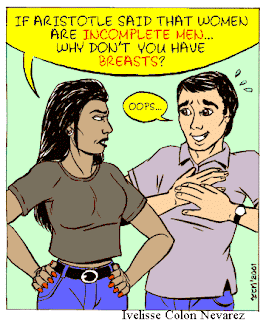
To Use Hitler's Deutsche, Aristotle's ἑλληνίζειν

Den gewaltigsten Gegensatz zum Arier bildet der Jude.
The mightiest counterpart to the Aryan is represented by the Jew.

So glaube ich heute im Sinne des allmächtigen Schöpfers zu handeln: Indem ich mich des Juden erwehre, kämpfe ich für das Werk des Herrn.
Hence today I believe that I am acting in accordance with the will if the Almighty Creator: by resisting the Jew, I am fighting for the work of the Lord..

Denn ein rassereines Volk, das sich seines Blutes bewußt ist, wird vom Juden niemals unterjocht werden können. Er wird auf dieser Welt ewig nur der Herr von Bastarden sein.
For a racially pure people which is conscious of its blood can never be enslaved by the Jew. In this world he will forever be master over bastards alone
--Adolf Hitler

τὸ γὰρ θῆλυ ὥσπερ ἄρρεν ἐστὶ πεπηρωμένον·
The female is, in fact, as it were, a mutilated male.


Hence it is manifest that all the persons mentioned have a moral virtue of their own, and that the temperance (sophrosyne [σωφροσύνη]) of a woman (gunaikos [γυναικὸς]) and that of a man  (andros [ἀνδρός]) are not the same, nor their courage and justice, as Socrates thought, but the one is the courage of command, and the other that of subordination, and the case is similar with the other virtues.
--Aristotle
Why would anyone want to use Aristotle's words or Hitler's?  What if you're a Jewish woman?

My wife, who works in words as a professional writer, recently shared with me the ways some women, in fact, have well appropriated not only Aristotle's words but also his advice about how to use them persuasively.  Look here:

Aristotle’s Ancient Guide to Compelling Copy

and here:

What Aristotle Taught Us About Web Content Development

My spouse was actually endorsing what Amy Harrison and Elise Redlin-Cook were doing with Aristotle's language, with his conception of rhetoric, as clarity and as persuasiveness.

This isn't to say that she doesn't understand the evil of Aristotle's words, his straightforward ugliness towards females, towards women, towards any other, any barbarian.  No.  In fact, my life partner actually gave my dissertation on the awful phallo-logo-centricity of Aristotle's τὸ ἑλληνίζειν an apt, 2-word nickname.  She named the academic project of mine:  Aristotle Exposed.  She and many understand it's not just that Aristotle used his words, his sexist and racist logic, to put down females and to denigrate non-Greeks un-like him


It's also the way Aristotle used language.  His logic left no room for womanly or for barbarian ways of using language.  He taught his elite Greek male-only students to avoid ambiguities, to scoff at hyperbole, to ridicule parable, to work only in what's "Natural" and never in anything else (such as the speakeristic, poetic, the lyrical, the dialectical, the supernatural).  He didn't teach his boys in his AkaDemy (his school for the People) to listen.

So let's listen.  Listen again to Sister Prudence Allen and then to rhetoric scholar Krista Ratcliffe listening to Aristotle:
In these statements the superior valuation of man over woman is explicitly stated [by Aristotle]. However, it is also present in the theory of contraries and in other aspects of Aristotle’s thoughts about sex identity. Aristotle stands out from his predecessors in that he a complete rationale for his theory of sex polarity. He developed reasons and arguments for the philosophically significant differentiation of the sexes and for the superiority of man over woman. Therefore, he is correctly identified [by historians] as the founder of the sex polarity position…. [H]e also laid the groundwork for another theory of sex identity in his philosophy of definition.

Aristotle’s Rhetoric assures students who study his rhetorical theory that they will learn not only how to produce enthymemes but also how to analyze them, and in a culture whose texts were primarily oral, such analysis implies listening. But Aristotle’s theory never delves into how to listen. Moreover, his production/ reception linkage is more complicated than his assurance allows.

Aristotle’s treatise of rhetoric was gender blind.
[Likewise, his treatise of politics is one in which w]omen, slaves and children were relegated to the category of ‘earthly possession’ for which men bargained. To redefine women’s position, feminist theories of rhetoric must critique this concept of language to determine if, and how, it can be made more inclusive. For how we assume language functions, more than anything else, determines how we read and write the cultural as well as the textual.
Listen again.  Allen helps us recall how Aristotle lays a groundwork with language, the groundwork for thinking of males as superior to females.  Now, of course, Aristotle was not the first man to do this.  But, as Ratcliffe also rightly observes, Aristotle's teachings on rhetoric and on politics functioned as categorical and categorizing language that somehow [if wrongly and incongruently] appealed to Nature.

So we come back to Hitler.  Why Hitler?  Well, he's also sexist and racist by how he uses language.  Does that mean we shouldn't use his language?  No, but it means we'd do well to know exactly how he used it.  We would do well to remember that he would not use our language, that he would not want language to be used so liberally, so freely.

My eldest daughter just gave me Viktor Frankl's book, Man's Search for Meaning.  Toward the end of the edition she gave me, Frankl tells this story about language and making meanings by it:
An American woman once confronted me with the reproach, "How can you still write some of your books in German, Adolf Hitler's language?"  In response, I asked her if she had knives in her kitchen, and when she answered that she did, I acted dismayed and shocked, exclaiming, "How can you still use knives after so many killers have used them to stab and murder their victims?"  She stopped objecting to my writing books in German.
To be fair to this American woman, Frankl was quite aware of just how awful, how sexist and how racist, the propaganda of Hitler really was.  Frankl experienced the effects.  Hitler's German is worse than just a kitchen knife.  It was a two-edged sword.  It was a gangster's switchblade, a guerilla's machete, a sadist's scalpel.  It was an IED, a terrorist's home-made bomb, an improvised explosive device.  It was Aristotle's Greek all over again, extreme racism and sexism in the guise of moderate rationality and by appeals to nature.  It was boxing up the Other in tight categories and putting oneself above as the default, unmarked Natural superior. 

Our question today (in these last few days of this Women's History Month) doesn't need to be whether we can use Adolf Hitler's Deutsche or Aristotle's ἑλληνίζειν.  We can.  And we can also do more.  We can use language inclusively, creatively, extremely.  We can listen to that preacher in the church down the street who exclaims that the Bible and Nature conspire against women to keep them silent.  We can eavesdrop on the husband who tells his wife that she is his helpmeet, his complement, his to-be-submissive God-given object, for "the Bible tells me so."  We can overhear the mostly-male politicians and the rule of law again and again justifying why males will have to continue to make more than women in the workplace.  We can ponder, sleeplessly if we must, how it is that young girls must still fear and must still have to work so hard at protecting themselves from being raped, fondled, abused, objectivized by men.  There is much more we can do.

Wednesday, December 12, 2007

Womanism, Fascism, and DE Translation

George Lakoff’s and Eugene Nida’s theories of language and of translation fail to do enough. Their theories, in their efforts at Aristotelian objectivism, would bear Moses’s authority and would keep Onesimus.

(Warning: in this post, there’s a little word play but little child’s play. In other words, this thing is full of high-horse, academic jargon, which is where much power language lives. Dialog is welcome here, because in translation, especially "dynamic equivalence" or DE translation, there's still too much silencing of the marginalized.)

First, then, two true stories about children and words. Call them personal testimonies to the power of parables. Not long ago, a friend of mine told me her grade school daughter came home from school and declared: “Mommy, I know the ‘d-word’ and I know the ‘s-word’ and I know the ‘f-word’ too.” My friend replied, “Oh, Melissa, I’m so sorry you have to learn these words. Who told you what they mean?” But the little girl persisted: “the ‘d-word’ is ‘dumb,’ and the ‘s-word’ is ‘stupid’ and the ‘f-word’ is ‘faker.’” The mother suppressed her smile and her sigh of relief, and proceeded to give her child a lesson in the proper and improper uses of such "four letter words." The second true parable is this: my son when in grade school came home and asked, “Mom, is sex bad?” My wife gave him a long answer, dynamically equivalent to his question. But I’ll explain the problems below.

Linguists and others familiar with the work of George Lakoff may note how my title here plays on one of his: Women, Fire, and Dangerous Things: What Categories Reveal about the Mind. Likely, some of you will remember Lakoff’s opener. He begins: “Many readers, I suspect, will take the title of this book as suggesting that women, fire, and dangerous things have something in common—say, that women are fiery and dangerous.” (He confesses that he is “inspired by the Australian aboriginal language Dyirbal, which has a category, balan, that actually includes women, fire, and dangerous things.”) With sure, confident certainty, he recalls the mixed reactions to his word play: “Most feminists I’ve mentioned it to have loved the title for that reason, though some have hated it for the same reason” (page 5).

Lakoff shows the arbitrary-but-common, nevertheless-coherent Dyirbal category of balan and its appositioned members. (Fortunately for his readers, Lakoff translates these members into English as “women,” “fire,” and “dangerous things” ). Unfortunately, in unveiling his title and its unifying term, balan, he can’t help but make a point about divisiveness among readers. Ironically, Lakoff can only assume he stands above them with a more unified, a more objective, approach. And yet you, reading closely (in English only), should be able to see his own arbitrary and coherent category of overlapping but varying members of readers: (1) “many readers,” (2) “most feminists,” and (3) “some [feminists who] have hated.”

That is, Lakoff believes that all of those “many readers” (e.g., those in group 1) can’t help but “take” his title to represent “women, fire, and dangerous things” as having “something in common.” Likewise, he believes that all of those “most feminists” (e.g., those in group 2) hold the same three variants in the title (e.g., “women,” and “fire,” and “dangerous things”) as part of the same single category (e.g., the “something in common. . . for that [same] reason”). And Lakoff believes that each and every one of the “some [feminists who] have hated” the title (e.g., those in group 3) have nonetheless belonged in the category with all of those who will take the three noun phrases of his main title to belong to the same single category (e.g., all readers). In summary, as Dyirbal holds together at least three unlikely terms in a single-word category so Lakoff identifies as dynamically equivalent his three explicitly-named groups of readers.

But neither Lakoff nor any of us reading his title can easily identify a single categorical word in English (such as balan, so superficially foregrounded in Dyirbal) that would name his category and ours (e.g., the category “that actually includes” the variant members (1) “many readers,” (2) “most feminists,” and (3) “some [feminists who] have hated [the title]”). If the common meaning were not so “transparent,” we English readers should perhaps agree on the noun phrase, readers. You see, Lakoff is trying to keep all of his readers (in one big dynamic readership). And he’s telling us all, as if objectively, something about our categories and our minds that we cannot categorize and comprehend either alone or collectively as part of a group of his readers. After more than 580 pages of carefully explicated examples, Lakoff begins his “Afterword,” by writing:

I began work on this book with the knowledge that objectivist views of the mind have a very wide currency in the academic world. Among my principal aims has been to characterize that view, name it, point out that it is an opinion, not a fundamental truth, and raise the question of its validity, so that is can be discussed in the open and no longer be presumed automatically as part of an unquestioned background. (page 586)

Nevertheless, Lakoff’s unnamed assumptions exemplify and enact the very “objectivist views of the mind” he purports to write against. For all the naming he does do, Lakoff fails to “point out [how his] is an opinion, not a fundamental truth”; and, to be sure, his opinion is that as an expert linguist (not a woman, not even a feminist) tenured at Berkeley he is objectively recording the facts, albeit the now-obvious facts about the dubious “objective views.”

To best interpret his argument, then, we readers can only try to “raise the question [of Lakoff’s argument’s] validity, so that it [is] discussed in the open and [is] no longer presupposed automatically as part of an unquestioned background” (page 586). What we have to attempt to do, now, is to show that Lakoff’s book (and our reading and critiquing it) is based on profound, unnamed, and unquestioned categories of belief, from our own subjective perspectives. What we might end up seeing is that his argument-belief contradiction (and even ours) is emblematic of slippery, sloppy language that DE translators want to tidy up. From his title to his closing words, Lakoff counts on all of his readers to believe certain categories, to suspend their disbelief, and to take his categories for granted as theirs. And we do go along, even if we “hate” it. But, oddly, Lakoff is careful to report, as an “objectivist” would, that there are the “some [feminists who] have hated [his title].” Suspiciously, the author himself cannot observe his title to be hateful or hate provoking. It’s “some feminists” who are in that category, and he is not.

So we can go on: neither Lakoff nor we his readers can easily fathom something more profound and problematic. That is this: if Lakoff could ever have written the book in Dyirbal, then how transparent balan would be to the Aboriginal native speakers. Of course, not much considering what deep suppositions they might have about us, we may tend to presume them to be illiterates and not necessarily speakers of English, and not linguists, feminists, or thinking people of any discipline. Yet wouldn’t and shouldn’t they be suspicious that we might read (as Lakoff suggests in English we will) the phrase “women, fire, and dangerous things” as suggesting “that women are fiery and dangerous”? Is it not a stretch to imagine, analogously, that readers (of English or of Dyirbal) would take the title “Womanism, Fascism, and Dynamic Equivalence Translation” to mean that womanism and fascism are dynamically equal? As we interpret, we do prefer not to be interpreted.

Specifically, we desire our vocabularies not to be mixed, our beliefs not to be contradicted, and our categories not to be exposed. Otherwise, when drawing sharp lines of distinction, we might be found sitting on the side of the others we criticize. Such is the case of George Lakoff (e.g., exposing objectivist views by employing the objectivist perspective, that would transcend a feminist and an Aboriginal critique). But he knows that he, and we, and they all do play the dynamic equivalence game.

We might have gone on long enough here. You can get “the meanings” of womanism and fascism and dynamic equivalency translation theory from a dictionary or an encyclopedia.

But I do think we’d do well to see what’s going on. There are positions of power, for any reader, for any translator. And the insider and outsider positions are subjective. Even the most objective scientist will use his or her head and his or her heart and stomach. Even the most artsy translator will find, in a text to be translated and its translation, at least these three alternative perspectives: particle (i.e., a unit), or wave (i.e., dynamism and change), or field (i.e., relativity in context). (Such is the contribution of the late great Kenneth Pike to language and translation). So Lakoff is on to something, wanting to resist objectivity, if he could only acknowledge how he assumes power over, say, feminists who hate his title and the Dyirbal speakers he presumes to speak for. And Nida, by referring to his translation approach as “dynamic equivalence” is on to something. Dynamic seems to be wavy (though it isn’t always in DE). Equivalence assumes a field of relationship (albeit an impossibly ideal one). And Translation (as DE) likes to think of itself as an objective thing, a particle if you will. But.

Let’s listen to a womanist, then a fascist. And let’s see how dynamically equivalent we may be to them. (I haven’t forgotten the children in the true parables above. We’ll hear them out too).

Now Alice Walker, the afrafeminist who coined “womanism,” didn’t write the Bible. She did write a book called The Temple of My Familiar. Let’s listen in on some of the characters’ conversations:

“‘You are saying,’ I asked her, ‘that all evil, like racism or sexism, is a result of sickness?’

“‘Not only that,’ she whispered, ‘the child will always, as an adult, do to someone else whatever was done to him when he was a child. It is how we, as human beings, are made. I shudder to think what Hitler’s childhood was like,’ she said. (page 310)

“ . . . I told her bluntly that I was in therapy, trying to get to the roots of my anger against white people. I didn’t tell her it was particularly against whites who were blond. I guess I was afraid she’d say, like so many people do: Well, everybody hates Nazis. That’s what they think I mean. They think of Hitler’s Aryan race as played by bleached-blond actors on TV. That image is, I know, only a small part of it. (page 326)

Now Lakoff and Nida might protest here. This is literature. The categories in non-literary works are not equal to others. Apples and oranges. We ought to know better.

So let’s all keep moving, then. To something more familiar. To translation of a didactic text or an epistolary one. How about these:

“Es ist immer der gleiche Jude. Daß diese Selbstverständlichkeit von einem normalen heutigen Ministerialrat oder höheren Polizeibeamten nicht begriffen wird, ist freilich auch selbstverständlich”
Adolf Hitler, Mein Kampf

“He is always the same Jew. That so obvious a fact is not recognized by the average head-clerk in a German government department, or by an officer in the police administration, is also a self-evident and natural fact”
Adolf Hitler, Mein Kampf (DE translator James Murphy)

“We hold these truths to be self-evident, that all men are created equal, that they are endowed by their Creator with certain unalienable Rights, that among these are Life, Liberty and the pursuit of Happiness.”
Thomas Jefferson, The Declaration of Independence

So let’s start with the most familiar (since, fortunately, more of us read the Bible and the Declaration of Independence it’s based on more than we do Mein Kampf).

Thomas Jefferson’s Declaration may name some (e.g., “the merciless Indian Savages”) while it unnames others (e.g., black males and women, regardless of color but especially black women). But it excludes all of them equally from the category of “all men created equal.” Moreover, the liberating document—invoking the names of God and of Nature—binds together, in an unintended dynamic equivalence, the revolutionary colonizers and their abusive King into one elite group: property owners, who are white men. These truths, if they are “to be self-evident,” we must hold; and we hold them to a certain advantage: our own. To read the Declaration of Independence otherwise is to see the inequalities in its explicit and implicit “natural” classes of ownership, race, and gender.

But “we” might be outsiders to a Nazi’s experience, and more to Alice Walker’s characters’ experiences. Neither we nor Adolf Hitler or Walker will interpret as equal both (A) his Übermensch and (B) the reality of her whispering black women. And only few of us (namely translator James Murphy) might see the phrase “self-evident” as a good translation of freilich; not many of us could believe or should want to imply that Hitler follows some method of Jefferson and is thereby less sinister. However, we all know that human beings have the power to call disparate things equal. Likewise, “we” in community can “hold these truths” in our collective subjectivity “to be self evident.” And we acknowledge our Creator, depending on our perspective of outsider or insider, as creating all men and women equal.

So back to the parables. My friend and her daughter were in learning conversation. Each was learning from the other. What the girl meant by “the s- word” was not anything “stupid” at all. And when calling it a “four-letter word,” the mother could take the context, and the power issues on the playground, and discover that the demeaning-term category often includes five letters.

And my son? After awkwardly listening to his mother discuss good sex and bad, he replied. “No Mom; not sex. Sucks. Is sucks a bad word?

(No, DE translators; not authority, rather “Moses’s seat.” And not Onesimus the slave; rather “Handy” the handy name of a human being “above a slave in the flesh and in the Master.”)