My wife and our daughters had an encounter with a street preacher downtown Fort Worth, Texas USA the other night. As they approach him, she said to our eldest, the most outspoken, "Now, just don't engage." And yet the guy was good at his craft. He rattled a mother by accusing her children. "You probably think you're Christians, that you're going to heaven, that you follow Jesus. But you little girls just follow Jesus around like puppy dogs. You're all going to hell." At that, my wife laid into him, telling him he had no idea who her daughters were let alone who Jesus is. They got into an argument about whether he was judging and whether he was, as he was claiming, like Moses in the dessert bringing good news to his people though some died eternally refusing to listen and following idols. And my daughter, the most outspoken, made her public profession of faith as a missile back at the guy: "Isn't 'good news' about love? I'd rather go to Hell than to follow your version of Jesus."
Words are weird. I grew up hearing the words "Tin Lành" in South Vietnam, where my American parents were Southern Baptist missionaries during the war. There was a war for words there too. In Vietnamese the word tin means "news" and lành mean "good." And the phrase "tin lành" means "gospel" or "evangelist" or "Protestant" and actually is the label for a large (not Baptist) Protestant denomination. "Good news," huh?
I've been thinking about these things a lot. Rachel Held Evans has a series of posts on "good news," trying to define it and trying to get others to have a concensus about it while enjoying the diversity of it. Wendy McCaig, similiarly, has a post "Good News?" and a post "What Label Do You Wear?" This makes me want to write a blog post on the Hebrew (and Greek) origins of the phrase Christians and evangelical Christians, even street preachers, have appropriated exclusively for themselves, so concerned about its definition and the Jesus ostensibly so associated with the phrase.
In the mean time, I've appreciated Bob McDonald's thoughts about words and their translation. Look here how he uses the metaphors "guest" and "host" languages! This is a rather non-Western and a particularly Chinese sort of metaphor, if you ask Lydia H. Liu. Look how Bob talks about those who think they are "far from God or Gospel." If I had time to blog more (I don't), I'd say more just how sexist the street preacher was to these women (my wife and my daughters) whom he accosted with his gospel. If I had time, I might also say how sexist I think the words niña and mallorquina are in the sonnet that Willis Barnstone (also a Bible translator) translated rather simply and all-too-benignly as "the pupil" and "the Mallorca whore." I think they mean something like "little girl" and "shiksa slut." Do I know Spanish and English and Yiddish and the author of the sonnet? We all thought the bad words were merely those other ones, didn't we? The excremental ones. But when "good news" hurts women and men and boys and girls, aren't these also bad words? Can't we talk about these words and their translation and our appropriations of them and exclusions by them a little more?
Showing posts with label just words. Show all posts
Showing posts with label just words. Show all posts
Saturday, August 27, 2011


Tuesday, April 5, 2011
The Gender of the Biblioblogger Count
This quick post is just an update of "The Gender of Blogger Clout."
3 things:
1. A comparison of woman : male ratios in the top OpEd journals with the woman : male ratios in the top Biblioblogs.
2. A couple of related posts and comments.
There's a new comment at the post where, as Rod puts it, "April DeConick was labelled a man-hating angry feminist as some of us just dismissed all too easy her request to even change how the stats take place (another day, another time)." The commenter self-identifies as a woman by name and says:
3. A comment on the title of this post.
The title of my posts can also be humorous. I'm following Anne Carson's lead here; she writes that insightful and funny essay, "The Gender of Sound." She has not, it seems, done anything to discontinue writing "about those institutions which defend the status quo." She does, in fact, write about the bible, the political system, and translator bias, and gender bias, and Aristotle, and so on and so forth.
3 things:
1. A comparison of woman : male ratios in the top OpEd journals with the woman : male ratios in the top Biblioblogs.
 |
| theopedproject.org VS, biblioblogtop50.wordpress.com |
2. A couple of related posts and comments.
There's a new comment at the post where, as Rod puts it, "April DeConick was labelled a man-hating angry feminist as some of us just dismissed all too easy her request to even change how the stats take place (another day, another time)." The commenter self-identifies as a woman by name and says:
I don't know about the Alexa ratings, but for those lists that exist because someone nominates a blog or requests that their own blog be listed-- if this is being perceived as a "boys club" (whether accurately or otherwise), some women may simply not be trying, or may not be interested in trying, to get in. Why try if the deck is already stacked against you? (Even if that's just a perception, it could be affecting the ratings.)There's a new post at The Biblioblog Top 50 blog. We can imagine, from the "us"-vs.-"them" and the "we"-vs.-"you" language, that the writer of the post is a man (and not one of those women bloggers of the Bible). He is ostensibly speaking on behalf of the top men blogging the Bible. He's taking a stab at humor, is saying "Now accepting women!" and is playing on "April" DeConick's name. His final sentences are as follows:
We will also oppose those forces of systemic gender inequality that exist to marginalize (but not in a victimy way, ok, April) women in academia and in academic biblical studies. In solidarity with all those who are othered by the hegemonic centre, we call on all bibliobloggers to discontinue blogging about those institutions which defend the status quo, such as the Bible, the political system, the churches, biblical studies, and the Biblical Archaeology Review - until such time as the system crumbles and falls! Ok?So is the deck stacked against women who are bibliobloggers? Who is really interested in joining this Top Club now? Are "we" men now joining "women in academia and in academic biblical studies" in opposing "systemic gender inequality"? Is our equal strategy really "to discontinue blogging about" any given or particular topic? Is that what this man thinks women want? Yes, I know. Get serious now. This guy (who doesn't need to identify his sex or even to use his name) is just funny and really only just wants a laugh. So lighten up. Ok?
3. A comment on the title of this post.
The title of my posts can also be humorous. I'm following Anne Carson's lead here; she writes that insightful and funny essay, "The Gender of Sound." She has not, it seems, done anything to discontinue writing "about those institutions which defend the status quo." She does, in fact, write about the bible, the political system, and translator bias, and gender bias, and Aristotle, and so on and so forth.
Tuesday, March 29, 2011
To Use Hitler's Deutsche, Aristotle's ἑλληνίζειν
Den gewaltigsten Gegensatz zum Arier bildet der Jude.
The mightiest counterpart to the Aryan is represented by the Jew.
So glaube ich heute im Sinne des allmächtigen Schöpfers zu handeln: Indem ich mich des Juden erwehre, kämpfe ich für das Werk des Herrn.
Hence today I believe that I am acting in accordance with the will if the Almighty Creator: by resisting the Jew, I am fighting for the work of the Lord..
Denn ein rassereines Volk, das sich seines Blutes bewußt ist, wird vom Juden niemals unterjocht werden können. Er wird auf dieser Welt ewig nur der Herr von Bastarden sein.
For a racially pure people which is conscious of its blood can never be enslaved by the Jew. In this world he will forever be master over bastards alone
--Adolf Hitler
τὸ γὰρ θῆλυ ὥσπερ ἄρρεν ἐστὶ πεπηρωμένον·Why would anyone want to use Aristotle's words or Hitler's? What if you're a Jewish woman?
The female is, in fact, as it were, a mutilated male.
Hence it is manifest that all the persons mentioned have a moral virtue of their own, and that the temperance (sophrosyne [σωφροσύνη]) of a woman (gunaikos [γυναικὸς]) and that of a man (andros [ἀνδρός]) are not the same, nor their courage and justice, as Socrates thought, but the one is the courage of command, and the other that of subordination, and the case is similar with the other virtues.
--Aristotle
My wife, who works in words as a professional writer, recently shared with me the ways some women, in fact, have well appropriated not only Aristotle's words but also his advice about how to use them persuasively. Look here:
Aristotle’s Ancient Guide to Compelling Copy
and here:
What Aristotle Taught Us About Web Content Development
My spouse was actually endorsing what Amy Harrison and Elise Redlin-Cook were doing with Aristotle's language, with his conception of rhetoric, as clarity and as persuasiveness.
This isn't to say that she doesn't understand the evil of Aristotle's words, his straightforward ugliness towards females, towards women, towards any other, any barbarian. No. In fact, my life partner actually gave my dissertation on the awful phallo-logo-centricity of Aristotle's τὸ ἑλληνίζειν an apt, 2-word nickname. She named the academic project of mine: Aristotle Exposed. She and many understand it's not just that Aristotle used his words, his sexist and racist logic, to put down females and to denigrate non-Greeks un-like him.
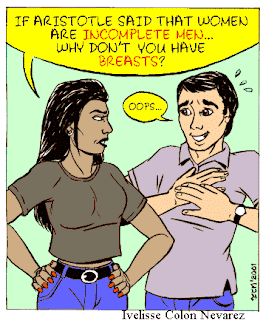
It's also the way Aristotle used language. His logic left no room for womanly or for barbarian ways of using language. He taught his elite Greek male-only students to avoid ambiguities, to scoff at hyperbole, to ridicule parable, to work only in what's "Natural" and never in anything else (such as the speakeristic, poetic, the lyrical, the dialectical, the supernatural). He didn't teach his boys in his AkaDemy (his school for the People) to listen.
So let's listen. Listen again to Sister Prudence Allen and then to rhetoric scholar Krista Ratcliffe listening to Aristotle:
In these statements the superior valuation of man over woman is explicitly stated [by Aristotle]. However, it is also present in the theory of contraries and in other aspects of Aristotle’s thoughts about sex identity. Aristotle stands out from his predecessors in that he a complete rationale for his theory of sex polarity. He developed reasons and arguments for the philosophically significant differentiation of the sexes and for the superiority of man over woman. Therefore, he is correctly identified [by historians] as the founder of the sex polarity position…. [H]e also laid the groundwork for another theory of sex identity in his philosophy of definition.
--Allen
Aristotle’s Rhetoric assures students who study his rhetorical theory that they will learn not only how to produce enthymemes but also how to analyze them, and in a culture whose texts were primarily oral, such analysis implies listening. But Aristotle’s theory never delves into how to listen. Moreover, his production/ reception linkage is more complicated than his assurance allows.
Aristotle’s treatise of rhetoric was gender blind.
[Likewise, his treatise of politics is one in which w]omen, slaves and children were relegated to the category of ‘earthly possession’ for which men bargained. To redefine women’s position, feminist theories of rhetoric must critique this concept of language to determine if, and how, it can be made more inclusive. For how we assume language functions, more than anything else, determines how we read and write the cultural as well as the textual.Listen again. Allen helps us recall how Aristotle lays a groundwork with language, the groundwork for thinking of males as superior to females. Now, of course, Aristotle was not the first man to do this. But, as Ratcliffe also rightly observes, Aristotle's teachings on rhetoric and on politics functioned as categorical and categorizing language that somehow [if wrongly and incongruently] appealed to Nature.
So we come back to Hitler. Why Hitler? Well, he's also sexist and racist by how he uses language. Does that mean we shouldn't use his language? No, but it means we'd do well to know exactly how he used it. We would do well to remember that he would not use our language, that he would not want language to be used so liberally, so freely.
My eldest daughter just gave me Viktor Frankl's book, Man's Search for Meaning. Toward the end of the edition she gave me, Frankl tells this story about language and making meanings by it:
An American woman once confronted me with the reproach, "How can you still write some of your books in German, Adolf Hitler's language?" In response, I asked her if she had knives in her kitchen, and when she answered that she did, I acted dismayed and shocked, exclaiming, "How can you still use knives after so many killers have used them to stab and murder their victims?" She stopped objecting to my writing books in German.To be fair to this American woman, Frankl was quite aware of just how awful, how sexist and how racist, the propaganda of Hitler really was. Frankl experienced the effects. Hitler's German is worse than just a kitchen knife. It was a two-edged sword. It was a gangster's switchblade, a guerilla's machete, a sadist's scalpel. It was an IED, a terrorist's home-made bomb, an improvised explosive device. It was Aristotle's Greek all over again, extreme racism and sexism in the guise of moderate rationality and by appeals to nature. It was boxing up the Other in tight categories and putting oneself above as the default, unmarked Natural superior.
Our question today (in these last few days of this Women's History Month) doesn't need to be whether we can use Adolf Hitler's Deutsche or Aristotle's ἑλληνίζειν. We can. And we can also do more. We can use language inclusively, creatively, extremely. We can listen to that preacher in the church down the street who exclaims that the Bible and Nature conspire against women to keep them silent. We can eavesdrop on the husband who tells his wife that she is his helpmeet, his complement, his to-be-submissive God-given object, for "the Bible tells me so." We can overhear the mostly-male politicians and the rule of law again and again justifying why males will have to continue to make more than women in the workplace. We can ponder, sleeplessly if we must, how it is that young girls must still fear and must still have to work so hard at protecting themselves from being raped, fondled, abused, objectivized by men. There is much more we can do.
Monday, November 3, 2008
Subverting & Reappropriating vs. Sexism
"This one definitely fits into the 'steamy underbelly' category of Biblical literature, which most English translations bowdlerize into sanitized scripture, so use your own judgment on what you’re comfortable with," warns ElShaddai Edwards in his post pointed to a post by N.T. Wrong.
Wrong's judgement is right, as he gets us recognizing the sexism of Hamlet and of Hosea. Shakespeare (or whoever he/ she is) is the one subverting and reappropriating English words by punning in "Hamlet." And Alice A. Keefe, by punning in translation, is subverting and reappropriating English and Hebrew words in the book of Hosea. Wrong gives Shakespeare's pun, Keefe's translating, and his own reworking of the Hebrew/ English for more on all of that.
It's a dirty, sexist word (or two or three) that Wrong is using, is playing with. This goes beyond our comfort level. It gets right to the issues of sexism (or as "right to" as indirect social commentary has to be). What you're comfortable with depends on how sexist you are, I'm afraid. What you're willing to deal with depends on how feminist you are willing to be. (With comments at Wrong's blog, I try to show how the first translators of the bible weren't so comfortable with the erotic language of rape. Some time back I posted on how uncomfortable these Jewish male translators were with Greek male sexism, unless they could blame it on the woman).
Let me end this post with what Ann Friedman said to end one of her posts at feministing.com a while ago. She said:
Wrong's judgement is right, as he gets us recognizing the sexism of Hamlet and of Hosea. Shakespeare (or whoever he/ she is) is the one subverting and reappropriating English words by punning in "Hamlet." And Alice A. Keefe, by punning in translation, is subverting and reappropriating English and Hebrew words in the book of Hosea. Wrong gives Shakespeare's pun, Keefe's translating, and his own reworking of the Hebrew/ English for more on all of that.
It's a dirty, sexist word (or two or three) that Wrong is using, is playing with. This goes beyond our comfort level. It gets right to the issues of sexism (or as "right to" as indirect social commentary has to be). What you're comfortable with depends on how sexist you are, I'm afraid. What you're willing to deal with depends on how feminist you are willing to be. (With comments at Wrong's blog, I try to show how the first translators of the bible weren't so comfortable with the erotic language of rape. Some time back I posted on how uncomfortable these Jewish male translators were with Greek male sexism, unless they could blame it on the woman).
Let me end this post with what Ann Friedman said to end one of her posts at feministing.com a while ago. She said:
I roll my eyes at this campaign [by a library that uses a sexist logo of a woman], but sport a tote bag with the Feministing logo [that's nearly the same]. It's why I rail against people who call powerful women "bitch," but subscribe to a magazine of the same name. It's why I am totally appalled to hear someone utter the word "cunt" as an epithet, but picked up Inga Muscio's book. The same image (or word) in different contexts can flip pretty quickly from subversion/reappropriation to just flat-out sexism.
Thursday, May 22, 2008
Births, Babies, and Bastards: Just Words
Eliminating racism
Empowering women
Empowering women
--sign on the side of the ywca van west-bound on I-30 this morning in Fort Worth , Texas USA
The origin is a masculine myth. . . .
The question, ‘Where do I come from?’ is basically a masculine, much more than a feminine question. The quest for origins, illustrated by Oedipus, doesn’t haunt a feminine unconscious. Rather it’s the beginning, or beginnings, the manner of beginning, not promptly with the phallus, but starting on all sides at once, that makes a feminine writing. A feminine text starts on all sides at once, starts twenty times, thirty times, over.
The question, ‘Where do I come from?’ is basically a masculine, much more than a feminine question. The quest for origins, illustrated by Oedipus, doesn’t haunt a feminine unconscious. Rather it’s the beginning, or beginnings, the manner of beginning, not promptly with the phallus, but starting on all sides at once, that makes a feminine writing. A feminine text starts on all sides at once, starts twenty times, thirty times, over.
--Hélène Cixous, “Castration or Decapitation?” tr. Annette Kuhn, Signs 7 (Autumn 1981): 53. fr. Nancy Mairs, “Essaying the Feminine,” Voice Lessons: On Becoming a (Woman) Writer, 85
Around the blogosphere are signs of word birth, and questions of origins or of beginnings, with more questions about legitimacy or otherings.
- April DeConick has begun a new word for better work in history writing. So far, the begininngs are here, and here, and here, and here, and here.
- Some men (yes some of us men) are concerned about the origin of an old word. (Don’t ask us what haunts us, please; and you have to scroll down past the pics of one Mr. Bean to the real serious hauntings.)
- Othering men (yes that kind) used original words to dis-empower women through words
- Other othering men used others original words, not to eliminate, but to perpetuate the denigration of human beings of races "darker."
- Jonathan Tilove more than a year ago wanted to know the origins of one of Barack Obama’s phrases.
Subscribe to:
Comments (Atom)