Showing posts with label mother. Show all posts

Thursday, November 6, 2008

Mahalia Jackson and Dr. Ann: Barack Obama's Rhetorical Mothers


To whom does Barack Obama owe his rhetorical abilities?  After his "Yes We Can" presidential acceptance speech, some are speculating without looking first to his mothers
  • Is his cadence the "cadence of the Bible"?  
  • Must we "[f]inally. . . give credit to the sermon style of the Black Church (which in Obama’s case, largely means that of Jeremiah Wright’s church)"?
  • Might it be Wright himself, as the Rev. Jim Wallis argues to Rolling Stone as early as the '04 DNC, asserting: "If you want to understand where Barack gets his feeling and rhetoric from just look at Jeremiah Wright"?
  • Could our next president be an imitator of Malcolm X for racist ends, as talk-show host Taylor Marsh has suggested?
  • Isn't it that "[h]e either deliberately or subconsiously, imitates the speaking style of Dr. Martin Luther King, whose style was grounded in the A-A church"?
Let's consider, initially instead, the womanly, rhetorical influences on King himself that are the same for Barack Obama.   Like King, Obama was greatly and deeply influenced by his own mother.  And both men are influenced by Mahalia Jackson.

King's mother was Alberta Williams King.  Biographer Keith Miller notes:
Not only was she an able parent and dedicated Christian, she also served as a church organist who communicated her love of music to her children, making sure that King, Jr., took piano lessons as a child. Years later King often spoke following performances by such stellar gospel singers as Mahalia Jackson and Cleo Kennedy. he encouraged group singing during protest rallies and called songs "the soul of the movement." Like folk preachers before him, including his father, he incorporated the lyrics of spirituals, hymns, gospel songs, and patriotic standards into his discourse. Plainly him mother encouraged his affinity for music and, along with her husband, helped foster the close relationship between they rhythms and content of King's oratory and the cadences and lyrics of religious songs. The metrical, rolling lines that make King's oratory memorable (e.g., "I have a dream," "Let freedom ring," "How long?") exemplify the forms of parallelism abounding in folk sermons. They also reflect the repeated refrains of spirituals, gospel standards, and hymns. The musical qualities of King's phrases are unmistakable. 
(Voice of Deliverance: The Language of Martin Luther King, Jr., and Its Sources, page 64)
On the 45th Anniversary of King's "I Had A Dream Speech," we were reminded by witness Roger Witkins and biographer Taylor Branch of the direct influence of Mahalia Jackon on King's famous speech.

Now, let's consider Barack Obama and his rhetorical mothers.  Amanda Ripley, in Time magazine, tells "The Story of Barack Obama's Mother" whose name is Stanley Ann Dunham (Obama) (Soetoro), Ph.D.:
Ironically, the person who mattered most in Obama's life is the one we know the least about—maybe because being partly African in America is still seen as being simply black and color is still a preoccupation above almost all else. There is not enough room in the conversation for the rest of a man's story.

But Obama is his mother's son. In his wide-open rhetoric about what can be instead of what was, you see a hint of his mother's credulity. When Obama gets donations from people who have never believed in politics before, they're responding to his ability—passed down from his mother—to make a powerful argument (that happens to be very liberal) without using a trace of ideology. On a good day, when he figures out how to move a crowd of thousands of people very different from himself, it has something to do with having had a parent who gazed at different cultures the way other people study gems.
Obama himself supplies some of the details. Ripley quotes him:
"My mother, whose parents were nonpracticing Baptists and Methodists, was one of the most spiritual souls I ever knew," Obama said in a 2007 speech. "But she had a healthy skepticism of religion as an institution. And as a consequence, so did I."

In her own way, Ann tried to compensate for the absence of black people in her son's life. At night, she came home from work with books on the civil rights movement and recordings of Mahalia Jackson. Her aspirations for racial harmony were simplistic. "She was very much of the early Dr. [Martin Luther] King era," Obama says. "She believed that people were all basically the same under their skin, that bigotry of any sort was wrong and that the goal was then to treat everybody as unique individuals." 
Clearly, Barack Obama's mother Dr. Ann Dunham and Mahalia Jackson are his rhetorical mothers.  If you now have been moved by him, you have been moved by them.

Wednesday, November 5, 2008

Barack Obama's Favorite Book, And Yours


What book has changed your life? Or what's your favorite?

My daughter, the bookworm, is reading The Book That Changed My Life: 71 Remarkable Writers Celebrate the Books That Matter Most to Them.  It's fascinating to think back through the books, to the ones that changed us most, and why.  Given a recent post of mine, you can imagine that Maurice Sendak's Where the Wild Things Are is one of my favorites, and has influenced me.

And then one of you googles this blog yesterday for obama saying his favorite book is "where the wild things are". Thanks! Here's where that led me: to youtube.com to hear Barack Obama talking about his mom, her influence on him through books, and how he loves Sendak's book. (Boy, does that remind me of my mom!)  Take a look, and listen:


And then would you share your story, a person or book that's influenced you?

Tuesday, June 12, 2007

Home Training: Rhetorical (Hellenist-Roman-Afra) Feminism


SEXISM

Julius Ceasar was a sexist man, as William Shakespeare portrays him. (See “Making a Woman and Other Institutionalized Diversions,” by Jeanne Addison Roberts and “O, what men dare do” by Anthony Sampson).

And generally men in ancient Rome were chauvanists, according Cheryl Glenn: “A particular point of Roman male pride seems to have been the deliberate exclusion of women from civil and public duties” (See Rhetoric Retold: Regendering the Tradition from Antiquity Through the Renaissance page, 61).

FEMINISM

But we must retell this history, a bit more, a bit differently. First, the facts we all know (from the cradle):

Julius Caesar was born to Gaius Caesar, the patrician, and to Aurelia Cotta, the plebian. The baby boy was born after two girls, Julia Caesaris the Elder and Julia Caesaris the Younger.

The historical facts show that Aurelia Cotta perfectly fulfilled the Roman “ideal of the domina, of the strong privatized woman” (Glenn 72). Aurelia Cotta was “very influential in her son’s upbringing and security” while her husband “was often away.” Thus, the “historian Tacitus, considers her as an ideal Roman matron and thinks highly of her. Plutarch describes her as a ‘strict and respectable’ woman. Highly intelligent, independent and renowned for her beauty and common sense, Aurelia was held in high regard throughout Rome” (See her history being written at Wikipedia.)

HINTS OF HELLENIST-ROMAN-AFRA RHETORICAL FEMINISM

But we must retell this story a bit more, and quite a bit differently. Second, the earliest factual accounts we tend to overlook (to the grave):

Julius Caesar had the presence of mind to speak and act when he was assassinated. Let’s review then rewind from Shakespeare’s (16 century A.D.) version of what he said:

“Et tu, Brute? Then fall Caesar!”

Let’s go back to and then beyond snippets of Plutarch’s (1st century A.D.) version (and of the 20th century A.D. English translations) of what he said and did:

πρτος δ Κάσκας ξίφει παίει παρ τν αχένα πληγν ο θανατηφόρον οδ βαθεαν, λλ’ ς εκς ν ρχ τολμήματος μεγάλου ταραχθείς, στε κα τν Καίσαρα μεταστραφέντα το γχειριδίου λαβέσθαι κα κατασχεν.

It was Casca who gave him the first blow with his dagger, in the neck, not a mortal would, nor even a deep one, for which he was too much confused, as was natural at the beginning of a deed of great daring; so that Caesar turned about, grasped the knife, and held it fast.

μα δέ πως ξεφώνησαν, μν πληγες ωμαϊστί· „μιαρώτατε Κάσκα, τί ποιες;“ δ πλήξας λληνιστ πρς τν δελφόν· „δελφέ, βοήθει“.

At almost the same instant both cried out, the smitten man in Latin: "Accursed Casca, what does thou?" and the smiter, in Greek, to his brother: "Brother, help!"

δι κα Βροτος ατ πληγν νέβαλε μίαν ες τν βουβνα. λέγεται δ’ πό τινων, ς ρα πρς τος λλους πομαχόμενος κα διαφέρων δερο κκε τ σμα κα κεκραγώς, τε Βροτον εδεν σπασμένον τ ξίφος, φειλκύσατο κατ τς κεφαλς τ μάτιον κα παρκεν αυτόν, ετ’ π τύχης εθ’ π τν κτεινόντων πωσθες πρς τν βάσιν φ’ ς Πομπηΐου βέβηκεν νδριάς.

Therefore Brutus also gave him one blow in the groin. And it is said by some writers that although Caesar defended himself against the rest and darted this way and that and cried aloud, when he saw that Brutus had drawn his dagger, he pulled his toga down over his head and sank, either by chance or because pushed there by his murderers, against the pedestal on which the statue of Pompey stood.

Let’s now read what the Roman historian Gaius Suetonius Tranquillus writes (in our earliest 1st century account, with a later 20th century translation):

Atque ita tribus et viginti plagis confossus est uno modo ad primum ictum gemitu sine voce edito, etsi tradiderunt quidam Marco Bruto irruenti dixisse: κα σ τκνον;

And in this wise he was stabbed with three and twenty wounds, uttering not a word, but merely a groan at the first stroke, though some have written that when Marcus Brutus rushed at him, he said in Greek, “You too, my child?”

Now, let’s reconsider.

What if Julius Caesar’s dying words were not Latin (as Shakespeare and Plutarch have suggested)?

What if, in the Hellenist language, Caesar said to Brutus (as the Latin-writing but then Hellenist-alphabet writing-historian Suetonius reports from his other earlier sources): κα σ τκνον?

Where would Julius have gotten those Hellenist utterances? Who would have trained him so viscerally in this other mother tongue?

HOME TRAINING

So we retell this a bit more, a good bit differently. Third, then, here are some things we do well to hear (feminist rhetorics of resistance):

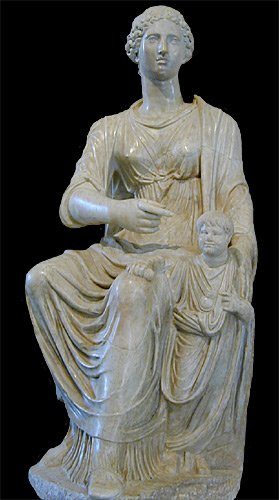
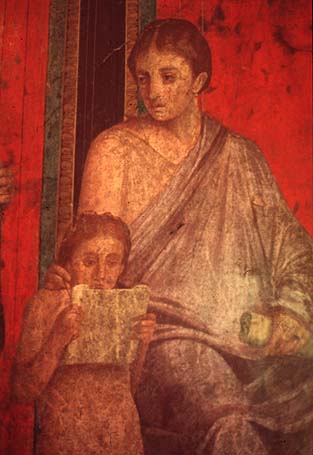
Aurelia Cotta was the trainer of those in her home. She was the mother of Julia Caesaris the Elder, Julia Caesaris the Younger, and Gaius Julius Caesar. She was the bodily present parent. She was the plebian parent (not one of the patricians, like her husband). She told stories. She was educated. She read Homer, Hesiod, and Sappho, and spoke the Hellenist tongue.

It is not too far fetched to imagine Aurelia Cotta reading the Illiad in her home place. It is likely to have been some act of resistance. Resistance to being silenced, as a woman, as a plebian, as a mother, in Rome! (Glenn reminds us here that:

Because the Romans clung to the ideal of the domina, of the strong privatized woman, they [i.e., the Roman men] often reacted with perplexity or disgust at the women who pursued intellectual or political aspirations. Unlike the very few Greek women who found acceptance and admiration in the public domain, no Roman woman seems to have succeeded in establishing herself as a public figure in her own right. [72])

It is not too difficult to think that little Julius hears his mother's Hellenistic words of resistance profoundly. He hears them as the Hellenist hero Achilles, the son, hears them from his own mother, Thetis. (James J. Murphy says little Roman boys profoundly learned lots of Hellenistic rhetoric: "The young lad who begins with a simple fable of Aesop ends up years later as a young adult doing the same thing with a complex speech of Demosthenes . . ." [61]. Feminist history explains the role of the mothers).

Listen as if to Aurelia Cotta reading and reciting to her children the Hellenist words of Thebis to her child (from the Illiad, Book 1, Line 414):

τν δ' ήμεβετ' πειτα Θέτις κατά δάκρυ χουσα:
Thetis answered him then letting the tears fall: 'Ah me,

μοι τκνον μν, τν σ' τρεφον ανά τεκοσα;
my child. Your birth was bitterness. Why did I raise you?

It is not impossible that “ μοι τκνον μν” [“ah me, my child”] is heard and heard and recited and recited and spoken again by young Julius. So it is not impossible that κα σ τκνον” [“and you? child”] rolls off the tongue of the dying man, Julius Caesar. He is a son who repeatedly heard his parent, his mother. When a dying man, as a parent (perhaps even the parent of Brutus) he now identifies with and repeats the words of his mother, those words of Thetis, who was (also) betrayed by a son.

I am not trying to suggest that Julius Caesar was not sexist. Or that ancient Roman (or Greek) men generally were not chauvinists.

Rather, I am hoping to show that such simple categorizations of ancient men hardly shows the profound impact of ancient women on such boys and men (from cradle to grave). The impact is in the rhetorics these women found and used.

HOMEGROWN FEMINIST RHETORICS

(Feminist) rhetorician, Patricia Bizzell, praises the “afrafeminist ideology” of Jacqueline Jones Royster as good “feminist rhetorical methodology.” And Royster says the following as she wonders how non-African American scholars can so speak for her, an African American woman (in her article, "When the First Voice You Hear is Not Your Own"):

People in the neighborhood where I grew up would say, “Where is their home training?” Imbedded in the question is the idea that when you visit other people’s “home places,” especially when you have not been invited, you simply can not go tramping around the house like you own the place, no matter how smart you are, or how much imagination you can muster, or how much authority and entitlement outside that home you may be privileged to hold. (32)

bell hooks, another Afrafeminist, puts it this way (in "Homeplace: a Site of Resistance"):

Throughout our history, African-Americans have recognized the subversive value of homeplace, of having access to private space where we do not directly encounter white racist agression. Whatever the shape and direction of black liberation struggle (civil rights reform or black power movement), domestic space has been a crucial site for organizing, for forming political solidarity.

In our young minds houses belonged to women, were their special domain, not as property, but as places where all that truly mattered in life took place—the warmth and comfort of shelter, the feeding of our bodies, the nurturing of our souls. There we learned dignity, integrity of being; there we learned to have faith. The folks who made this life possible, who were our primary guides and teachers, were black women . . . [who fostered] a radical political dimension . . . [and who created] a site of resistance and liberation struggle (47).

I shall never forget the sense of shared history, of common anguish, I felt when first reading about the plight of black women domestic servants in South Africa, black women domestic servants in South Africa, black women laboring in white homes. Their stories evoked vivid memories of our African-Amerocian past. . .

I want to remember these black women today. The act of remembrance is a conscious gesture honoring their struggle, their effort to keep something for their own. I want us to respect and understand that this effort has been and continues to be a radically subversive political gesture. For those who dominate and oppress us benefit most when we have nothing to give our own, when they have so taken from us our dignity, our humaness that we have nothing left, no “homeplace” where we can recover ourselves. I want us to remember these black women today, both past and present. (42-43)


Let's make the connections, between women (Africans, African Americans, Hellenists [goddesses and humans] and Romans) and men. How profound our histories, our passionate bodily rhetoric of memory:

Aurelia Cotta bore and raised Julius Caesar. But most later (merely sexist, even "feminist") histories have him simply living and dying as a sexist.

What gets missed in such historying (i.e., historiography) is the Hellenist-Roman-Afra-feminism of Aurelia Cotta and of the Hellenist Thebis that influenced Caesar to his dying words. His words, because of his mother's rhetorical influence, have him, at the very end, identifying with the pain, and the loss, of a mother.

Feminist retelling of feminist rhetorics (such as that of Sappho, of Aurelia Cotta, of Laura Cereta, of Christine de Pizan, of Cheryl Glenn, of Patricia Bizzell, of bell hooks, and of Jacqueline Jones Royster's) indicate the power of the woman. The woman's power is in resistance. Her power is in rhetorically telling and retelling histories more fully, with our profound identification with the pain, and the loss, of a mother separated from her child. The ultimate uttered response to such betrayal runs deep in boys and men and girls and women trained in her home place.