The central portion of The Bold and the Brave explores issues for women in contemporary engineering and science, but the book begins with sections on the philosophical and historical views of women's nature and nurture.
Plato, for example, was opposed to equality for all women, but believed that some women were better equipped to be leaders than some men and therefore deserved the same training and education.
Aristotle, on the other hand, believed the female is a "deformed male." Jean-Jacques Rousseau argued that science is beyond a woman's grasp, so her education should be practical. David Hume wrote that women "are too easily swayed by their emotions."
Despite the fact that society agreed that women were not suited to science by their own nature and education was routinely denied their nurture, some woman made significant contributions to science. They rarely got credit for it.
The Danish astronomer Sophia Brahe (1556-1643) helped her brother Tycho Brahe predict comets and eclipses, but Tycho usually gets the credit.
Maria Winkelmann (1670-1720) discovered a comet, but her husband's name was on the report.
-----
the above is an excerpt from an essay "From martyrdom to poor Mrs. Einstein: For women, science and engineering has been -- and is -- a long, hard road" by Joanne Laucius in which she reviews the book -- The Bold and the Brave: A History of Women in Science and Engineering, a contemporary report and history -- by Monique Frize.
Laucius notes: "Frize is a scientist, so it's no surprise that she uses numbers to illuminate the modern part of the story, which has hardly been a steady upwards-and-onwards. The Montreal massacre didn't appear to immediately discourage young Canadian women from studying engineering. Between 1990 and 1995, the number of young women who enrolled in undergraduate engineering courses increased to 22 per cent from 12 per cent."
Frize is also a writing professor (or at least gets her students writing history in and history of science). Read the rest here.
Showing posts with label historiography. Show all posts
Showing posts with label historiography. Show all posts
Monday, April 12, 2010


Sunday, March 14, 2010
If Your Body's Sexed Female, "Who Do You Think You Are"
Have you caught the histories being written on NBC's new series from executive producer, Emmy Award winner, Lisa Kudrow? It's called "Who Do You Think You Are":
In the first episode, "Sarah [Jessica Parker]'s father's side of the family dates back to Eastern European Jewish, but there is a lot unknown about her mother's side." Much of this then becomes known.
In the second episode, "Emmitt [Smith] wants to know how he connects to the motherland of Africa and what impact that has on who he is." Julie and I watched this one Friday evening and were drawn to tears with Smith as he learns of his great, great, great, great grandmother Mariah Puryear and her unsung heroism.
The program is part documentary, part reality show — all with the added appeal of a little celebrity dish. Sarah Jessica Parker, running back Emmitt Smith, Brooke Shields and Susan Sarandon are among those who delve into their respective histories. Kudrow’s episode, the third of seven in the series, airs on March 19.And women are written into personal and public history for the first time.
In the first episode, "Sarah [Jessica Parker]'s father's side of the family dates back to Eastern European Jewish, but there is a lot unknown about her mother's side." Much of this then becomes known.
In the second episode, "Emmitt [Smith] wants to know how he connects to the motherland of Africa and what impact that has on who he is." Julie and I watched this one Friday evening and were drawn to tears with Smith as he learns of his great, great, great, great grandmother Mariah Puryear and her unsung heroism.
Thursday, March 11, 2010
If Your Body's Sexed Female, Who's First in History How?
It's interesting how history is written this month. Yes, this month in 2010. What's written is making (sexed) history. In some month some time from now, some of us or our grandchildren will look back and see how we've gendered our memory:
Via my iPhone, I get news feeds and some of those feeds include "history firsts." On March 9, for example, I got these two items.
Notice in this first one below, there's mention of 19 males but only 3 females, if you include also the plastic doll "Barbie." The history spans from 1454 to 2010.
http://www.answers.com/topic/tuesday-march-9-2010-from-today-s-highlights-archive
Now see in this second one here, written by a woman even to focus exclusively on women, the history is given month by month but only goes back to 1805 and never makes it forward past 1995.
http://www.star-telegram.com/2010/03/09/v-mobile/2026277/a-look-at-womens-history-milestones.html
I'm sure these "histories" are only random samples of other writings of history that are much better, much more accurate and fuller representations of people who are firsts in history. But as my children increasingly get history bits through technologies like I'm trying to adopt, well I wonder.
One encouraging piece comes via the WhiteHouse App on my iPhone from US Secretary of Labor Hilda Solis. Maybe its the stories more than the soundbites that will endure. Here's Solis's first:
http://www.whitehouse.gov/blog/2010/03/09/values-behind-international-women-s-day-0
Via my iPhone, I get news feeds and some of those feeds include "history firsts." On March 9, for example, I got these two items.
Notice in this first one below, there's mention of 19 males but only 3 females, if you include also the plastic doll "Barbie." The history spans from 1454 to 2010.
http://www.answers.com/topic/tuesday-march-9-2010-from-today-s-highlights-archive
Now see in this second one here, written by a woman even to focus exclusively on women, the history is given month by month but only goes back to 1805 and never makes it forward past 1995.
http://www.star-telegram.com/2010/03/09/v-mobile/2026277/a-look-at-womens-history-milestones.html
I'm sure these "histories" are only random samples of other writings of history that are much better, much more accurate and fuller representations of people who are firsts in history. But as my children increasingly get history bits through technologies like I'm trying to adopt, well I wonder.
One encouraging piece comes via the WhiteHouse App on my iPhone from US Secretary of Labor Hilda Solis. Maybe its the stories more than the soundbites that will endure. Here's Solis's first:
http://www.whitehouse.gov/blog/2010/03/09/values-behind-international-women-s-day-0
Monday, March 8, 2010
If Your Body's Sexed Female, Why You May Provoke Re-Membering
At this blog, you've read the phrase "bodies sexed female." It's a particularly (intentionally) provocative phrase, I think. It's evocative, to me, in ways reminding me of why some women write, of why Christine de Pizan (writing The Book of the City of Ladies and The Treasure of the City of Ladies) and Laura Cereta (writing her letter to Bibolo Semproni) had to write to regender the corpus of male-only history books.
I first heard the phrase "bodies sexed female" from historian Cheryl Glenn. Glenn is one of our contemporary de Pizans and Ceretas. She's a good one to listen to during our "women's history month" in the USA. (Canada's and India's will be in October). She knows that the body of books inscribing our histories is male only by and large. Listen:
I first heard the phrase "bodies sexed female" from historian Cheryl Glenn. Glenn is one of our contemporary de Pizans and Ceretas. She's a good one to listen to during our "women's history month" in the USA. (Canada's and India's will be in October). She knows that the body of books inscribing our histories is male only by and large. Listen:
For the past twenty-five hundred years in Western culture, the ideal woman has been disciplined by cultural codes that require a closed mouth (silence), a closed body (chastity), and an enclosed life (domestic confinement). . .And hear why:
Rhetoric always inscribes the relation of language and power at a particular moment (including who may speak, who may listen or who will agree to listen, and what can be said); therefore, canonical rhetorical history has represented the experience of males, powerful males, with no provision or allowance for females. . .
Except for rhetoric, no intellectual endeavor—not even the male bastion of philosophy—has so consciously rendered women invisible and silent. . . .
Even though gender is merely a concept borrowed from grammar, it, nevertheless, continues to have far-reaching effects on cultural notions of the relation between the sexed body and its behavior.
Men have appropriated many public social practices, particularly prestigious practices like rhetoric, as universally masculine; the feminine experience (that of bodies sexed female) has come to represent exceptions, or the particular.And listen to the conclusion of Glenn's Rhetoric Retold: Regendering the Tradition from Antiquity Through the Renaissance:
I am gratified to be concluding this project, but I must resist closure. A regendered, retold rhetorical tradition opens up--not closes down--investigation into rhetorical practices. Even though gender is merely a concept borrowed from grammar, it, nevertheless, continues to have far-reaching effects on cultural notions of the relation between the sexed body and its behavior. Gendered experiences continue to be difficult, if not impossible, to separate from human ones. And for that reason alone, the masculine gender, just like male experience or display, has come to represent the universal. Men have appropriated many public social practices, particularly prestigious practices like rhetoric, as universally masculine; the feminine experience (that of bodies sexed female) has come to represent exceptions, or the particular.Now, ask with Glenn, "is there a 'woman's' or a 'feminine' rhetoric?" And consider why you may provoke with your answers (by listening to Glenn's conclusion in Andrea A. Lunsford's Reclaiming Rhetorica: Women in the Rhetorical Tradition):
In regendering the tradition [of the history of rhetoric], I have not gone so far as to "destroy gender" or even to "abolish the category of gender" (Wittig 67). Instead, I have analyzed distributions of power along the axis of gender that have for too long been easily accepted as nature's empirical design for masculine superiority, for patriarchal representations of the universal. This discourse of regendering has allowed me to examine gender(ed) performances within and across cultural constructions of the body, human identity, and power.
To this end, the project of regendering rhetorical history is a feminist performative act, a commitment to the future of women, a promise that rhetorical histories and theories will eventually (and naturally) include women. Of course, gender as a category of analysis contributes to this feminist project, but it is regendering that unsettles stable gender categories and enacts a promise that rhetorical history will be a continuous process of investigating the works of women and men rather than a final product that can be finally or universally represented. As soon as it is written, any historical interpretation--including this regendered rhetorical tradition from antiquity through the Renaissance--becomes an anachronism, for it immediately codes its own investigative site as needing/deserving more attention....
Usually, such rhetoric comes out of bodies sexed female.... it has surely come out of the mouths of men as well, of African Americans, of political prisoners, of the poor, the uneducated, the weak.... [Such rhetoric of] the (seemingly) disempowered could and does continually incite such powerful response ... those in power are all too often enraged by such rhetoric.
Monday, February 15, 2010
defining (Black) women
AFRICAN AMERICAN WOMEN,
TRUTH AND STRENGTH
People of African descent have long been told that slavery, mercifully, introduced Africans (and, later, African Americans) to Christianity. However, this assertion is not completely true. Proof of this is found in 1 and 2 Esdras, two apocryphal books that have roots connecting them directly to two African countries--Ethiopia and Egypt.... The book of 1 Esdras, estimated to be written in the first century, is canonical for Coptic Christians.... Coptic Orthodox Christianity is said to have been established by the Apostle Mark in Egypt during the first century.... In addition, 2 Edras is absent from the Western Christian canon but is canonical for Ethiopian Christians.... The Ethiopian Church still credits its beginnings to the evangelism of Philip [evangelizing the Ethiopian eunuch].
While those in the African diaspora, in general, may be helped by 1 and 2 Edras, African American women in particular may be helped by chapter 4 of Esdras. Of interest is the story in Chapter 4 that depicts the king's three bodyguards competing to prove the meaning of true strength. It is the third bodyguard, Zerubbabel, who wins the contest by combining knowledge of womanhood and truth to highlight strength.... Zurubbabel portends two images of women--the concubine or mistress, and the dutiful wife. Attaching images or even labels to women is nothing new. For example, since most Black women during antebellum America were enslaved, many in society expected them to play the role of plantation "mistress." This usually occurred through either coercion or force. Historically, Black women were rarely perceived as the "dutiful wife" as there were no legal systems to protect this social designation for the enslaved. Among other things, marriages was seen as a sign of civilization and social stability. In this way, Zerubbabel helps by highlighting the strength and social contributions of wives and mothers.
Contemporary literary critics suggest that the fictional writings of Black women in nineteenth-century America demonstrate a dialectic tension between marriage and freedom.... [E]nslaved Black women were rarely afforded protection or status through marriage. While Zurubbabel's admiration of women is undoubtedly high, his two images of womanhood are rather narrow. Contemporary Black women might ask, "Are we only mothers or mistresses?" Perhaps this serves as a reminder that even the best intention to define women can be insufficient: no one can define us better than we can.
---
above, an excerpt from the chapter "1-2 Esdras," by C. L. Nash, in The Africana Bible: Reading Israel's Scriptures from Africa and the African Diaspora. (HT David Ker)
TRUTH AND STRENGTH
People of African descent have long been told that slavery, mercifully, introduced Africans (and, later, African Americans) to Christianity. However, this assertion is not completely true. Proof of this is found in 1 and 2 Esdras, two apocryphal books that have roots connecting them directly to two African countries--Ethiopia and Egypt.... The book of 1 Esdras, estimated to be written in the first century, is canonical for Coptic Christians.... Coptic Orthodox Christianity is said to have been established by the Apostle Mark in Egypt during the first century.... In addition, 2 Edras is absent from the Western Christian canon but is canonical for Ethiopian Christians.... The Ethiopian Church still credits its beginnings to the evangelism of Philip [evangelizing the Ethiopian eunuch].
While those in the African diaspora, in general, may be helped by 1 and 2 Edras, African American women in particular may be helped by chapter 4 of Esdras. Of interest is the story in Chapter 4 that depicts the king's three bodyguards competing to prove the meaning of true strength. It is the third bodyguard, Zerubbabel, who wins the contest by combining knowledge of womanhood and truth to highlight strength.... Zurubbabel portends two images of women--the concubine or mistress, and the dutiful wife. Attaching images or even labels to women is nothing new. For example, since most Black women during antebellum America were enslaved, many in society expected them to play the role of plantation "mistress." This usually occurred through either coercion or force. Historically, Black women were rarely perceived as the "dutiful wife" as there were no legal systems to protect this social designation for the enslaved. Among other things, marriages was seen as a sign of civilization and social stability. In this way, Zerubbabel helps by highlighting the strength and social contributions of wives and mothers.
Contemporary literary critics suggest that the fictional writings of Black women in nineteenth-century America demonstrate a dialectic tension between marriage and freedom.... [E]nslaved Black women were rarely afforded protection or status through marriage. While Zurubbabel's admiration of women is undoubtedly high, his two images of womanhood are rather narrow. Contemporary Black women might ask, "Are we only mothers or mistresses?" Perhaps this serves as a reminder that even the best intention to define women can be insufficient: no one can define us better than we can.
---
above, an excerpt from the chapter "1-2 Esdras," by C. L. Nash, in The Africana Bible: Reading Israel's Scriptures from Africa and the African Diaspora. (HT David Ker)
Tuesday, February 9, 2010
Ruth's (Sons') Races
Hitler adopted Jewish "purity of race" as nothing less than a model for his own weltanschauung regarding the necessity of the racial purity of Aryans.
It is enough to say that Yeshua and his circle, whatever masks their writers gave them, would have fared less well in Germany between 1933 and 1945. In those days, the designation of the Jew as "vermin," found famously first in Matthew's "brood of vipers," was fixed, and even the intervention of Pope Pius XII could not have altered that designation of Yeshua's blood and racial identity, and his inevitable way to the chamber. His parents, brothers, sister, and messengers would also have been picked up in trucks and sent to the death camps as Jews. In the eyes of the master race, the identity of Yeshua as one of the Jews had no way out.
Responsible reading of the scriptures of Israel also calls for revisiting the ways in which racial constructs are imposed on the text. Israelite identity is, like all identities, a constructed identity; in its earliest formulation, it is a cultural rather than a biological identity. Yaakov, the Heel-Grabbing Sneak, who becomes Israel the God-Wrestler, is the grandson of Abraham the Chaldean in Gen. 11:28. His Caldean kinfolk would eventually evolve into the Babylonian Empire that decimated his descendants -- so the Israelites and Babylonians shared biology but not culture. The tribes of Ephraim and Manasseh shared African maternity because of Joseph's marriage to Asenat, the Egyptian in Gen. 41:45. Even Moshe, Moses, the Torah-Vessel, married non-Israelite women -- Zipporah the Midianite in Exod. 2:21 and an unnamed Nubian woman in Num. 12:1 -- meaning that some of the priestly community had multicultural heritage. A non-Israelite, mixed multitude accompanied Israel when they departed Egypt in Exod. 12:38 and became absorbed into the community. In 2 Sam. 22:51, David -- called "meshiach," or "messiah" in Hebrew, and "christos," or "christ" in Greek (although generally translated "anointed" in English) -- was the grandson of a Moabite woman named Ruth.
The multicultural nature of Israel is especially important to read over and against racialized constructions of Israel as ethnically and racially monolithic, and their construction as "white" in the nineteenth and twentieth centuries. The supposed whiteness of biblical Israel has been used to sanctify colonization of black, brown, and beige peoples around the globe, invoking the ahistorical "Conquest of Canaan" paradigm.


--Brigitte Hamann, "Jews in Vienna," Hitler's Vienna: A Dictator's Apprenticeship
It is enough to say that Yeshua and his circle, whatever masks their writers gave them, would have fared less well in Germany between 1933 and 1945. In those days, the designation of the Jew as "vermin," found famously first in Matthew's "brood of vipers," was fixed, and even the intervention of Pope Pius XII could not have altered that designation of Yeshua's blood and racial identity, and his inevitable way to the chamber. His parents, brothers, sister, and messengers would also have been picked up in trucks and sent to the death camps as Jews. In the eyes of the master race, the identity of Yeshua as one of the Jews had no way out.
--Willis Barnstone, "Afterword:... A Gentleman's Agreement in the Gospels that Jews in the Yeshua Movement Not Be Perceived as Jews," The New Covenant: Commonly Called the New Testament
Responsible reading of the scriptures of Israel also calls for revisiting the ways in which racial constructs are imposed on the text. Israelite identity is, like all identities, a constructed identity; in its earliest formulation, it is a cultural rather than a biological identity. Yaakov, the Heel-Grabbing Sneak, who becomes Israel the God-Wrestler, is the grandson of Abraham the Chaldean in Gen. 11:28. His Caldean kinfolk would eventually evolve into the Babylonian Empire that decimated his descendants -- so the Israelites and Babylonians shared biology but not culture. The tribes of Ephraim and Manasseh shared African maternity because of Joseph's marriage to Asenat, the Egyptian in Gen. 41:45. Even Moshe, Moses, the Torah-Vessel, married non-Israelite women -- Zipporah the Midianite in Exod. 2:21 and an unnamed Nubian woman in Num. 12:1 -- meaning that some of the priestly community had multicultural heritage. A non-Israelite, mixed multitude accompanied Israel when they departed Egypt in Exod. 12:38 and became absorbed into the community. In 2 Sam. 22:51, David -- called "meshiach," or "messiah" in Hebrew, and "christos," or "christ" in Greek (although generally translated "anointed" in English) -- was the grandson of a Moabite woman named Ruth.
The multicultural nature of Israel is especially important to read over and against racialized constructions of Israel as ethnically and racially monolithic, and their construction as "white" in the nineteenth and twentieth centuries. The supposed whiteness of biblical Israel has been used to sanctify colonization of black, brown, and beige peoples around the globe, invoking the ahistorical "Conquest of Canaan" paradigm.
--Wil Gafney, "Reading the Hebrew Bible Responsibly:... Multicultural Israel," The Africana Bible: Reading Israel's Scriptures from Africa and the African Diaspora
Ruth was abducted into the messianic lineages of David and Jesus. But the text should not be read as an endorsement of abduction. It is in Ruth's power to choose where she will make her way in the world. She chooses her mother-in-law.... When Ruth gives birth, she is a surrogate for Naomi:
"Blessed be YHWH, who has not left you, woman, without redeeming kin this day; and may that name be proclaimed in Israel! That one shall be to you, woman, a restorer of life and a provider when your hair grays, woman; for your daughter-in-law, she who loves you, woman, she has given birth -- she who is more to you, woman, than seven sons." Then Naomi took the child and laid him in her bosom, and became his nurturer. The women of the neighborhood gave him a name, saying, "A son has been born to Naomi." (Ruth 4:14-17, my [Wil Gafney's] translation)
--Wil Gafney, "Ruth," The Africana Bible: Reading Israel's Scriptures from Africa and the African Diaspora


images found at www.last.fm/group/Peace/journal
Monday, September 21, 2009
Choosing your methodS
April DeConick has prompted another interesting discussion, defending one method of historiography over another, or so it seems. The Bible and / or History are what're at stake for so many, or so it seems. First, she gives (her) "perspective" (i.e., "Historical-critical scholarship is [to be] built on the presuppositions of the scientific search for knowledge."). Second, she coins as "confessional" those "scholars who are so invested theologically in a religious tradition and its maintenance [that they] are willing to suspend what we [historical-critical scientific types] know to be factual about our world in order to read their scriptures as fact." Then she comes in like Moses and lays down the "10 commandments" in scholarship with respect to the bible, and history, like a sacred cow or a golden calf. What I wish DeConick would've done (and she might still do it) is talk about Her Master's Tools?: Feminist And Postcolonial Engagements of Historical-Critical Discourse.
How I might respond is by putting up a post soon to get us listening to Jacqueline Jones Royster, which might help us listen to the bible. Royster, the expert in "textual studies (rhetoric, literacy, composition, literature, etc.)" and also the strong, factual "historian."
How I might respond is by putting up a post soon to get us listening to Jacqueline Jones Royster, which might help us listen to the bible. Royster, the expert in "textual studies (rhetoric, literacy, composition, literature, etc.)" and also the strong, factual "historian."
Wednesday, May 27, 2009
Sonia Sotomayor in the Spotlight

Lots of people are reserving judgment about Sonia Sotomayor as Supreme Justice of the United States of America. But those who are not interested in the American President's succeeding have already started to pick at her: "She's an ivy-leaguer, an elitist with no family other than the staff in her office, no common-man experience." "What an obvious, stupid choice by Obama - obviously playing up the gender and race issues." Overhearing such comments on the radio on the drive home yesterday, I wonder who's making them. How invisible is their sex and their skin color on the other side of their anonymous telephone calls?
For some reason, I starting thinking about Sonia Sotomayor when reading a paragraph from a wikipedia entry on someone else whose father seems not to have been around early, the girl whose parents named her Marie Gouze, who later named herself Olympe de Gouges:
Surviving paintings of de Gouges show her to be a woman of beauty. She chose to cohabit with several men who supported her financially. By 1784 (the year that her putative biological father died), however, she began to write essays, manifestoes, and socially conscious plays. Seeking upward mobility, she strove to move among the aristocracy and to abandon her provincial accent.
Of course, the wikipedia editing is collaborative, but I wonder what the race and gender of the author is, who makes the first sentence in that paragraph cohabit with the next? (Fortunately, the writers do give credit to the white de Gouges for all of her work to expose slavery and mistreatment of blacks, work which came before her work for women.)

Monday, May 19, 2008
When is the Puzzle(r) Sexist? Ask Your Daughter
Using subject position as a terministic screen in cross-boundary discourse permits analysis to operate kaleidoscopically, thereby permitting interpretation to be richly informed by the converging of dialectical perspectives.
--Jacqueline Jones Royster
“When the First Voice You Hear is Not Your Own”
Sometimes a man’s ostensible attempts at objective representation is more problematic than just a jigsaw puzzle.
My daughter has her Honors Biology final today. Last night, she asked me to help her review the material. Much in the textbook, explicitly, is directly from Aristotle. In fact, he’s given credit for the classifications and the classification system as a “scientist and philosopher.” The test is over various Phyla and Classes of lower level species, and the textbook is fairly thorough, just as is Aristotle. What the book leaves out, is Aristotle’s discussion of females. He claims females leave a lot out that whole males complete. My daughter, in talking about that, has lots of questions about the credibility of Aristotle, and of his observational method. So do I.
Then, this morning, I read David Ker’s latest post on puzzles. It’s another fantastic one, asking about what people in
What's wrong with this picture? It's pretty unlikely that . . . ! Imagine the art director for . . . [the] Magazine talking to the illustrator and saying, “For this story we want a picture of . . . ” Then the illustrator went to the drawing board and thought to himself, “What kind of picture can my young readers understand?” The result was this . . . . Does this image have any relation to the actual historical event?”
Now some questions that David Ker doesn’t ask, but our daughters do.
- Isn’t it ironic that men feel like they have to conceive of biology or history as a jigsaw puzzle, and yet some of the biggest pieces left out are females?
- Why in our imagined hierarchy is there an “art director” directing art to “the illustrator” who directs the representation of some “actual historical event” to “my young readers”? Why, along the hierarchical chain here, must we imagine the “illustrator” to be a male by default, who must represent down to children?
- Why does a King trying to solve a puzzle at his own dinner table say to his own child, “You son of a perverse and rebellious woman!” Why is the story, in history, represented this way by the male historian? And why don’t we, whether in the West or in
- And when professor Ker has us blog readers “Imagine the trouble we had several years ago translating this [other] strange scene . . .,” why do we not by default find it unimaginable that the very strange thing is that the woman in this history is always unnamed (to this day!)? Why is she always the representative “sinner” in the story, and represented as “at his feet, weeping, and began[ing] to bathe his feet with her tears and to dry them with her hair”? Is she just a missing piece of our puzzle really only, mainly, to represent our Western or Mozambiquan or Jewish imaginations of him?
I suppose this is very difficult for some of us. Not because it’s some puzzle of history, or of art. But because we are so reflexively trained to ask certain questions, and not others. We think with our “objectivity” (i.e., from the perspective at the top of the hierarchical heap) as the best way to solve our problems. Are we afraid that our subjectivity is going to miss something? Or, really, is it just maybe we are afraid that subjectivity’s going to knock us down off our (male, Western, interpreting and translating for others) high horse?
My daughter asks me, “Why don’t I get to study psychology in high school?” And she, just completing her first year, is starting to see that there are some things very personal that biology, Aristotle-style, just leaves missing. She’s also in Honors Bible at her private Christian school. Can you imagine her questions about that subject? “Why do men say so much about women without letting the women say much of anything?” Good questions for us men and women to ask.
Monday, March 31, 2008
Aristotle Lives in Singapore (and Co-Teaches Logic, Ethics, and Love in Translation)
Aristotle lives in Singapore today. However, the Greek scientist must share his teaching post in his new multilingual and multicultural Athens with three other "great thinkers," all barbarians if all men:
Nonetheless, we note a subtle sexist extreme while reading of the plural contemporary influences on us (as noted by Dr. Emiliano T. Hudtohan in the Manila Times of March 25 and April 1, 2008).
We note that our multicultural, multiracial, multilingual, multispiritual influences who make us fully human only represent, rather extremely, half of the human race: the male half.
- an enlightened North Indian prince;
- a Chinese sage;
- and a Jewish rabbi.
Nonetheless, we note a subtle sexist extreme while reading of the plural contemporary influences on us (as noted by Dr. Emiliano T. Hudtohan in the Manila Times of March 25 and April 1, 2008).
We note that our multicultural, multiracial, multilingual, multispiritual influences who make us fully human only represent, rather extremely, half of the human race: the male half.
Wednesday, January 23, 2008
Know Your Abortion Histories
Yesterday, my daughter spoke up freely. She made her choice to speak out on abortion in her school in America in an essay turned in on the 35th anniversary of Roe v. Wade.
NO FREEDOM OF SPEECH FOR FEMALES
But long ago, daughters as they were schooled in the democratic Athens and in the republican Rome didn’t have such free speech. (They didn’t have free choice for abortions either; but more on that in a moment).
Now, the Greek men did allow more women more opportunities to write and to speak publicly. Today, for example, we can read Sappho (and even Aristotle on Sappho as he has to fawn some over her) and, through Plato, we can read of Diotima and we can read Aspasia (who may have taught Pericles how to speak and Socrates how to dialog).
But the Roman males shut all that down, making outlaws of females who chose to write or to speak. (One of the best histories on this to date is Cheryl Glenn’s Rhetoric Retold).
The legal code in the empire of Rome simply reflected the common practices of Roman men. Glenn puts it this way: “A particular point of Roman male pride seems to have been the deliberate exclusion of women from civil and public duties; and in the first centuries of its history, Roman law reflected rigid legal inequalities between males and females” (page 61).
(One Roman male was also a Jewish male who was also a Christian male. Parenthetically, here, I’m mentioning Paul/Saul of Tarsus to highlight the male Roman influence on the silencing of women. The multilingual, multicultural, multi-citizened, multi-monotheist Paul in his famous letter to the Roman church gave many instructions; but Paul didn’t have to instruct the women in Rome to be silent; by practice and by law, females were not allowed freedom of speech. Paul did, nonetheless, feel compelled to have to teach women in Corinth to be silent in the churches, as if they didn’t get the Roman practice. Paul also had his multilingual, multicultural, multi-monotheistic disciple Timothy instruct women to be quiet. Timothy had trouble giving up his Greek roots, so Paul got him to identify more with his Jewish side, and his new Jesus-following side, by getting his penis circumcised. Just to be clear, however, Paul frees slaves. Curiously, however, Paul writes to the Jewish Christians in Rome in the Greek language, saying there there are two kinds of humans, Jews first and then Greeks [but in his Jesus, there are neither the necessary distinctions between slave and free nor the must-have inequalities between male and female]; both kinds of humans [Jews and Greeks] have [for the Roman Paul] a more liberal practice and legal code than do the Roman males with respect to females writing or speaking in public; but in Rome to Romans, there’s no need to state the obvious: women don’t and shouldn’t have free speech. So when in Rome, . . .; and when elsewhere in the Roman empire, . . . )
NO CHOICE TO ABORT FOR FEMALES
What does all this have to do with abortion? Plenty. Just as Greek and Roman males prohibited the practice of free speech for females, so they prohibited their abortion practice too. Neither Greek nor Roman males allowed mothers to choose abortion. No, it was the men who chose abortion for the women.
In Section VI of his majority opinion in Roe v. Wade, Mr. Justice Harry Blackmun makes this very clear: “Greek and Roman law afforded little protection to the unborn. If abortion was prosecuted in some places, it seems to have been based on a concept of a violation of the father's right to his offspring. Ancient religion did not bar abortion.” Women must be silent, for the gods and goddesses are silent, on “the father’s right” to choose “his offspring” or to abort it prematurely when the law allows it. Mr. Justice Blackmun also has made very explicit that “abortion was practiced in Greek times as well as in the Roman Era, and that ‘it was resorted to without scruple.’”
MINORITY VOICES OF PROTEST SILENCED
The men with “scruple” were few, according to Mr. Justice Blackmun’s history in Section VI of his Roe v. Wade decision. And yet he does praise two Greek males with “scruple”:
First, there is the “Ephesian, Soranos, often described as the greatest of the ancient gynecologists,” who “appears to have been generally opposed to Rome's prevailing free-abortion practices. He found it necessary to think first of the life of the mother, and he resorted to abortion when, upon this standard, he felt the procedure advisable.”
And, second, there is Dr. Hippocrates who wrote “the famous Oath that has stood so long as the ethical guide of the medical profession.” Hippocrates is “the great Greek (460(?)-377(?) B. C.), who has been described as the Father of Medicine, the ‘wisest and the greatest practitioner of his art,’ and the ‘most important and most complete medical personality of antiquity,’ who dominated the medical schools of his time, and who typified the sum of the medical knowledge of the past.”
Although Mr. Justice Blackmun gives praise to Dr. Soranos and Dr. Hippocrates in his Roe v. Wade decision, the American Supreme Court Justice effectively silences both Greek physicians in their teaching against the Roman and the Greek male practice of abortion. “Ancient attitudes” such as Dr. Soranos’s, “are not capable of precise determination,” asserts Mr. Justice Blackmun. And of the protests of Dr. Hippocrates, he complains: “The Oath varies somewhat according to the particular translation.” Let’s come back to the question of translation in a moment.
Let’s now get to the burning question Mr. Justice Blackmun rushes to: “Why did not the authority of Hippocrates dissuade abortion practice in his time and that of Rome?”
How would you answer that question in light of the male Greek and Roman practices and laws against free speech for females? Or in light of the fact that it was Greek and Roman males, not females, who had the choice to abort?
My guess is you would not have answered it how Mr. Justice Blackmun answers it. You probably would not have turned to Mr. Ludwig Edelstein, Ph.D., but that’s what Mr. Justice Blackmun does. The Justice reads from the classics scholar’s book: The Hippocratic Oath: Text, Translation, and Interpretation (Baltimore: Johns Hopkins University Press, 1943). And the male Justice quotes the male scholar, putting his opinion into Roe v. Wade this way:
Now, I wonder what would have happened if a woman had spoken up at this point? Yes, I know: 1943 is much earler than 1997. 1943 is when Mr. Edelstein, Ph.D. offers his theory of how minor the voice of Dr. Hippocrates must be. 1972 is when Mr. Justice Blackmun reads us Mr. Edelstein’s classic-scholar theory. But it’s not until 1997 that Ms. Cheryl Glenn, Ph.D. is finally able to speak out for Greek and Roman minor voices, namely the rhetorical voices of females. Rhetorician Glenn writes Rhetoric Retold: Regendering the Tradition from Antiquity Through the Renaissance, beginning to give females an equal voice in their history, which is our history, the histories of men and women.
NOW TRANSLATION
Remember how Mr. Justice Blackmun suggests that “The Oath [of Hippocrates] varies somewhat according to the particular translation”? Well, translation, like history writing, seems to be skewed towards Greek male and Roman male ways of understanding. I’m suggesting, like Glenn does, that Socrates, Plato, Aristotle, and Cicero and Quintilian have created “the Tradition” and that our translations (following the epistemologies of these men) have helped to perpetuate “the Tradition.” If we must rewrite our histories more inclusively, more equally, then it takes lots of reworking, and sometimes much regendering. How then if we must retranslate some of the texts of “the Tradition”? Fortunately, some are doing that with the Jewish and Christian male-dominant scriptures already. What now of some of the classical Greek and Roman documents on which we base so much of our practice and so much of our law?
Mr. Justice Blackmun makes this simple assertion:
“The Oath varies somewhat according to the particular translation, but in any translation the content is clear: ‘I will give no deadly medicine to anyone if asked, nor suggest any such counsel; and in like manner I will not give to a woman a pessary to produce abortion,’ or ‘I will neither give a deadly drug to anybody if asked for it, nor will I make a suggestion to this effect. Similarly, I will not give to a woman an abortive remedy.’”
And the Justice's conclusion about the Oath is rigid: “This, it seems to us, is a satisfactory and acceptable explanation of the Hippocratic Oath's apparent rigidity. It enables us to understand. in historical context, a long-accepted and revered statement of medical ethics.”
Now the male Justice for the male court majority has justified his views by the voice of the male classicist again. The rigid translations that we’re given are are those of Mr. Edelstein, Ph.D. But what we don’t get is even the excerpt of Dr. Hippocrates’s Oath alongside the translations. So here it is: οὐδὲ ὑφηγήσομαι ξυμβουλίην τοιήνδε. Ὁμοίως δὲ οὐδὲ γυναικὶ πεσσὸν φθόριον δώσω.
And completely missing from Roe v. Wade is this very important question: Is the Oath only made to other men? Surely Hippocrates wouldn’t make a pledge to women, right? Surely he must only be writing to other males, to only men gynecologists, to midhusbands alone (and not to females or to midwives), right? No. Wrong. And wrong again. The physician’s vow is to men and to women, and most equally also to gods and to goddesses. (If Mr. Justice Blackmun is rightly observing the American constitutional separation of church and state by keeping out the theology here, then he’s perhaps right on other grounds—silent indeed—to reject the Oath of Dr. Hippocrates. But ignoring the silenced women, in voice and abortion choice, in Greece and in Rome, Mr. Justice Blackmun turns away from the inclusive and egalitarian Dr. Hippocrates and turns to the very sexist Greek and Roman males, who silence women and who abort babies by the father’s choice).
NOW A FEMINIST CHOICE TO TRANSLATE
Let’s pause here now to read the Oath, to consider its equality, and to reconsider how it might be retranslated to recognize its gendering against the male-only Greek and Roman choices. On the day after the 35th year, here’s the text silenced through the translation of Mr. Edelstein Ph.D. and through the majority opinion of Mr. Justice Blackmun:
(PS: Now lest anyone accuse me, with the post, of some sort of titular play on David Letterman’s game “Know Your . . .,” let me respond by saying, “I’d never thought of that, until now.” My daughters and I are still hoping that the professional women and men on strike from their writing will get the raises they deserve before the Oscars. And we're pulling for Diablo Cody, Ellen Page, Jason Reitman, and Juno.)
NO FREEDOM OF SPEECH FOR FEMALES
But long ago, daughters as they were schooled in the democratic Athens and in the republican Rome didn’t have such free speech. (They didn’t have free choice for abortions either; but more on that in a moment).
Now, the Greek men did allow more women more opportunities to write and to speak publicly. Today, for example, we can read Sappho (and even Aristotle on Sappho as he has to fawn some over her) and, through Plato, we can read of Diotima and we can read Aspasia (who may have taught Pericles how to speak and Socrates how to dialog).
But the Roman males shut all that down, making outlaws of females who chose to write or to speak. (One of the best histories on this to date is Cheryl Glenn’s Rhetoric Retold).
The legal code in the empire of Rome simply reflected the common practices of Roman men. Glenn puts it this way: “A particular point of Roman male pride seems to have been the deliberate exclusion of women from civil and public duties; and in the first centuries of its history, Roman law reflected rigid legal inequalities between males and females” (page 61).
(One Roman male was also a Jewish male who was also a Christian male. Parenthetically, here, I’m mentioning Paul/Saul of Tarsus to highlight the male Roman influence on the silencing of women. The multilingual, multicultural, multi-citizened, multi-monotheist Paul in his famous letter to the Roman church gave many instructions; but Paul didn’t have to instruct the women in Rome to be silent; by practice and by law, females were not allowed freedom of speech. Paul did, nonetheless, feel compelled to have to teach women in Corinth to be silent in the churches, as if they didn’t get the Roman practice. Paul also had his multilingual, multicultural, multi-monotheistic disciple Timothy instruct women to be quiet. Timothy had trouble giving up his Greek roots, so Paul got him to identify more with his Jewish side, and his new Jesus-following side, by getting his penis circumcised. Just to be clear, however, Paul frees slaves. Curiously, however, Paul writes to the Jewish Christians in Rome in the Greek language, saying there there are two kinds of humans, Jews first and then Greeks [but in his Jesus, there are neither the necessary distinctions between slave and free nor the must-have inequalities between male and female]; both kinds of humans [Jews and Greeks] have [for the Roman Paul] a more liberal practice and legal code than do the Roman males with respect to females writing or speaking in public; but in Rome to Romans, there’s no need to state the obvious: women don’t and shouldn’t have free speech. So when in Rome, . . .; and when elsewhere in the Roman empire, . . . )
NO CHOICE TO ABORT FOR FEMALES
What does all this have to do with abortion? Plenty. Just as Greek and Roman males prohibited the practice of free speech for females, so they prohibited their abortion practice too. Neither Greek nor Roman males allowed mothers to choose abortion. No, it was the men who chose abortion for the women.
In Section VI of his majority opinion in Roe v. Wade, Mr. Justice Harry Blackmun makes this very clear: “Greek and Roman law afforded little protection to the unborn. If abortion was prosecuted in some places, it seems to have been based on a concept of a violation of the father's right to his offspring. Ancient religion did not bar abortion.” Women must be silent, for the gods and goddesses are silent, on “the father’s right” to choose “his offspring” or to abort it prematurely when the law allows it. Mr. Justice Blackmun also has made very explicit that “abortion was practiced in Greek times as well as in the Roman Era, and that ‘it was resorted to without scruple.’”
MINORITY VOICES OF PROTEST SILENCED
The men with “scruple” were few, according to Mr. Justice Blackmun’s history in Section VI of his Roe v. Wade decision. And yet he does praise two Greek males with “scruple”:
First, there is the “Ephesian, Soranos, often described as the greatest of the ancient gynecologists,” who “appears to have been generally opposed to Rome's prevailing free-abortion practices. He found it necessary to think first of the life of the mother, and he resorted to abortion when, upon this standard, he felt the procedure advisable.”
And, second, there is Dr. Hippocrates who wrote “the famous Oath that has stood so long as the ethical guide of the medical profession.” Hippocrates is “the great Greek (460(?)-377(?) B. C.), who has been described as the Father of Medicine, the ‘wisest and the greatest practitioner of his art,’ and the ‘most important and most complete medical personality of antiquity,’ who dominated the medical schools of his time, and who typified the sum of the medical knowledge of the past.”
Although Mr. Justice Blackmun gives praise to Dr. Soranos and Dr. Hippocrates in his Roe v. Wade decision, the American Supreme Court Justice effectively silences both Greek physicians in their teaching against the Roman and the Greek male practice of abortion. “Ancient attitudes” such as Dr. Soranos’s, “are not capable of precise determination,” asserts Mr. Justice Blackmun. And of the protests of Dr. Hippocrates, he complains: “The Oath varies somewhat according to the particular translation.” Let’s come back to the question of translation in a moment.
Let’s now get to the burning question Mr. Justice Blackmun rushes to: “Why did not the authority of Hippocrates dissuade abortion practice in his time and that of Rome?”
How would you answer that question in light of the male Greek and Roman practices and laws against free speech for females? Or in light of the fact that it was Greek and Roman males, not females, who had the choice to abort?
My guess is you would not have answered it how Mr. Justice Blackmun answers it. You probably would not have turned to Mr. Ludwig Edelstein, Ph.D., but that’s what Mr. Justice Blackmun does. The Justice reads from the classics scholar’s book: The Hippocratic Oath: Text, Translation, and Interpretation (Baltimore: Johns Hopkins University Press, 1943). And the male Justice quotes the male scholar, putting his opinion into Roe v. Wade this way:
The late Dr. Edelstein provides us with a theory: The Oath was not uncontested even in Hippocrates' day; only the Pythagorean school of philosophers frowned upon the related act of suicide. Most Greek thinkers, on the other hand, commended abortion, at least prior to viability. See Plato, Republic, V, 461; Aristotle, Politics, VII, 1335b 25. For the Pythagoreans, however, it was a matter of dogma. For them the embryo was animate from the moment of conception, and abortion meant destruction of a living being. The abortion clause of the Oath, therefore, “echoes Pythagorean doctrines,” (p132) and “[i]n no other stratum of Greek opinion were such views held or proposed in the same spirit of uncompromising austerity.”
Dr. Edelstein then concludes that the Oath originated in a group representing only a small segment of Greek opinion and that it certainly was not accepted by all ancient physicians. He points out that medical writings down to Galen (A. D. 130-200) “give evidence of the violation of almost every one of its injunctions.” But with the end of antiquity a decided change took place. Resistance against suicide and against abortion became common. The Oath came to be popular. The emerging teachings of Christianity were in agreement with the Pythagorean ethic. The Oath “became the nucleus of all medical ethics” and “was applauded as the embodiment of truth.” Thus, suggests Dr. Edelstein, it is “a Pythagorean manifesto and not the expression of an absolute standard of medical conduct.”
Now, I wonder what would have happened if a woman had spoken up at this point? Yes, I know: 1943 is much earler than 1997. 1943 is when Mr. Edelstein, Ph.D. offers his theory of how minor the voice of Dr. Hippocrates must be. 1972 is when Mr. Justice Blackmun reads us Mr. Edelstein’s classic-scholar theory. But it’s not until 1997 that Ms. Cheryl Glenn, Ph.D. is finally able to speak out for Greek and Roman minor voices, namely the rhetorical voices of females. Rhetorician Glenn writes Rhetoric Retold: Regendering the Tradition from Antiquity Through the Renaissance, beginning to give females an equal voice in their history, which is our history, the histories of men and women.
NOW TRANSLATION
Remember how Mr. Justice Blackmun suggests that “The Oath [of Hippocrates] varies somewhat according to the particular translation”? Well, translation, like history writing, seems to be skewed towards Greek male and Roman male ways of understanding. I’m suggesting, like Glenn does, that Socrates, Plato, Aristotle, and Cicero and Quintilian have created “the Tradition” and that our translations (following the epistemologies of these men) have helped to perpetuate “the Tradition.” If we must rewrite our histories more inclusively, more equally, then it takes lots of reworking, and sometimes much regendering. How then if we must retranslate some of the texts of “the Tradition”? Fortunately, some are doing that with the Jewish and Christian male-dominant scriptures already. What now of some of the classical Greek and Roman documents on which we base so much of our practice and so much of our law?
Mr. Justice Blackmun makes this simple assertion:
“The Oath varies somewhat according to the particular translation, but in any translation the content is clear: ‘I will give no deadly medicine to anyone if asked, nor suggest any such counsel; and in like manner I will not give to a woman a pessary to produce abortion,’ or ‘I will neither give a deadly drug to anybody if asked for it, nor will I make a suggestion to this effect. Similarly, I will not give to a woman an abortive remedy.’”
And the Justice's conclusion about the Oath is rigid: “This, it seems to us, is a satisfactory and acceptable explanation of the Hippocratic Oath's apparent rigidity. It enables us to understand. in historical context, a long-accepted and revered statement of medical ethics.”
Now the male Justice for the male court majority has justified his views by the voice of the male classicist again. The rigid translations that we’re given are are those of Mr. Edelstein, Ph.D. But what we don’t get is even the excerpt of Dr. Hippocrates’s Oath alongside the translations. So here it is: οὐδὲ ὑφηγήσομαι ξυμβουλίην τοιήνδε. Ὁμοίως δὲ οὐδὲ γυναικὶ πεσσὸν φθόριον δώσω.
And completely missing from Roe v. Wade is this very important question: Is the Oath only made to other men? Surely Hippocrates wouldn’t make a pledge to women, right? Surely he must only be writing to other males, to only men gynecologists, to midhusbands alone (and not to females or to midwives), right? No. Wrong. And wrong again. The physician’s vow is to men and to women, and most equally also to gods and to goddesses. (If Mr. Justice Blackmun is rightly observing the American constitutional separation of church and state by keeping out the theology here, then he’s perhaps right on other grounds—silent indeed—to reject the Oath of Dr. Hippocrates. But ignoring the silenced women, in voice and abortion choice, in Greece and in Rome, Mr. Justice Blackmun turns away from the inclusive and egalitarian Dr. Hippocrates and turns to the very sexist Greek and Roman males, who silence women and who abort babies by the father’s choice).
NOW A FEMINIST CHOICE TO TRANSLATE
Let’s pause here now to read the Oath, to consider its equality, and to reconsider how it might be retranslated to recognize its gendering against the male-only Greek and Roman choices. On the day after the 35th year, here’s the text silenced through the translation of Mr. Edelstein Ph.D. and through the majority opinion of Mr. Justice Blackmun:
Ὄμνυμι Ἀπόλλωνα ἰητρὸν, καὶ Ἀσκληπιὸν, καὶ Ὑγείαν, καὶ Πανάκειαν, καὶ θεοὺς πάντας τε καὶ πάσας, ἵστορας ποιεύμενος, ἐπιτελέα ποιήσειν κατὰ δύναμιν καὶ κρίσιν ἐμὴν ὅρκον τόνδε καὶ ξυγγραφὴν τήνδε.
Ἡγήσασθαι μὲν τὸν διδάξαντά με τὴν τέχνην ταύτην ἴσα γενέτῃσιν ἐμοῖσι, καὶ βίου κοινώσασθαι, καὶ χρεῶν χρηίζοντι μετάδοσιν ποιήσασθαι, καὶ γένος τὸ ἐξ ωὐτέου ἀδελφοῖς ἴσον ἐπικρινέειν ἄῤῥεσι, καὶ διδάξειν τὴν τέχνην ταύτην, ἢν χρηίζωσι μανθάνειν, ἄνευ μισθοῦ καὶ ξυγγραφῆς, παραγγελίης τε καὶ ἀκροήσιος καὶ τῆς λοιπῆς ἁπάσης μαθήσιος μετάδοσιν ποιήσασθαι υἱοῖσί τε ἐμοῖσι, καὶ τοῖσι τοῦ ἐμὲ διδάξαντος, καὶ μαθηταῖσι συγγεγραμμένοισί τε καὶ ὡρκισμένοις νόμῳ ἰητρικῷ, ἄλλῳ δὲ οὐδενί.
Διαιτήμασί τε χρήσομαι ἐπ' ὠφελείῃ καμνόντων κατὰ δύναμιν καὶ κρίσιν ἐμὴν, ἐπὶ δηλήσει δὲ καὶ ἀδικίῃ εἴρξειν.
Οὐ δώσω δὲ οὐδὲ φάρμακον οὐδενὶ αἰτηθεὶς θανάσιμον, οὐδὲ ὑφηγήσομαι ξυμβουλίην τοιήνδε. Ὁμοίως δὲ οὐδὲ γυναικὶ πεσσὸν φθόριον δώσω. Ἁγνῶς δὲ καὶ ὁσίως διατηρήσω βίον τὸν ἐμὸν καὶ τέχνην τὴν ἐμήν.
Οὐ τεμέω δὲ οὐδὲ μὴν λιθιῶντας, ἐκχωρήσω δὲ ἐργάτῃσιν ἀνδράσι πρήξιος τῆσδε.
Ἐς οἰκίας δὲ ὁκόσας ἂν ἐσίω, ἐσελεύσομαι ἐπ' ὠφελείῃ καμνόντων, ἐκτὸς ἐὼν πάσης ἀδικίης ἑκουσίης καὶ φθορίης, τῆς τε ἄλλης καὶ ἀφροδισίων ἔργων ἐπί τε γυναικείων σωμάτων καὶ ἀνδρῴων, ἐλευθέρων τε καὶ δούλων.
Ἃ δ' ἂν ἐν θεραπείῃ ἢ ἴδω, ἢ ἀκούσω, ἢ καὶ ἄνευ θεραπηίης κατὰ βίον ἀνθρώπων, ἃ μὴ χρή ποτε ἐκλαλέεσθαι ἔξω, σιγήσομαι, ἄῤῥητα ἡγεύμενος εἶναι τὰ τοιαῦτα.
Ὅρκον μὲν οὖν μοι τόνδε ἐπιτελέα ποιέοντι, καὶ μὴ ξυγχέοντι, εἴη ἐπαύρασθαι καὶ βίου καὶ τέχνης δοξαζομένῳ παρὰ πᾶσιν ἀνθρώποις ἐς τὸν αἰεὶ χρόνον. παραβαίνοντι δὲ καὶ ἐπιορκοῦντι, τἀναντία τουτέων.
(PS: Now lest anyone accuse me, with the post, of some sort of titular play on David Letterman’s game “Know Your . . .,” let me respond by saying, “I’d never thought of that, until now.” My daughters and I are still hoping that the professional women and men on strike from their writing will get the raises they deserve before the Oscars. And we're pulling for Diablo Cody, Ellen Page, Jason Reitman, and Juno.)
Tuesday, June 12, 2007
Home Training: Rhetorical (Hellenist-Roman-Afra) Feminism


And generally men in ancient
πρῶτος δὲ Κάσκας ξίφει παίει παρὰ τὸν αὐχένα πληγὴν οὐ θανατηφόρον οὐδὲ βαθεῖαν, ἀλλ’ ὡς εἰκὸς ἐν ἀρχῇ τολμήματος μεγάλου ταραχθείς, ὥστε καὶ τὸν Καίσαρα μεταστραφέντα τοῦ ἐγχειριδίου λαβέσθαι καὶ κατασχεῖν.
It was Casca who gave him the first blow with his dagger, in the neck, not a mortal would, nor even a deep one, for which he was too much confused, as was natural at the beginning of a deed of great daring; so that Caesar turned about, grasped the knife, and held it fast.
At almost the same instant both cried out, the smitten man in Latin: "Accursed Casca, what does thou?" and the smiter, in Greek, to his brother: "Brother, help!"
Therefore Brutus also gave him one blow in the groin. And it is said by some writers that although Caesar defended himself against the rest and darted this way and that and cried aloud, when he saw that Brutus had drawn his dagger, he pulled his toga down over his head and sank, either by chance or because pushed there by his murderers, against the pedestal on which the statue of Pompey stood.
Let’s now read what the Roman historian Gaius Suetonius Tranquillus writes (in our earliest 1st century account, with a later 20th century translation):Atque ita tribus et viginti plagis confossus est uno modo ad primum ictum gemitu sine voce edito, etsi tradiderunt quidam Marco Bruto irruenti dixisse: καὶ σὑ τὲκνον;
And in this wise he was stabbed with three and twenty wounds, uttering not a word, but merely a groan at the first stroke, though some have written that when Marcus Brutus rushed at him, he said in Greek, “You too, my child?”
What if Julius Caesar’s dying words were not Latin (as Shakespeare and Plutarch have suggested)?
What if, in the Hellenist language, Caesar said to Brutus (as the Latin-writing but then Hellenist-alphabet writing-historian Suetonius reports from his other earlier sources): καὶ σὑ τὲκνον?
Where would Julius have gotten those Hellenist utterances? Who would have trained him so viscerally in this other mother tongue?
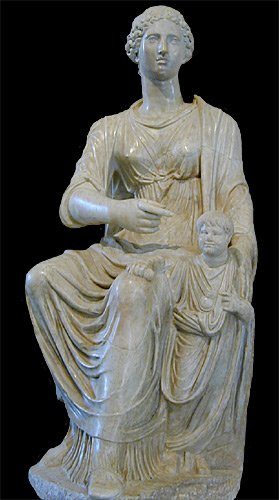
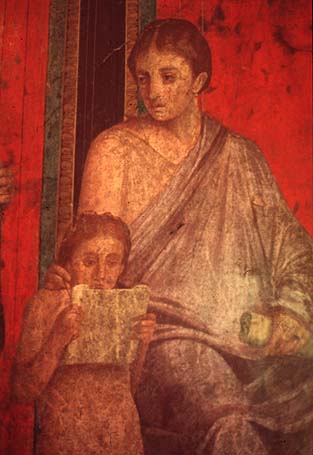
Aurelia Cotta was the trainer of those in her home. She was the mother of Julia Caesaris the Elder, Julia Caesaris the Younger, and Gaius Julius Caesar. She was the bodily present parent. She was the plebian parent (not one of the patricians, like her husband). She told stories. She was educated. She read Homer, Hesiod, and Sappho, and spoke the Hellenist tongue.
It is not too far fetched to imagine Aurelia Cotta reading the Illiad in her home place. It is likely to have been some act of resistance. Resistance to being silenced, as a woman, as a plebian, as a mother, in Rome! (Glenn reminds us here that:
Because the Romans clung to the ideal of the domina, of the strong privatized woman, they [i.e., the Roman men] often reacted with perplexity or disgust at the women who pursued intellectual or political aspirations. Unlike the very few Greek women who found acceptance and admiration in the public domain, no Roman woman seems to have succeeded in establishing herself as a public figure in her own right. [72])
It is not too difficult to think that little Julius hears his mother's Hellenistic words of resistance profoundly. He hears them as the Hellenist hero Achilles, the son, hears them from his own mother, Thetis. (James J. Murphy says little Roman boys profoundly learned lots of Hellenistic rhetoric: "The young lad who begins with a simple fable of Aesop ends up years later as a young adult doing the same thing with a complex speech of Demosthenes . . ." [61]. Feminist history explains the role of the mothers).
Listen as if to Aurelia Cotta reading and reciting to her children the Hellenist words of Thebis to her child (from the Illiad, Book 1, Line 414):
τὸν δ' ήμεἰβετ' ἐπειτα Θέτις κατά δάκρυ χἐουσα:
Thetis answered him then letting the tears fall: 'Ah me,
ὥ μοι τἐκνον ἐμὸν, τἰ νὑ σ' ἐτρεφον αἰνά τεκοῦσα;
my child. Your birth was bitterness. Why did I raise you?
It is not impossible that “ὥ μοι τἐκνον ἐμὸν” [“ah me, my child”] is heard and heard and recited and recited and spoken again by young Julius. So it is not impossible that “καὶ σὑ τὲκνον” [“and you? child”] rolls off the tongue of the dying man, Julius Caesar. He is a son who repeatedly heard his parent, his mother. When a dying man, as a parent (perhaps even the parent of Brutus) he now identifies with and repeats the words of his mother, those words of Thetis, who was (also) betrayed by a son.


I am not trying to suggest that Julius Caesar was not sexist. Or that ancient Roman (or Greek) men generally were not chauvinists.
Rather, I am hoping to show that such simple categorizations of ancient men hardly shows the profound impact of ancient women on such boys and men (from cradle to grave). The impact is in the rhetorics these women found and used.
HOMEGROWN FEMINIST RHETORICS
(Feminist) rhetorician, Patricia Bizzell, praises the “afrafeminist ideology” of Jacqueline Jones Royster as good “feminist rhetorical methodology.” And Royster says the following as she wonders how non-African American scholars can so speak for her, an African American woman (in her article, "When the First Voice You Hear is Not Your Own"):
People in the neighborhood where I grew up would say, “Where is their home training?” Imbedded in the question is the idea that when you visit other people’s “home places,” especially when you have not been invited, you simply can not go tramping around the house like you own the place, no matter how smart you are, or how much imagination you can muster, or how much authority and entitlement outside that home you may be privileged to hold. (32)
In our young minds houses belonged to women, were their special domain, not as property, but as places where all that truly mattered in life took place—the warmth and comfort of shelter, the feeding of our bodies, the nurturing of our souls. There we learned dignity, integrity of being; there we learned to have faith. The folks who made this life possible, who were our primary guides and teachers, were black women . . . [who fostered] a radical political dimension . . . [and who created] a site of resistance and liberation struggle (47).
I shall never forget the sense of shared history, of common anguish, I felt when first reading about the plight of black women domestic servants in
I want to remember these black women today. The act of remembrance is a conscious gesture honoring their struggle, their effort to keep something for their own. I want us to respect and understand that this effort has been and continues to be a radically subversive political gesture. For those who dominate and oppress us benefit most when we have nothing to give our own, when they have so taken from us our dignity, our humaness that we have nothing left, no “homeplace” where we can recover ourselves. I want us to remember these black women today, both past and present. (42-43)
Let's make the connections, between women (Africans, African Americans, Hellenists [goddesses and humans] and Romans) and men. How profound our histories, our passionate bodily rhetoric of memory:
Aurelia Cotta bore and raised Julius Caesar. But most later (merely sexist, even "feminist") histories have him simply living and dying as a sexist.
What gets missed in such historying (i.e., historiography) is the Hellenist-Roman-Afra-feminism of Aurelia Cotta and of the Hellenist Thebis that influenced Caesar to his dying words. His words, because of his mother's rhetorical influence, have him, at the very end, identifying with the pain, and the loss, of a mother.
Feminist retelling of feminist rhetorics (such as that of Sappho, of Aurelia Cotta, of Laura Cereta, of Christine de Pizan, of Cheryl Glenn, of Patricia Bizzell, of bell hooks, and of Jacqueline Jones Royster's) indicate the power of the woman. The woman's power is in resistance. Her power is in rhetorically telling and retelling histories more fully, with our profound identification with the pain, and the loss, of a mother separated from her child. The ultimate uttered response to such betrayal runs deep in boys and men and girls and women trained in her home place.
Subscribe to:
Posts (Atom)