For the past twenty-five hundred years in Western culture, the ideal woman has been disciplined by cultural codes that require a closed mouth (silence), a closed body (chastity), and an enclosed life (domestic confinement).
--Cheryl Glenn
Shelly Mandell, president of the Los Angeles chapter of the National Organization for Women, introduced Alaska Gov. Sarah Palin at a rally recently by saying - in an echo of Gloria Steinem a generation ago - "This is what a feminist looks like." As a women's historian, I would have to disagree. Mrs. Palin, despite her membership in the organization Feminists for Life, is not really a feminist. She is, rather, a "maternalist"- a woman who accepts the gendered division of labor but uses her assignment to home and family to claim the right to public participation.
--Sonya Michel
The effort to create new metaphors for God bespeaks an understanding of monotheism that rejects the worship of a single image of God in favor of a new and inclusive notion of unity. Many Jewish feminists have pointed out that the inability of most Jews to imagine God as anything but male is a form of idolatry in that it identifies a finite image with the reality of God. Jews are used to thinking of idols as stones and carved figures, but verbal images can be equally idolatrous in their fixedness--indeed, can actually be more dangerous for being invisible. Underlying feminist metaphors, by way of contrast, is a conception of monotheism, not as a single image of God, but, in Falk's phrase, as "an embracing unity of a multiplicity of images." . . . God is not male. God is not a lord and king. God is not a being outside us, over against us, who manipulates and controls us and raises some people over others. God is not the dualistic Other who authorizes all other dualisms. God is the source and wellspring of life in its infinite diversity. God--as our foremothers seem to have known--is present in all aspects of life, but present not just as father and protector but as one who empowers us to act creatively ourselves. . . . God is known in community, encountered by the Jewish people at Sinai at the same time they became a community. But God embraces the inexhaustible particularities of all communities and is named fully by none.
--Judith Plaskow
he decisively broke with the conventions of his day that excluded women from receiving instruction on the Law and taught them openly and individually on the same profound matters he taught his male disciples.
When Jesus taught the multitudes, he employed metaphors from a woman's experience to draw their interest. He visited places where women commonly gathered. Beside a well, he engaged the Samaritan woman in serious theological conversation about living water. And here, in the house at Bethany, he spoke at length with Mary, despite her unfinished domestic duties and pressure from her sister.
--Carolyn Custis James
With the blessings of God, this [translation of mine] is the first complete English translation of the Quran that uses [an alternative to] the original [and male-traditional] meaning of "to beat" [a wife] in 4:34 which was [in my translation] "to go away." The translator gives three arguments for why this is so: . . . .
1. The word "beat" is a command which the Prophet chose not to carry out; and 2. The Arabic word "beat" has 25 meanings so why chose a meaning that does not follow the legal and moral principles of the Quran and the Sunnah of the Prophet? 3. Interpreting the word as "beat" contradicts 2:231 and fosters divorce rather than marriage, commands to immorality and prohibits morality which is one of the definitions of a hypocrite in the Quran (see 9:67).
--Laleh Bakhtiar
According to Aristotle’s aesthetics, a narrative must be arranged according to some organizing principle. . . . Aristotle also offers us the classificatory system of binaries to help us order our stories, to order our experiences, to order ourselves. . . . But perhaps Woman can (un)speak in the unthought, not-yet-thought, non-spaces produced by alternative paradigms, by new idioms, by paralogical and paratactical and, thus, illegitimate discourses. What . . . if our narrative had no syllogistic, metonymic, linear or triangular structure? . . . . What if Truth were a Woman . . . what then?
Cixous replies,
Then all stories would have to be told differently. . . .
--Michelle Baliff
Females blurt out a direct translation of what should be formulated indirectly. . . . since woman does not bound herself, she must be bounded. The celebrated Greek virtue of self-control (sophrosyne) has to be defined differently for men and for women, Aristotle maintains. Masculine sophrosyne is rational self-control and resistance to excess, but for the woman [according to Aristotle] sophrosyne means obedience and consists in submitting herself to the control of others.
--Anne Carson
And I finally realized the irony of my reasoning: by enthymemically arguing my case from existing commonsense assumptions . . . , I was retreating into an Aristotelian rhetoric of common sense (i.e., the sense we hold in common), which was the very rhetoric that my manuscript challenged. Now I grant you, Aristotelian rhetoric is a very powerful, very useful way to reason. But as I argued . . . , it can be gender blind, that is, naïvely blind to concerns of gender. What I was realizing in my own life was that it can also be race blind. . . . When asking myself whether my defense of Woolf, Daly, and Rich was as race blind as Aristotle’s treatise of rhetoric was gender blind, I answered myself with a well-intentioned, “Of course it is.”
--Krista Ratcliffe
Western rhetorics, at least the legacies of them that we have inherited through scholarship, are demonstrably dominated by elite male viewpoints and experiences.
--Jacqueline Jones Royster
We must risk, then, getting the story crooked. We must look crookedly, a bit out of focus, into the various strands of meaning in a text in such a way as to make the categories, trends, and reliable identities of history a little less inevitable, less familiar. In short, we need to see beyond the familiar to the unfamiliar, to the unseen.
--Cheryl Glenn
Showing posts with label women's rhetorics. Show all posts
Showing posts with label women's rhetorics. Show all posts
Thursday, October 16, 2008


Wednesday, September 3, 2008
Women's Rhetorics Class on Palin
Want intelligent (feminist) analysis of Sarah Palin as John McCain's VP selection?
Writer, blogger, academic Charlotte offers the next best thing to taking her course in Women's Rhetorics. Cecile Richards, Gov. Ann Richards, and Deborah Tannen give added perspective. Get some (perspective that is), especially if you (like me) have been finding lots of blogs and newsmedia outlets rather predictably partisan in the commentary on Palin. Here's "Sarah Plain and Tall."
Writer, blogger, academic Charlotte offers the next best thing to taking her course in Women's Rhetorics. Cecile Richards, Gov. Ann Richards, and Deborah Tannen give added perspective. Get some (perspective that is), especially if you (like me) have been finding lots of blogs and newsmedia outlets rather predictably partisan in the commentary on Palin. Here's "Sarah Plain and Tall."
Thursday, August 28, 2008
Mahalia Jackson's Dream Rhetoric
Forty-five years ago today, Mahalia Jackson sang at Martin Luther King Jr.'s request. To half a million people in front of the Lincoln Memorial, she sang "I Been 'Buked and I been Scorned."
Then she listened to Martin speak. Just as he was about to deliver a line containing the scripted phrase "the International Association for the Advancement of Creative Dissatisfaction," Mahalia shouts out to him:
"Tell them about the dream, Martin."
So, Taylor Branch tells us now, "King launched into a series of riffs. . . Among them were phrases like 'let freedom ring,' 'with this faith' — and 'I have a dream.'" Take a look at King's prepared sermon notes and halfway through, when Jackson shouts outs, "You can see exactly where it broke off." Roger Wilkins was there and adds, "If Mahalia, with that voice, told you to do something, you did it."
Jackson sang and shouted and prepared King, prompted him, to speak from the heart. It was the dream for change, the audacity of hope. Listen again.
Then she listened to Martin speak. Just as he was about to deliver a line containing the scripted phrase "the International Association for the Advancement of Creative Dissatisfaction," Mahalia shouts out to him:
"Tell them about the dream, Martin."
So, Taylor Branch tells us now, "King launched into a series of riffs. . . Among them were phrases like 'let freedom ring,' 'with this faith' — and 'I have a dream.'" Take a look at King's prepared sermon notes and halfway through, when Jackson shouts outs, "You can see exactly where it broke off." Roger Wilkins was there and adds, "If Mahalia, with that voice, told you to do something, you did it."
Jackson sang and shouted and prepared King, prompted him, to speak from the heart. It was the dream for change, the audacity of hope. Listen again.
Sunday, March 23, 2008
What She Said
According to all four Gospels, women were the first witnesses of the resurrection, a fact that no conspirator in the first century would have invented. Jewish courts did not even accept the testimony of female witnesses [much less Roman courts]. A deliberate cover-up would have put Peter or John or, better yet, Nicodemus in the spotlight, not built its case around reports from women. Since the Gospels were written several decades after the events, the authors had plenty of time to straighten out such an anomaly—unless, of course, they were not concocting a legend but recording the plain facts.
A conspiracy also would have tidied up the first witnesses stories. Were there two white clad figures or just one? Why did Mary Magdalene mistake Jesus for a gardener? Was she alone or with Salome and another Mary? Accounts of the discovery of the empty tomb sound breathless and fragmentary. The women were "afraid yet filled with joy," says Matthew; "trembling and bewildered," says Mark.
--Philip Yancey
μετὰ φόβου καὶ χαρᾶς μεγάλης
--Matthew
τρόμος καὶ ἔκστασις
--Mark
A conspiracy also would have tidied up the first witnesses stories. Were there two white clad figures or just one? Why did Mary Magdalene mistake Jesus for a gardener? Was she alone or with Salome and another Mary? Accounts of the discovery of the empty tomb sound breathless and fragmentary. The women were "afraid yet filled with joy," says Matthew; "trembling and bewildered," says Mark.
--Philip Yancey
μετὰ φόβου καὶ χαρᾶς μεγάλης
--Matthew
τρόμος καὶ ἔκστασις
--Mark
Wednesday, February 27, 2008
Here's a First
"Dr. Serene Jones has been selected to become the 16th and first woman president of the historic Union Theological Seminary in the City of New York. . .
Jones, the Titus Street Professor of Theology at Yale Divinity School, will come to Union after 17 years on the Yale faculty. At present she also serves as chair and faculty member of Women, Gender and Sexuality Studies at Yale University. Jones has held faculty appointments at Yale Law School and in the Department of African American Studies and Religious Studies. . .
Jones is a prolific and popular scholar in the fields of religion and gender studies. In addition to publishing 37 articles and book chapters since 1991, she has delivered a long list of professional papers and public lectures across the United States and around the world. She is the author of Feminist Theory and Theology: Cartographies of Grace (2000) and Calvin and the Rhetoric of Piety (1995). She co-edited Feminist and Womanist Essays in Reformed Dogmatics (2006), Constructive Theology: A Contemporary Engagement with Classical Themes (2005), Liberating Eschatology: Essays in Honor of Letty Russell (1999), and Setting the Table: Women in Theological Conversation (1995).
Jones, the Titus Street Professor of Theology at Yale Divinity School, will come to Union after 17 years on the Yale faculty. At present she also serves as chair and faculty member of Women, Gender and Sexuality Studies at Yale University. Jones has held faculty appointments at Yale Law School and in the Department of African American Studies and Religious Studies. . .
Jones is a prolific and popular scholar in the fields of religion and gender studies. In addition to publishing 37 articles and book chapters since 1991, she has delivered a long list of professional papers and public lectures across the United States and around the world. She is the author of Feminist Theory and Theology: Cartographies of Grace (2000) and Calvin and the Rhetoric of Piety (1995). She co-edited Feminist and Womanist Essays in Reformed Dogmatics (2006), Constructive Theology: A Contemporary Engagement with Classical Themes (2005), Liberating Eschatology: Essays in Honor of Letty Russell (1999), and Setting the Table: Women in Theological Conversation (1995).
Jones earned her M.Div. from Yale Divinity School (1985) as well as her Ph.D. in theology from Yale University (1991). She holds a B.A. from the University of Oklahoma (1981) and is an ordained minister in both the Christian Church (Disciples of Christ) and the United Church of Christ.
Jones is the recipient of numerous awards and honors. She has received grants from the Pew Scholars and the Louisville Institute and is currently co-principal investigator on the "Women, Religion, and Globalization Grant" for the Henry T. Luce Initiative on Religion and International Affairs."
Read more.Wednesday, January 30, 2008
“Our First Woman President”
Toni Morrison was perhaps the first to say that “Bill Clinton is our first black president.” Now that she endorses the Senator from Illinois, I've been asking whether she may be able some day to say that “Barack Obama is our first woman president.”
Now Aristotelians seem to want to explain away such words. In fact, we’d all do well to hear what Morrison says, but let’s first listen to why an Aristotelian won’t.
AN ARISTOTELIAN EXPLANATION
The Aristotelian first classifies Morrison and her text. For example, the Aristotelian writer for an Oxford University Press encyclopedia concisely captures her this way: “Morrison, Toni (b. 1931), novelist, essayist, editor, short fiction writer, lecturer, educator, and Nobel Prize laureate.” Her text? “African American literature.” And sometimes, “literary criticism.” Hence, perhaps here, “political commentary” by a mere “novelist.”
What Morrison is not, and what her text is not, must also be very important, therefore. She’s not a political authority. Neither do her words constitute an authoritative text on presidents. Besides, Bill Clinton is not black, and Barack Obama is not a woman. The most extreme binary classification is this: Morrison is not a writer inspired with something like plenary inspiration. Her words are not God’s words.
(The extreme classifications may, for the Aristotelian, suggest a sort of Platonic ideal with a sliding scale. But don’t think the binary principle of non-contradiction is entirely lost. Aristotle didn’t completely abandon all he heard from Plato. Neither do contemporary Aristotelians. For instance, although Aristotle’s pure logic is not enough for Eleanor Rosch, prototype theory is just fine. And if Rosch won’t admit it, Aristotle did write some about “more or less” and did not just use pure “either or.” Likewise, George Lakoff would reject Aristotle’s pure method of objectivity, especially cold objectivity as Platonic Noam Chomsky uses it to view syntax abstractly; Lakoff nonetheless more-or-less-coldly observes metaphors we live by, a real specialty of Aristotle. In addition, Richard Rhodes gets a preacher to preach as if against Aristotle: “We must escape the slavery of words and give loyal adherence to meanings instead. Words should express ideas, not originate them.” But Rhodes and Aristotle together could care less about translation of words, because meaningful, prototypical, natural classes are the really important thing and are, for Rhodes at least, what makes prototypical translation possible, if you’ll pardon the circularity of the argument.)
So, a quick review of the Aristotelian’s method: first, the classification by binary features; second, the classification by hierarchy. What Morrison is (not), and what Morrison does (not) mean, maps her naturally, and in the extreme as below the man whose words mean what God’s words mean. (The Aristotelian rhetorician would say, then, that all of a sudden we’ve got an enthymeme: that what Morrison says is rhetorically not important, at least when compared to what God says. But let’s get back to words, to meanings, to logic.)
There are other things going on here for the Aristotelian logician, so let’s listen a bit more.
Because Morrison’s words are so like the man’s words that are God’s words, there has to be further distancing from her and her text. The Rhodesian Aristotelian does that this way:
>first classification as in “God’s meanings, naturally, are not Morrison’s” and “We’ve got a category mismatch here, a big issue in translation.”
>second hierarchy as in “In fact, it takes some significant training to get to recognize the differences between first order communication and second and third order communication. Literary critics, who should know better, are actually the worst. If they understood these distinctions even a little we never would have gotten into this post-modernism mess.”
>therefore if Morrison has written “Bill Clinton is the first black president” or writes someday “Barack Obama is the first woman president,” then we may just dismiss her and her meanings. Fair enough, the first order stuff, those words she uses, might be observed as “not for the faint in heart.” Okay, fine, it may appear she’s writing “in a stream of consciousness mode” and using “the kind of extreme terms Jesus did.” But come on, folks, “it’s the meanings that are important and that the words are only tools to get to the meanings.”
THE WORDS OF (THE FEMINIST THE AFRAFEMINIST THE WOMANIST THE NOVELIST THE LITERARY CRITIC) an old woman blind but wise
Jesus isn’t the only one who throws stories beside the stories of the one who has ears to hear (otherwise rendering deaf those who would claim to hear and making blind those who claim to see). C. S. Lewis isn’t the only one resisting Aristotelian modernism and saying (as an outsider reflecting on somebody else’s psalms): words have “second meanings,” which also means that what anyone’s words mean is always more than what he or she only intends them to mean. Kenneth L. Pike isn’t the only one who says (going beyond Rosch with the very first words of his Introduction to Linguistic Concepts): “When [a] man studies ‘things,’ he injects part of himself into their definition. What is a chair, if there is no [hu]man to sit on it? A flute, with no player? A concert, with no listeners? A saw, with no carpenter? The relevance or intended use of a thing is part of its nature as experienced by us—a component added to it by its designer or user or deduced by an observer. . . . [T]he observer universally affects the data and becomes part of the data. . . . The beginner’s ear [because she or he is an outsider] may play tricks on [her or] him and [may] refuse to listen at all, and ‘tell’ [her or] him that the words sound the same. . . Seeing or hearing or learning is facilitated when the observer has a stake in the outcome.”
Morrison has a stake in the outcome of her words. If they make you laugh, then you get them. They get you too. If you’re listening to her say that “Bill Clinton is the first black president” or hear her say “Barack Obama is the first woman president,” then you begin to affect her words and her words begin to become part of you. If you’re American and a voter, then there’s a stake in the outcome of Morrison’s words for you. If you’re black, then yes a stake. If you’re a woman, then yes a stake.
But even if you’re not any of those, you can listen from any of “several cultures” to “an old woman. Blind but wise. Or was it an old man? A guru, perhaps. Or a griot soothing restless children.” Or is it not Morrison? Or not God? And if you listen closely, to this parable, to someone else’s story thrown beside your own, then what? What’s “the end?” You may know who’s saying this to you: “I trust you now. I trust you with the [thing] that is not in your hands because you have truly caught it. Look. How lovely it is, this thing we have done - together.” You may get these words: “we are our brother's keeper; we are our sister's keeper; . . . we are all tied together in a single garment of destiny.”
Update: Girl with Pen
Now Aristotelians seem to want to explain away such words. In fact, we’d all do well to hear what Morrison says, but let’s first listen to why an Aristotelian won’t.
AN ARISTOTELIAN EXPLANATION
The Aristotelian first classifies Morrison and her text. For example, the Aristotelian writer for an Oxford University Press encyclopedia concisely captures her this way: “Morrison, Toni (b. 1931), novelist, essayist, editor, short fiction writer, lecturer, educator, and Nobel Prize laureate.” Her text? “African American literature.” And sometimes, “literary criticism.” Hence, perhaps here, “political commentary” by a mere “novelist.”
What Morrison is not, and what her text is not, must also be very important, therefore. She’s not a political authority. Neither do her words constitute an authoritative text on presidents. Besides, Bill Clinton is not black, and Barack Obama is not a woman. The most extreme binary classification is this: Morrison is not a writer inspired with something like plenary inspiration. Her words are not God’s words.
(The extreme classifications may, for the Aristotelian, suggest a sort of Platonic ideal with a sliding scale. But don’t think the binary principle of non-contradiction is entirely lost. Aristotle didn’t completely abandon all he heard from Plato. Neither do contemporary Aristotelians. For instance, although Aristotle’s pure logic is not enough for Eleanor Rosch, prototype theory is just fine. And if Rosch won’t admit it, Aristotle did write some about “more or less” and did not just use pure “either or.” Likewise, George Lakoff would reject Aristotle’s pure method of objectivity, especially cold objectivity as Platonic Noam Chomsky uses it to view syntax abstractly; Lakoff nonetheless more-or-less-coldly observes metaphors we live by, a real specialty of Aristotle. In addition, Richard Rhodes gets a preacher to preach as if against Aristotle: “We must escape the slavery of words and give loyal adherence to meanings instead. Words should express ideas, not originate them.” But Rhodes and Aristotle together could care less about translation of words, because meaningful, prototypical, natural classes are the really important thing and are, for Rhodes at least, what makes prototypical translation possible, if you’ll pardon the circularity of the argument.)
So, a quick review of the Aristotelian’s method: first, the classification by binary features; second, the classification by hierarchy. What Morrison is (not), and what Morrison does (not) mean, maps her naturally, and in the extreme as below the man whose words mean what God’s words mean. (The Aristotelian rhetorician would say, then, that all of a sudden we’ve got an enthymeme: that what Morrison says is rhetorically not important, at least when compared to what God says. But let’s get back to words, to meanings, to logic.)
There are other things going on here for the Aristotelian logician, so let’s listen a bit more.
Because Morrison’s words are so like the man’s words that are God’s words, there has to be further distancing from her and her text. The Rhodesian Aristotelian does that this way:
>first classification as in “God’s meanings, naturally, are not Morrison’s” and “We’ve got a category mismatch here, a big issue in translation.”
>second hierarchy as in “In fact, it takes some significant training to get to recognize the differences between first order communication and second and third order communication. Literary critics, who should know better, are actually the worst. If they understood these distinctions even a little we never would have gotten into this post-modernism mess.”
>therefore if Morrison has written “Bill Clinton is the first black president” or writes someday “Barack Obama is the first woman president,” then we may just dismiss her and her meanings. Fair enough, the first order stuff, those words she uses, might be observed as “not for the faint in heart.” Okay, fine, it may appear she’s writing “in a stream of consciousness mode” and using “the kind of extreme terms Jesus did.” But come on, folks, “it’s the meanings that are important and that the words are only tools to get to the meanings.”
THE WORDS OF (THE FEMINIST THE AFRAFEMINIST THE WOMANIST THE NOVELIST THE LITERARY CRITIC) an old woman blind but wise
Jesus isn’t the only one who throws stories beside the stories of the one who has ears to hear (otherwise rendering deaf those who would claim to hear and making blind those who claim to see). C. S. Lewis isn’t the only one resisting Aristotelian modernism and saying (as an outsider reflecting on somebody else’s psalms): words have “second meanings,” which also means that what anyone’s words mean is always more than what he or she only intends them to mean. Kenneth L. Pike isn’t the only one who says (going beyond Rosch with the very first words of his Introduction to Linguistic Concepts): “When [a] man studies ‘things,’ he injects part of himself into their definition. What is a chair, if there is no [hu]man to sit on it? A flute, with no player? A concert, with no listeners? A saw, with no carpenter? The relevance or intended use of a thing is part of its nature as experienced by us—a component added to it by its designer or user or deduced by an observer. . . . [T]he observer universally affects the data and becomes part of the data. . . . The beginner’s ear [because she or he is an outsider] may play tricks on [her or] him and [may] refuse to listen at all, and ‘tell’ [her or] him that the words sound the same. . . Seeing or hearing or learning is facilitated when the observer has a stake in the outcome.”
Morrison has a stake in the outcome of her words. If they make you laugh, then you get them. They get you too. If you’re listening to her say that “Bill Clinton is the first black president” or hear her say “Barack Obama is the first woman president,” then you begin to affect her words and her words begin to become part of you. If you’re American and a voter, then there’s a stake in the outcome of Morrison’s words for you. If you’re black, then yes a stake. If you’re a woman, then yes a stake.
But even if you’re not any of those, you can listen from any of “several cultures” to “an old woman. Blind but wise. Or was it an old man? A guru, perhaps. Or a griot soothing restless children.” Or is it not Morrison? Or not God? And if you listen closely, to this parable, to someone else’s story thrown beside your own, then what? What’s “the end?” You may know who’s saying this to you: “I trust you now. I trust you with the [thing] that is not in your hands because you have truly caught it. Look. How lovely it is, this thing we have done - together.” You may get these words: “we are our brother's keeper; we are our sister's keeper; . . . we are all tied together in a single garment of destiny.”
Update: Girl with Pen
Friday, January 4, 2008
(feminist) rhetorical questions for us voters
Jim Aune at The Blogora thinks it's all rhetoric. Barack Obama has a "winning formula" while Hillary Clinton "can't give a decent speech." So Aune gets us re-reading Karlyn Kohrs Campbell's essay "The Discursive Performance of Femininity: Hating Hillary" in the first issue of Rhetoric & Public Affairs (1998): 1-20.
Campbell says there:
"Hillary Rodham Clinton's style of public advocacy typically omits all of the discursive markers by which women publicly enact their femininity. Her tone is usually impersonal . . . her ideas unfold deductively . . . all kinds of evidence is used. . . . she is impassioned but very rarely emotional. . . . [She is unable to] feminize her rhetorical style, to perform a culturally defined feminine role publicly. . . . [while her audiences have a] failure to appreciate [her true power to persuade]. . . . If we reject all those who lack the feminizing skills of an Elizabeth Hanford Dole, we shall deprive ourselves of a vast array of talent" (pages 1, 6, 15).
In Iowa yesterday, did Mr. Obama and Mr. Edwards have Ms. Dole's "feminizing skills"?
Do only women such as Ms. Clinton and Ms. Dole have to "publicly enact femininity" to be persuasive?
Or have frontrunners Mr. Obama and Mr. Huckabee exhibited "discourse markers" and exuded a "tone" that are more "personal," if they also use (in a more manly way) all kinds of evidence and are also more (masculinely and, therefore, more) logically deductive?
Is John F. Hobbins fair in comparing a rhetorically savvy "mother in Israel" with Mr. Obama and Mr. Huckabee?
Can Hugo Schwyzer be so sure of himself when implying (1) that Mr. Obama and Mr. Huckabee contrast greatly with really "handsome, articulate men [such as Mr. Romney and Mr. Edwards] who [therefore more] struggle with slickness"? And (2) that "a debate between Obama and Mike Huckabee would be a thing to behold; [because they are more like women -- less handsome, and less articulate, rather like] two consummate 'outsiders', two men running on two differing visions of hope, two men who have an extraordinary ability to connect with a wide variety of people"?
What does feministing rhetoric really sound like for (or against) Ms. Clinton, Mr. Obama, Mr. Huckabee, and other candidates?
(and here's another in quick update) Can you answer Virginia Rutter's questions: "Who votes their gender?" and "What does this mean?"
Campbell says there:
"Hillary Rodham Clinton's style of public advocacy typically omits all of the discursive markers by which women publicly enact their femininity. Her tone is usually impersonal . . . her ideas unfold deductively . . . all kinds of evidence is used. . . . she is impassioned but very rarely emotional. . . . [She is unable to] feminize her rhetorical style, to perform a culturally defined feminine role publicly. . . . [while her audiences have a] failure to appreciate [her true power to persuade]. . . . If we reject all those who lack the feminizing skills of an Elizabeth Hanford Dole, we shall deprive ourselves of a vast array of talent" (pages 1, 6, 15).
In Iowa yesterday, did Mr. Obama and Mr. Edwards have Ms. Dole's "feminizing skills"?
Do only women such as Ms. Clinton and Ms. Dole have to "publicly enact femininity" to be persuasive?
Or have frontrunners Mr. Obama and Mr. Huckabee exhibited "discourse markers" and exuded a "tone" that are more "personal," if they also use (in a more manly way) all kinds of evidence and are also more (masculinely and, therefore, more) logically deductive?
Is John F. Hobbins fair in comparing a rhetorically savvy "mother in Israel" with Mr. Obama and Mr. Huckabee?
Can Hugo Schwyzer be so sure of himself when implying (1) that Mr. Obama and Mr. Huckabee contrast greatly with really "handsome, articulate men [such as Mr. Romney and Mr. Edwards] who [therefore more] struggle with slickness"? And (2) that "a debate between Obama and Mike Huckabee would be a thing to behold; [because they are more like women -- less handsome, and less articulate, rather like] two consummate 'outsiders', two men running on two differing visions of hope, two men who have an extraordinary ability to connect with a wide variety of people"?
What does feministing rhetoric really sound like for (or against) Ms. Clinton, Mr. Obama, Mr. Huckabee, and other candidates?
(and here's another in quick update) Can you answer Virginia Rutter's questions: "Who votes their gender?" and "What does this mean?"
Tuesday, June 12, 2007
Home Training: Rhetorical (Hellenist-Roman-Afra) Feminism


And generally men in ancient
πρῶτος δὲ Κάσκας ξίφει παίει παρὰ τὸν αὐχένα πληγὴν οὐ θανατηφόρον οὐδὲ βαθεῖαν, ἀλλ’ ὡς εἰκὸς ἐν ἀρχῇ τολμήματος μεγάλου ταραχθείς, ὥστε καὶ τὸν Καίσαρα μεταστραφέντα τοῦ ἐγχειριδίου λαβέσθαι καὶ κατασχεῖν.
It was Casca who gave him the first blow with his dagger, in the neck, not a mortal would, nor even a deep one, for which he was too much confused, as was natural at the beginning of a deed of great daring; so that Caesar turned about, grasped the knife, and held it fast.
At almost the same instant both cried out, the smitten man in Latin: "Accursed Casca, what does thou?" and the smiter, in Greek, to his brother: "Brother, help!"
Therefore Brutus also gave him one blow in the groin. And it is said by some writers that although Caesar defended himself against the rest and darted this way and that and cried aloud, when he saw that Brutus had drawn his dagger, he pulled his toga down over his head and sank, either by chance or because pushed there by his murderers, against the pedestal on which the statue of Pompey stood.
Let’s now read what the Roman historian Gaius Suetonius Tranquillus writes (in our earliest 1st century account, with a later 20th century translation):Atque ita tribus et viginti plagis confossus est uno modo ad primum ictum gemitu sine voce edito, etsi tradiderunt quidam Marco Bruto irruenti dixisse: καὶ σὑ τὲκνον;
And in this wise he was stabbed with three and twenty wounds, uttering not a word, but merely a groan at the first stroke, though some have written that when Marcus Brutus rushed at him, he said in Greek, “You too, my child?”
What if Julius Caesar’s dying words were not Latin (as Shakespeare and Plutarch have suggested)?
What if, in the Hellenist language, Caesar said to Brutus (as the Latin-writing but then Hellenist-alphabet writing-historian Suetonius reports from his other earlier sources): καὶ σὑ τὲκνον?
Where would Julius have gotten those Hellenist utterances? Who would have trained him so viscerally in this other mother tongue?
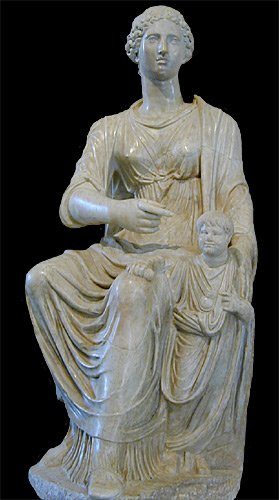
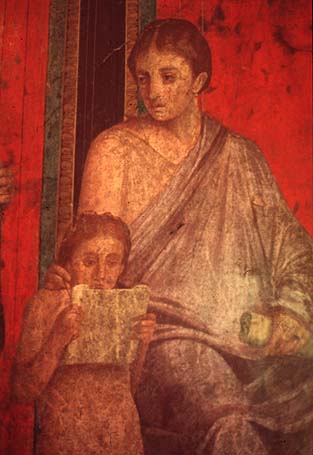
Aurelia Cotta was the trainer of those in her home. She was the mother of Julia Caesaris the Elder, Julia Caesaris the Younger, and Gaius Julius Caesar. She was the bodily present parent. She was the plebian parent (not one of the patricians, like her husband). She told stories. She was educated. She read Homer, Hesiod, and Sappho, and spoke the Hellenist tongue.
It is not too far fetched to imagine Aurelia Cotta reading the Illiad in her home place. It is likely to have been some act of resistance. Resistance to being silenced, as a woman, as a plebian, as a mother, in Rome! (Glenn reminds us here that:
Because the Romans clung to the ideal of the domina, of the strong privatized woman, they [i.e., the Roman men] often reacted with perplexity or disgust at the women who pursued intellectual or political aspirations. Unlike the very few Greek women who found acceptance and admiration in the public domain, no Roman woman seems to have succeeded in establishing herself as a public figure in her own right. [72])
It is not too difficult to think that little Julius hears his mother's Hellenistic words of resistance profoundly. He hears them as the Hellenist hero Achilles, the son, hears them from his own mother, Thetis. (James J. Murphy says little Roman boys profoundly learned lots of Hellenistic rhetoric: "The young lad who begins with a simple fable of Aesop ends up years later as a young adult doing the same thing with a complex speech of Demosthenes . . ." [61]. Feminist history explains the role of the mothers).
Listen as if to Aurelia Cotta reading and reciting to her children the Hellenist words of Thebis to her child (from the Illiad, Book 1, Line 414):
τὸν δ' ήμεἰβετ' ἐπειτα Θέτις κατά δάκρυ χἐουσα:
Thetis answered him then letting the tears fall: 'Ah me,
ὥ μοι τἐκνον ἐμὸν, τἰ νὑ σ' ἐτρεφον αἰνά τεκοῦσα;
my child. Your birth was bitterness. Why did I raise you?
It is not impossible that “ὥ μοι τἐκνον ἐμὸν” [“ah me, my child”] is heard and heard and recited and recited and spoken again by young Julius. So it is not impossible that “καὶ σὑ τὲκνον” [“and you? child”] rolls off the tongue of the dying man, Julius Caesar. He is a son who repeatedly heard his parent, his mother. When a dying man, as a parent (perhaps even the parent of Brutus) he now identifies with and repeats the words of his mother, those words of Thetis, who was (also) betrayed by a son.


I am not trying to suggest that Julius Caesar was not sexist. Or that ancient Roman (or Greek) men generally were not chauvinists.
Rather, I am hoping to show that such simple categorizations of ancient men hardly shows the profound impact of ancient women on such boys and men (from cradle to grave). The impact is in the rhetorics these women found and used.
HOMEGROWN FEMINIST RHETORICS
(Feminist) rhetorician, Patricia Bizzell, praises the “afrafeminist ideology” of Jacqueline Jones Royster as good “feminist rhetorical methodology.” And Royster says the following as she wonders how non-African American scholars can so speak for her, an African American woman (in her article, "When the First Voice You Hear is Not Your Own"):
People in the neighborhood where I grew up would say, “Where is their home training?” Imbedded in the question is the idea that when you visit other people’s “home places,” especially when you have not been invited, you simply can not go tramping around the house like you own the place, no matter how smart you are, or how much imagination you can muster, or how much authority and entitlement outside that home you may be privileged to hold. (32)
In our young minds houses belonged to women, were their special domain, not as property, but as places where all that truly mattered in life took place—the warmth and comfort of shelter, the feeding of our bodies, the nurturing of our souls. There we learned dignity, integrity of being; there we learned to have faith. The folks who made this life possible, who were our primary guides and teachers, were black women . . . [who fostered] a radical political dimension . . . [and who created] a site of resistance and liberation struggle (47).
I shall never forget the sense of shared history, of common anguish, I felt when first reading about the plight of black women domestic servants in
I want to remember these black women today. The act of remembrance is a conscious gesture honoring their struggle, their effort to keep something for their own. I want us to respect and understand that this effort has been and continues to be a radically subversive political gesture. For those who dominate and oppress us benefit most when we have nothing to give our own, when they have so taken from us our dignity, our humaness that we have nothing left, no “homeplace” where we can recover ourselves. I want us to remember these black women today, both past and present. (42-43)
Let's make the connections, between women (Africans, African Americans, Hellenists [goddesses and humans] and Romans) and men. How profound our histories, our passionate bodily rhetoric of memory:
Aurelia Cotta bore and raised Julius Caesar. But most later (merely sexist, even "feminist") histories have him simply living and dying as a sexist.
What gets missed in such historying (i.e., historiography) is the Hellenist-Roman-Afra-feminism of Aurelia Cotta and of the Hellenist Thebis that influenced Caesar to his dying words. His words, because of his mother's rhetorical influence, have him, at the very end, identifying with the pain, and the loss, of a mother.
Feminist retelling of feminist rhetorics (such as that of Sappho, of Aurelia Cotta, of Laura Cereta, of Christine de Pizan, of Cheryl Glenn, of Patricia Bizzell, of bell hooks, and of Jacqueline Jones Royster's) indicate the power of the woman. The woman's power is in resistance. Her power is in rhetorically telling and retelling histories more fully, with our profound identification with the pain, and the loss, of a mother separated from her child. The ultimate uttered response to such betrayal runs deep in boys and men and girls and women trained in her home place.
Subscribe to:
Posts (Atom)