Showing posts with label all men and women are created equal. Show all posts

Friday, August 26, 2011

Women's Equality Day in the USA: What Do You Know?

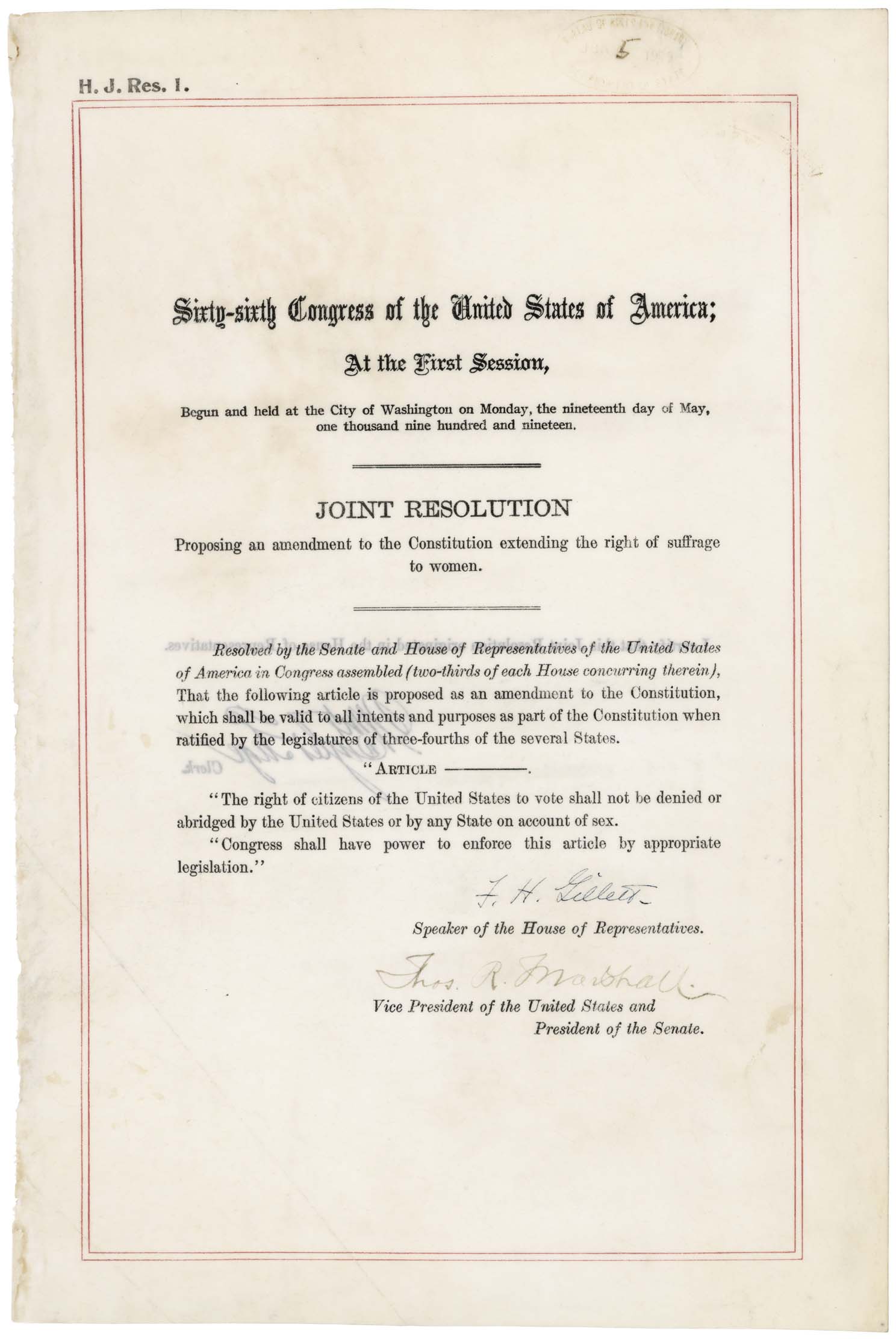
Did you know that 66th Congress of the United States of America was comprised of 559 men?  Do you know how many women were in the Congress?  Yes, that's right.  0.  Zero.  Not even 1.

Did you know that the 65th Congress of the USA did have 1 woman?  Yes, that's right.  Jeannette Rankin, who first served as a Representative, a Republican, from the State of Montana, from 1917 to 1919.  She was the only woman among all the men, the first woman to serve as an elected representative ever.

A pacifist and a suffragette, Ms. Rankin opened the Congress floor in January 1918 with these questions:

“How shall we answer the challenge, gentlemen? How shall we explain to them the meaning of democracy if the same Congress that voted to make the world safe for democracy [through war] refuses to give this small measure of democracy to the women of our country?”


Do you know what's most significant, most ironic, about these facts?

It was not until 1920, on August 26, that the Congress afforded the right to vote to women in all states of the United States. This was 42 years after Susan B. Anthony and Elizabeth Cady Stanton drafted the amendment to the U.S. Constitution and first introduced it to the all-male government in 1878.  This was 62 years after women and men gathered in Seneca Falls, New York, to sign the Declaration of Sentiments, to address the inequalities in the American democracy.  This was 144 years after the birth of the American democracy.

This Amendment reads:

The right of citizens of the United States to vote shall not be denied or abridged by the United States or by any State on account of sex.  Congress shall have power to enforce this article by appropriate legislation.

To celebrate the day of the passing of this Amendment, Congresswoman Bella Abzug introduced the following statement:

Joint Resolution of Congress, 1971
Designating August 26 of each year as Women’s Equality Day

WHEREAS, the women of the United States have been treated as second-class citizens and have not been entitled the full rights and privileges, public or private, legal or institutional, which are available to male citizens of the United States; and


WHEREAS, the women of the United States have united to assure that these rights and privileges are available to all citizens equally regardless of sex; and

WHEREAS, the women of the United States have designated August 26, the anniversary date of the passage of the Nineteenth Amendment, as symbol of the continued fight for equal rights: and

WHEREAS, the women of United States are to be commended and supported in their organizations and activities,

NOW, THEREFORE, BE IT RESOLVED, the Senate and House of Representatives of the United States of America in Congress assembled, that August 26th of each year is designated as Women’s Equality Day, and the President is authorized and requested to issue a proclamation annually in commemoration of that day in 1920, on which the women of America were first given the right to vote, and that day in 1970, on which a nationwide demonstration for women’s rights took place.


That statement, that joint resolution, was resolved 41 years ago.  So what do you know today?  How are we doing?  How are you doing with equality?

Quiz yourself here.

What of the historical data, to date, do you know?  Are you really happy about the equality of women today?  How many women have you voted for?  Have you voted for women and men equally?  Why not?  Is America ready for a woman president?

Read how one woman goes back to the Sacred Texts of Feminism here.

Read the 19th Amendment again here:


Tuesday, July 19, 2011

The Declaration of Sentiments

Wednesday Morning.

On the morning of the 19th [of July, 1848], the Convention assembled at 11 o'clock.... The Declaration of Sentiments, offered for the acceptance of the Convention, was then read by E[lizabeth] C[ady] Stanton. A proposition was made to have it re-read by paragraph, and after much consideration, some changes were suggested and adopted. The propriety of obtaining the signatures of men to the Declaration was discussed in an animated manner: a vote in favor was given; but concluding that the final decision would be the legitimate business of the next day, it was referred.


[In the afternoon] The reading of the Declaration was called for, an addition having been inserted since the morning session. A vote taken upon the amendment was carried, and papers circulated to obtain signatures.

Thursday Morning.

The Convention assembled at the hour appointed, James Mott, of Philadelphia, in the Chair. The minutes of the previous day having been read, E. C. Stanton again read the Declaration of Sentiments, which was freely discussed . . . and was unanimously adopted, as follows.


Declaration of Sentiments.

When, in the course of human events, it becomes necessary for one portion of the family of man to assume among the people of the earth a position different from that which they have hitherto occupied, but one to which the laws of nature and of nature's God entitle them, a decent respect to the opinions of mankind requires that they should declare the causes that impel them to such a course.

We hold these truths to be self-evident: that all men and women are created equal; that they are endowed by their Creator with certain inalienable rights; that among these are life, liberty, and the pursuit of happiness; that to secure these rights governments are instituted, deriving their just powers from the consent of the governed. Whenever any form of Government becomes destructive of these ends, it is the right of those who suffer from it to refuse allegiance to it, and to insist upon the institution of a new government, laying its foundation on such principles, and organizing its powers in such form as to them shall seem most likely to effect their safety and happiness. Prudence, indeed, will dictate that governments long established should not be changed for light and transient causes; and accordingly, all experience hath shown that mankind are more disposed to suffer, while evils are sufferable, than to right themselves by abolishing the forms to which they are accustomed. But when a long train of abuses and usurpations, pursuing invariably the same object, evinces a design to reduce them under absolute despotism, it is their duty to throw off such government, and to provide new guards for their future security. Such has been the patient sufferance of the women under this government, and such is now the necessity which constrains them to demand the equal station to which they are entitled.

The history of mankind is a history of repeated injuries and usurpations on the part of man toward woman, having in direct object the establishment of an absolute tyranny over her. To prove this, let facts be submitted to a candid world.

He has never permitted her to exercise her inalienable right to the elective franchise.

He has compelled her to submit to laws, in the formation of which she had no voice.

He has withheld from her rights which are given to the most ignorant and degraded men—both natives and foreigners.

Having deprived her of this first right of a citizen, the elective franchise, thereby leaving her without representation in the halls of legislation, he has oppressed her on all sides.

He has made her, if married, in the eye of the law, civilly dead.

He has taken from her all right in property, even to the wages she earns.

He has made her, morally, an irresponsible being, as she can commit many crimes with impunity, provided they be done in the presence of her husband. In the covenant of marriage, she is compelled to promise obedience to her husband, he becoming, to all intents and purposes, her master—the law giving him power to deprive her of her liberty, and to administer chastisement.

He has so framed the laws of divorce, as to what shall be the proper causes of divorce; in case of separation, to whom the guardianship of the children shall be given; as to be wholly regardless of the happiness of women—the law, in all cases, going upon the false supposition of the supremacy of man, and giving all power into his hands.

After depriving her of all rights as a married woman, if single and the owner of property, he has taxed her to support a government which recognizes her only when her property can be made profitable to it.

He has monopolized nearly all the profitable employments, and from those she is permitted to follow, she receives but a scanty remuneration.

He closes against her all the avenues to wealth and distinction, which he considers most honorable to himself. As a teacher of theology, medicine, or law, she is not known.

He has denied her the facilities for obtaining a thorough education—all colleges being closed against her.

He allows her in Church as well as State, but a subordinate position, claiming Apostolic authority for her exclusion from the ministry, and, with some exceptions, from any public participation in the affairs of the Church.

He has created a false public sentiment, by giving to the world a different code of morals for men and women, by which moral delinquencies which exclude women from society, are not only tolerated but deemed of little account in man.

He has usurped the prerogative of Jehovah himself, claiming it as his right to assign for her a sphere of action, when that belongs to her conscience and her God.

He has endeavored, in every way that he could to destroy her confidence in her own powers, to lessen her self-respect, and to make her willing to lead a dependent and abject life.

Now, in view of this entire disfranchisement of one-half the people of this country, their social and religious degradation,—in view of the unjust laws above mentioned, and because women do feel themselves aggrieved, oppressed, and fraudulently deprived of their most sacred rights, we insist that they have immediate admission to all the rights and privileges which belong to them as citizens of these United States.

In entering upon the great work before us, we anticipate no small amount of misconception, misrepresentation, and ridicule; but we shall use every instrumentality within our power to effect our object.  We shall employ agents, circulate tracts, petition the State and national Legislatures, and endeavor to enlist the pulpit and the press in our behalf.  We hope this Convention will be followed by a series of Conventions, embracing every part of the country.

Firmly relying upon the final triumph of the Right and the True, we do this day affix our signatures to this declaration.

At the appointed hour the meeting convened. The minutes having been read, the resolutions of the day before were read and taken up separately. Some, from their self-evident truth, elicited but little remark; others, after some criticism, much debate, and some slight alterations, were finally passed by a large majority.

Monday, July 11, 2011

3 of the top 5 are women, queens of the biblioblogosphere:

Rod of Alexandria breaks the news this week.  Women have broken through the glass ceiling of the Top 10 Biblioblogs for June 2011.

He notes, "3 of the top 5 are women:"

1. Suzanne McCarthy, Suzanne’s Bookshelf
2. James McGrath, Exploring Our Matrix
3. Joel Watts, Unsettled Christianity
4. April DeConick, The Forbidden Gospels
5. Jane Stranz, Of life, laughter and liturgy

Notice how the 2 men in the mix are wanting to suggest now "How to Determine the Queen and King of the Biblioblogosphere."  Being now under a woman, even only 1, is, presumably, not good enough.  The 1 man makes his suggestion with a picture of the other 1 man:


What we the people must notice, with all of the talk and images about king-dom-ination, is how there's been a coup d'état, a revolution, a democratic decision-making reversal of the order of power that has let 1 un-defined and un-official and un-sanctified women in the top 10!

First, I want you to listen again to the rant by blogger and Bible Blogger and woman Amanda Mac.  Then see the Official Response that would exclude some women.  Finally see the injustice of male dominance overcome by people power!

First, her rant:
Once again, a call has gone out encouraging more women to biblioblog.  I think I’m getting a little frustrated by this.  Why?

Because there are female bibliobloggers.  They may be in the minority, but they’re out there.
So why aren’t they on the top 50?  A couple of reasons:

1. The top 50 is not an accurate representation of biblioblog rankings.  If it was, Rachel Held Evans would be # 8 on the list.  Also, Elizabeth Scalia would be on the list (now granted, part of the problem with ranking Elizabeth Scalia’s blog is that it is over at Patheos, and Alexa can’t separate out the different blogs).  Evangel over at First Things would also be on the list, as it has several female bloggers contributing.  Internet Monk also has female contributors and would rank around # 22.  Parchment and Pen would be #6.

I suggest we drop this whole “you have to sign up” excuse.  Is it the Top 50 biblioblogs or not?  If it’s not, it needs to be retitled “Top 50 Biblioblogs of people who volunteered to be on the list.”

2. The majority of the female bibliobloggers that I read wouldn’t make the Top 50 because their Alexa ranking is too low to be counted.  So it’s not that there is only a handful of female biblibloggers out there, it is that there is only a handful of female biblobloggers who generate enough traffic to rank in the top 50.

Solution:  Let’s find ways to send some of these fine ladies some more traffic so that their numbers can rank.

Grrr.  So ends my rant.
Then, the Official Response from the official officials, denying access into the kings' domination of the kingdom of the Top 50 Biblioblogs:
The field of biblical studies does not include everything that is written about the Bible, and in particular does not include theological, spritual, or sermon material, which is why Rachel Held Evans, Evangel, Internet Monk, and Parchment and Pen are not included. If these blogs include incidental material relevant to biblical studies, they may be included under “Related Blogs.”
Finally, the revolution of people power:


That's right.  The officially-excluded Rachel Held Evans is in the Top 10!   And she's not even agreeing to wear some crown.

Congrats to Suzanne, April, Jane, and Rachel!

Thursday, March 31, 2011

For Him Who Has Ears to Hear


May I give the floor now... to the wife of Leonidas
and queen of Sparta.

- What's this?
- This is nothing.


Councilmen:
I stand before you
not only as your queen.
I come to you as a mother.
I come to you as a wife.
I come to you as a Spartan woman.
I come to you with great humility.

I am not here to represent Leonidas.
His actions speak louder
than my words ever could.

I am here for all those voices
which cannot be heard.
Mothers, daughters, fathers, sons.
Three hundred families
that bleed for our rights
and for the very principles
this room was built upon.

----------------------------------


The king held out the golden sceptre to Esther,
and Esther rose and stood before the king. She said,


‘If it pleases the king,
and if I have won his favour,
and if the thing seems right before the king,
and I have his approval,
let an order be written
to revoke the letters devised
by Haman son of Hammedatha the Agagite,
which he wrote giving orders
to destroy the Jews
who are in all the provinces of the king.
For how can I bear to see
the calamity that is coming on my people?
Or how can I bear to see
the destruction of my kindred?’

ויושט המלך לאסתר את שרבט הזהב ותקם אסתר
ותעמד לפני המלך
ותאמר אם־
על־המלך טוב ואם־מצאתי חן לפניו
וכשר הדבר לפני המלך
וטובה אני בעיניו יכתב להשיב את
־הספרים מחשבת המן בן־
־המדתא האגגי אשר כתב לאבד את־היהודים אשר בכל־
מדינות המלך

כי איככה אוכל
וראיתי ברעה אשר
־ימצא את־
עמי ואיככה אוכל
וראיתי באבדן מולדתי
ס

ἐξέτεινεν δὲ ὁ βασιλεὺς Εσθηρ τὴν ῥάβδον τὴν χρυσῆν
ἐξηγέρθη δὲ Εσθηρ παρκέναι τῷ βασιλεῖ
καὶ εἶπεν Εσθηρ

εἰ δοκεῖ σοι καὶ εὗρον χάριν
πεμφθήτω ἀποστραφῆναι
τὰ γράμματα τὰ ἀπεσταλμένα ὑπὸ Αμαν
τὰ γραφέντα ἀπολέσθαι τοὺς Ιουδαίους
οἵ εἰσιν ἐν τῇ βασιλείᾳ σου

πῶς γὰρ δυνήσομαι ἰδεῖν
τὴν κάκωσιν τοῦ λαοῦ μου
καὶ πῶς δυνήσομαι σωθῆναι
ἐν τῇ ἀπωλείᾳ τῆς πατρίδος μου


So the king held out the golden rod to Esther,
and Esther rose and stood before the king.
And Esther said,

"If it pleases you and if I have found favor,
let an order be dispatched to revoke
the letters sent by Haman,
which were written to destroy the Judeans
who are in your kingdom.

For how can I bear to see
the suffering of my people?
And how can I bear to be saved
amidst the destruction of my lineage?"

----------------------------------


----------------------------------


----------------------------------


----------------------------------

Sunday, October 4, 2009

St. Paul and Joshua and woman's equality

There was probably no moment in early Christianity where women were totally included as equals with men. Christianity was born and developed in the context of patriarchal social structures in both the Jewish and Hellenistic worlds. But there were radical ideas floating around in early Christianity that suggested that gender hierarchy had been dissolved through baptism into Christ for a new humanity beyond gender. This is expressed in the baptismal formula used by St. Paul in Galatians 3:27-8: "For as many of you as were baptized into Christ have put on Christ. There is neither Jew nor Greek, there is neither slave nor free, there is neither male nor female, for you are all one in Christ Jesus." This baptismal formula was not invented by Paul, but belonged to the Hellenistic Jewish-Christian church that he joined upon his conversion.
--Rosemary Radford Ruether, "St. Paul, Friend or Enemy of Women?"

Paul's conversion was radical and sudden but gradual as well.  It seems to have fits and starts.  And when he writes to advise others, the Jew and the Greek, Paul sometimes makes it sound like conversion is a thing done before time in heaven or a thing to be done once and for all in eternity future or a process in the here and now.

The important thing, to me, is that there was conversion, and advocacy of profound change in oneself.  Paul works through his ideas but more importantly his personal experiences with things like slavery and man-over-woman hierarchy and Jew-over-goyish-ethnic arrogance.  He also, very profoundly, works through his epistemology, his hermeneutics too, away from objective Aristotelian logic (i.e., phallologentrism) toward personal subjectivities.  His starts to become the sort of inside-out being that Joshua Mashiach (aka Jesus Christ) preaches in the Sermon on the Mount.

"Let this mind be in you, which was also in Christ Jesus," he wrote to people in Aristotle's and Alexander's Macedonia.  "He, being in the form of God, thought it not robbery to be equal with God: But made himself of no reputation, and took upon him the form of a servant, and was made in the likeness of men."

And Paul's own mind was this:  "But what things were gain to me, those I counted loss for Christ. Yea doubtless, and I count all things but loss for the excellency of the knowledge of Christ Jesus my Lord: for whom I have suffered the loss of all things, and do count them but dung, that I may win Christ, And be found in him, not having mine own righteousness, which is of the law, but that which is through the faith of Christ, the righteousness which is of God by faith:"

If you read this Greek letter in Paul's Greek, you start to get a sense of just how scandalous it is.  I've quoted Paul in the King James Version, which loses much.  What the translators make "dung" is something like "dog shit" and "dogs" to Paul's fellow Jews are unclean and "shit" to his contemporary Greek friends is just nasty.

I don't think anyone has better understood Paul than C.S. Lewis and George Steiner, both of whom confess they don't understand Paul well.  Both are literary critics.  Lewis is an outsider to Judaism and to Jews (although he marries a Jewish American who helps him some).  And Steiner is a Jew.  Here's what Lewis and Steiner say about Paul (as they're saying similar things, not about Aristotle, but about the Joshua that KJV Bible readers have called Jesus), Lewis first, then Steiner:
He [i.e., Jesus or Joshua] uses paradox, proverb, exaggeration, parable, irony; even (I mean no irreverence) the "wisecrack". He utters maxims which, like popular proverbs, if rigorously taken, may seem to contradict one another. His teaching therefore cannot be grasped by the intellect alone, cannot be ‘got up’ as if it were a ‘subject’. If we try to do that with it, we shall find Him the most elusive of teachers. He hardly ever gave a straight answer to a straight question. He will not be, in the way we want, ‘pinned down’. The attempt is (again I mean no irreverence) like trying to bottle a sunbeam.
Descending lower, we find a somewhat similar difficulty with St. Paul. I cannot be the only reader who has wondered why God, having given him so many gifts, withheld from him (what would to us seem so necessary for the first Christian theologian [albeit a formidable Jew]) that of lucidity and orderly exposition. (C. S. Lewis, Reflections on the Psalms, page 113)
Jesus' discourse in parables, his statements of withdrawal from statement--of which the episode in which he writes in the dust and effaces his writing is the emblematic instance--give to linguistic verticality, to the containment of silence in language, a particular impetus. As do the constantly polysemic, stratified techniques of semantic motions in the Pauline Epistles. It is these parables and indirect communications, at once more internalized and open-ended than are the codes of classical rhetoric, which beget the seeming contradiction of enigmatic clarity, the "comprehendit imcomprehensible esse" celebrated in Anselm's Proslogion. In turn, from these dramatizations of manifold sense, evolve the instruments of allegory, of analogy, of simile, of tropes and concealments in Western literature (though here also there are obvious and indispensible classical sources). (George Steiner, Grammars of Creation, page 75)
Maybe the only other thing to add here, is that there is another insider Jew who says similar things about Paul's writings.  I'm talking about Joshua's apprentice Shimon called Kefa or Petros or Rock.  In Greek to the Jews, Peter is trying to get his readers to understand the difficult commands of his Master Teacher as he writes on the difficulties of understanding Paul.  That some, with good reason perhaps, conjecture that this writer is someone just trying to sound like Peter makes no difference.  The point is that Paul has become like Jesus, demanding profound changes in thinking and in experience (something Aristotle never demanded of himself):
ὁ ἀγαπητὸς ἡμῶν ἀδελφὸς Παῦλος κατὰ τὴν δοθεῖσαν αὐτῷ σοφίαν ἔγραψεν ὑμῖν ὡς καὶ ἐν πάσαις ἐπιστολαῖς [Παῦλου] λαλῶν ἐν αὐταῖς περὶ τούτων ἐν αἷς ἐστιν δυσνόητά τινα ἃ οἱ ἀμαθεῖς καὶ ἀστήρικτοι στρεβλοῦσιν ὡς καὶ τὰς λοιπὰς γραφὰς πρὸς τὴν ἰδίαν αὐτῶν ἀπώλειαν
So to sum up, I've been trying to show a little history.  First how Paul and Aristotle are so alike:  Paul's approaches to men (vs women), to logic (vs rhetoric and dialectic and such), and to elitist centricism (vs feminisms and pluralisms and multiculuralisms) seem suspiciously like Aristotle's phallogocentrism.  Now this:  Paul's encounters with a Jew named Joshua and his apprentices began to unravel much of the Aristotelian(-like) system.  The conversion was a process, a profound inside-out change, and still is.


Monday, June 1, 2009

All Men Are Created Equal (with no regard to gender and race)

Before we think about the translation of the Declaration of Independence, I wonder if we can't think about its interlation.

I'm thinking about the little clause therein that goes "all men are created equal." What did the original author, Thomas Jefferson, and the original signers intend by "men"?

Well, sure, some of these white men owned black women and african men and had their own wives without the same rights and protections as they, the husbands, enjoyed under the law of the new states and the new federal government, which did not recognize the governments of "the merciless Indian Savages whose known rule of warfare, is an undistinguished destruction of all ages, sexes and conditions" because, well, because they were Savages and merciless. But proof positive that these original American men had an inclusive intention for "men" is that they quickly formed a Constitution constituted by "the People."

Never mind all those unnecessary Sentiments of Elizabeth Cady Stanton (a woman) and Frederick Douglass (a black man) and others in 1848, who declared that all men might read "a history of repeated injuries and usurpations on the part of man toward woman, having in direct object the establishment of an absolute tyranny over her."

Never mind all those briefs of Dred Scott's lawyers who ignored what the Supreme Court of "all white men" would eventually write so precisely: "The words 'people of the United States' and 'citizens' are synonymous terms, and mean the same thing." and " The language of the Declaration of Independence is equally conclusive." Which means. . . .

Never mind what Abraham Lincoln had to address among bodies, not all white men, at Gettysburg: something "conceived" not yet delivered.

Never mind what Martin Luther King, Jr. scribbled, questioning how extreme all men must be, while jailed by all-white men: "And Thomas Jefferson: 'We hold these truths to be self-evident, that all men are created equal ...' So the question is not whether we will be extremists, but what kind of extremists we will be."

Never mind that these words of Jefferson were intended to mirror the Enlighted words of John Locke and of the Bible of King James, men whose concern was not the gender or the race of "all men."

Never mind that some Germans in 1776 mistook that in translation as "alle Menschen." (or that that woman, namely Laurie G. Alberts, backtranslated that as "all people" in 1999.)

(Now, I'm trying to understand our little word problem here. If we allow "all men" to be anything other than "all men" in uni-directional translation, then we'll have to allow "translation" to be something like "interlation" whether in the original source language or in the target language. Sex and skin color are not good things by which to confuse Language or good translation. And language, if we can't fix it, will just be un-fixed.)

Thursday, May 21, 2009

Woman, Black: the Double Whammy of Inequality in Your Neighborhood

"When Black women are beaten, raped, or otherwise exploited we are not understood as victims because our bodies are understood to exist for the purposes of exploitation."

"
There are few rushing to her defence because these constructions uphold not only the black white binary but the crushing dominance that patriarchy has established over women."

--Renee at Womanist Musings
gets at a huge problem of in-equal-ity in (y)our neighborhoods,
showing those
Nude Photos of Rihanna and Prejean
[asking] Which One Is The Slut?

Wednesday, December 17, 2008

Wednesday, December 3, 2008

What Feminisms Recover: in Others' Words

In Aristotle’s time, . . . the facts of women’s nature were certainly not sufficiently comprehended . . . . [But to] any true appreciation of a woman’s qualities . . . Aristotle, by the whole trend of his prejudices, was opposed. His mistake was that he failed to realise the moral aspects of feminism. A nation that degrades its women will inevitably suffer degradation itself. Aristotle lent the weight of his name to a profound error, and helped to perpetuate the malady which had already been the chief cause of the destruction of Greece.

There has been a dramatic increase in the size and scope of Israel's feminist organizations over the past 18 years, with 69 different groups, including nine rape crisis centers and 14 battered women's shelters, currently operational. . . . Although the report will be published in full only next January [2009], [Dorit] Abramovitz presented partial data on Thursday at the country's 16th National Conference on Feminism, which runs through Saturday in Nazareth. . . . Beyond the issue of Israeli-Arab coexistence, she said, there had been numerous joint campaigns in such areas as sexual discrimination, the sexual abuse of women by public office-holders, and the economic independence of women and their place in the workforce. Abramovitz said the report would be published in Hebrew, Arabic, English and German.
--Ruth Eglash, "Major rise in number of Israeli feminist organizations"

In these three sutras, Candrottara, Jewel Brocade, and Queen Srimala not only provide positive role models for women seeking enlightenment, but also address the issue of sexual transformation. The Buddha was male, and much has been made of the necessity of being male in order to attain enlightenment. The Mahayana tradition holds that one of the thirty-two major marks of a Buddha is maleness, thus women cannot hope to become Buddhas unless they transform their female bodies into male. However, in The Sutra of the Dialogue of the Girl Candrottara, Candrottara speaks on the meaninglessness of sexual transformation. . . . Jewel Brocade, . . . in The Sutra of Sagara, the Naga King, responds to the claim that one cannot attain Buddhahood within a woman's body. . . . Alex and Hideko Wayman, translators of the complete scripture The Lion's Roar of Queen Srimala would place Srimala in one of the last three Bodhisattva stages. Although not a Buddha, at such a high level of realization Queen Srimala remains an important example of the potentialities of women on the path to enlightenment.
--Kerry L. Fitz-Gerald, "Buddhism Needs Feminism"

In India after 1947, laws were made to men’s advantage; it was men (mainly upper-caste Hindu men) who put the Constitution together. When policies and plans were formulated, they made no mention of women. For Indian nationalists, some citizens were more equal than others. But then, I tell myself, Indians are not unique in this: there’s hardly a place in the world where national liberation movements have meant liberation for women. . . . Today, the problem hasn’t gone away. Rather, it has become more complicated. India’s new nationalism, vocally pro-pounded by the Hindu right wing, sees women as mothers and wives, supporters of men as they struggle for a Hindu rashtra or nation. Feminism is an ugly word. Good Hindu women stay at home and help to shore up patriarchy.
--Urvashi Butalia, "Mother India"

In the Muslim world the women need to be empowered in all respects. I am not calling for a feminist movement in the Western sense. I am calling instead for the Khadijaization of the Muslim women who should be economically independent, educationally well-equipped, politically alert and socially active. This class of Muslim women is the need of the time. The welfare of the Muslim community cannot be uplifted unless its female half is uplifted. The phenomenal success of the microcredit scheme and the Grameen bank experiment in Bangladesh is a clear illustration of what women empowerment can do to the development of Muslim societies. A woman is just another insan created by Allah who has endowed equally with all the faculties that Allah has granted to men. An insan is creative in essence and it is the duty of the society to remove any obstacle that prevents the blossoming of this creative faculty of insans. Islamic orthodoxy has been a killer of female creativity. Muslim women are breaking out of their shackles. Their struggle for emancipation from the bondage of tribal traditions and irrational customs has started. Hundreds of Muslim women intellectuals and activists in every part of the world are leading the struggle. It is a new and revolutionary wave that is lashing the intellectual and social beaches of Islam. In this country also Muslim women have established their own research and action forum. This gives me a sense of optimism and hope and it is a sign that another of Azeez's visions is becoming a reality.
--Assalamu alaikum, "The Muslim predicament: some reflections on local and international challenges"

Carolyn Custis James wants women to be theologians—passionate, unabashed, and learned theologians, regardless of their official title. Her book When Life and Beliefs Collide encourages bake-sale supervisors to do this as much as academics. James is so audacious, that she wants every single Christian woman in the world to appropriate theology as a way of life, a discipline, a relationship, and a spirituality. And she wants men to recognize this desire as being in conformity with the will of God. . . . The [Christian] Scriptures, unsurprisingly, have been a battleground regarding women's involvement in theology, and it is precisely on this territory that James endeavors to win women back. She is disgusted, and rightly so, with the false dichotomy between Marys and Marthas. The former, it is assumed, live in their heads and neglect proper service projects, while the latter more comfortably settle into a hospitality role without a care in the world for useless theological abstractions.
--Sarah E. Hinlicky, "The CT Review: Reuniting Mary and Martha; Theology is women's work, too"

Aristotle believed you could not teach philosophy to women and slaves. A sexist society would love it if women continued to see themselves as either saints or slaves, victims guilty of nothing or demons guilty of everything, for none of these roles demand inclusion in the human contract of responsibility and justice.
--Naomi Wolf, Fire with Fire: The New Female Power and how it Will Change the 21st Century

Monday, September 29, 2008

mother of Matthew

So how do you read Matthew's gospel, if you're a woman? How, if you respect your mother?

Can we enumerate some of the problems, especially with the "Lord's Prayer"? Did you see Bob MacDonald's wonderful mention of maridly in a comment on an earlier post here? What translational problem is Bob getting at? What can it mean?

But what are other translational issues, if you're a woman? What, if you respect your mother?

Who is πάτερ ἡμῶν ὁ ἐν τοῖς οὐρανοῖς? Who is our father, that one in the skies? Who's Matthew's father, and why don't any of the gospels say for sure that it's Alphaeus? Who is the father of this Joshua (aka Jesus, who is the "Lord" saying this prayer that Matthew translates)? Why does Matthew begin his gospel of Jesus listing men (i.e., fathers), when the ultimate father (i.e., Joseph) is not the father at all? And how come Matthew makes David "king" in that list of men? How is the prayer requesting a "father" to ἐλθέτω ἡ βασιλεία, to "bring the kingdom?" Why does Matthew mention the father of the king Herod, and why does he have John the Baptist questioning his Jewish brothers about whether Abraham is their father? And why Greek, if Matthew doesn't know Aristotle or Homer and their fathers? And how different from his own mother tongue, and Jesus's mother tongue, if the latter is punning "the words 'father' (אבא, abba), 'Abraham' (אברהם, abraham) and the verb 'to do' (עבד, `abad)"?

But why these other translational issues, if you're a woman? Why, if you respect your mother?

Where is Matthew's mother tongue? Where is she, Matthew's mother? Is she Alphaeus's woman, the woman (i.e., the "wife") of father Clopas? Why is she not named, this other Mary, another Miriam?

How come Mary the mother of Jesus, Miriam the mother of Joshua, is not in the list of named men at the beginning of Matthew's gospel? Why do English translators mention "father" overtly if Matthew does not translate his mother tongue אבא (abba), πάτερ here in this list? Why does Matthew name women in this list of men as the ones ἐκ τῆς "out of whom the" males come? Why the father-seducing Tamar, whose namesake later was the victim of rape by her father's son, whose brother murdered him and then fathered his own daughter of the same name? Why the foreign whore Rahab? Why the foreign woman Ruth? Why the unnamed woman of the man named Uriah, whom the king father stole from and murdered dead?

Where is Joshua's (i.e., Jesus's) mother tongue? Doesn't it slip out and into Matthew's Greek translation? Doesn't it speak out "eli eli lama sabachthani" when he cries out on the cross, within earshot of his mother, Miriam? Why is she present there at the end, but not the father, not the one in the list at the beginning, and not the father at the beginning of the prayer, why, and why not, and where?

So how do you read Matthew's gospel, if you're a woman or a man? How can you translate across cultures and languages and millennia as if you are equal to all your very own answers about respecting mothers, your very own mother? How is she so unimportant, so silent and so silenced, so unequal?

Friday, September 26, 2008

Slaves conquer the cotton fields, and that's OK with masters

What's wrong with this picture? Ever read a study biased by the conclusions of the researcher?

"Across all decision-making realms, it tilts to the woman," says Rich Morin, lead author of the study, being released today.

"We'd all like to believe we're moving toward gender equality — not just in the workplace but in the home," Morin says. "There's evidence that men are doing more around the house these days, but when it comes to absolute equality in decision-making, it's the exception, not the rule, in the typical American couple."

from Sharon Jayson, "Women rule the roost, and that's OK with men," USA TODAY.
(HT Kruse Kronicle)

Thursday, September 11, 2008

The (NIV) Bible (Men) Upset

The Bible's position on women couldn't be upside down
if there were no male-over-female hierarchy.

Okay, let's unpack this:

What follows below is a little bit from one writer (a man, of course) that shows how he (the writer) places a man (or two) over a woman (or two). The writer is a reader of Greek (a reader of such writings as the medical journals of men: of Hippocrates, who follows Hesiod, and of Aristotle, who follows both of these men and Pythagoras as well). The male knows something as he writes the Bible bit below; he knows how
“Aristotle accords to the male in the act of procreation the role of active agent, contributing ‘motion’ and ‘formation’ while the female provides the ‘raw material,’ as when a bed (the child) is made by a carpenter (the father) out of wood (the mother).”
The male writer of a bit of the Bible below, who is a reader of other male writers, is like the other men:

he is a male, a writer with active agency, a physician. He’s interested in physics, in the reality of nature, and stands above nature as the male standing above the female.
(You and I get this reading in Greek and in translation. The above quotation on Aristotle is from Anne Carson writing Men in the Off Hours. The quotation below is from Dr. Luke, as translated from his Greek into English by a team of men only (no women, not 1 of more than 100); the translation of these men is the version--as Kevin Sam notes--that's“the most authoritative translation today.”)
The little bit below from the Greek-male-physician-reading writer is what we call in English Luke 2:25-38 NIV (and we can read a Greek version of that too).

To illustrate the hierarchy (men over women) of the NIV men and of the Greek male Dr. Luke, I’ve just inverted the bit of text. I’ve just put the woman where the man is, and the men in the textual bit where the women were.

Here is that long awaited bit of the Bible. Here’s how that (upset wooden interpretation) reads now:
25Now there was a (wo)man [not a goddess] in Jerusalem called Anna, who was righteous and devout. [We don't need to know who her father is because she's not an Athenian citizen whose father's name must be registered in the text because she's a female.] She was waiting for the consolation of Israel, and the Holy Spirit was upon the child. 26It had been revealed to her by the Holy Spirit that she would not die before she had seen the Lord's Christ. 27Moved by the Spirit, she went into the temple courts. When the parents brought in the child Jesus to do for the child what the custom of the Law required, 28Anna took the child in her arms and praised God, saying:
29"Sovereign Lord, as you have promised,
you now dismiss your daughter in peace.
30For my eyes have seen your salvation,
31which you have prepared in the sight of all people,
32a light for revelation to the Gentiles
and for glory to your people [the nation of father] Israel."
33The child's mother and father marveled at what was said about the child. 34Then Anna blessed them and said to Joseph, his father:
"This child is destined to cause the falling and rising of many in [the nation of father] Israel, and to be a sign that will be spoken against, 35so that the thoughts of many hearts will be revealed. And a sword will pierce your own soul too."
36There was also a prophet-man, Simeon, the boy child of father Phanuel, of the tribe of the son Asher. He was very old; he had lived with his spouse seven years after his marriage [to which he gave his virginity to a woman, to his spouse], 37and then was a widow-er until he was eighty-four. He never left the temple but worshiped night and day, fasting and praying. 38Coming up to them at that very moment, he gave thanks to God and spoke about the child to all who were looking forward to the redemption of Jerusalem.
The Bible's position on women couldn't be upside down
if there were no male-over-female hierarchy.

I think we’ll see something else,
if we keep reading this story,
the story that Dr. Luke is trying to write so “faithfully to nature” as the Greek men then (so “faithful to nature”) and the NIV translator men (so “faithful to Greek male nature”) would have it.

What we see (and this requires multiple witnesses) is that the little boy in the story grows up to be a man who considers the image of the Creator. This re-consideration turns upside down the wooden things crafted by men. This re-consideration upsets their tables in the most sacred of places. To notice how upsetting this is will require multiple witnesses. It requires the merger of nature and the supernatural. It requires parable, and hyperbole, and other rhetorics of women forbidden by the man Aristotle. It requires witnesses who also (we see) are women.

Saturday, May 31, 2008

it's The End of the world (as we know it) and I feel fine

καὶ διαγενομένου τοῦ σαββάτου Μαρία ἡ Μαγδαληνὴ καὶ Μαρία ἡ τοῦ Ἰακώβου καὶ Σαλώμη ἠγόρασαν ἀρώματα ἵνα ἐλθοῦσαι ἀλείψωσιν αὐτόν

2 καὶ λίαν πρωῒ τῇ μιᾷ τῶν σαββάτων ἔρχονται ἐπὶ τὸ μνημεῖον ἀνατείλαντος τοῦ ἡλίου

3 καὶ ἔλεγον πρὸς ἑαυτάς τίς ἀποκυλίσει ἡμῖν τὸν λίθον ἐκ τῆς θύρας τοῦ μνημείου

4 καὶ ἀναβλέψασαι θεωροῦσιν ὅτι ἀποκεκύλισται ὁ λίθος

ἦν γὰρ μέγας σφόδρα

5 καὶ εἰσελθοῦσαι εἰς τὸ μνημεῖον εἶδον νεανίσκον καθήμενον ἐν τοῖς δεξιοῖς περιβεβλημένον στολὴν λευκήν

καὶ ἐξεθαμβήθησαν

6 ὁ δὲ λέγει αὐταῖς μὴ ἐκθαμβεῖσθε Ἰησοῦν ζητεῖτε τὸν Ναζαρηνὸν τὸν ἐσταυρωμένον ἠγέρθη οὐκ ἔστιν ὧδε ἴδε ὁ τόπος ὅπου ἔθηκαν αὐτόν 7 ἀλλὰ ὑπάγετε εἴπατε τοῖς μαθηταῖς αὐτοῦ καὶ τῷ Πέτρῳ ὅτι προάγει ὑμᾶς εἰς τὴν Γαλιλαίαν ἐκεῖ αὐτὸν ὄψεσθε καθὼς εἶπεν ὑμῖν

8 καὶ ἐξελθοῦσαι ἔφυγον ἀπὸ τοῦ μνημείου

εἶχεν γὰρ αὐτὰς τρόμος καὶ ἔκστασις

καὶ οὐδενὶ οὐδὲν εἶπαν

ἐφοβοῦντο γάρ

It’s come to that Seventh Day when Mariam from Magdala, Mariam of Jacob’s family, and Shaloma have been to the market for perfumes to go slather him with.

It’s very early on this one Seventh Day when they go, when on the memorial cave the sun’s just risen.

They’ve talked among themselves: “Who’s going to roll the boulder for us out of the doorway of the memorial cave?”

Looking up, they see that the boulder’s been rolled.

There it was, in fact, massively huge.

Going into the memorial, they observed a youth sitting on the righthand side of a white wrapped up robe.

They were freaked out.

He talks to them: “Don’t freak out. Joshua who you’re searching for who’s from Nazareth who was strung on a cross, he’s gotten up. He is not here, look. The place where he was positioned. The other thing is this. Set off to say this to his apprentices (even to Rocky): “He’s gone off ahead of you all, right into Galilee, where he’ll be observed, just as he said to you all.”

Going out, they ran from the memorial grave.

What they had, in fact, each of one them, were the shakes and weak knees.

Nobody said anything.

Terror had them, in fact.

[UPDATE: there's this alternate updated ending that ends with something like "Amen." It's to tidy up the terror in the text; it's the textual war on terror, if you will. But don't updates, like this one, somehow detract as alternates, unless we stay open to what might have been, which changes what is (as we know it)? If everybody thought that was the original ending, or the final one, then I would just translate that "The End."]

Thursday, April 24, 2008

Since Aristotelians Need Definition & System:

Simply put, feminism is a movement to end sexism, sexist exploitation, and oppression. This was a definition of feminism I offered in Feminist Theory: From Margin to Center more than 10 years ago [in 1985]. It was my hope that at that time that it would become a common definition everyone would use. I liked this definition because it did not imply that men were the enemy. By naming sexism as the problem it went directly to the heart of the matter. Practically, it is a definition which implies that all sexist thinking and action is the problem, whether those who perpetuate it are female or male, child or adult. It is also broad enough to include an understanding of systemic institutionalized sexism. As a definition it is open-ended. To understand feminism it implies one has to necessarily understand sexism.
--bell hooks
"Feminist Politics: Where We Stand"
Feminism is For Everyone: Passionate Politics
page 1

Friday, February 22, 2008

Rethinking Jobes: Translator Fears and Freedom

The anglo-centric Bible translators are afraid. They’re not afraid, as Koran translators in certain democratic states must be, of going to prison. No, the Bible translators are afraid of certain methods of translation.


The Bible translators are afraid of humility and ambiguity. Hmm, that sounds like Muhammed who sounds like Aristotle. (Thankfully, neither Ayaan Hirsi Ali nor Cheryl Glenn sounds like either one of them or is in jail because of them; but we digress, a little).


Let’s do this. First, let’s listen to some of the fears. Second, let’s rethink (with) Karen H. Jobes. Third, let’s muster the courage to translate a sacred anglo-centric text and see if we can still bravely declare our liberty.


1. Some Anglo-Centric Bible-Translator Fears


Listen to the fear of the concerns that might squander accuracy:

. . . what’s lacking in English translations, there isn’t a respect for the text as primary. Every translation is colored by concerns of political correctness or theological correctness, concern for audience (aimed at xth grade), and/or continuity of a translational tradition.

Why can’t we just have a straight up translation concerned with accuracy first? Something that hits the English speaker’s ear the way the original hit the Greek and Hebrew speaker’s ear.

--Richard A. Rhodes


I Totally agree, Myself being in the translation online translation business (see profile @ Language123)this is pretty common. The involvement of new ideas changing the meaning of the original text should not be acceptable, the text should remain intact regardless of the language pairs.

--Silvia (a professional translator endorsing the anglo-centric fears)


Now listen to the fear that the first Bible translators played modern or postmodern but not professional accuracy games:

I find beauty in realistic and impressionistic art. I do not find beauty in modern art, because I do not understand it. . . We are trying to ask too much of general audiences if we think they can be served by essentially literal translations. Professional translators are not allowed to obscure meaning by translating figures of speech literally from one language to another. Why should we not hold Bible translators to the same standard of accuracy and excellence in translation?

. . . as we do Bible translation into English or any other language we should not follow the practices of the authors of the N.T. or translators of the LXX when they translated. I realize that this may sound like heresy, but I really do have a high view of scripture and I really do believe that the Holy Spirit was involved when the authors wrote the N.T. But that does *not* mean that the Holy Spirit caused the LXX translators or N.T. authors to follow the best translation techniques. . . . we don't have to learn from the N.T. authors or LXX translators how we should translate accurate and naturally today. We are not creating *new* inspired texts. We are simply translating texts that are already written.

--Wayne Leman


I accept that in the original Hebrew there was very likely a deliberate word play . . . This word play has been recognised by modern, or perhaps post-modern, contemporary commentators. My scepticism is about whether the LXX translators or the thinker Paul, pre-modern people . . . would have recognised this word play and . . . translated . . . with an entirely different word in order to preserve the word play.

--Peter Kirk


2. μετανοεῖτε (rethink everything!), says Karen H. Jobes


Okay, that’s being a little inaccurate. Jobes didn’t say that. But neither did Jesus. (It was Matthew translating with a flair for modern art and with a knack for simultaneous interpretation).

But Jobes is calling on anglo-centric Bible translators to rethink everything. She’s going before the U.N. (And, to avoid ambiguities, Matthew really was before the U.N.). She’s calling on any with ears to hear and with eyes to see.

Look! Listen! She’s saying this:

You have heard that it was said:

“Either Formal Equivalence or Dynamic Equivalence.”

But I say to you:

“Just about every Bible translation has stirred hot controversy ever since the first one, the Septuagint, was produced”

and

“the apostles of Jesus Christ apparently did not hesitate to preserve the Lord’s teachings in Greek translation or to use the Greek translation of the Old Testament authoritatively in their writings that became the New Testament. Therefore, the example of the divinely inspired New Testament writers themselves provides the warrant for the translation of Scripture into other languages.”

and

an anglo-centric Bible translator is not greater than his or her master. In great humility, with great ambiguity, “the translator must so identify his or her translation with the speaker being translated that the translator must use the first-person when speaking in the target language on behalf of the speaker, much as the Bible translator must seek to be invisible to the Bible reader. More importantly, Bible translation is not just the translation of ancient texts but, like simultaneous translation, it is a living act of communication”

To be clear, Jobes wants accuracy (and so does Matthew). But she doesn’t DO what Muhammed and Aristotle do, taking the original “talent” of some objective, accurate, unambigous text they’ve been given and hiding it away in the dirt, later to whine like one wicked and slothful servant: “I knew thee that thou art an hard man, reaping where thou hast not sown, and gathering where thou hast not strawed.”

And she doesn’t DO what anglo-centric Bible translators do either, making Xerox copies of the originals to drop like fully-inspired accurate and unambiguous leaflets from the heavens.

No, Jobes does DO what Joshua does. (And by Joshua, I mean Yeshua, or “Jesus” as he’s less accurately translated). Her method is to see that the living original is planted and dies in the ground so that it can multiply as originals now alive and anew and a-plenty. She’s not afraid. She scatters subjective humility and vague ambiguity.

3. The Certain Soiling Inaccuracies (Be not afraid—there’s good potential):

Let’s turn from the fear of mishandling sacred texts such as the Organon, the Koran, and the Bible. That’s not necessarily taking Leman’s turn today: his turn to “everyday examples of translation equivalence and then [his] turn to equivalence in Bible translation.” Even in his “everyday” examples he’s afraid of a “literal translation” which anglo-centric Bible translators do not hold as equal to the “translation equivalent” which is another name for the debated “dynamic equivalence” which is simply finding “an expression that means the same in each language.”

(Tomorrow, Leman will re-“introduce” the anglo-centered fear of “inaccuracy-by-literal translation,” and much more prescriptively. He will mandate with some misquoted authority [to which I'll add some italics and bolded font]: “To translate properly, we need to match equivalent form-meaning composites, as the late tagmemicist, Ken Pike, would have said. The meanings of the forms must match for there to be translation equivalence.” And then we'll remember, in stark contrast, that Pike’s only prescriptions for his monolingual demonstration were these: 1] the interpersonal interaction was likely to fail [but not either for fear of “literal translation” or for any trepidation about some mis-match between unequal form-meaning composites]; 2] the other person's language “should” be the one they use; 3] he and the other person “should” be friendly; and 4] Pike would wrap up with a poem [with all its ambiguities and with his audience-focused humility]. Now, lest you're missing the fear Leman’s introducing, he’s promised to keep on re-introducing it until we have the fears down. Here's what he'll say on the third day: “translation equivalents between languages where literal translation isn't proper”; and Leman will use "pregnancy" in TNIV as more "proper"--to which I'll have to reply in a comment that Willis Barnstone is more accurate when more literal. Stay tuned.)

No, let’s return to something more comfortable. I’m talking about our own subjectivities, and our abilities plurally. The kind of thing that allows us to declare: “We hold these truths. . .” Sure I’m talking about an extant text in our possession: the original, the autographed, the Declaration of Independence with certain knowledge, even, of what’s on the back of it.

Let’s just take a snippet, and be aware all the time of whether we’re insiders and outsiders. The comfort zone changes depending on which side of the Atlantic (on which side of the Occident, on which side of the American canal) we find ourselves. For example, French speakers Elise Marienstras and Naomi Wulf have confessed to being on the outside of this text:

It is thus quite difficult for French readers of the American Declaration of Independence to understand the perennial and sacred character of a document that still remains, with its original wording, a moral and political guide -- the first part of a “secular American bible” whose second part would be the Constitution.

Don’t be afraid whoever and whereever you are when you hear that word “bible.” We’re going back in the direction of Jobes: in which we turn from equivalence in Bible translation and turn to everyday examples of translation, but not necessarily of “equivalence” as towards invariable “accuracy.” We’re turning in our ambiguous humble subjectivities to this seed of a text:

“We hold these truths to be self-evident: that all men are created equal; that they are endowed by their Creator with certain inalienable rights;”

Where have we scattered (in translation)? You might want to skip to the good stuff.

some fell by the way side

“We hold these truths to be [sacred and undeniable] selfevident, that all men are created equal and independent; that from that equal creation they derive in rights inherent and inalienables,”

--one real original, a seed draft that fell by the wayside, 28 June 1776.

Cherokee Elias Boudinot in the 1830s did NOT translate the “American Declaration of Independence.” Could it be because the text unmercilessly refers to his nation as “the merciless Indian Savages whose known rule of warfare, is an undistinguished destruction of all ages, sexes and conditions”? Boudinot did translate the Cherokee Nation Constitution into English, and he did translate the Bible, texts that gave more equal treatment.


Here's Fukuzawa Yukichi's Japanese translation of 1866 (and where's "their Creator"?)


some fell on stony ground

“As a result, we reaffirm the following to be self evident: That all men are created equal, that they are endowed by their Creator with certain unalienable rights,”

--A Modern American Declaration of Liberty, 1999


“We think that all people are created the same and that God wants every one of us to be free and happy.”

--The Declaration of Independence Translated for Kids, 2000


“Everyone can see that the following things are true: That all men are created equal; All people are created with equal rights; that they are endowed by their Creator with certain unalienable rights; God made them with rights that cannot be taken away;”

--The NEW MILLENNIUM Declaration of Independence Line by Line Mr. Peel’s 7th Grade Social Studies Class, 2003


“We think it’s pretty obvious that God created every person equal, and he gave each person specific unchanging rights which should never be trampled upon. . .”

--The Declaration of Independence for Dummies, Part I, 2003

some fell among thorns

“All we got to say on this proposition is this: first, you and me is as good as anybody else, and maybe a damn sight better; second, nobody ain’t got no right to take away none of our rights; third, every man has got a right to live, to come and go as he pleases, and to have a good time however he likes, so long as he don’t interfere with nobody else.”

--H. L. Mencken’s “The Declaration of Independence in American,” 1921

“He is always the same Jew. That so obvious a fact is not recognized by the average head-clerk in a German government department, or by an officer in the police administration, is also a self-evident and natural fact.”

--James Murphy’s translation of Adolf Hitler’s Mein Kampf, 1942

“Hỡi đồng bào cả nước, Tất cả mọi người đều sinh ra có quyền bình đẳng. Tạo hoá cho họ những quyền không ai có thể xâm phạm được; . . . Suy rộng ra, câu ấy có nghĩa là: tất cả các dân tộc trên thế giới đều sinh ra bình đẳng, dân tộc nào cũng có quyền sống, quyền sung sướng và quyền tự do.”

--Hồ Chí Minh’s Proclamation of Independence of the Democratic Republic of Vietnam, 1945


other fell on good ground,
and did yield fruit that sprang up
and increased;
and brought forth,
some thirty, and some sixty,
and some an hundred

“We hold these truths to be self-evident: that all men and women are created equal; that they are endowed by their Creator with certain inalienable rights;”

--Elizabeth Cady Stanton’s and colleagues’ Declaration of Sentiments, 1848

“. . . a new nation, conceived in Liberty, and dedicated to the proposition that all men [black and white] are created equal.”

--Abraham Lincoln’s “Gettysburg Address,” 1863


“And Thomas Jefferson: ‘We hold these truths to be self evident, that all men [of any color] are created equal . . .’ So the question is not whether we will be extremists, but what kind of extremists we will be.”

--Martin Luther King, Jr.’s “Letter from a Birmingham Jail,” 1863

“Nous tenons pour évidentes pour elles-mêmes les vérités suivantes : tous les hommes sont créés égaux ; ils sont doués par le Créateur de certains droits inaliénables;”

--French (contemporary)

“Wir halten diese Wahrheiten für ausgemacht, daß alle Menschen gleich erschaffen worden, daß sie von ihrem Schöpfer mit gewissen unveräusserlichen Rechten begabt worden,”

--German 1776

“Folgende Wahrheiten erachten wir als selbstverständlich: daß alle Menschen gleich geschaffen sind; daß sie von ihrem Schöpfer mit gewissen unveräußerlichen Rechten ausgestattet sind;”

--German 1950

“Noi consideriamo come verità evidenti in se medesime che tutti gli uomini sono stati creati uguali; che han ricevuti dal loro Creatore certi diritti inalienabili;”

--Italian 1776

“Noi riteniamo che le seguenti verità siano di per sé stesse evidenti, che tutti gli uomini sono stati creati uguali, che essi sono stati dotati dal loro Creatore di alcuni Diritti inalienabili,”

--Italian 1961

“Noi riteniamo che le seguenti verità siano di per se stesse evidenti; che tutti gli uomini sono stati creati uguali, che essi sono dotati dal loro creatore di alcuni Diritti inalienabili,”

--Italian (contemporary)

“Kita berpegang kepada kebenaran yang nyata ini, bahawa semua manusia diciptakan sama tarafnya, bahawa mereka dikurniakan oleh Pencipta mereka hak-hak tertentu yang tidak boleh dipisahkan;”

--Malaysian, 2002

“Nós sustentamos estas verdades como auto evidentes: que todos os homens nascem iguais e que são dotados pelo Criador de certos direitos inalienáveis,”

--Portugese (contemporary)

“Nosotros creemos ser evidente en sí mismo, que todos los hombres nacen iguales y dotados por su Criador de ciertos derechos inagenables:”

-- Spanish 1821

“Sostenemos como evidentes estas verdades: que todos los hombres son creados iguales; que son dotados por su Creador de ciertos derechos inalienables;”

-- Spanish (contemporary)


and here's more good, more Japanese and Hebrew and Polish and Russian. Stay tuned.