Showing posts with label Hellenism. Show all posts

Tuesday, June 12, 2007

Home Training: Rhetorical (Hellenist-Roman-Afra) Feminism


SEXISM

Julius Ceasar was a sexist man, as William Shakespeare portrays him. (See “Making a Woman and Other Institutionalized Diversions,” by Jeanne Addison Roberts and “O, what men dare do” by Anthony Sampson).

And generally men in ancient Rome were chauvanists, according Cheryl Glenn: “A particular point of Roman male pride seems to have been the deliberate exclusion of women from civil and public duties” (See Rhetoric Retold: Regendering the Tradition from Antiquity Through the Renaissance page, 61).

FEMINISM

But we must retell this history, a bit more, a bit differently. First, the facts we all know (from the cradle):

Julius Caesar was born to Gaius Caesar, the patrician, and to Aurelia Cotta, the plebian. The baby boy was born after two girls, Julia Caesaris the Elder and Julia Caesaris the Younger.

The historical facts show that Aurelia Cotta perfectly fulfilled the Roman “ideal of the domina, of the strong privatized woman” (Glenn 72). Aurelia Cotta was “very influential in her son’s upbringing and security” while her husband “was often away.” Thus, the “historian Tacitus, considers her as an ideal Roman matron and thinks highly of her. Plutarch describes her as a ‘strict and respectable’ woman. Highly intelligent, independent and renowned for her beauty and common sense, Aurelia was held in high regard throughout Rome” (See her history being written at Wikipedia.)

HINTS OF HELLENIST-ROMAN-AFRA RHETORICAL FEMINISM

But we must retell this story a bit more, and quite a bit differently. Second, the earliest factual accounts we tend to overlook (to the grave):

Julius Caesar had the presence of mind to speak and act when he was assassinated. Let’s review then rewind from Shakespeare’s (16 century A.D.) version of what he said:

“Et tu, Brute? Then fall Caesar!”

Let’s go back to and then beyond snippets of Plutarch’s (1st century A.D.) version (and of the 20th century A.D. English translations) of what he said and did:

πρῶτος δὲ Κάσκας ξίφει παίει παρὰ τὸν αὐχένα πληγὴν οὐ θανατηφόρον οὐδὲ βαθεῖαν, ἀλλ’ ὡς εἰκὸς ἐν ἀρχῇ τολμήματος μεγάλου ταραχθείς, ὥστε καὶ τὸν Καίσαρα μεταστραφέντα τοῦ ἐγχειριδίου λαβέσθαι καὶ κατασχεῖν.

It was Casca who gave him the first blow with his dagger, in the neck, not a mortal would, nor even a deep one, for which he was too much confused, as was natural at the beginning of a deed of great daring; so that Caesar turned about, grasped the knife, and held it fast.

ἅμα δέ πως ἐξεφώνησαν, ὁ μὲν πληγεὶς Ῥωμαϊστί· „μιαρώτατε Κάσκα, τί ποιεῖς;“ ὁ δὲ πλήξας Ἑλληνιστὶ πρὸς τὸν ἀδελφόν· „ἀδελφέ, βοήθει“.

At almost the same instant both cried out, the smitten man in Latin: "Accursed Casca, what does thou?" and the smiter, in Greek, to his brother: "Brother, help!"

διὸ καὶ Βροῦτος αὐτῷ πληγὴν ἐνέβαλε μίαν εἰς τὸν βουβῶνα. λέγεται δ’ ὑπό τινων, ὡς ἄρα πρὸς τοὺς ἄλλους ἀπομαχόμενος καὶ διαφέρων δεῦρο κἀκεῖ τὸ σῶμα καὶ κεκραγώς, ὅτε Βροῦτον εἶδεν ἐσπασμένον τὸ ξίφος, ἐφειλκύσατο κατὰ τῆς κεφαλῆς τὸ ἱμάτιον καὶ παρῆκεν ἑαυτόν, εἴτ’ ἀπὸ τύχης εἴθ’ ὑπὸ τῶν κτεινόντων ἀπωσθεὶς πρὸς τὴν βάσιν ἐφ’ ἧς ὁ Πομπηΐου βέβηκεν ἀνδριάς.

Therefore Brutus also gave him one blow in the groin. And it is said by some writers that although Caesar defended himself against the rest and darted this way and that and cried aloud, when he saw that Brutus had drawn his dagger, he pulled his toga down over his head and sank, either by chance or because pushed there by his murderers, against the pedestal on which the statue of Pompey stood.

Let’s now read what the Roman historian Gaius Suetonius Tranquillus writes (in our earliest 1st century account, with a later 20th century translation):

Atque ita tribus et viginti plagis confossus est uno modo ad primum ictum gemitu sine voce edito, etsi tradiderunt quidam Marco Bruto irruenti dixisse: καὶ σὑ τὲκνον;

And in this wise he was stabbed with three and twenty wounds, uttering not a word, but merely a groan at the first stroke, though some have written that when Marcus Brutus rushed at him, he said in Greek, “You too, my child?”

Now, let’s reconsider.

What if Julius Caesar’s dying words were not Latin (as Shakespeare and Plutarch have suggested)?

What if, in the Hellenist language, Caesar said to Brutus (as the Latin-writing but then Hellenist-alphabet writing-historian Suetonius reports from his other earlier sources): καὶ σὑ τὲκνον?

Where would Julius have gotten those Hellenist utterances? Who would have trained him so viscerally in this other mother tongue?

HOME TRAINING

So we retell this a bit more, a good bit differently. Third, then, here are some things we do well to hear (feminist rhetorics of resistance):

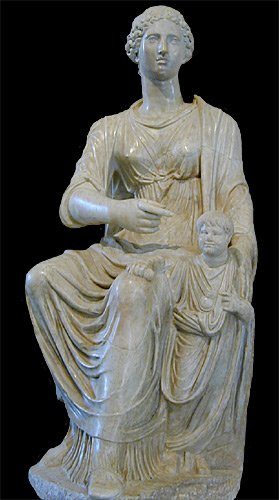
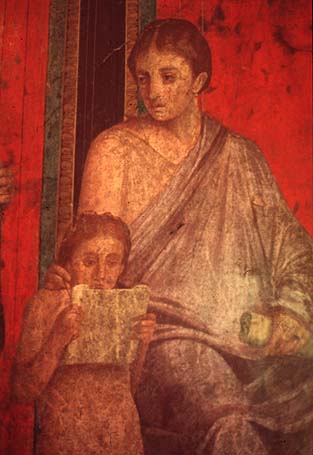
Aurelia Cotta was the trainer of those in her home. She was the mother of Julia Caesaris the Elder, Julia Caesaris the Younger, and Gaius Julius Caesar. She was the bodily present parent. She was the plebian parent (not one of the patricians, like her husband). She told stories. She was educated. She read Homer, Hesiod, and Sappho, and spoke the Hellenist tongue.

It is not too far fetched to imagine Aurelia Cotta reading the Illiad in her home place. It is likely to have been some act of resistance. Resistance to being silenced, as a woman, as a plebian, as a mother, in Rome! (Glenn reminds us here that:

Because the Romans clung to the ideal of the domina, of the strong privatized woman, they [i.e., the Roman men] often reacted with perplexity or disgust at the women who pursued intellectual or political aspirations. Unlike the very few Greek women who found acceptance and admiration in the public domain, no Roman woman seems to have succeeded in establishing herself as a public figure in her own right. [72])

It is not too difficult to think that little Julius hears his mother's Hellenistic words of resistance profoundly. He hears them as the Hellenist hero Achilles, the son, hears them from his own mother, Thetis. (James J. Murphy says little Roman boys profoundly learned lots of Hellenistic rhetoric: "The young lad who begins with a simple fable of Aesop ends up years later as a young adult doing the same thing with a complex speech of Demosthenes . . ." [61]. Feminist history explains the role of the mothers).

Listen as if to Aurelia Cotta reading and reciting to her children the Hellenist words of Thebis to her child (from the Illiad, Book 1, Line 414):

τὸν δ' ήμεἰβετ' ἐπειτα Θέτις κατά δάκρυ χἐουσα:
Thetis answered him then letting the tears fall: 'Ah me,

ὥ μοι τἐκνον ἐμὸν, τἰ νὑ σ' ἐτρεφον αἰνά τεκοῦσα;
my child. Your birth was bitterness. Why did I raise you?

It is not impossible that “ὥ μοι τἐκνον ἐμὸν” [“ah me, my child”] is heard and heard and recited and recited and spoken again by young Julius. So it is not impossible that “καὶ σὑ τὲκνον” [“and you? child”] rolls off the tongue of the dying man, Julius Caesar. He is a son who repeatedly heard his parent, his mother. When a dying man, as a parent (perhaps even the parent of Brutus) he now identifies with and repeats the words of his mother, those words of Thetis, who was (also) betrayed by a son.

I am not trying to suggest that Julius Caesar was not sexist. Or that ancient Roman (or Greek) men generally were not chauvinists.

Rather, I am hoping to show that such simple categorizations of ancient men hardly shows the profound impact of ancient women on such boys and men (from cradle to grave). The impact is in the rhetorics these women found and used.

HOMEGROWN FEMINIST RHETORICS

(Feminist) rhetorician, Patricia Bizzell, praises the “afrafeminist ideology” of Jacqueline Jones Royster as good “feminist rhetorical methodology.” And Royster says the following as she wonders how non-African American scholars can so speak for her, an African American woman (in her article, "When the First Voice You Hear is Not Your Own"):

People in the neighborhood where I grew up would say, “Where is their home training?” Imbedded in the question is the idea that when you visit other people’s “home places,” especially when you have not been invited, you simply can not go tramping around the house like you own the place, no matter how smart you are, or how much imagination you can muster, or how much authority and entitlement outside that home you may be privileged to hold. (32)

bell hooks, another Afrafeminist, puts it this way (in "Homeplace: a Site of Resistance"):

Throughout our history, African-Americans have recognized the subversive value of homeplace, of having access to private space where we do not directly encounter white racist agression. Whatever the shape and direction of black liberation struggle (civil rights reform or black power movement), domestic space has been a crucial site for organizing, for forming political solidarity.

In our young minds houses belonged to women, were their special domain, not as property, but as places where all that truly mattered in life took place—the warmth and comfort of shelter, the feeding of our bodies, the nurturing of our souls. There we learned dignity, integrity of being; there we learned to have faith. The folks who made this life possible, who were our primary guides and teachers, were black women . . . [who fostered] a radical political dimension . . . [and who created] a site of resistance and liberation struggle (47).

I shall never forget the sense of shared history, of common anguish, I felt when first reading about the plight of black women domestic servants in South Africa, black women domestic servants in South Africa, black women laboring in white homes. Their stories evoked vivid memories of our African-Amerocian past. . .

I want to remember these black women today. The act of remembrance is a conscious gesture honoring their struggle, their effort to keep something for their own. I want us to respect and understand that this effort has been and continues to be a radically subversive political gesture. For those who dominate and oppress us benefit most when we have nothing to give our own, when they have so taken from us our dignity, our humaness that we have nothing left, no “homeplace” where we can recover ourselves. I want us to remember these black women today, both past and present. (42-43)


Let's make the connections, between women (Africans, African Americans, Hellenists [goddesses and humans] and Romans) and men. How profound our histories, our passionate bodily rhetoric of memory:

Aurelia Cotta bore and raised Julius Caesar. But most later (merely sexist, even "feminist") histories have him simply living and dying as a sexist.

What gets missed in such historying (i.e., historiography) is the Hellenist-Roman-Afra-feminism of Aurelia Cotta and of the Hellenist Thebis that influenced Caesar to his dying words. His words, because of his mother's rhetorical influence, have him, at the very end, identifying with the pain, and the loss, of a mother.

Feminist retelling of feminist rhetorics (such as that of Sappho, of Aurelia Cotta, of Laura Cereta, of Christine de Pizan, of Cheryl Glenn, of Patricia Bizzell, of bell hooks, and of Jacqueline Jones Royster's) indicate the power of the woman. The woman's power is in resistance. Her power is in rhetorically telling and retelling histories more fully, with our profound identification with the pain, and the loss, of a mother separated from her child. The ultimate uttered response to such betrayal runs deep in boys and men and girls and women trained in her home place.
Sunday, June 3, 2007

on academic snobbery: where are the true feminists and Hellenists?

Feminists and Hellenists should provide antidotes to academic snobbery. More on that in a moment. First, a true story about some personal moments.

This is my introduction to the attitudes and behaviors of intellectual superiority. In the fall semester of my sophomore year of college, all my professors happened to be thirty-something know-it-alls. Sure enough, they fostered critical thinking in me and, I suppose, in my classmates. But they also heightened my painful sensitivity to academic snobbery. In the course of the next five semesters, I couldn't help but notice how even the most experienced, tenured professors tended to retain (well beyond their thirties) this quality: they were all arrogant intellectuals. They made us students know we were mere undergraduates.

I remember one prof who, in class, actually attacked the identity of one student. As the student left crying, the teacher declared victory of one sort or another. (The victory, I found out later, was also, at least, the professor's own "victory" over the "identity," a personal identity rejected. Two of my friends at that university, struggling over the same identity, had taken their own lives that same semester. I myself shared--but not openly--the same personal identity, an identity I did not choose. The next year, another friend with the same identity--a friend from high school who I'd followed to the college--decided to drop out the last month of the last semester of the senior year, just as the parents arrived from overseas for graduation. Private coping with a profound identity was not something snobs, in the public academy, helped with. At least we were not entirely alone). In all my classes, I clearly remember, the instructors who were men treated very differently the students who were women (just because they were women). Many of my classmates who were women, some of them feminists, were starting to talk about the arrogant thought and actions of power of some of these professors. (My classmates never used that radical word "feminist" nor the other useful terms many undergraduates today find commonplace: "sexism," "misogyny," "deconstruction," "hermeneutic of suspicion," "meta-narratives," "cultural studies," and "post structuralism, post colonialism." The U.S. was, then, riding out our second wave of feminism--and we had not yet begun to whiff the postmodern air stirring at the time in France. And I was taking semester after semester of classical Greek, not yet connecting the importance of the Hellenistic roots either philologically or philosophically. I will explain what I mean here below). It's taken me decades, now, to get to the point where I can find antidotes to academic snobbery. I've gone in and out of my thirties; in and out of my own hypocrisy, my own arrogance of intellect; in and out of a semester of seminary to examine academically--spiritually?--my own angst with my personal identity, which I need not name here; through a master's degree in linguistics; through the coursework and qualifying exams of a Ph.D. in "English" focused on ancient Greek rhetoric and on feminist rhetorics; into life as a spouse, life as a parent; and into a score of years of work with ESL college students--those women and men truly on the outside of the academy in monolingual America. It's June 3, 2007, and now I'm (nearly) ready to suggest two antidotes to academic snobbery.

First, feminists should offer an antidote to academic snobbery. Humility and profundity are the hallmarks of the woman who gets looked down upon by men (just because she's a woman) and who is seen as lacking the capability of being as rational as men are (precisely because she's not a man). Modesty and emotional depth are hardly the characteristics of self aggrandizing rational(izing) snobs.

I could say lots more. But I couldn't write anything better than Nancy Mairs has written, sitting in a wheel chair "waist-high in the world," in a body she didn't choose. So I just recommend scholar Mair's Voice Lessons: On Becoming a (Woman) Writer.

Second, Hellenists should give us another antidote to academic snobbery in twenty-first century America. I use the English word, should, here with all the ambiguous imperative-subjunctive glory we academic insiders give it. Some of you are demanding, then, that I say what I mean. Let me just warn you that, with the classic poetic feministic Greeks, I'm mainly going to play with language. (I may sound like a snob, at first. But I'll try to translate if you'll agree to try to read on and ask me questions, continue this dialogue: jkgayle at gmail dot com privately or comment here publicly.)

Helen (or Ἑλένη) is, after all, the beautiful beginning, middle, and end of Hellenism. She is a person whose personal identity--an identity she did not choose--divides and unifies. Hence, she is humble and profound. She did not choose, either, to be captured by Paris of Troy or recaptured by Menelaus or Theseus, or in epic legend by Homer and in rhetorical praise by Sappho and Gorgias and Isocrates. (I know this sounds like snobbish name dropping.) Here's how we should care: the stories of Helen are stories of a person; they are stories of beauty and of battle; they are stories of nation building; they are stories of people; they are stories of stories; they are stories of learning, of literature, of letters, of literacy, of orality. They are stories of personal identity, of passion, of profundity, of deep change in who I am and in who you are. They are stories of flawed deities and flawed humanity, stories of humility, stories of woman and man and of common humanity. They are stories that should bring down the arrogant academic.

We get our English word, academic, from their Hellenistic origins. Plato used the word to name his Ακαδήμεια, his Academy. It's related to that other word we Americans tend to love: δημοκρατία, or democracy. Both words, of course, share a common root: δῆμος, the Hellenistic word for common people, for the ones who tend to be on the outside. So where do arrogant academics in America get the right to their attitude and their behavior of power over the common sophomore? Hardly from the humble, profound Ακαδήμεια. (Just a quick aside on Plato. Feminist scholars in the history of Greek rhetoric, including Cheryl Glenn, Susan Jarratt, Lisa Ede, and Madeleine Henry, have begun to show us that just as we know of Socrates from Plato, we know of Aspasia from Plato. The former, Socrates, is the much more famous teacher of Plato, the inventor of the famous Socratic method. The latter, Aspasia, is hidden in the infamy of her membership in the ἡετερεία, or "heterae," the kept women of ancient Greek higher education. But now our more inclusive, more humble and profound histories of Hellenistic influences on our American academy show something new. Of course, Plato credits Aspasia for writing for and influencing male speech givers. And yet, Plato may also have known that the Socratic method really was something that Socrates received from Aspasia, from a profound, lowly woman in higher education.)

Will you now revisit with me the first sentence of Homer's Hellenistic Odyssey? I want us to look at, to listen to, a phrase from the fourth line of the first book (repeated in Book XIII, Line 90).

It reads and speaks (humbly and profoundly) this way:

πολλὰ πάθεν ἄλγεα ὃν κατὰ θυμόν

or

many passions [Odysseus, our hero] suffered by heart

These are the very same sorts of words and ideas that Aristotle, in his Hellenistic Rhetoric, uses much later. In the opener of his treatise on rhetoric, for instance, Aristotle complains that all previous compilers of writings on the "skills of statement" have neglected central concepts. He talks about how common rhetoric is among all people, and he names πάθος and θυμα (or passion and heart) as key concepts thoroughly mixed up with and mixed in with the common rhetoric and conversation of all people.

Here's our problem now in America, where the academy tends to be full of academic snobs.
We have divided the common from the ivory tower. That is, we move from Homer's opener to Aristotle's and think there's nothing common between them, and hardly anything here or there for the common person.

So, in our literate minds, we move from the heart of orality to literacy alone.
From epic poetry to didactic rhetoric.
From story to precept.
From passion suffered to "pathos" as merely one of three available means of persuasion competing somehow with "ethos" and the much preferred "logos."
From passion, then, to "pathos," and from "pathos," ultimately to "logos."
From profound heart to shallow "enthymeme," as a heady syllogism in formal rhetoric.
From Helen to Hellenism, from Hellenism to Greek, from classical Greek to American academic English.
From the common to the snobbish.
From either feminism to Hellenistic intellectualism or from intellectualism to feminism
(but never to feminism in Hellenism or Hellenism that is feministic).
From the personal identity of Hellenism, feminism
to the impersonal intellectualism of higher ivory tower education.

We can hardly fathom that anything we do in the university in this nation today, from our high vantage, should cause us to bear any responsibility for the suicide of two undergraduates and for the decision to drop out of college by a third. Will the higher education labels we put on ourselves and our students (whether "traditionalist" or "feminist" or something else) bring down our arrogance? Do we work against student passion and profundity? What can we learn from our dropouts? Are we too snobbish also to acknowledge the humble feminist and deep Hellenist roots of our academy?