And generally men in ancient
πρῶτος δὲ Κάσκας ξίφει παίει παρὰ τὸν αὐχένα πληγὴν οὐ θανατηφόρον οὐδὲ βαθεῖαν, ἀλλ’ ὡς εἰκὸς ἐν ἀρχῇ τολμήματος μεγάλου ταραχθείς, ὥστε καὶ τὸν Καίσαρα μεταστραφέντα τοῦ ἐγχειριδίου λαβέσθαι καὶ κατασχεῖν.
It was Casca who gave him the first blow with his dagger, in the neck, not a mortal would, nor even a deep one, for which he was too much confused, as was natural at the beginning of a deed of great daring; so that Caesar turned about, grasped the knife, and held it fast.
At almost the same instant both cried out, the smitten man in Latin: "Accursed Casca, what does thou?" and the smiter, in Greek, to his brother: "Brother, help!"
Therefore Brutus also gave him one blow in the groin. And it is said by some writers that although Caesar defended himself against the rest and darted this way and that and cried aloud, when he saw that Brutus had drawn his dagger, he pulled his toga down over his head and sank, either by chance or because pushed there by his murderers, against the pedestal on which the statue of Pompey stood.
Let’s now read what the Roman historian Gaius Suetonius Tranquillus writes (in our earliest 1st century account, with a later 20th century translation):Atque ita tribus et viginti plagis confossus est uno modo ad primum ictum gemitu sine voce edito, etsi tradiderunt quidam Marco Bruto irruenti dixisse: καὶ σὑ τὲκνον;
And in this wise he was stabbed with three and twenty wounds, uttering not a word, but merely a groan at the first stroke, though some have written that when Marcus Brutus rushed at him, he said in Greek, “You too, my child?”
What if Julius Caesar’s dying words were not Latin (as Shakespeare and Plutarch have suggested)?
What if, in the Hellenist language, Caesar said to Brutus (as the Latin-writing but then Hellenist-alphabet writing-historian Suetonius reports from his other earlier sources): καὶ σὑ τὲκνον?
Where would Julius have gotten those Hellenist utterances? Who would have trained him so viscerally in this other mother tongue?
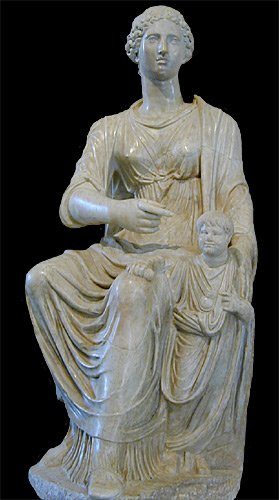
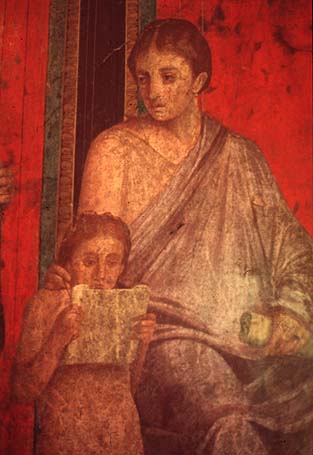
Aurelia Cotta was the trainer of those in her home. She was the mother of Julia Caesaris the Elder, Julia Caesaris the Younger, and Gaius Julius Caesar. She was the bodily present parent. She was the plebian parent (not one of the patricians, like her husband). She told stories. She was educated. She read Homer, Hesiod, and Sappho, and spoke the Hellenist tongue.
It is not too far fetched to imagine Aurelia Cotta reading the Illiad in her home place. It is likely to have been some act of resistance. Resistance to being silenced, as a woman, as a plebian, as a mother, in Rome! (Glenn reminds us here that:
Because the Romans clung to the ideal of the domina, of the strong privatized woman, they [i.e., the Roman men] often reacted with perplexity or disgust at the women who pursued intellectual or political aspirations. Unlike the very few Greek women who found acceptance and admiration in the public domain, no Roman woman seems to have succeeded in establishing herself as a public figure in her own right. [72])
It is not too difficult to think that little Julius hears his mother's Hellenistic words of resistance profoundly. He hears them as the Hellenist hero Achilles, the son, hears them from his own mother, Thetis. (James J. Murphy says little Roman boys profoundly learned lots of Hellenistic rhetoric: "The young lad who begins with a simple fable of Aesop ends up years later as a young adult doing the same thing with a complex speech of Demosthenes . . ." [61]. Feminist history explains the role of the mothers).
Listen as if to Aurelia Cotta reading and reciting to her children the Hellenist words of Thebis to her child (from the Illiad, Book 1, Line 414):
τὸν δ' ήμεἰβετ' ἐπειτα Θέτις κατά δάκρυ χἐουσα:
Thetis answered him then letting the tears fall: 'Ah me,
ὥ μοι τἐκνον ἐμὸν, τἰ νὑ σ' ἐτρεφον αἰνά τεκοῦσα;
my child. Your birth was bitterness. Why did I raise you?
It is not impossible that “ὥ μοι τἐκνον ἐμὸν” [“ah me, my child”] is heard and heard and recited and recited and spoken again by young Julius. So it is not impossible that “καὶ σὑ τὲκνον” [“and you? child”] rolls off the tongue of the dying man, Julius Caesar. He is a son who repeatedly heard his parent, his mother. When a dying man, as a parent (perhaps even the parent of Brutus) he now identifies with and repeats the words of his mother, those words of Thetis, who was (also) betrayed by a son.


I am not trying to suggest that Julius Caesar was not sexist. Or that ancient Roman (or Greek) men generally were not chauvinists.
Rather, I am hoping to show that such simple categorizations of ancient men hardly shows the profound impact of ancient women on such boys and men (from cradle to grave). The impact is in the rhetorics these women found and used.
HOMEGROWN FEMINIST RHETORICS
(Feminist) rhetorician, Patricia Bizzell, praises the “afrafeminist ideology” of Jacqueline Jones Royster as good “feminist rhetorical methodology.” And Royster says the following as she wonders how non-African American scholars can so speak for her, an African American woman (in her article, "When the First Voice You Hear is Not Your Own"):
People in the neighborhood where I grew up would say, “Where is their home training?” Imbedded in the question is the idea that when you visit other people’s “home places,” especially when you have not been invited, you simply can not go tramping around the house like you own the place, no matter how smart you are, or how much imagination you can muster, or how much authority and entitlement outside that home you may be privileged to hold. (32)
In our young minds houses belonged to women, were their special domain, not as property, but as places where all that truly mattered in life took place—the warmth and comfort of shelter, the feeding of our bodies, the nurturing of our souls. There we learned dignity, integrity of being; there we learned to have faith. The folks who made this life possible, who were our primary guides and teachers, were black women . . . [who fostered] a radical political dimension . . . [and who created] a site of resistance and liberation struggle (47).
I shall never forget the sense of shared history, of common anguish, I felt when first reading about the plight of black women domestic servants in
I want to remember these black women today. The act of remembrance is a conscious gesture honoring their struggle, their effort to keep something for their own. I want us to respect and understand that this effort has been and continues to be a radically subversive political gesture. For those who dominate and oppress us benefit most when we have nothing to give our own, when they have so taken from us our dignity, our humaness that we have nothing left, no “homeplace” where we can recover ourselves. I want us to remember these black women today, both past and present. (42-43)
Let's make the connections, between women (Africans, African Americans, Hellenists [goddesses and humans] and Romans) and men. How profound our histories, our passionate bodily rhetoric of memory:
Aurelia Cotta bore and raised Julius Caesar. But most later (merely sexist, even "feminist") histories have him simply living and dying as a sexist.
What gets missed in such historying (i.e., historiography) is the Hellenist-Roman-Afra-feminism of Aurelia Cotta and of the Hellenist Thebis that influenced Caesar to his dying words. His words, because of his mother's rhetorical influence, have him, at the very end, identifying with the pain, and the loss, of a mother.
Feminist retelling of feminist rhetorics (such as that of Sappho, of Aurelia Cotta, of Laura Cereta, of Christine de Pizan, of Cheryl Glenn, of Patricia Bizzell, of bell hooks, and of Jacqueline Jones Royster's) indicate the power of the woman. The woman's power is in resistance. Her power is in rhetorically telling and retelling histories more fully, with our profound identification with the pain, and the loss, of a mother separated from her child. The ultimate uttered response to such betrayal runs deep in boys and men and girls and women trained in her home place.