Showing posts with label (y)our racism. Show all posts

Thursday, September 15, 2011

Mary the Parthenon as equal to Joseph the Heitheon

Let me propose translations of LXX Isaiah 7:14 and of Matthew 1:23 and of Luke 1:26, 27, 34 that do not emphasize virginity. It's not because I'm a "liberal" (therefore not a "conservative") translator trying to diminish or downplay the biblical and accurate stories of pregnancies of virgins. Not sure I fit in either of those boxes ("liberal" or "conservative") very well. I'm not wanting to try a different translating because the Greek word parthenos (παρθενος) never refers to female virgins. We all know of examples where that's the case, where the Parthenon has to be female only and in which the emphasis is on her purity on her being yet untouched by a male.

What I'm hoping to do with English translation is to get at the part of the range of meanings of the Greek word parthenos (παρθενος) that gets beyond the female as the virgin .

Sometimes Often, female virginity is all that counts. For the radical extremist terrorists of September 11, 2001, (as the horrible folklore goes) female virginity was of supreme importance as their reward for their suicide mission. And for US culture in general, male virginity can actually be something of a joke.


The quick point I'm trying to make is one that Hanne Blank shows with her history of the concept of female virginity: there's a huge disparity between how cultures have regarded virginity in girls and women compared with boys and men.


Now, interestingly, Euripedes made use of another Greek word for virgins, untouched.  In his play Hippolytus, the playwright has the character Theseus ask the protagonist:

"Are you the chaste one, untouched by evil?"  David Kovacs is translating.  The words are σὺ σώφρων καὶ κακῶν ἀκήρατος; Notice how a-kēratos (ἀ-κήρατος) is the word for "un-touched" and sṓphrōn (σώφρων) the word for "chaste." The question is whether these sorts of words apply equally to males and to females. For Aristotle, of course, females are botched males, naturally, and therefore, it is important to divide them. The same word, such as sōphrosȳnē (σωφροσύνη) or "temperance," actually divides women and men, for Aristotle, just as for Hitler, Blutes or "blood," actually divided der Jude or "the Jew" and the untainted Arier or "the Aryan."


Homer's Greek did not always so divide people by blood, by temperance, by how and whether they were untouched and untainted and virgin.  The epics of Homer actually made good use of a pair of words that marked difference in sex but that gave import to both girls and boys as equals more or less. The pair included parthenos (παρθενος) as the feminine and hēitheos (ἠιθεος) as the masculine. Both, as a pair, together, refer to unmarried young people, to eligible bachelorettes and eligible bachelors.

You can see this pair in the following excerpt from a fragment of papyri recording a bit from Homer's Iliad, Book 22. It's probably from sometime in the 3rd century B.C.E. and is now in the collection of papyri at the University of Heidelberg.


Alex C. Purves in 1891 translated that bit in the following way:

IL.22.128 παρθένος ἠΐθεός τ' ὀαρίζετον ἀλλήλοιϊν.

IL.22.128 maid and bachelor in amorous prate;

The longer context goes like this, where you can see it as a repetition of the pair:

IL.22.123 μή μιν ἐγὼ μὲν ἵκωμαι ἰών, ὃ δέ μ' οὐκ ἐλεήσει
IL.22.123 Surely, if I solicit him, he will have no pity

IL.22.124 οὐδέ τί μ' αἰδέσεται, κτενέει δέ με γυμνὸν ἐόντα
IL.22.124 nor courtesy, but will slay me like a helpless

IL.22.125 αὔτως ὥς τε γυναῖκα, ἐπεί κ' ἀπὸ τεύχεα δύω.
IL.22.125 woman, a naked man, who have put off mine arms;

IL.22.126 οὐ μέν πως νῦν ἔστιν ἀπὸ δρυὸς οὐδ' ἀπὸ πέτρης
IL.22.126 I may not talk with him from tree or stone,

IL.22.127 τῷ ὀαριζέμεναι, ἅ τε παρθένος ἠΐθεός τε
IL.22.127 like a man and a maid, like

IL.22.128 παρθένος ἠΐθεός τ' ὀαρίζετον ἀλλήλοιϊν.
IL.22.128 maid and bachelor in amorous prate;

IL.22.129 βέλτερον αὖτ' ἔριδι ξυνελαυνέμεν ὅττι τάχιστα:
IL.22.129 better to close with him in speedy anger;

IL.22.130 εἴδομεν ὁπποτέρῳ κεν Ὀλύμπιος εὖχος ὀρέξῃ.
IL.22.130 so shall we know to whom the Olympian gives the glory.

And in Book 18 of the Illiad, the pair of words is used a couple of other times.


The pair of words also can be heard in Homer's Odyssey. With Samuel Butler's English translation of 1900, that with some context went like this:

OD.11.35 ἐλλισάμην, τὰ δὲ μῆλα λαβὼν ἀπεδειροτόμησα
OD.11.35 I cut the throats of the two sheep

OD.11.36 ἐς βόθρον, ῥέε δ' αἷμα κελαινεφές: αἱ δ' ἀγέροντο
OD.11.36 and let the blood run into the trench, whereon the ghosts came

OD.11.37 ψυχαὶ ὑπὲξ Ἐρέβευς νεκύων κατατεθνηώτων.
OD.11.37 trooping up from Erebus -

OD.11.38 νύμφαι τ' ἠΐθεοί τε πολύτλητοί τε γέροντες
OD.11.38 brides, young bachelors, old men worn out with toil,

OD.11.39 παρθενικαί τ' ἀταλαὶ νεοπενθέα θυμὸν ἔχουσαι,
OD.11.39 maids who had been crossed in love,

OD.11.40 πολλοὶ δ' οὐτάμενοι χαλκήρεσιν ἐγχείῃσιν,
OD.11.40 and brave

OD.11.41 ἄνδρες ἀρηΐφατοι βεβροτωμένα τεύχε' ἔχοντες:
OD.11.41 men who had been killed in battle, with their armour still smirched with blood;


So now we come to the Bible. Even though the male counterpart is lost after Homer's epic works, there's still reason to believe that readers could have heard "unmarried young person" as what was meant.

Here's Isaiah:

διὰ τοῦτο δώσει κύριος αὐτὸς ὑμῖν σημεῖον
Thus, this is what he will give -- Master himself will give something to you all -- a sign.

ἰδοὺ ἡ παρθένος ἐν γαστρὶ ἕξει
Look, the eligible bachelorette -- in her innermost belly -- will have it

καὶ τέξεται υἱόν
And, she will deliver and have a child, a son

καὶ καλέσεις τὸ ὄνομα αὐτοῦ Εμμανουηλ
And, she will call its name EmmanouĒl

Here's Matthew:

Ἰδού, ἡ παρθένος ἐν γαστρὶ ἕξει
Look, the eligible bachelorette -- in her innermost belly -- will have it

καὶ τέξεται υἱόν
And, she will deliver and have a child, a son

καὶ καλέσουσιν τὸ ὄνομα αὐτοῦ Ἐμμανουήλ
And, she will call its name EmmanouḖl

ὅ ἐστιν μεθερμηνευόμενον
which is rendered literally

Μεθ’ ἡμῶν ὁ θεός
"with us - God"


Here's Luke:

Ἐν δὲ τῷ μηνὶ τῷ ἕκτῳ
And yet in the sixth month

ἀπεστάλη ὁ ἄγγελος Γαβριὴλ ἀπὸ (or possibly ὑπὸ) τοῦ θεοῦ
there was the Messenger GabriḔl from God sent

εἰς πόλιν τῆς Γαλιλαίας, ᾗ ὄνομα Ναζαρὲθ (or possiblyΝαζαρέτ)
into the City-State of Galilaias named Nazareth

πρὸς παρθένον
to an eligible bachelorette,

μεμνηστευμένην (or possibly ἐμνηστευμένην) ἀνδρί,
to be engaged to a man,

ᾧ ὄνομα Ἰωσήφ, ἐξ οἴκου Δαυίδ·
named Joseph, of the household of David.

καὶ τὸ ὄνομα τῆς παρθένου Μαριάμ.
and she, this bachelorette, was named Mariam,

Εἶπεν δὲ Μαριὰμ πρὸς τὸν ἄγγελον,
Mariam, nonetheless, said to the Messenger,

Πῶς ἔσται τοῦτο,
How is this going to be,

ἐπεὶ ἄνδρα οὐ γινώσκω;
seeing how I have not yet known a husband?


Now you tell me, does this translation disrupt the Greek?  Does it rob the narrative of female virginity that would be so very important to men and to males and to the Christian Bible?

Monday, August 22, 2011

Seeing "The Help" and "The Passion of the Christ"

It's been a week now since we went to the theater and saw the film, "The Help." This is my review for what it's worth. Suzanne says the movie is enjoyable if you suspend your disbelief, and she links to a couple of other reviews that point out worthwhile things about the pictureshow. 

It's been a week now.  Since our seeing "The Help," the anniversary of the 19th Amendment to the U.S. Constitution came and went.  I'm just bringing this up to get in a quotation by Anna Julia Haywood Cooper, who said for herself the following as a woman and as a colored as a representative of the World's Congress of Representative Women, some 27 years before the 19th Amendment and the equal right of women to vote with men in the United States:
The colored woman feels that woman's cause is one and universal; and that not till the image of God, whether in parian or ebony, is sacred and inviolable; not till race, color, sex, and condition are seen as the accidents, and not the substance of life; not till the universal title of humanity to life, liberty, and the pursuit of happiness is conceded to be inalienable to all; not till then is woman's lesson taught and woman's cause won—not the white woman's, nor the black woman's, not the red woman's, but the cause of every man and of every woman who has writhed silently under a mighty wrong.
In the film, "The Help," one of the first things you hear, and something you hear repeated, is the main character, Aibileen, saying the following to a young white girl under her care, as a black woman, as one of the help some forty years or so after women in the United States were finally granted the vote:
You is smart, you is kind, you is important.
This is the voice of the black woman, of black women, teaching other women as daughters who some day will later employ their own daughters when both grow up.  We wondered what the young and old African American women in the theater with us in Fort Worth, Texas, USA were thinking.  And there were many, relatively speaking.  At the end of the movie, there was light and not unanimous applause.  One African American couple headed straight to the door before the credits started rolling.

The representations and the misrepresentations got us wondering about the stereotyping.  (Karlyn Kohrs Campbell, not a black woman herself, has helped us wonder much; and here's how she has changed her mind and the sensitive and rhetorical questions she's asked.)  How do we want our black women to represent themselves?  How if we're a white woman novelist or her chosen white male screenplay writer, both from Mississippi?  I'm reading The Immortal Life of Henrietta Lacks by Rebecca Skloot, who self identifies as white, agnostic, half New York Jewish, half MidWestern Protestant, to show how different she is from Ms. Lacks and especially from her daughter Deborah, to whom this writer gives voice.  There's much much care and concern for right representation, for historical accuracy, for the issues at stake.  I highly recommend Skloot's book but hardly recommend the movie, The Help.  Oprah Winfrey has discussed with Skloot making her book into an HBO film, and she's hired Alan Ball to write the screenplay.  Ball is a man, a white person, who has proven how important it is to represent women fairly, and not just white women, for example in his writing of the screenplay "Towelhead," based on the book by Alicia Erian, who writes as an Egyptian-Polish American young woman.

Now, I'm not saying to anyone that they must boycott "The Help."  It is important to see the film the way it was important to see "The Passion of the Christ," written and directed and produced by a known anti-Semite and misogynist.  It was first written in English and then translated into Aramaic and into Latin, not any Greek.  The Latin was not the Latin of the characters in the film but is ecclesiastical Latin.  Who makes such films and how their characters speak does matter.  The backstory of the person telling somebody else's story does matter.  The "original" tellings of the story portrayed were translations from Aramaic and from Latin and from high Hebrew into goyish Greek turned Hebraic Hellene.  Now that's real important.  You understand the reactions of the different audience members, and you must freely have your own responses, when you get the story behind the telling of the story.

I know I'm not giving you much of a review of a movie.  I hope you'll hear and see for yourself some of the issues when someone is denied her voice or when a voice is represented and misrepresented.

Friday, August 12, 2011

Will You see "The Help"? (How?)

We don't usually boycott films or books.  But this morning "J" tells me she's not sure about "The Help."  Maybe she'll go with our daughters and use it as a teaching moment.  She'd seen Melissa Harris-Perry's review.  I'd told her what "V," our friend, had shouted out to me last night as her husband, their son, our son, and I jumped in the car to go to the T. D. Jakes "man" conference.  "The book is good," V said. "But not the movie."  That's Oprah's assessment too, my spouse reminded me.  And Oprah's question to all of us is, "So what do you think?"  And Martha Southgate's evaluation - "The Help is only a symptom, not the disease" - almost gives the book and the film a pass.  However, there's still the question,

"Will you see the film 'The Help'?"

Whether you do or not, whether you consider a movie viewable because it's only a symptom, then can we see the disease?

Southgate points it out the disease of remembering and figuring white people as necessary but black people as always just merely only in the shadows, as marginal, even in their own histories.  She concludes:
Suffice it to say that these stories are more likely to get the green light and to have more popular appeal (and often acclaim) if they have white characters up front. That's a shame. The continued impulse to reduce the black women and men of the civil rights movement to bit players in the most extraordinary step toward justice that this nation has ever known is infuriating, to say the least. Minny and Aibileen are heroines, but they didn't need Skeeter to guide them to the light. They fought their way out of the darkness on their own — and they brought the nation with them.
And this history is still being written.  We may be part of the contagion, of the spread of the disease today.

If we ourselves are not, then at the very very least, the movie industry that we support by our movie watching is.  For example, just a few months ago this year, the day after the Oscars were handed out earlier this year, Kevin Eason stated the obvious:
"As controversial as the Oscar nominations usually are, there is one issue that stands out more than most. Namely, why are there no black Oscar nominees this year?"
Then Easton concludes, as with some hope:
"It also seems that there may not be that many opportunities this year for African-American actors to make the shortlist either. Two big films that might change the situation are The Help, about the lives of housemaids during the segregation of the Civil War-era, and Winnie, a biopic of Winnie Mandela starring Jennifer Hudson...."
Of course, Easton might have seen the disease, with both of his hopeful films this year being symptoms.  Nonetheless, it seems he didn't anticipate the controversies surrounding either film.

The film "Winnie" was written by white South African filmmaker, Darrell Roodt.


And it's based on the book Winnie Mandela: a Life, by white South African, Anné Mariè du Preez Bezdrob, the former UN peacekeeper and radio reporter, who also wrote The Nelson Mandela Story, about Winnie's ex-husband of course.  But neither du Preez Bezdrob nor Roodt consulted either of the Mandelas for the books or the film.

The book by du Preez Bezdrob didn't fairly represent Ms. Mandela's experience, according to some.  For example, the Nigerian-Jewish British actor, Sophie Okonedo, who played Winnie Mandela for the tv film "Mrs. Mandela," said this about the book:
[I had to do my research] about five weeks before filming. So I started reading. I read the Anthony Samson book, which gave me a pretty good overview; the Emma Gilbey book, which is more judgmental I think. I started the one which is quite famous, Winnie Mandela: A Life [Anné Mariè du Preez Bezdrob], but I just thought she kept assuming things about Winnie. There was lots of, "No one knows what happened in that cell but we can imagine"… then a whole chapter of imaginings. I just put that book down.
The film by Roodt is one that Winne Mandela herself has publicly criticized:
"I have absolutely nothing against Jennifer [Hudson, who was cast to play me], but I have everything against the movie itself," she told CNN.  "I am still alive and I think it is total disrespect to come to South Africa, make a movie about my struggle and call that movie some translation of a romantic life of Winnie Mandela. I think it is an insult."
Of course, "Winnie" may earn Jennifer Hudson an Oscar nomination.  Likewise, "The Help" may provide Viola Davis or Octavia Spencer an Academy Award nomination as well.

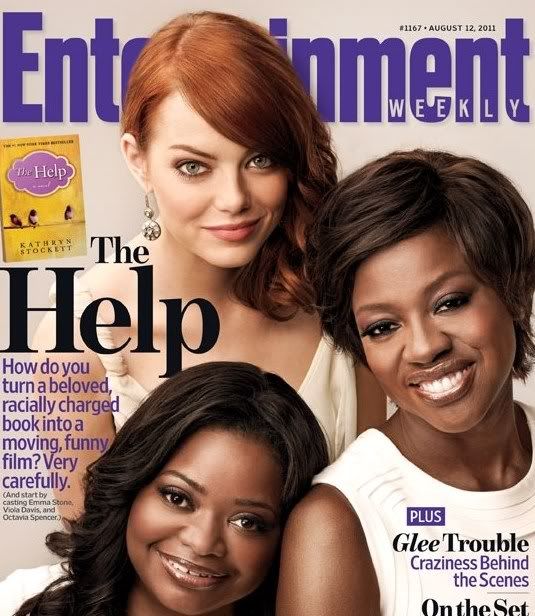
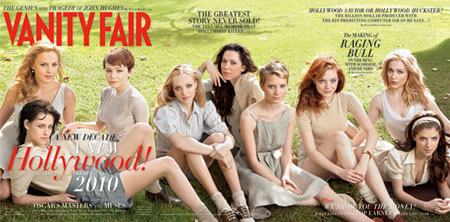
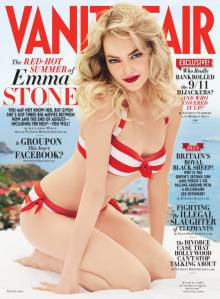
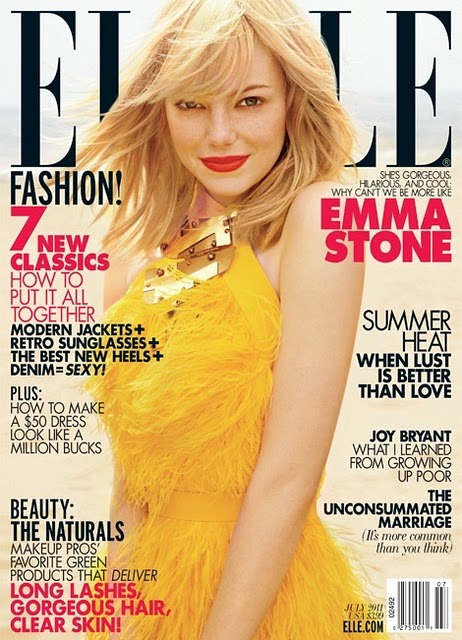
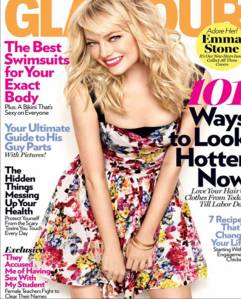
Any yet, we may well note already how differently the main black actress(es) of "The Help" are being portrayed in the media compared with the main white actress.  As you decide whether to go see "The Help," notice just the magazine cover differences.  Notice which magazines Emma Stone is the cover girl for.  Notice which ones for Viola Davis and for Octavia Spencer.  Already our daughters (and sons) are getting an education in the representation of women, and of white and black women differently:


So (how) will you see "The Help"?

Wednesday, July 20, 2011

Would You Have Acted on July 20th? Will You?

"On Thursday, July 20, 1848, at the morning session on the second day of the First Women's Rights Convention, sixty-eight women signed the Declaration of Sentiments under the heading, 'Firmly relying upon the final triumph of the Right and the True, we do this day affix our signatures to this declaration.' 

Thirty-two men signed the Declaration of Sentiments under the heading '...the gentlemen present in favor of this new movement.'"
   -- from nps.gov, "Signers of the Declaration of Sentiments"

It was not until 1920 that the United States of America allowed its women to vote.  "More than 150 years later," Kristen reminds us yesterday, "and we are still fighting" for equality of women with men.

"Today is 20 July, an important day for us personally, but a more important day in history.  This was the day in 1944 when a group of army officers decided it was time to act against Hitler."
   -- from Jane, "A passing thought on the 20th July"
 
It was not until the next year that Adolf Hitler was no longer the dictator of one of the most brutal regimes in history.  But neo-nazi racism is not dead yet.
 
Here is a list of the 68 women and 32 men who publicly acted and signed The Declaration of Sentiments:

http://www.nps.gov/wori/historyculture/signers-of-the-declaration-of-sentiments.htm 

Here is a list of the 3 women and 184 men who secretly acted and attempted to overthrow Hitler:

http://en.wikipedia.org/wiki/List_of_members_of_the_20_July_plot


Would you have been as brave as these women and men on July 20th?  Will you be?  Can you act against discriminations against women?  Can you oppose sexisms around you?  Can you fight racists and racisms?

Friday, April 29, 2011

Royal Robbery: Stripping Women of the King's Bible for 400 Years

Lady Holland visited Lord Macaulay one day in May 1831, and they had a genteel discussion about words in English that she found distasteful, such as influential, gentlemanly, and talented.  Macaulay picked her up on talented.  Didn't Lady Holland know that it came from the parable of talents in the Bible?  'She seeemed surprised by this theory,' he later remarked in a letter to Hannah More, 'never having, so far as I could judge, heard of the parable of the talents.'  And he adds:  'I did not tell her, though I might have done so, that a person who professes to be a critic in the delicacies of the English langauge ought to have the Bible at his fingers' ends.'
    --David Crystal, "Prologue 1," Begat: The King James Bible and the English Language, 2010
AS a farther confirmation of what has been advanced on the different bent of the understanding in the sexes, it may be observed, that we have heard of many female wits, but never of one female logician—of many admirable writers of memoirs, but never of one chronologer.—In the boundless and aërial regions of romance, and in that fashionable species of composition which succeeded it, and which carries a nearer approximation to the manners of the world, the women cannot be excelled: this imaginary soil they have a peculiar talent for cultivating.... 
but were the [female] sex to be totally silent when any topic of literature happens to be discussed in their presence, conversation would lose much of its vivacity, and society would be robbed of one of its most interesting charms.
    --Hannah More, "Introduction" and "Thoughts on Conversation," Essays on Various Subjects, Principally Designed for Young Ladies, 1777
The virtues of the King James Bible -- produced 400 years ago in 1611 -- are being celebrated.  Wayne Leman is encouraging a "happy birthday" celebration because ostensibly the KJV affirmatively answers the "controversial question [that] had been dividing nations:   should the common man [and woman-W.L.] be able to read God’s Word?"  And Theophrastus is expressing happiness because the "editors working on" a two-volume Norton Critical Edition of the KJV "are top-notch," and in 2011 will likely produce what should become the "standard secular teaching text on the King James Bible," very probably including an "explanation of archaic terms and phrases [that] may prove useful for ordinary readers."  If the historical moment four centuries ago really was for openness and for democracy with respect to common literacy, then let's celebrate.  If the future brings more accessibility and explanation for more people, then let's celebrate even more.  But, while we're planning the Royal parties, we readers may want to be fully aware:

The King James Bible has a sexist and elitist history.  And we might not see it getting too much better any time soon.

First, there's the King who commissioned the translation to consider.  James, at age 23, married a 14-year-old, Anne of Denmark.  Well, of course, it was a marriage to strengthen political power, as was so common for the royalty.  So she was a convenient means for furthering the goals of empire building.  And the rumor among historians who sift through his correspondence and that of other good looking young men he so much hung around with is that she was not even his type.  At age 1, he was King of Scots, and at age 37, he was finally King of England and King of Ireland also, so that he began calling himself "King of Great Britain."  As a 38-year-old, the King of Great Britain also called himself the "King of France."  And that's when, as he worked for power in the churches of the various countries he was king of, he started the plans for a new Bible translation to replace the ones different peoples were reading.  He selected the men to translate his Bible very carefully, making sure that none of his religious enemies had any influence there.  Before he was 45, the Authorized Version rolled off the presses of Robert Barker, the King's Printer.

Second, there's the translators.  As the project Wayne links to shows, there were "47 scholars":


[update: oops! while trying to show some of the images better, I inadvertently deleted half of this post. Below is an attempt to reconstruct that to the best of my ability, remembering what and how I wrote as best as I'm able.]

The forty-seven scholars who finally produced the King James Bible were not Jews.  None was Catholic.  None was from France.  None was from any place that the British crown might venture into or later colonize or evangelize:  Africa, the Americas, vast Asia, Australia.  And none of the 47 was a woman.  In fact, that "sex [would] be totally silent when any topic of literature" related to this King's Bible translation project.

Third, there are those who could actually get their "fingers' ends" on that Bible.

Again, going to Wayne's source, we find that there is a difficulty of access for women in particular. 


On May 2nd, 1611, who in Great Britain could afford even a 10 Shilling loose leaf copy as it came off the presses of Robert Barker, the King's Printer?

Well, if you were a military captain, then you might earn 10-12 shillings in one day.  You, a man of such a position, might not eat for a day, might want to forgo any expenses, might want to dip into your savings equal to a day's work.  And, then, on May 3rd, you could buy any copy of the King's Bible available.

And if you were a mere laborer, a different kind of man (but not a woman), then some merchant might let you purchase a Bible.  He'd part with it provided you paid him the equivalent of two week's of your work.   Hence, you could have your Authorized Bible on around May 16th.


However, if you were a "female," a servant of a military man or perhaps even a man of the laboring class, then you could earn enough shillings to buy a Bible.  Would a man sell one to you?  If he were mercenary and entrepreneurial, then he might be selling bibles to women.  And if so, then, after half a year, provided you didn't spend your earnings on food or clothing or your husband or your children, provided you really owned shillings all your own, then you might be able to buy your Bible.  You might if you spent no money that you worked for for six long months.  Then you could negotiate to buy a Bible on around November 2nd, 1611.

So that's some of the who, the how, and the how much of the King James Bible on May 2, 1611.  It was a Royal, a political, an elite, a highfalutin, an expensive affair, that kept at bay the influences of the enemies of a religious king and of his Church and that kept this literature with a certain slant, the printed book itself, out of the hands of commoners and women, who were uneducated. 

Now as we fast forward to 2011, some 400 years ago this month, we notice how commoners today in England aren't all taken with the Bible of King James.  In particular, we see how another James, at the Royal Wedding of his commoner sister to a Prince, read not from the KJV but from a more inclusive English translation of the Bible, not an Authorized Version but an American one, which addressed not just the brethren but brothers and sisters in an appeal to diversity and unity and humility and democracy and perhaps republicanism more than elite monarchism.

This commoner, standing in the Church of England, did not read:
I beseech you therefore, brethren, by the mercies of God, that ye present your bodies a living sacrifice, holy, acceptable unto God, your reasonable service....
Rather, in the only scripture reading of the ceremony, he let the Bible say:
I appeal to you, brothers and sisters, by the mercies of God, to present your bodies as a living sacrifice, holy and acceptable to God, which is your spiritual worship.
And you can hear him too [here, after a 30 second ABC commercial].  And the Royalty watchers listened.

So that's this past week, as we look back some 400 years of England's and the world's having the King James Bible.

Now we look forward.  There's the announcement Theophrastus has brought.  It's the announcement of the "Norton Critical Edition of The English Bible, King James Version, appearing on the four hundredth anniversary of the great translation."  We read promotional statements from Harold Bloom and Robert Alter.  We anticipate the wonderful and competent and capable editorial voices of Herbert Marks and Gerald Hammond and Austin Busch.

But where's Margaret Reynolds, Ania Loomba, Elizabeth Ammons?  Where's Marie Borroff, Laura L. Howes, Grace Ioppolo?  Why the silence from Susanna Rowson, Jennifer Panek, Susan McReynolds Oddo?  Do the Norton publishing editors and acquisition editors not want Leah S. Marcus?  Why the silence from the likes of Alice Levine?  Is she unqualified to work on the King's Bible, as literature, in a critical edition, to come out later in 2011?

So we think again only of that "imaginary soil they have a peculiar talent for cultivating" when the unmarked they is always and only the "brethren" and not also the "brothers and sisters." We hear again the silence. We wonder why now women still must be "totally silent" on this celebrated "topic of literature."  Without a woman's voice how much of our conversation will lose its vivacity?  How much of society has been "robbed of one of its most interesting charms."

And so now there's more than ever that "appeal, to you, brothers and sisters, by the mercies of God ...."

Thursday, April 28, 2011

About This Topic, well honestly

It is less dangerous to draw a cartoon of Allah French-kissing Uncle Sam — which, let me make it very clear, I have not done — than it is to speak honestly about this topic.
-- authoress, comedienne, Tina Fey, "Confessions of a Juggler"
I know that there’s going to be a segment of people for which, no matter what we put out, this issue will not be put to rest. But I’m speaking to the vast majority of the American people, as well as to the press. We do not have time for this kind of silliness. We’ve got better stuff to do. I’ve got better stuff to do. We’ve got big problems to solve. And I’m confident we can solve them, but we’re going to have to focus on them — not on this.
-- speaker, President, Barack Obama, The White House
Tina is speaking honestly about the dicey topic of mothers in the workplace; Barack about the public certification of his birthplace.  I'd like to speak about something else too.  (But feel free to skip down to the last couple of paragraphs, more on Tina and Barack and silly topics.)

One thing that first motivated me to do human-subject, sociolinguistic research on prejudices of certain individuals toward others was encountering the profound and hurtful ugliness that my colleague Tan Ai Lin (Ailene) experienced.   Would you believe that the prejudice was unfair?  Not only had Ailene grown up in a nation that saw her Chinese roots as a threat to the "indigenous" race of people who ran their country politically and culturally but she also had grown up there, in that place, a girl (and not a boy). When I met her, she was in the U.S.  She was multi-lingual (her mother mainly speaking Hakka, her father Cantonese, her maternal grandmother Hokkien, and her playmates and school teachers also Malay and English), she was a graduate student in linguistics at the university where we both worked as instructors, and she was more than qualified to teach first-year writing and English as an additional language.   In fact, the faculty members in the Department of Linguistics were so impressed with her pedagogy that they assigned her to mentor other graduate students who were just learning how to teach.  I was one of her mentorees and acquired from Ailene numerous tricks of the trade which, some twenty-three-years later now, I still use and try to pass along to those I mentor.  However, the natural fact is Ailene had darker skin, a "non-native," "non-standard" English speaker's accent and lexicon and syntax, and a body sexed female.  And the silly thing is that her U.S. "freshman" composition students and her international ESL students believed that she was inadequate.  The tragic thing is that Ailene herself came to believe some of the prejudicial things that some of her students said about her.  It wasn't so much that she was convinced that they were right when they said she was "not a good teacher"; rather it was more that she was hurt when the student evaluations came in and there were racist and sexist, anonymous, comments made about her, comments which the departmental chairman had the audacity to call her in to question her about.

That's what first prompted me to start doing sociolinguistic research using W. E. Lambert's matched-guise technique.  I wanted to investigate the prejudices.  Prejudices is actually one of the words in the title of my M.A. thesis and it figures again in other research I've done in different places, some published.  What are the profound beliefs one person has about another?  Why?  How do they become public or stay private?  When do they form into hurtful silliness?  How come they don't change easily?  How do institutions and textual authorities and cultures perpetuate the beliefs?  How long?  How long?

My first project was to interview 100 Chinese students at the university.  Some, like Ailene (whom I did not interview for this study), were from Malaysia.  In fact, 50 were from Malaysia or some other former or current British colony such as Singapore, Brunei, and Hong Kong.  (The other 50 were from the mainland or Taiwan.)  So I asked them about their own languages, about their English, about others' English, about who they believe speaks the best English.  "The British speak the best," was the general answer from those who grew up in Hong Kong or in the former colonies.  ("It's the Americans," was the general answer to the same question from those who were here in the USA for higher education after having had the rest of their education in Chinese, not British-system, schools.  So far, no surprise.)  However, what is surprising was the contradiction.  Most of the 50 Chinese students who grew up in the British-influenced school systems and who professed publicly their belief that "The English speak the best English" ended up contradicting themselves.  They believed, they said, that the best English is spoken by the English not the Americans.  But they believed that actual speakers of British English did not speak as well as actual speakers of American English.  That is, when they listened to tapes of people speaking British English and American English, they overwhelmingly rated the language of the British speakers much lower than they rated the speech of the Americans (at least overwhelming in terms of statistical significance).  They rated the American English speakers as having better English, as better models of English for learners, and as better teachers of English.  And then it got really personal.  The Chinese who'd publicly said that "The best English is spoken in England by the English" rated the American speakers of English, in general, more intelligent, better looking, friendlier, more trustworthy, kinder, and wealthier than the British speakers of English.  (Now, to be sure, the American speakers and the British speakers were talking about the very same topic in the very same -- weather in Texas and how it changes constantly.  So it wasn't the topic that prejudiced Chinese students on their private ratings of the speakers.  And, the American speakers and the British speakers were actually the very same people.  Yes, that's right.  I'd hired actors who could speak both varieties of English, and other varieties too.  Linguistics faculty members and graduate students -- all from America -- listened and were fooled into thinking the actors speaking British English were not the same individuals who were speaking American English.  Likewise, all of the members of the British club in Dallas at the time listened and believed that each actor was different people, a Brit and an American and so forth.  So it wasn't the voice quality that prejudiced Chinese students on their private ratings of the speakers.  It was something else.  In public, British England was the standard, the model, the gauge by which a Chinese English speaker's English is to be measured.  But in private, the Chinese speaker was willing to believe, to really believe, something else.)

Well, I've bored you long enough with science, with research.  I might as well have bored you with stories of my childhood, of my father, who believed he was the God-appointed head of his household, that his children were to obey him but that his wife really was too.  His employer, a Christian foreign mission board, believed that he should hold the position of "field evangelist" while his wife should be assigned differently and in a complementary way, as his "helpmeet," to "church and home."  His bible and his reading of that Bible reinforced those beliefs.  And my mother, his wife, had no say.  Literally, she had no say in church when it came to teaching men or to preaching in public or to asking questions in the public assembly; at home is where she was to ask her questions, in private, not to question her husband ever but to get all answers from him.  At home, likewise, she had no say when he ruled on any matter or any topic.  Eve sinned first, and she was blessed to have children but cursed then to have them in pain, while he toiled in this work of his naturally outside of the home to save the world from hell.  That last word, I know, is a little harsh.  But it goes to those beliefs which many now have divided over before reading a book about love.

So I want to come back then to Tina Fey.  After reading some of her essays in old issues of The New Yorker in a Dr.'s office waiting room this week, I want to read her book Bossypants.  There readers find that, when she wants "to speak honestly about this topic," this topic for her is the topic of being a woman, a woman who is both an employee and a parent.  The profound beliefs of many are that this should not be so.  That is is not natural.  Yes, I'm not just talking about beliefs of Aristotle, who thought that it was the mother's fault when she gave birth to a girl and not a boy (because girls are, he believed, beings with botched bodies and souls) and who was married to a woman (who bore him only a daughter) and who shacked up with another woman (who finally produced a son for him) and who thought that women really shouldn't work outside the home or the brothel and who backed up his beliefs with Greek culture and with Greek Politics and with Greek Poetics and with Greek Rhetoric and especially with good Greek language and Logic.  Yes, I mentioned this to my wife this week; and she laughed knowingly at Tina's jokes and said with all sincerity, conviction, belief, and experience:  "you have no idea just how 'dangerous' it is to be a working mom."

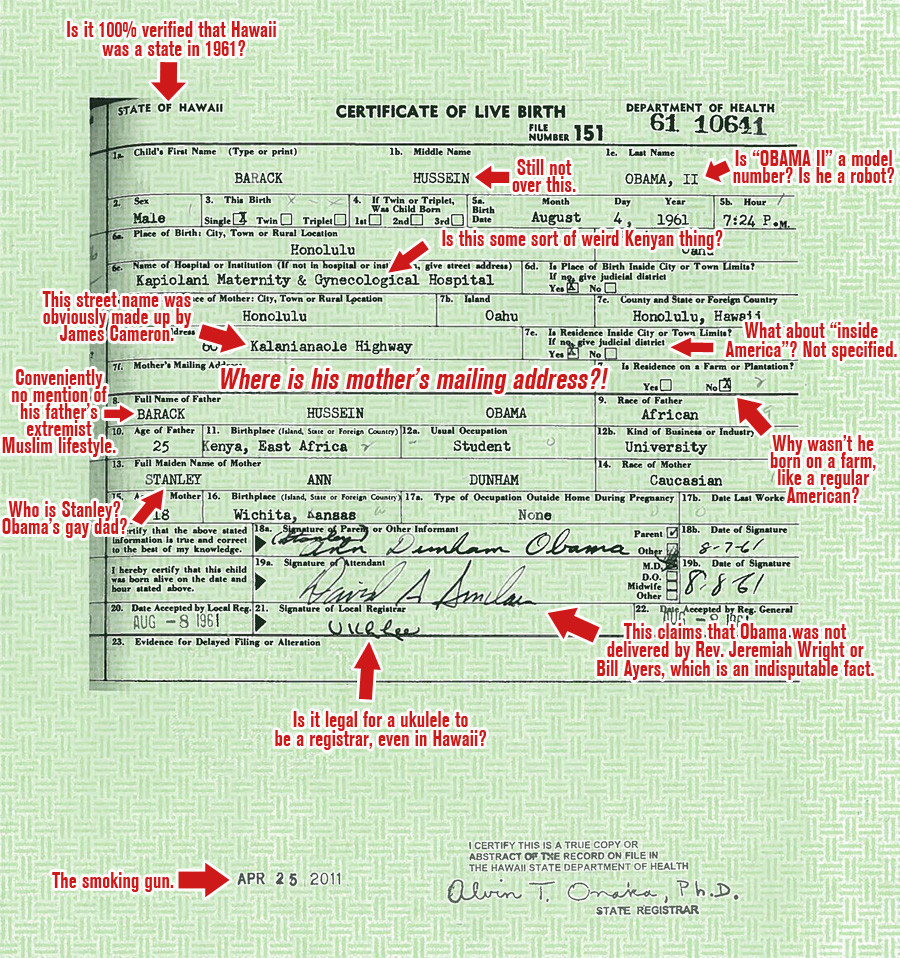
So I also want to come back then to Barack Obama.  After hearing his press conference yesterday, I too want us Americans to start spending time on "better stuff."  Worse stuff to spend time on is the evidence-defying belief that we've elected a president unconstitutionally.  Yes, the Constitution of the United States of America, like the Organon of Aristotle, like the Bible of my father, can be the rein-force-r of our beliefs, of our silliness.  We may even feel forced to say something in public while we contradict ourselves in private.  The depths of our raced and sexed bodies feel these beliefs.  The beliefs may come before full evidence as something to be valued, which is what Frank Schaeffer said before the birth certificate long form was made public:
How is it possible that a significant portion of the American population believes, or says it believes, that President Obama was not born in America, that Donald Trump would make a great president, that Sarah Palin is fit to lead our country, that Michele Bachmann is telling the truth, that health care for all means "Death Panels" etc., etc., ad nauseam?

Put it this way: being ignorant in America is now considered a virtue.
Or the beliefs may come after the evidence, which is what Aaron Rathbun said after (HT Mike Aubrey via Facebook):
With Donald Trump parading around as a possible Republican presidential candidate (God help us), he has been reviving the “birther” issue: whether or not Obama was in fact born in the U.S.

I think this is a fascinating case study in the radical “believing” nature of human beings, as noted in Notre Dame sociologist Christian Smith’s book, Moral, Believing Animals (2003).  There, he suggests humans are not the autonomous, rational cognizers that so much of our political-economic theory makes us out to be, but rather humans are fundamentally believing creatures (“homo credens”), situated in a moral order.
And either way, the questions in front of the beliefs may remain (again HT Mike via fb):


I guess what I'm trying to say and to convey in this post and its final paragraph is that talking honestly about deeply held perpetual beliefs of anybody who would believe that they should somehow put other people down or hold them back is sometimes mostly dangerous.  And that's why I first started using the matched-guise technique to - in some way if possible - get at, and - maybe - to allow someone some day to change, the prejudices.

Wednesday, April 14, 2010

Re-presenting Genesis: through a sexist, racist, anti-Semitic misogynist's eyes

"Well, he is a sexist, racist, anti-Semitic misogynist," says his second wife who is Jewish as was his first wife. And in answer to the question of whether Robert Crumb is in denial about having a foot fetish, she sets the record straight:
Legs and ass are No 1. He does not like fat women. He likes muscular, powerful women, physically and psychically!! He has strong footwear preferences but I would not consider him a foot fetishist.
She's been representing R.Crumb for some time now in relation to women, Jewish women, and muscular, powerful Jewish women.  On the cover of her "graphic memoir," Need More Love, she pictures herself as his type of covergirl:


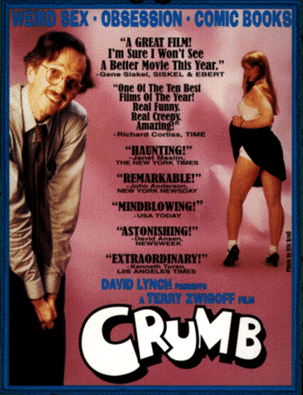
And she appears with him, strong, on the poster of the documentary film about him:


But do you think that Aline Ricky Goldsmith Kominsky-Crumb can call Robert Crumb's graphic art sexist, racist, anti-Semitic, or misogynistic?  If she were to review his Genesis, would she say anything about his women and Jew denigrating illustrations of the first book of the Bible?  Could she?  Of course she could.

So why can't John Hobbins, who's praised David Peterson's review of R. Crumb's Genesis as "judicious"?  And why isn't Peterson's so-called judiciousness a recognition of Genesis through the eyes of a sexist, racist, anti-Semitic misogynist?  Here's why:

Hobbins quotes himself as having said:
The loathing Crumb inspires in a few, the accolades he receives from others, cast shadows and light on his most recent work . . . Crumb is a satirist. Satirists offend. Satirists offend by exaggerating truth.
Then he links to Peterson's review that offers:
To characterize Crumb’s tome as a graphic novel would be apt for another reason. Genesis is, indeed, a graphic book. In his drawings, Crumb does not hesitate to depict human bodies, violence, and sexual behavior in a graphic fashion, hence the aforementioned warning to minors. So, for example, the depiction of Lot and his daughters (Gen 19) or Judah and Tamar (Gen 34) leaves little to the imagination. Blood flies when Cain kills Abel. Some readers will, no doubt, complain about the overt depiction of sexual activity and violence.
What I think is fascinating is how Hobbins and Peterson and a whole host of other men love to focus on Crumb's art while, in contrast, his wife, an artist, loves to focus on Crumb himself in his art and in his life and as her art.  She doesn't just appreciate him for the satire or the way he offends or exaggerates.  She doesn't consider his truth so exaggerated or offensive so it seems.  She doesn't classify Crumb's representations of women and Jews as entirely different from Crumb the man, and goy.  She doesn't abstract his art from his self-loathing self.

In contrast, the sort of male abstracting that Hobbins does is akin to what men do when complaining to their wives, "Come on honey, I look at Playboy for the high-class articles."  The separation and the valuing separately conveniently allow men to allow men to denigrate women and, in some cases, certain races of women.  Now, I'm not accusing Hobbins of being blatant about this sort of Aristotelian categorization.  He's not necessarily in denial if he denies it.  He may have other intentions for praising Crumb's art as high satire apart from his blatant sexism and his expressed racism.  Nonetheless, it is convenient not to mention who Crumb is or at the very least who he has been or at the very very least who those being denigrated by Crumb recognize that he is.

Maybe some day, I'll write a review of Crumb's Genesis here at this blog.  He certainly includes some very interesting statements in the illustrated work on the text of Genesis and the sources of the stories therein.  Until then, and right now then, let me just link back to a few posts that have pointed out the abstracting reviews of R Crumb's Genesis by various men in the biblioblogosphere:  here, here, and here.

Sunday, March 28, 2010

Open Words, Open Letter, Open Book

So the question arises in my mind, Mary, do you ever really read the work of Black women?  Did you ever read my words, or did you merely finger through them for quotations which you thought might valuably support an already conceived idea concerning some old and distorted connection between us?  This is not a rhetorical question.
--Audre Lorde, "An Open Letter to Mary Daly," Sister outsider: essays and speeches

In sum, Daly claims that Lorde misunderstood her intent in Gyn/Ecology and contends that a public debate about this issue will serve no purpose.
      Respectfully, I disagree.  Without downplaying how personally painful this debate undoubtedly was for both women (as Rich says, such debates are meant to break our hearts), perhaps the rest of us can now benefit from the debate if we revision it [i.e., Rich's concept of revision from "When We Dead Awaken" (35)], using it [i.e., the debate] to imagine not who was right and who was wrong but rather how one moves from a rhetoric of dysfunctional silence to a rhetoric of listening.
--Krista Ratcliffe, Rhetorical listening: identification, gender, whiteness

      Explosions of Diversity do not happen without conflict, however.  One of the responses to Gyn/Ecology was a personal letter from Audre Lorde, which was sent to me in May 1979.  For deep and complex personal reasons I was unable to respond to this lengthy letter immediately.  However, when Lorde came to Boston to give a poetry reading that summer, I made a point of attending it and spoke with her briefly.  I told her that I would like to discuss her letter in person so that we would have an adequate opportunity to understand each other in the dialogue, and I suggested places where we might meet for a discussion. Our meeting did in fact take place at the Simone de Beauvoir conference in New York on September 29, 1979.  In the course of that hour-or-so-long meeting we discussed my book and her response.  I explained my positions clearly, or so I thought.  I pointed out, for example, in answer to Audre Lorde’s objection that I failed to name Black goddesses, that Gyn/Ecology is not a compendium of goddesses. Rather, it focuses primarily on myths and symbols which were direct sources of christian myth. Apparently Lorde was not satisfied, although she did not indicate this at the time. She later published and republished slightly altered versions of her original personal letter to me in This Bridge Called My Back and in Sister Outsider as an "Open Letter."
      It continues to be my judgment that public response in kind would not be a fruitful direction.  In my view Gyn/Ecology is itself an "Open Book."
--Mary Daly, from the 1990 introduction to Gyn/Ecology 
Writing this book is participating in a feminist process.  This is problematic.  For isn't a book by definition a "thing," an objectification of thinking/imagining/speaking?  Here is a book in my hands:  fixed, solid.  Perhaps--hopefully--its author no longer wholly agrees with it.  It is, at least partially, her past.  The dilemma of the living/verbing writer is real, but much of the problem resides in the way books are perceived.  If they are perceived/used/idolized as Sacred Texts (like the bible or the writings of chairman Mao), then of course the idolators are caught on a wheel that turns but does not move.
--Mary Daly, from the 1975 introduction to Gyn/Ecology

When I set it [i.e., the book Gyn/Ecology] free so it could be in the world, I did not see it as a work of perfection.  For some women it could be an Awakening shock, for others a Source of information, or a springboard from which they might Leap into their own A-mazing Searches, Words, Metaphors.
      Above all, I was acutely aware that I had not done or written everything.  I had not written the Last Word.  (Otherwise, how could I ever write again?)
--Mary Daly, from the 1990 introduction to Gyn/Ecology
In preparing to write this post, I re-read all of my favorite bloggers' obituarial responses to the death of Mary Daly.  Several patterns re-sound.  First, many thoughts are personal reflections, opportunities for each blog writer to reflect on her or his self identity (i.e., as an openly gay man who's never bothered reading Gyn/Ecology because of Daly's infamous transphobia; as a woman, a feminist, raised as a girl by a mother who was converted Catholic and strict, stricter than her father who was born Catholic; as a young woman, a fledgling woman studies scholar not so eager, just yet, to critique Daly for her obvious shortcomings; as a woman, a black woman, a transgendered black woman).  Second, most are grateful to Audre Lorde's critique of Daly as "full of privilege," white privilege and born-woman privilege.  Third, hardly any neglects marking Daly as transphobic.

What I didn't see when I wrote an earlier post, and when re-reading so many of my favorite bloggers posts, and before re-reading Gyn/Ecology in Boston last week is how Bonnie Mann starts her re-view of Daly's book. Mann begins:

"I began using Gyn/Ecology in my work with battered women because it is a book that faces the big Questions."

This is the true value of Daly's work, and I want to explain what I mean by "This."  I began this post on Gyn/Ecology with words, open words.  The "di-a/logue" or "de-bate" or "di-s/pute" with Daly can be, I think, "di-s/en-chant-ment" with ourselves.  This is not to say that we cannot blame much of who we are on The Patriarchy.

In other words, in less Dalyesque words perhaps, I'm trying to say that words have consequences of power.

The true value of Daly's work is for the battered woman, whether you are one or not.  You might be the batterer of a woman.  Why won't you cry, then, re-reading about the consequences of your power?  The culpability of re-covery and di-s/covery is very very personal, very individual.  You sit and read these words, of mine, in silence, or aloud.  You choose.


When I sat in Boston, reading, I cried.  You cannot know where these words met me, where inside me.  Gyn/Ecology reads, to me, like the Bible.  In other words, they (i.e., Daly's words) are not written to me, perhaps not even at me, although the latter is more likely since I am a man, heterosexed (and I am also white), a pinnacle part of that elite establishment of higher education of the world's superpower, America.  These words are now old, two decades old.  They open up to Lorde's critique, if you will, a debate not necessarily one you and I are so involved in.  And yet you hear yourself, don't you?  It's been two decades, twenty years now, and how far have we come, other than to put Mary Daly this year in a box (a pine box or others of our own construction)?  Let me re-read Daly's words, here, from her 15 years of reflection after first writing them the first time, lest you hear them somehow (and want, also, to change, want for change, open):
      In Gyn/Ecology I went beyond the scope of Beyond God the Father.  First, the analysis is not restricted to christianity but extends to the universality of patriarchal religion itself....  I wrote to expose the atrocities perpetrated against women under patriarchy on a planetary scale....
     Since Gyn/Ecology was published, the agents of patriarchal evil [some 15 years later] have invaded women and nature with more and more virulent attacks....
      To list a few of these "developments":  A ten-billion-dollar pornography industry has developed and continues to escalate; its images of the torture, murder, and dismemberment of women and girls are everywhere, "inspiring" more and more rapists and sex murderers to copy these images.  Women battering and incest are alarmingly widespread.  The reality of these horrors has always existed under patriarchy, but in recent years there has been an increase not only of information about them but also of the "practices" themselves.  There has been an upsurge of international trafficking in women.  Women of color are the primary victims of this atrocity as well as all other crimes.  The demand for child prostitutes is enormous, especially around military bases and as "tourist attractions."  The new reproductive technologies have developed at an alarming rate, taking on new forms that reduce women to subhuman "subjects" of experimentation.  The torture of animals in laboratories and in agribusiness beggars description.  And the Life-killers continue to kill the earth and its inhabitants. (pages xxiv - xxv)

Friday, March 12, 2010

Our (Pregnant) Talk about Pregnant Texts of the Bible

Sacred and secular texts about sex and violence are pregnant:
heavy with emotional and religious implications;
heavy in that many tend to misread or ignore these texts.
-- Rev. Dr. Cheryl A. Kirk

Problematically, contradictions between biblical themes of justice and those that distort and devalue Black humanity, along with narrow evangelical, oppressive interpretations adapted as good news, produce spiritual death....  Unfortunately, prophets for justice often demonize women to show Israel/Judah their errors.  Wisdom literature, especially the Psalms, provides a liturgical corpus....  The Gospels examine Jesus' life, times, and teachings....  As an African Diasporan biblical scholar, I work to expose white supremacist interpretation, debunk oppressive ideologies, and avoid romanticizing the text and its problems.
-- Rev. Dr. Cheryl A. Kirk

David Ker and his African students in Mozambique "live in a culture torn by war and driven by the same ethnic impulses that drive the narratives of the Old Testament."  So the white American teacher does not want any one black African pupil to focus on verse 9 of Psalm 63, the very violent, very vengeful verse that the learner wants to highlight and to make into a song:

9Mas aqueles que procuram a minha vida para a destruírem,
irão para as profundezas da terra.

9Enemies seek to destroy my life,
but they will descend into the depths of the earth.

Ker explains, "I asked one of my students, a choir leader, how he would go about setting this Psalm to music."  And he gets at his student's forceful point by asking, "How would you do it?"  The answer:  "Procurar um verso forte.  [Find force in a verse]."  Ker later notes:  "There’s very little metaphorizing of the Scriptures here in Africa." And he explains:   "My hope is not to get African believers to discount the revelation of the First Testament but to see that 'better things relating to salvation' await them in Christ."

So exactly what's a white evangelical Christian male teacher to do with this violent, vengeful First Testament verse, or with this First Testament song, or with the First Testament?  

Ker does not first turn to the black womanist Christian female scholar Cheryl A. Kirk, who writes what are the epigrams of this blogpost here.  (He does know her work, some of her writings from a book we've been reading together, a book he very kindly sent to me from which the second epigraph above comes:  The Africana Bible: Reading Israel's Scriptures from Africa and the African Diaspora.  I don't know if he knows her collaborative book from which the first epigraph above comes:  Pregnant Passion: Gender, Sex, and Violence in the Bible.)  Instead, he initially turns to bibliobloggers, all white men each far from Africa:  "I tag: Darrell , John, Doug, d. miller, Bob, J.K, (I’d also like to hear what Peter thinks.)."  He reminds us of his audacious, "controversial claim that the Gospel is more important than the Bible" and returns us to "this topic from a slightly different angle":
 What do we do about the curses, the bloodshed, and the vengeance found in the Old Testament? The answer is very simple: we skip it.
Jesus did it, Ker shows us.  Look how Jesus Christ would "tend to misread or ignore these texts" of vengeance in the First Covenant as an example for us and our brothers in Africa and his brothers in Jerusalem.  And so the biblioblogger brouhaha begins.

If you go back to Ker's first and second post on this topic, you can see some very interesting responses.  The most interesting responses come from Jay Seidler, who says:  "There is an assumption that because texts such as the ones that support genocide or inequality towards women are part of the Holy Bible 'Our Bible', that they must somehow in the end be interpreted positively."

I myself have already said way too much over at David Ker's blog.  But over here I mainly want to point out that it's mainly a bunch of white Euro and Euro-American males talking over there and around the so-called biblioblogosphere so far.  (One "Dana" is as far as I can tell the only woman in the conversation to date.  And there are no black African or African-American males or females yet in the dialog).  I don't think (by telling what we might offer Ker or what he might offer his African students) that we see the half of it.  I don't think I've begun to see -- and yet how we'd all be better for seeing -- how this conversation "Our Holy Conversation" is, nonetheless or therefore, as Cheryl A. Kirk puts it, pregnant.

Monday, February 15, 2010

Sexist & Racist Indoctrination in the Olympics

"It is true that women cannot compete with men in the Olympics, but women have other strengths," concedes Suzanne McCarthy.  And yet she concludes, "If women were really so weak, then some men would not have to waste so much bluster indoctrinating women into their own subordination."

Here's evidence of sexist indoctrinating around the 2010 Winter Olympics (from blogger Laura Leonard):
In Olympic tradition, 216 athletes will march behind our flag tonight as members of the U.S. Olympic team — 123 men, 93 women. But, according to Olympic Women and the Media, a new book by University of Alberta professor Pirkko Markula, the women will have received only 5 percent of pre-Olympics media coverage, and will receive only 25.2 percent during the Games, despite composing half of the team. When those female Olympians do receive attention, Markula notes, it tends to be for their appearance rather than their skill.

Case in point: American skier Lindsey Vonn. She’s competing in her third Olympics at age 25, is the current world champion in the Downhill Super-G, and a two-time World Cup season overall champion. She’s considered America’s best hope for gold in Vancouver. But when Sports Illustrated featured her on the cover of their Olympic Preview issue last week, Lindsey Vonn, world-class athlete, became Lindsey Vonn, Olympic sex symbol.

On the cover, Vonn wears her Team USA uniform, standard gear, and what at least resembles standard tuck form for her sport. The cover ignited a controversy over the sexualization of female athletes, though perhaps unfairly, since it’s nearly identical to the 1992 Olympic Preview cover, which featured male skier A. J. Kitt. But then Vonn appeared again in this week’s issue: the annual Swimsuit issue. Vonn, along with three other female Olympians, wears a bikini in the snow to promote her Olympic bid.

Sports Illustrated features women on its cover 4 percent of the time. For a weekly magazine, that means about 2 out of every 52 issues. And with the Swimsuit issue accounting for one each year, that doesn’t leave a lot of room for acknowledging female athletes.

It’s a problem, certainly, that we can’t seem to talk about female athletes without talking about sex.
Likewise, here's evidence of racist indoctrinating (as noticed by blogger Monica Roberts):
With the Vancouver Games starting today and it also being Black History month, I have pondered why we haven’t had as many excellent African-American winter Olympians as we consistently produce for the Summer Games....  African-Americans have a long and distinguished history in Summer Games competition dating back to the 1904 St. Louis Games. George Poage not only was the first African-American competitor, he took two bronze medals in the 200m the 400m hurdles.
From Jesse Owens to Flo Jo to the Dream Team, it’s a long and proud history of sterling athletic achievement. But when it comes to the Winter Games, we’ve been invisible.

Wednesday, December 16, 2009

The Good Samaritan Woman

Jay Seidler has a quick post today, linking to a psychology blog which drudges up that old 1973 study showing that, "Religious personality variables" do not predict whether a person will show kindness or care to another human being in need. ABC Primetime did a 2008 repeat of that study that focused, not on religious personality, but, in part, on whether race and gender had much to do with being "a good Samaritan." And I remember at Suzanne's Bookshelf a post in which she considers how "There is no male way to care for others, and no female way to care for others." (The whole notion of whether personality and gender are bound together is something Suzanne had already talked about some in another post.)  The studies show that people (whether female or male or black or white or religious in personality or otherwise) tend to show kindness when they are not rushed and are not overly busy.

But I do want to look at what's racist and sexist in this story of Jesus.  If you hear the parable of the Good Samaritan, then you do get the idea that there's something racist going on. Definitely, the first and intended audience for the story was religious racists. And the story teller (a pure Jew and a male) had apparently learned a little already from a good Samaritan (a half-breed Jew?, a female). So I want to post here about that. And I want to make available Peggy Weaver's essay "The Good Samaritan Woman," which gets at the religious, racist, sexist crux of the parable.

First, there's the hilarious dramatized version of Jesus telling the parable of the good Samaritan with all the PC backlash we might expect today (posted by Deeky at Shakesville).

Second, there's Jesus learning from the Samaritan whose body was sexed female and mixed-breed too. (Here's how Carolyn Custis James recalls it in her book, When Life and Beliefs Collide, page 40:
When Jesus taught the multitudes, he employed metaphors from a woman's experience to draw their interest. He visited places where women commonly gathered. Beside a well, he engaged the Samaritan woman in serious theological conversation about living water. And here, in the house at Bethany, he spoke at length with Mary, despite her unfinished domestic duties and pressure from her sister.
And here's how James hears it from a sermon by Charles Haddon Spurgeon, preaching gender equality as what Jesus learned and taught but gender inequality as "horrible superstition" believed and practiced by men of religion.)

Third, then, is Weaver's essay (from page 25 of The Wisdom of Daughters: Two Decades of the Voice of Christian Feminism by Reta Halteman Finger).  I read the essay this morning after reading Bill Heroman's post discussing "Paul's inherent misogyny" that ostensibly "had begun to abate." And then I thought of the horrors of this holiday season, for so many.

Unfortunately, labeling of the one spouse as "submissive" and the other as "loving" has led to the crumbling of marriages of friends and families close to me. For the first holiday season in a quarter of a century, some good friends of ours will not be together -- divorce in progress. The wife, a submissive woman because she believes that's her role, has given no time to herself but all to her "loving" husband and all to their children and grandchild. Two families in my extended families are torn apart another holiday season, because of the inequalities. Submissive wives (like slaves of Aristotle and of the first century) are kept busy by roles of service to others first. Gender, especially bodies sexed female, (and race, typically bodies born blacker or mixed) mark the inequality, the "nature" of the roles. Listen, then, to what blocks your care of another human being this holiday season. Listen, and remember yourself:

The Good Samaritan Woman
by Peggy Weaver

     Yesterday I heard a sermon which angered me.  Everyone else seemed touched by it.  Even the priest cried as he spoke of two men who had been mentors in his life.  It was not the individual stories that bothered me.  It was the concept being presented:  give everything of yourself.  Give it until the very end, until you have nothing left.  And then your reward will come.

     How readily women hear that message!  How easily we believe these words.  Give all.  Don't question.  Don't be angry.  Don't doubt that your reward will be on some distant horizon.

     Perhaps the lesson the priest spoke of is needed by those who are not familiar with commitment, with toughing it out until the end.  But there is another lesson to learn, and we women especially need to hear a new message.  Most of us do not need more instruction in holding on until the end.  We need instruction and mentors to teach us how to let go.

     The parable of the Good Samaritan came to my mind, but with a new lesson, one particularly for women.
     ...a Samaritan, as she journeyed, came to where he was, and when she saw him, she had compassion, and went to him and bound up his wounds, pouring oil and win, then she set him on her own beast and brought him to an inn, and took care of him.  And the next day she took out two denarii and gave them to the innkeeper, saying, "Take care of him; and whatever more you spend, I will repay when I come back." (adapted from Luke 10:33-35 KJV)
      She left.  She left!  The woman tended to his wounds, brought him to a safe place, took care of him, and paid his way.  And then she left.
      It sounds almost sinful when we replace the "he" with "she."  You mean she didn't stay long enough to be sure that he had a job or a home?  What kind of woman would leave so quickly?  Yet the parable tells us that the woman had compassion when she saw the man.  The lesson is that she also had compassion for herself.  She knew her limits.  She did what she could at the time, and then she went on her way.  The Samaritan woman did not leave the man totally alone; she arranged to return when she came back through town, to pay any extra costs.  She trusted that the man would know when he was healed and would leave of his own accord.  She knew how much she could give; she knew how much to trust others to provide.
      Jesus said, "Go and do likewise."
      Amen!

Tuesday, October 20, 2009

bibliobloggers on Robert Crumb: few mentions of his sexism and racism

Bibliobloggers are talking up a storm about Robert Crumb's comic book of Genesis.  But none of them has mentioned Crumb's sexism or his rape portrayal or his anti-Semitism or his other racism.

(David Ker was the first, in September of 2008, to notice Crumb's book as Ker tried to help a friend laugh by reproducing "Keep on Truckin'."  And John Hobbins can't seem to get enough after reading the reviews by Paul Buhle and fellow biblioblogger Chris Brady.  Dr. Jim West reads his fellow biblioblogger Roland Boer's post and gets most offended by how God's portrayed before finding that Robert Alter is not upset with Crumb's portrayals in the least. Doug Chaplin notes too how Alter is just fine and adds the take of Nick Baines with the conclusion that "the graphic sex and violence was there long before anyone drew it." Joel Watts quotes Ben Leach on how Christians down under are taking offense at "biblical characters having intercourse and [at the] 'gratuitous' depictions of violence." Theophrastus says "It certainly looks better than that awful Manga Bible." Karyn Traphagen compares Crumb's work to "JT Waldman’s Megillat [Esther]." And Michael Carden muses how less homophobic Crumb seems than "Jack Chick's 1980s tract, Doom Town.")

So we should not forget Robert Crumb's infamous sexism
("I do this stuff, and then I'm horrified and embarrassed when I see it on the paper, and I say, 'Oh, my God,' but somehow I can't stop doing it," Crumb says. "I have this hostility toward women," Crumb admits on camera.)
or his gynophobic, misogynistic rape portrayals
(Crumb took perverse pleasure in scorning anyone who had ever rejected him before, which included hippies, commercialism, and especially women. Aside from a few acid-inspired flights of fancy, Crumb’s art became cynical and neurotically, painfully autobiographical. Crumb’s favorite character to draw was himself: a poor, geeky shlub with pimples and a slouch hat. His comix [which had never been particularly woman-friendly] became violently misogynistic, as he graphically poured what were essentially his masturbatory fantasies onto the printed page. Women were raped, dismembered, mutilated, and murdered, sometimes all at once.)
or his anti-Semitism
(don't click here if you don't want to see more male over female sex in the context of hate of Jews; or don't click here or here if you don't want to see more of his portrayals of his own anti-Semitism from "When the Goddamn Jews Take Over America" by R. Crumb)
or his other racism
(don't click here if you don't want to see this white guy's comics to denigrate African Americans from "When the Niggers Take Over America!" in Weirdo #28, 1993 and reprinted in Taken from America, published by Knockabout Comics, London, 1994).