Showing posts with label equal rights. Show all posts

Friday, August 26, 2011

Women's Equality Day in the USA: What Do You Know?

Did you know that 66th Congress of the United States of America was comprised of 559 men?  Do you know how many women were in the Congress?  Yes, that's right.  0.  Zero.  Not even 1.

Did you know that the 65th Congress of the USA did have 1 woman?  Yes, that's right.  Jeannette Rankin, who first served as a Representative, a Republican, from the State of Montana, from 1917 to 1919.  She was the only woman among all the men, the first woman to serve as an elected representative ever.

A pacifist and a suffragette, Ms. Rankin opened the Congress floor in January 1918 with these questions:

“How shall we answer the challenge, gentlemen? How shall we explain to them the meaning of democracy if the same Congress that voted to make the world safe for democracy [through war] refuses to give this small measure of democracy to the women of our country?”


Do you know what's most significant, most ironic, about these facts?

It was not until 1920, on August 26, that the Congress afforded the right to vote to women in all states of the United States. This was 42 years after Susan B. Anthony and Elizabeth Cady Stanton drafted the amendment to the U.S. Constitution and first introduced it to the all-male government in 1878.  This was 62 years after women and men gathered in Seneca Falls, New York, to sign the Declaration of Sentiments, to address the inequalities in the American democracy.  This was 144 years after the birth of the American democracy.

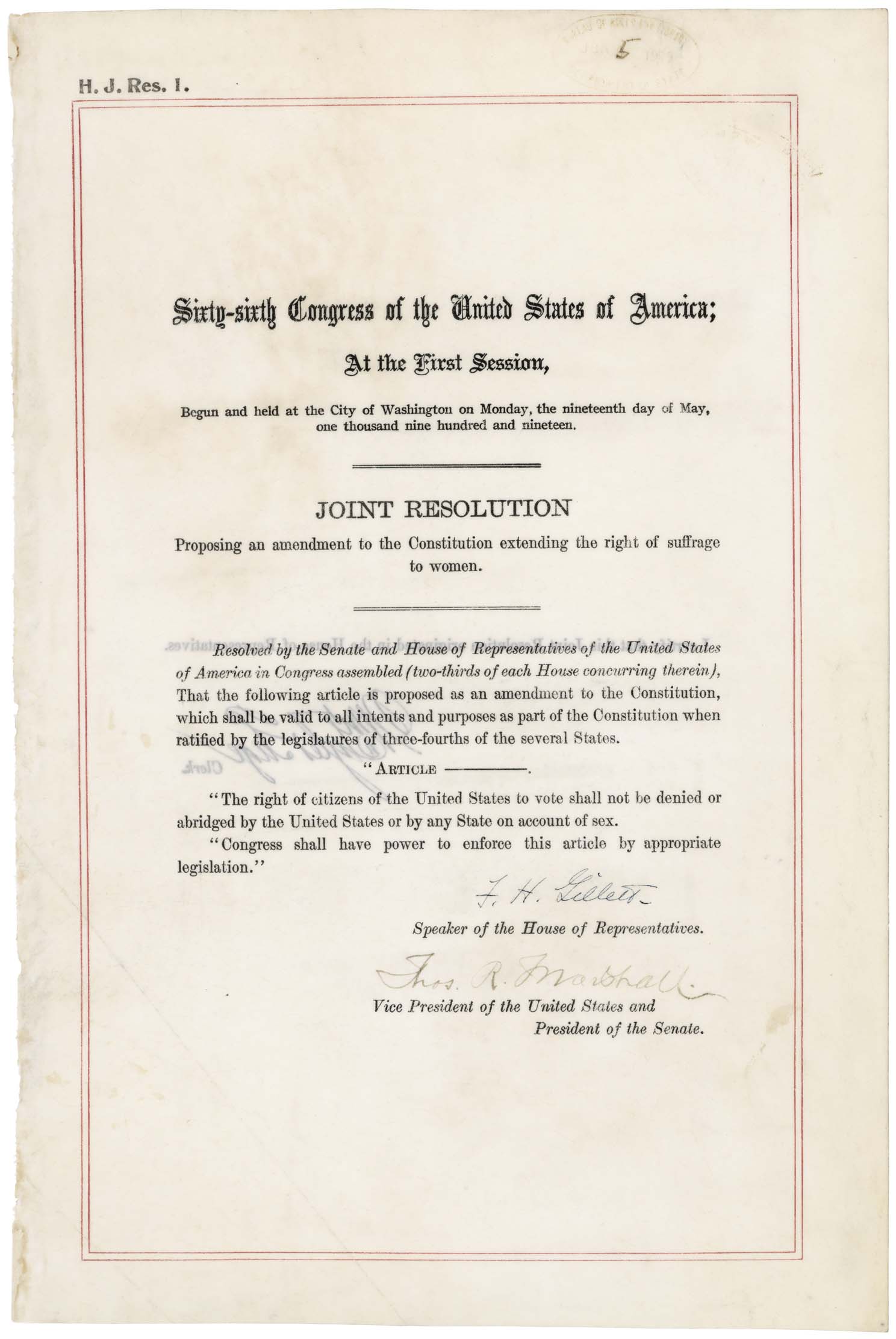
This Amendment reads:

The right of citizens of the United States to vote shall not be denied or abridged by the United States or by any State on account of sex.  Congress shall have power to enforce this article by appropriate legislation.

To celebrate the day of the passing of this Amendment, Congresswoman Bella Abzug introduced the following statement:

Joint Resolution of Congress, 1971
Designating August 26 of each year as Women’s Equality Day

WHEREAS, the women of the United States have been treated as second-class citizens and have not been entitled the full rights and privileges, public or private, legal or institutional, which are available to male citizens of the United States; and


WHEREAS, the women of the United States have united to assure that these rights and privileges are available to all citizens equally regardless of sex; and

WHEREAS, the women of the United States have designated August 26, the anniversary date of the passage of the Nineteenth Amendment, as symbol of the continued fight for equal rights: and

WHEREAS, the women of United States are to be commended and supported in their organizations and activities,

NOW, THEREFORE, BE IT RESOLVED, the Senate and House of Representatives of the United States of America in Congress assembled, that August 26th of each year is designated as Women’s Equality Day, and the President is authorized and requested to issue a proclamation annually in commemoration of that day in 1920, on which the women of America were first given the right to vote, and that day in 1970, on which a nationwide demonstration for women’s rights took place.


That statement, that joint resolution, was resolved 41 years ago.  So what do you know today?  How are we doing?  How are you doing with equality?

Quiz yourself here.

What of the historical data, to date, do you know?  Are you really happy about the equality of women today?  How many women have you voted for?  Have you voted for women and men equally?  Why not?  Is America ready for a woman president?

Read how one woman goes back to the Sacred Texts of Feminism here.

Read the 19th Amendment again here:

Friday, October 30, 2009

Equal Pay in the UK? Not yet!

April 28th was Equal Pay Day in the USA. At that point, women here, on average, earned just 78 pennies to each Dollar men here, on average, made.  Given that a man and a woman started working the same job on January 1, 2008 in America -- then April 28, 2009 symbolized how far into 2009 the woman had to work to earn, finally, as much as the man, who stopped his work on December 31, 2008.

Today is Equal Pay Day in the UK.  Think there's equal pay there yet?  Think again.


It's depressing and sad, but read more here and here and here and here.

Tuesday, April 28, 2009

Test Your Fair Pay 'Cents'

Today is Equal Pay Day in the USA.

Q. Why today, already 116 days into the year? (And why Tuesday?)

A. "The day, observed on a Tuesday in April, symbolizes how far into the year a woman must work, on average, to earn as much as a man earned the previous year. (Tuesday is the day on which women's wages catch up to men's wages from the previous week.) Because women earn less, on average, than men, they must work longer for the same amount of pay. The wage gap is even greater for most women of color."
--National Committee on Pay Equity

Now,
TEST YOUR FAIR PAY 'CENTS':

1. In 1963, when the Equal Pay Act was passed, women made ___¢ on the dollar compared to men.

a. 59¢ b. 63¢ c. 74¢ d. 81¢

2. Today that figure is ___¢ on the dollar compared to men.

a. 85¢ b. 91¢ c. 72¢ d. 78¢

3. Black women earn ___¢ on the dollar compared to white men.

a. 65¢ b. 69¢ c. 85¢ d. 87¢

4. Hispanic women earn ___¢ on the dollar compared to white men.

a. 59¢ b. 52¢ c. 72¢ d. 82¢

5. Over a lifetime, how much less will women earn than men?

a. $550,000 b. $700,000 c. $1,200,000 d. $2,000,000

6. Under the Equal Pay Act, employers cannot pay women and minorities less than white men with the same qualifications for doing the same job.

True False

7. Under the Equal Pay Act, plaintiffs are entitled to compensatory and punitive damages if their employer has violated the law.

True False

8. Women make up __% of the American labor force today.

a. 38% b. 42% c. 44.5% d. 46%


9. What is pay equity?

10. What is the legal status of pay equity?

11. How large is the wage gap?

12. Why is there a wage gap?

13. Hasn't the wage gap closed considerably in recent years?

14. Is it possible to compare different jobs?

15. Who really needs pay equity?

16. Is pay equity an effective anti-poverty strategy?

17. Will the wages of white men be reduced if pay equity is implemented?

18. Will achieving pay equity require a national wage-setting system?

19. Doesn't pay equity cost employers too much?

20. Are wage inequalities the result of women's choices?

21. Will implementing pay equity disrupt the economy?

22. What is the status of efforts to achieve pay equity?

23. What can I do about pay equity?

24. What does the first bill signed into law by President Obama (the Lilly Ledbetter Fair Pay Restoration Act) do?

25. What does the opposition say?

Check your answers:

1.-8. http://www.pay-equity.org/info-quiz.html

9.-23. http://www.pay-equity.org/info-Q&A.html

24. http://www.whitehouse.gov/the_press_office/RemarksbythePresidentUponSigningtheLillyLedbetterBill/

25. http://www.pay-equity.org/info-opposition.html


Thursday, December 11, 2008

Feminists are False Women: "The Bible Tells Me So"

'True Woman' movement seeks counter-revolution to feminism -- that's the headline.

A group of conservative Christian women is seeking 100,000 signatures on a "True Woman Manifesto" aimed at sparking a counter-revolution to the feminist movement of the 1960s. -- that's the lead-in to the news article.

[T]he document calls not for equal rights, but instead proclaims 
that men and women are created to reflect God's image in "complementary and distinct ways" . . . 
that women are called "to honor and support God-ordained male leadership in the home and in the church" . . . 
that men are to be the heads of the homes . . . 
that [female submission] is taught in Scripture -- that's the skinny.

Never mind that the very first American feminists, women and men, were Bible-reading, church-going Christians.  

Never mind that their "Declaration of Sentiments" was that "We hold these truths to be self-evident: that all men and women are created equal; that they are endowed by their Creator with certain inalienable rights."  Never mind that they wrote a commentary on the Bible called The Woman's Bible.  Never mind that the most-recent feminist manifesto (a third-wave document), Manifesta, invokes the Sentiments of that first-wave.

Never mind that many "Bible believing church going" Christians today (men and women, feminists and uncommitted) are as egalitarian as the God of Genesis and Jesus is.

Never mind that the Bible, as sexist and pro-slavery as it is, never says even once anywhere that "men are to be the heads of the homes."

[HT Polycarp]


Tuesday, October 7, 2008

Bias Against Your Mom, Your Wife, Your Sisters, Your Daughters, Your Friends, Your Teachers, Your Researchers, Your Professors

My son called me yesterday from college in another state to say he was thinking about going into teaching. His girlfriend an education major made the suggestion to him that he apply his interests and abilities in art to teaching others. My daughters also have, from time to time, expressed an interest in a profession in the classroom and in research. This makes an academic parent like me rather proud to hear.

But if these young people do become teachers, instructors, researchers, or professors, then how well will they be compensated for their very important work? And will my son, because he's male, have an easier time getting work and good pay than his girlfriend will, because she's female? Will the teacher man make more than his teacher sisters, because of the gender gap?

It seems in the Academy, in the U.S. anyway, we still haven't gotten very far. I mean we haven't gotten very far from Aristotle's elitist academy for "pure" humans, who must be males and who have to be males of the right race and class, of course.

There's evidence this morning. Reporter Kate Moser of the Chronicle of Higher Education publishes an article entitled "Rutgers U. Weighs Complaints of Bias Against Women in Political Science." Here's the lead:
Female faculty members and graduate students in Rutgers University's political-science department feel unfairly compensated and shut out of leadership positions by their male counterparts, says an internal university report obtained by The Chronicle. In at least one case, a woman has been afraid to complain about sexual harassment because of worries about retaliation.
Moser reports many of the shocking details in this specific Rutgers case. And she goes on to remind us of the general picture in the U.S.:
Across disciplines, female faculty members continue to lag behind men in pay, particularly at doctoral universities, where their average salaries are 78.1 percent of their male colleagues', according to the most recent study on gender equity in the professoriate, which was conducted in 2006 by the American Association of University Professors (The Chronicle, November 3, 2006).
So, I went back and read that report, from two years ago, and see that then the study determined how back in November 2006 "the overall numbers show[ed] there hasn't been that much progress, even if you look at the last 30 years." The numbers, just in terms of the salary gap then, were as follows:


I think we can see what must change. I just wonder how it will change. It's been 45 years since the U.S. government passed the The Equal Pay Act. That's four and a half decades, nearly half a century, with little enforcement of the law it seems. It's the spirit of the law, too, that's broken, isn't it? To fix something like this requires more than government; it requires some audacious hope and change. So I do like the presidential candidate who has a stake in the issue of equal pay for my daughters and son: the presidential candidate who publicly pledges that he's committed to creating equal opportunities for his daughters. And I think muckraking reports such as Kate Moser's today are important.

What other possibilities do we have for seeing the next generation have more equality than we do?

Friday, September 19, 2008

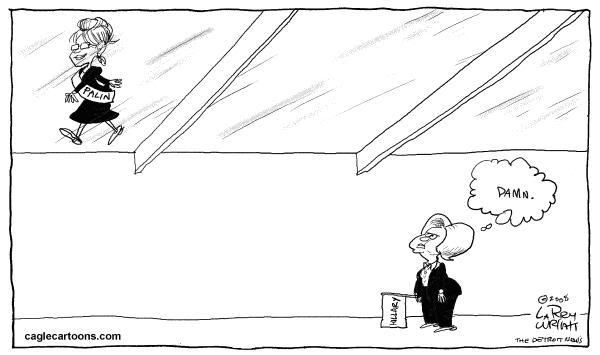
Glass Ceiling Show-&-Tell

[from various sources, click and see:]

"And now is the time to keep the promise of equal pay for an equal day’s work, because I want my daughters to have exactly the same opportunities as your sons…"
--Barack Obama


"...2008! ...women still only make 77 cents for every dollar a man makes. When you break it down, the facts get more dismal: African-American women make 63 cents and Latinas make 52 ..."
--Louisa Warren, Writer, The Progressive Pulse


"This cartoon is also (inadvertently) an interesting illustration of something I think a lot of people get wrong about the proverbial "glass ceiling." The glass ceiling is a metaphor for the idea that women as a group are prevented by sexism and other gender-related factors from rising to the upper echelons of politics, science, business, you name it. (I'd actually argue there's one glass ceiling for white women, and another, harder-to-crack glass ceiling for women of color.) It is not something that can be busted by the achievements of one single woman."
--Ann Friedman, Editor, Writer, Television Commentator

Sexual discrimination was outlawed in the United States through the Civil Rights Act of 1964 in the hopes of allowing women to rise in the working world once proper experience has been achieved. Variations and related terms ("Glass Ceiling" wikipedia)

  • Bamboo Ceiling - The exclusion of Asian-Americans from executive and managerial roles on the basis of subjective factors such as "lack of leadership potential" or "inferior communication ability" where the East Asian-American candidate has superior objective credentials such as Ivy League credentials (in comparison to their white counterparts with only state university credentials). [15] For example, research shows that there are a decent number of partners at leading prestigious law firms in the United States who did not attend top notch law schools. However, you will seldom find an East Asian American partner of a leading law firms who did not attend a "T14" (Top 14 according to the US News ranking) law school.
  • Glass Closet - The exclusion of openly gay men and women from certain jobs, espescially in the media.
  • Glass elevator (or glass escalator) - The rapid promotion of men over women, especially into management, in female-dominated fields such as nursing.
  • Glass cliff - A situation wherein someone has been promoted into a risky, difficult job where the chances of failure are higher.
  • Celluloid ceiling, referring to the small number of women in top positions in Hollywood, as documented by Lauzen (2002) and others.
  • Sticky Floor - refers to women who are trapped in low-wage, low mobility jobs in state and local government.
  • Sticky Ladder - A term used to describe women's struggle to reach the top of the corporate ladder. This term describes the theory that women are not incapable of reaching the top; they just get "stuck" on the middle rungs of the ladder.


"The upshot for chief executives should be to move over to the ‘female’ side of management, whether you're a thoroughgoing left-brainer or a woman trying to manage ‘male’. Turns out, girls can do it better."
--Joanna L. Krotz, President and Founder of Muse2Muse Productions, Inc. and author

"Gotta go. My husband appears to be packing my bag, shredding my useless resume, and writing down some things I should say like, "Yes, of course I'm carrying a gun." He's a fast learner and supportive -- like Republican men."
--Dr. Kathleen Reardon in:

The Palin Glass Ceiling Bypass

Tuesday, August 26, 2008

Happy Birthday, 19th Amendment!

"Today is the 88th anniversary of the passage of the 19th Amendment, which gave women the right to vote." Read more from Jessica at feministing who shares her first-time-voting story and gets others sharing theirs too.

Lydia Taft was the first woman voter in America, voting as "the widow Josiah Taft" on October 30, 1756 some 164 years before the 19th Amendment.

And "in 1776 [the] New Jersey State Constitution gave the vote to 'all inhabitants' who had a certain level of wealth. This included both women and blacks; although not married women, who could not own property. Both sides, in several elections, claimed that the other side had had unqualified women vote, and mocked them for use of 'petticoat electors' (entitled to vote or not); on the other hand, both parties passed Voting Rights Acts. In 1807, the legislature passed a bill interpreting the constitution to mean universal white male suffrage, excluding paupers."

Then a woman's right to vote came to "States and territories of the USA, progressively, starting with the Wyoming Territory in 1869 and Utah Territory in 1870. The latter was repealed by the U.S. Congress through the Edmunds-Tucker Act in 1887. Wyoming acquired statehood in 1890 (Utah in 1896) and thus 1892 was the first United States presidential election in which women cast legal votes. The USA as a whole acquired women's suffrage in 1920 through the Nineteenth Amendment to the United States Constitution; voting qualifications in the U.S., even in federal elections, are set by the states, and this amendment prohibited states from discriminating on the basis of sex."

Here's the international timeline of women getting to vote.