Friday, August 26, 2011

Women's Equality Day in the USA: What Do You Know?

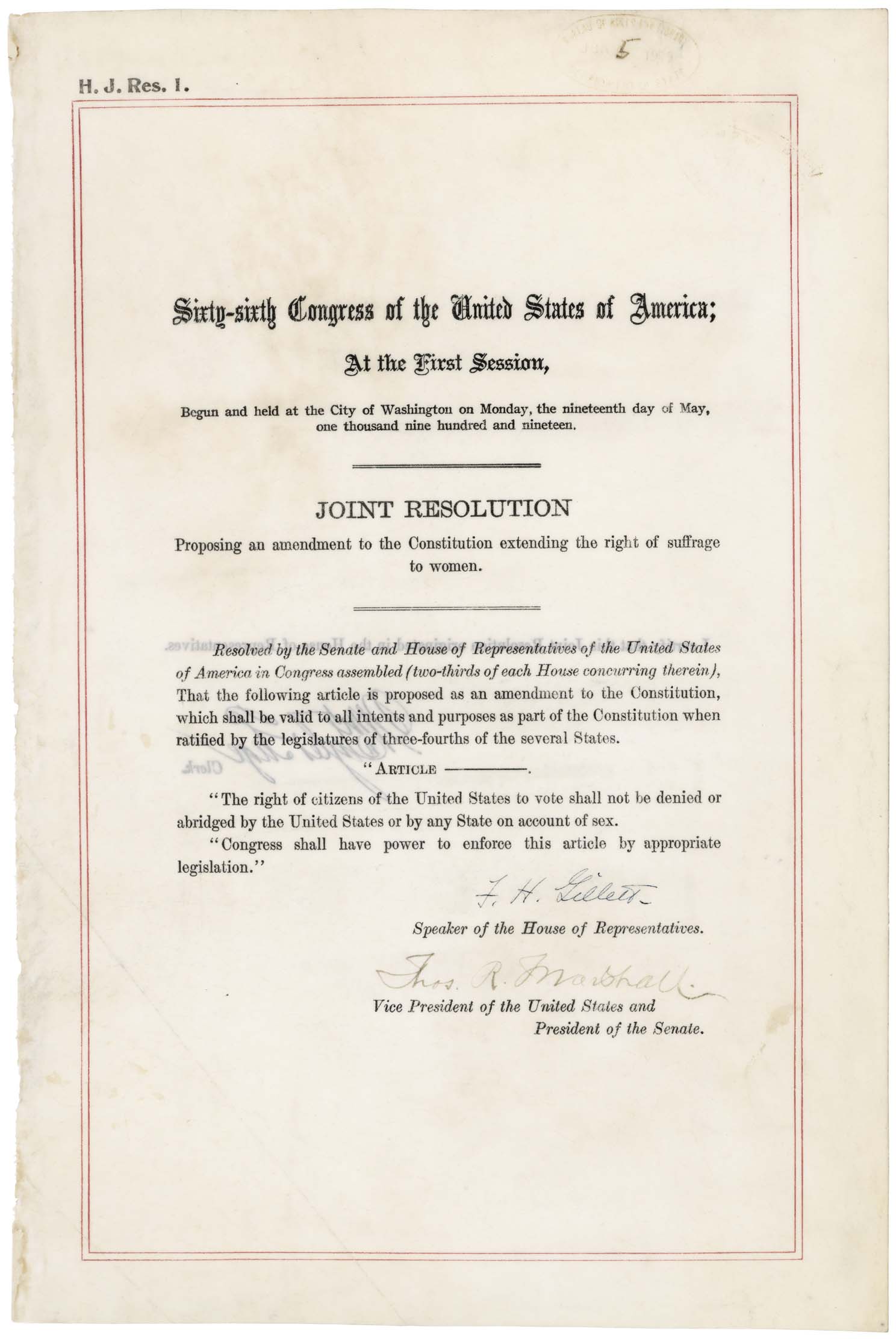
Did you know that 66th Congress of the United States of America was comprised of 559 men?  Do you know how many women were in the Congress?  Yes, that's right.  0.  Zero.  Not even 1.

Did you know that the 65th Congress of the USA did have 1 woman?  Yes, that's right.  Jeannette Rankin, who first served as a Representative, a Republican, from the State of Montana, from 1917 to 1919.  She was the only woman among all the men, the first woman to serve as an elected representative ever.

A pacifist and a suffragette, Ms. Rankin opened the Congress floor in January 1918 with these questions:

“How shall we answer the challenge, gentlemen? How shall we explain to them the meaning of democracy if the same Congress that voted to make the world safe for democracy [through war] refuses to give this small measure of democracy to the women of our country?”


Do you know what's most significant, most ironic, about these facts?

It was not until 1920, on August 26, that the Congress afforded the right to vote to women in all states of the United States. This was 42 years after Susan B. Anthony and Elizabeth Cady Stanton drafted the amendment to the U.S. Constitution and first introduced it to the all-male government in 1878.  This was 62 years after women and men gathered in Seneca Falls, New York, to sign the Declaration of Sentiments, to address the inequalities in the American democracy.  This was 144 years after the birth of the American democracy.

This Amendment reads:

The right of citizens of the United States to vote shall not be denied or abridged by the United States or by any State on account of sex.  Congress shall have power to enforce this article by appropriate legislation.

To celebrate the day of the passing of this Amendment, Congresswoman Bella Abzug introduced the following statement:

Joint Resolution of Congress, 1971
Designating August 26 of each year as Women’s Equality Day

WHEREAS, the women of the United States have been treated as second-class citizens and have not been entitled the full rights and privileges, public or private, legal or institutional, which are available to male citizens of the United States; and


WHEREAS, the women of the United States have united to assure that these rights and privileges are available to all citizens equally regardless of sex; and

WHEREAS, the women of the United States have designated August 26, the anniversary date of the passage of the Nineteenth Amendment, as symbol of the continued fight for equal rights: and

WHEREAS, the women of United States are to be commended and supported in their organizations and activities,

NOW, THEREFORE, BE IT RESOLVED, the Senate and House of Representatives of the United States of America in Congress assembled, that August 26th of each year is designated as Women’s Equality Day, and the President is authorized and requested to issue a proclamation annually in commemoration of that day in 1920, on which the women of America were first given the right to vote, and that day in 1970, on which a nationwide demonstration for women’s rights took place.


That statement, that joint resolution, was resolved 41 years ago.  So what do you know today?  How are we doing?  How are you doing with equality?

Quiz yourself here.

What of the historical data, to date, do you know?  Are you really happy about the equality of women today?  How many women have you voted for?  Have you voted for women and men equally?  Why not?  Is America ready for a woman president?

Read how one woman goes back to the Sacred Texts of Feminism here.

Read the 19th Amendment again here:

Wednesday, August 24, 2011

A Bible Translator Uses Bad Words ("Ass, Fart, Whore, Piss, Shit")

Well, you're going to protest again maybe.  Here I go quoting a Bible translator's translation that makes you read bad words.  To be exact, ass, fart, whore, piss, and shit.

So would it make any difference to you if I told you that the published translation helped win this particular translator the "PEN American Center / Book of the Month Club Translation Award"?  Would you give the translator a break if one notable critic said that this is the translator's "most remarkable translation thus far" and that "it is, in fact, more an act of wizardry than of translation"?  What if you knew that the translator was also a poet, who was "[t]wice nominated for the Pulitzer Prize in poetry"?

What else might matter to you?  That the translator is not a woman, but a man?  Does he need to be a theologian?  A linguist?  If he's translated the New Testament, does he need to be a Greek scholar?  A Christian?  Part of a team of men scholars of theology and of Greek language and of translation science?  Would those things then make it okay for him to use ass, fart, whore, piss, and shit in his translation?

What I'm trying to get at is what counts for you.

Yesterday, I started in on a post by quoting a feminist, a woman feminist saying "pissed off."  But I said that this was Jesus speaking.  Immediately, you began to protest.  "Gloria Steinem is no Jesus."  And some of you were thinking, "Cuss words are not the Word of God."

What I'm trying to get at is how the Bible can immediately make seemingly unequal things equal.

What I'm trying to get at is how translation, likewise, makes things that don't at first seem to count as the same really, nonetheless, the same.

What I'm trying to get at is how literature, even a poem, a sonnet for instance, makes seemingly unequal things equal. 

"Now, just wait a minute," some of you are saying.  "The Bible in the original language(s) is not translation.  And a translation is not the original by any stretch.  Don't you know much gets lost in translation?  And, since you're bringing up literature, and poetry, don't you even remember how Poet Robert Frost wisely noted that 'Poetry is what gets lost in translation'?"

What I'm trying to get at is how you can make things you think are unequal equal.  Men and women?  Yes, equal.  Jesus and a feminist?  Yes, equal again.  The original spoken word of Jesus and it's written translation by someone claiming to be his student named John?  Right, equal.  A bit of history and a possibly fictional, late-added episode of narrative complexity?  Of course.  Equals.

What I'm trying to get at is how the Western mode of thinking that is binary really is what scholars Andrea Lunsford and Lisa Ede rightly refer to as the "logic-chopping automaton."


But none of us has to be that much of a scholar to see this.  Let me just turn things around and come at it from another direction.  What if you yourself are not really making unequal things -- say, males and females -- equal?  What if they really are equal but it's just your use of Western, Aristotelian logic that makes them un-equal?  What if the Bible, translation, and literature in general really free you to reconsider difference?


Okay.  I suppose you're dying to know.  Who is this Bible translator mentioned at the beginning of the post?  It's Willis Barnstone.  "What?!" some of you are exclaiming.  "He's not a real translator of the Bible.  He's only translated the New Testament and not anything else.  Well, okay.  He's translated the New Testament, but not the one I grew up with.  He's not gotten to any of the Hebrew books, or any of what may be called the Old Testament.  And he's thrown in a whole bunch of Greek books that are not canonical.  The best and top-most-ranked Bible bloggers didn't know much about him until you started mentioning him here.  Yes, we know you mentioned him yesterday in a post.  Yes, we saw how you quoted from his translation.  But where did he use the bad words, the unbiblical English, that you quote in this post today?"


Please let me answer.  What I'm trying to get at is that Barnstone is the equal of any other Bible translator, dead or alive.  He's a poet, a historian, a theoretician, and a practitioner of translation.  Here's his complete, to date, bibliography.  If that's not impressive enough, then do know that he does have his critics.  Even literary types are good critics, somewhat severely critical critics, of his New Testament translation.  And those who know some of the original languages better than Barnstone does perhaps, even though these might still be students, can be good critics, somewhat severely critical critics.  


Now if you've stayed with me this far, anticipating Willis Barnstone's translation that uses those words I mentioned earlier, then do know you're going to get to read it (and them).  I'm not going to say a thing really about the passage that Barnstone has translated other than this:  it really is an award winning translation, but it really isn't from the Bible.  It really is a sonnet, perhaps equal to the Spanish sonnet Barnstone is rendering.  Thus, if you believe me that Barnstone is equal to a translator of the Bible, then here's a translation of something else by "a Bible translator who uses these "bad words":


from Six Masters of the Spanish Sonnet

Tuesday, August 23, 2011

adding to the narrative complexity: pissed off bloggers and egalitarians and feminists and Bible translators

 “The truth will set you free. But first, it will piss you off.”
– Jesus

Oh, sorry.  The truth is that my attribution for this quotation above has added to the narrative complexity.  I guess I'll blog a bit further then.  The quotation, in truth, really sort of goes something more like this:

Then Yeshua [aka Joshua] said to the Jews who believed in him,
  If you remain with my word,
  Then you are truly my students,
  And you will know the truth
  And the truth will set you free.

You see, in the very same gospel, in the very same chapter, Jesus [aka the Jewish Joshua, aka Yeshua] had done something. He had already begun to add to the narrative complexity.

He had self-identified, by his actions, by his word too, as an egalitarian.   He had regarded his audience with respectfulness and had called them disrepectful.  Notice, he could have called them sexist. And he could called himself a feminist.

You see, his audience of men had caught a woman in the act of adultery, had brought her alone to him, and were hoping to catch Jesus being soft on her.  They had already accused him of being “emotional,” “erratic,” “self-righteous,” “snarky,” and “out-of-line.”  The whole truth of all of this really pissed him off.  They were treating a woman not as an equal.  But rather than calling them “man-first sexists,” he called on them to disrespect themselves first, to cast the first stone at their own sins first.  Later, his disciples stayed with his word, which is one of those words I've already quoted above here.  Since my blog audience is so big and sometimes some of the readers are so easily offended, let me not repeat them here again.

Let me just suggest that Jesus was talking like a feminist.  I think we can safely say, in quotation marks to be sure, it was the egalitarian feminist Gloria Steinem who, noticing the disrespect of many sexists, said:

 “The truth will set you free. But first, it will piss you off.”

I myself am playing with these words in a blogpost because I just saw how Rachel Held Evans does too.

And Rachel adds to the narrative complexity.  Let me explain.  She discusses how her blogging has changed, how she's gained her voice and has begun to stand up for egalitarianism and against disrepect.  I'm going to say she stands up like a feminist (depending on who her audience is) and stands against sexists (since there are some in the blogosphere even).  So she gives credit not only to Gloria Steinem but also to “women like Margaret Feinberg, Christine Caine, Carolyn Custis James, Mimi Hadaad, Elaine Storkey, Phyllis Tickle, Lauren Winner, Kathleen Norris, Nancy Ortberg, Nadia Bolz-Weber, Mama Maggie Gobran” and to “women of valor” such as “Marta, Andrea, Elana, Cinda, Janet,” and “Lilet.”  Rachel has also thanked “men like John Stackhouse, Scot McKnight, Brian McLaren, Tony Campolo, Jim Webb, John Ortberg, our husbands, our fathers, our brothers, our pastors, and our friends.”

And so this brings up another issue:  Jesus, like Rachel, thanks many others.  At least he shows his gratitude, his belief in those around him, his fore-trust of his students anyway.  There's an adding to the narrative complexity.  Here's what I mean by that.  It's almost as if he's counting on feminists, like Gloria, and egalitarians, like Rachel, to do what they do.  Just as he's spoken up for the woman so alone in the accusation of adultery, the disciples of Jesus speak up for him.  One way some of them have done this is not only by “remaining in his word” but also by translating his word.

Here's the way Rachel, civil as heck, uses her words to advise choosing words:

Depending on our audience, we may want to use the word “disrespectful” instead of “sexist” or “egalitarian” instead of “feminist.” There’s no need to turn people off with words that may be misunderstood.

I'm sure the earliest of students of Jesus got that, sort of.  They got how he didn't always go on a full-out assault of his enemies.  For example, here's the way his student, John, a self-identifying Jew discussing his fellows, re-ported and re-presented and trans-lated what Jesus said originally; notice how he chooses his words when rendering the words of Jesus into a language of world-dominating non-Jews:

ἔλεγεν οὖν ὁ Ἰησοῦς πρὸς τοὺς πεπιστευκότας αὐτῷ Ἰουδαίους·
  ἐὰν ὑμεῖς μείνητε ἐν τῷ λόγῷ τῷ ἐμῷ
  ἀληθῶς μαθηταί μου ἐστε
  καὶ γνώσεσθε τὴν ἀλήθειαν
  καὶ ἡ ἀλήθεια ἐλευθερώσει ὑμᾶς.


Now, to be sure, the truth of the matter is that this written Greek of John's has been translated countless times into written English.  I particularly like the way Willis Barnstone renders the gospel Greek (as Hebraic Hellene) into Poetry.  If you haven't already guessed, the English verse you read above is Barnstone's recognition and representation of the Greek as verse.

At one point in the narrative of the woman and of Jesus, Barnstone makes a remark, in a footnote, about John's wording to translate what Jesus said.  Barnstone says:

The Greek is sparse and needs no fleshing out, saying word for word, “The blameless you [gen.] first at her throw stone.”

In verse, in our English, that goes this way:

  The one among you without sin
  Let him first cast a stone at her.


And Barnstone, now the poet-translator of the poet-translator and the narrator's new narrator, after he's noted the real sparseness of the rendered speech, adds another footnote to the story:

[John] 7.53 - 8.11 is not in early manuscripts and is thought to be an addition.  Although an interruption in the flow of Yeshua's debate in the Temple and whether authentic or spurious, it still adds to the narrative complexity.