It's rare to find a book on translation that gets at many different issues. Some of my favorite books on the topic are these:
The Routledge Encyclopedia of Translation Studies, (2nd ed), edited by Mona Baker and Gabriela Saldanha
The Poetics of Translation: History, Theory, Practice, by Willis Barnstone
Faithful Renderings: Jewish-Christian Difference and the Politics of Translation (Afterlives of the Bible), by Naomi Seidman
Gender in Translation: Cultural Identity and the Politics of Transmission, by Sherry Simon
After Babel: Aspects of Language and Translation, by George Steiner
The Translation Studies Reader, (2nd ed), by Lawrence Venuti
Language in Relation to a Unified Theory of the Structure of Human Behavior by Kenneth L. Pike
And now
Is That a Fish in Your Ear?: Translation and the Meaning of Everything, by David Bellos
At BLT, I've written a review of the Bellos book. He kindly replied there to acknowledge he'd given Olympe de Gouges the short shrift and to promise that he was correcting that in the French edition due out in January and in the English paperback version to become available eventually.
Also at BLT, quoting Bellos, I've added to the series on Eugene Nida that I began here, and here, here, and here.
Showing posts sorted by date for query Willis Barnstone Bible Translation. Sort by relevance Show all posts
Showing posts sorted by date for query Willis Barnstone Bible Translation. Sort by relevance Show all posts
Tuesday, October 25, 2011


Friday, September 30, 2011
blame the Jews (not the Korinthians or the Romans)?: Paul and that slogan, again
Dennis J. Preato has listed three options for reading what Paul wrote to an Assembly in Korinth, Greece. Preato states (with my emphases):
The Second option is entirely possible, but even if it's the case that Paul didn't write what's written, then whoever did add the verses really did want to sound like Paul. Supposing this doesn't at all solve the problem of whether the "Pauline" statement is ultimately (1) to silence women or (2) whether it's to rebuke men who are silencing women. The interpolater was either pretending to be Paul forbidding women from speaking. Or he was pretending to be Paul rebuking men who were forbidding women from speaking. So we still have our decision to make: (1) Are the readers to take what's written as regulating and restricting the behavior of women? (2) Or can the readers take this epistle to mean that women are as free to speak as men?
So we turn to the First (and Fourth) option(s). Is Paul (or is Torah) forbidding women?
This set of options -- that would make Paul (or Torah) forbid women in Korinth from speaking -- makes for some strange bedfellows. The strange group, for example, includes these:
The Bible.org people have this footnote on the verses:
In contrast, Barnstone is very much a feminist ally, writing a pro-woman essay "The Role of Silent Women" within his commentary on Paul (see pages 628-30 of his Restored New Testament); Barnstone makes clear, likewise, that Paul was pro-woman, if he did contradict himself sometimes by looking to "earlier [religious] . . . hierarchies":
So we turn to the Third (and Fifth) option(s). Is Paul rebuking sexist men by quoting back to them their rabbinic slogan, or Korinthian slogan, or Roman slogan?
Maybe it is an oral rabbinic slogan. If so, this gets at least Barnstone thinking that Paul sounds like he's quoting "earlier Jewish temple customs" and is thereby contradicting himself. But Paul is only contradicting himself if he agrees with such a slogan or endorses following such sexist customs. And, as Barnstone shows, Paul's own customs were very pro-woman. Why not consider that Paul might be actually quoting back to Korinthian men some slogan they were repeating to him?
Translator Ann Nyland does consider this. She notes how S. Aalen has claimed there's "A Rabbinic Formula in 1 Cor. 14,34" (see, Texte und Untersuchungen zur Geschichte der altchristlichen Literatur 87 [1964] 513-25). And Ann Nyland cites a later version of Aalen's paper to suggest, "The language in the quotation resembles known Jewish oral law" (page 330, The Source New Testament With Extensive Notes On Greek Word Meaning).
Maybe it is a Korinthian slogan, and not really a Jewish one. This, to me, seems much more plausible. When Paul writes the Philippoi (the men and women) in Philippi, Greece, he is very clear and explicit when he contradicts "old Jewish customs" (Philippians 3:5). He's more likely rebuking the men in Korinth concerning a slogan that is NOT Jewish. If I were a Bible commentator, or the writer of the footnote on I Corinthians 14:34-35, then I'd probably read the Greek there and blame it on Aristotle. Paul seems to be considerably influenced by Aristotle. Whether it's considering women differently from and as naturally ordered under men; whether it's their unique use of "logic"; whether it's their ideals for the marriage ages of husbands and their women or the ideals of whether to marry at all or their understanding of the naturalness of male baldness and of female hair length -- Paul appears to agree with Aristotle.
Well, you could probably convince me, instead, to blame it on some other Greek man. You could probably tell me Paul was quoting a sexist Greek slogan to the men in Korinth. You might even convince me that Paul was even quoting this woman disparaging slogan right back at them, to rebuke them. After all, men in Greece have this gyne-phobic and misogynistic legacy. As Peter Hammond of the Africa Christian Action network has observed:
Well, that's all fine.
But there is that other variation on this Fifth option. Couldn't this be a Roman slogan? Barnstone and Grudem have ruled this out - but only because they attribute the words to Paul quoting Torah (or "the Old Testament law") vaguely.
Grudem goes on and on in a footnote, asking for proof for the Roman slogan -- even more proof than he himself can provide for his own claim - an unwarranted claim itself without "one shred of proof" - that "'Law' here most likely refers to the teaching of the Old Testament in general on men and women, because Paul does not quote any specific Old Testament passage." Grudem's footnote on page 162 is here:
Is Grudem going to blame the Jews (and not the Romans)? Why not blame, instead, the men of Korinth and their use of a slogan of the Roman law to silence women in their Assembly?
I know, I know. This blog post has gone on long enough. I've risked boring readers and losing you all. Maybe this is burying the evidence, the real punchline, of what I'm hoping you'll see. Would you get out your old copies of the Roman Twelve Tables? Would you review, as I'm guessing the Korinthian men did, the Roman law of patria potestas and the man's exclusive rights in pateras familias? Or will you at least look at your old edition of The Encyclopaedia Britannica: a Dictionary of Arts, Sciences and General Literature, Volume XXIV, to find the entry on "Women, Laws concerning" and then the long paragraph on Roman law? Don't have it anymore. Well, let me read it here then:
What's very interesting is how the writer, the historian in brief, concludes. It was late and progressive Roman emperors, Christians, who did what Wayne Grudem does not want the Old Testament Law or Paul to do. They changed the law. But the Korinthian men didn't want that, it seems. And I think Paul was trying to show, in practice and by his letter, that anti-woman Roman slogans just don't reflect the Jewish scriptural liberties given to those created in the image of God, male and female.
First Corinthians 14:34-35 presents the reader with three interpretive options.
First, are verses 34-35 a declarative statement written from the pen of the apostle Paul with the intention of forbidding women to speak in church?....Second, are these verses an interpolation, meaning a later addition or alteration to Scripture not written by the apostle Paul but by an uninspired writer?....
Now, we might note a couple of additional options:Third, are verses 34-35 a Corinthian slogan or rabbinic saying that Paul repeats for the purpose of rebuking?....
A Fourth option is a variation of the First. Is Paul quoting Torah with the intention of forbidding women to speak in Synagogues and in Greek-convert Assemblies of followers of Yeshua?Let's evaluate the options.
A Fifth option is a variation of the Third. Are verses 34-35 a Roman slogan that Paul repeats for the purpose of rebuking?
The Second option is entirely possible, but even if it's the case that Paul didn't write what's written, then whoever did add the verses really did want to sound like Paul. Supposing this doesn't at all solve the problem of whether the "Pauline" statement is ultimately (1) to silence women or (2) whether it's to rebuke men who are silencing women. The interpolater was either pretending to be Paul forbidding women from speaking. Or he was pretending to be Paul rebuking men who were forbidding women from speaking. So we still have our decision to make: (1) Are the readers to take what's written as regulating and restricting the behavior of women? (2) Or can the readers take this epistle to mean that women are as free to speak as men?
So we turn to the First (and Fourth) option(s). Is Paul (or is Torah) forbidding women?
This set of options -- that would make Paul (or Torah) forbid women in Korinth from speaking -- makes for some strange bedfellows. The strange group, for example, includes these:
- The Bible.org people, a group that works to "harness the Internet for God" with their New English Translation (NET) Bible;
- Wayne Grudem, a Protestant Evangelical Complementarian Christian and member of the Translation Oversight Committee for the English Standard Version of the Bible (ESV);
- Willis Barnstone, a Jewish translator and restorer of the Christian-translation abuses of the New Testament.
The Bible.org people have this footnote on the verses:
For they are not permitted to speak. In light of 11:2-16, which gives permission for women to pray or prophesy in the church meetings, the silence commanded here seems not to involve the absolute prohibition of a woman addressing the assembly. Therefore (1) some take be silent to mean not taking an authoritative teaching role as 1 Tim 2 indicates, but (2) the better suggestion is to relate it to the preceding regulations about evaluating the prophets (v. 29). Here Paul would be indicating that the women should not speak up during such an evaluation, since such questioning would be in violation of the submission to male leadership that the OT calls for (the law, e.g., Gen 2:18).Grudem, in his book, Evangelical Feminism: A New Path to Liberalism? (pages 161-62), has this note on the verses:
Finally, and perhaps most important, we should note the reason that Paul does give for instruction on this matter. Paul does not give "noisy women" as a reason for his instruction, but rather he cites the Old Testament law. He says, "For they are not permitted to speak, but should be in submission, as the Law also says (1 Cor. 14:34). "Law" here most likely refers to the teaching of the Old Testament in general on men and women, because Paul does not quote any specific Old Testament passage. He frequently uses "law" (Greek nomos) to refer to the Old Testament, and especially with this formula, "as the Law . . . says" (see the other two instances in Rom. 3:19 and 1 Cor. 9:8). It is unlikely that "law" refers to Roman law or to Jewish oral traditions, for Paul does not elsewhere use nomos in those ways.Barnstone, in his, The Restored New Testament: A New Translation with Commentary, Including the Gnostic Gospels Thomas, Mary, and Judas (page 751), has this footnote:
Paul evokes the law, meaning Torah law of the Hebrew Bible rather than Roman law. It is not clear whether he has a specific verse in mind or whether there is one for his purpose. Normally, when Paul wants to alter a habitual practice or interpretation of law, such as the laws on circumcision, Sabbath, marriage, and divorce, he refers to Deuteronomy or Exodus in Torah. Here he does not do so. Most commonly, without reference to Torah, he proposes his own moral code for the emerging Jesus movement with respect to marriage, homosexuality, and deportment in the temple.Interestingly, the Bible.org people and Grudem are motivated by anti-feminist views. The former reproduce on their website a Council on Biblical Manhood and Womanhood (CBMW) essay, "'Silent in the Churches': On the Role of Women in 1 Corinthians 14:33b-36" by D. A. Carson; and the latter has been President of the CBMW and still plays an active role in this organization that views biblical womanhood as meaning that Christian women cannot preach or teach men in church.
In contrast, Barnstone is very much a feminist ally, writing a pro-woman essay "The Role of Silent Women" within his commentary on Paul (see pages 628-30 of his Restored New Testament); Barnstone makes clear, likewise, that Paul was pro-woman, if he did contradict himself sometimes by looking to "earlier [religious] . . . hierarchies":
Paul, like Walt Whitman, loved to contradict himself.... Paul speaks frequently of many women as his founding companions in the churches, his most trusted collaborators; he appoints women to keep new missions in order; and in Romans he notes that he has asked Phoebe (Rom. 16.1) a deacon (an ordained minister) in the church located in Cenchrea, an eastern port of Corinth, to carry his letter to the Romans to Rome. Deacon Priscilla (Rom. 16.3) is associated with the same [Corinthian, Cenchrean] church, and he promotes one of his colleagues to his own missionary status, saying about Junia, later Saint Junia, that she and her companion Andronikos are "outstanding among the messengers [apostles]":To summarize, the Bible.org people suggest that Paul is referencing Genesis 2:18, but Grudem and Barnstone suggest that he is referring to the "Old Testament law" or to "Torah" more generally. They all agree that it is Paul who is referring to the Hebrew Bible to build his case that the Korinthian men may silence their women. The Bible.org people and Grudem are anti-feminist; Barnstone is pro-woman and sees Paul as progressively pro-woman too even if Paul would contradict himself with the older religious hierarchies.
Greet Andronikos and Iounias,
Who were in prison with me, OustandingFrom Paul's time, and in large part because of Paul, women were ordained to preach and hold high administrative offices. Those were his [pro-woman Jewish] actions nearly two thousand years before anything like them was beginning to be permitted in Protestant churches, and more frequently in Jewish synagogues. But insofar as Paul contributed to silencing and separating women, he was following the practice of not only earlier Jewish temple customs but also Hindu, Buddhist, and later Muslim hierarchies.
Among the messengers, even before me
They were working furiously for the Mashiah.
--ROM 16.7
So we turn to the Third (and Fifth) option(s). Is Paul rebuking sexist men by quoting back to them their rabbinic slogan, or Korinthian slogan, or Roman slogan?
Maybe it is an oral rabbinic slogan. If so, this gets at least Barnstone thinking that Paul sounds like he's quoting "earlier Jewish temple customs" and is thereby contradicting himself. But Paul is only contradicting himself if he agrees with such a slogan or endorses following such sexist customs. And, as Barnstone shows, Paul's own customs were very pro-woman. Why not consider that Paul might be actually quoting back to Korinthian men some slogan they were repeating to him?
Translator Ann Nyland does consider this. She notes how S. Aalen has claimed there's "A Rabbinic Formula in 1 Cor. 14,34" (see, Texte und Untersuchungen zur Geschichte der altchristlichen Literatur 87 [1964] 513-25). And Ann Nyland cites a later version of Aalen's paper to suggest, "The language in the quotation resembles known Jewish oral law" (page 330, The Source New Testament With Extensive Notes On Greek Word Meaning).
Maybe it is a Korinthian slogan, and not really a Jewish one. This, to me, seems much more plausible. When Paul writes the Philippoi (the men and women) in Philippi, Greece, he is very clear and explicit when he contradicts "old Jewish customs" (Philippians 3:5). He's more likely rebuking the men in Korinth concerning a slogan that is NOT Jewish. If I were a Bible commentator, or the writer of the footnote on I Corinthians 14:34-35, then I'd probably read the Greek there and blame it on Aristotle. Paul seems to be considerably influenced by Aristotle. Whether it's considering women differently from and as naturally ordered under men; whether it's their unique use of "logic"; whether it's their ideals for the marriage ages of husbands and their women or the ideals of whether to marry at all or their understanding of the naturalness of male baldness and of female hair length -- Paul appears to agree with Aristotle.
Well, you could probably convince me, instead, to blame it on some other Greek man. You could probably tell me Paul was quoting a sexist Greek slogan to the men in Korinth. You might even convince me that Paul was even quoting this woman disparaging slogan right back at them, to rebuke them. After all, men in Greece have this gyne-phobic and misogynistic legacy. As Peter Hammond of the Africa Christian Action network has observed:
Throughout a woman’s entire life [in much of Greek history,] she was not permitted to speak in public.
As Sophocles wrote: “Silence is an adornment to women”; Euripides asserted: “Silence and discression are most beautiful in women and remaining quiet within the house”. Aristotle declared: “Silence gives grace to women”. Homer wrote: “Speech shall be for men”. Euripides wrote: “Women, specious curse to man”. Aeschylus wrote: “Evil of mind are they, and guileful of purpose, with impure hearts”. Aristophanes wrote: “For women are a shameless set, the vilest of creatures going”. Homer wrote: “One cannot trust women!”Doesn't that sound like this?
34 the women should keep silent in the churches. For they are not permitted to speak, but should be in submission, as the Law also says. 35If there is anything they desire to learn, let them ask their husbands at home. For it is shameful for a woman to speak in church.What Paul writes there to the Korinthian men sounds so much like many other Greek men, that Dennis J. Preato is led to ask, "[A]re verses 34-35 a Corinthian slogan"?
- 1 Corinthians 14:34-35, English Standard Version (ESV)
Well, that's all fine.
But there is that other variation on this Fifth option. Couldn't this be a Roman slogan? Barnstone and Grudem have ruled this out - but only because they attribute the words to Paul quoting Torah (or "the Old Testament law") vaguely.
Grudem goes on and on in a footnote, asking for proof for the Roman slogan -- even more proof than he himself can provide for his own claim - an unwarranted claim itself without "one shred of proof" - that "'Law' here most likely refers to the teaching of the Old Testament in general on men and women, because Paul does not quote any specific Old Testament passage." Grudem's footnote on page 162 is here:
Linda Belleville say, "law" here refers to Roman law ("Women in Ministry," 119). As evidence, she says, "Official religion of the Roman variety was closely supervised," but the only proof she gives is a reference to her book, Women Leader and the Church: Three Crucial Questions (Grand Rapids, Mich.: Baker, 2000), 36-38. On those pages, we look in vain for any reference to Roman law regulating Christian conduct or any other religious activity within a worship service. Belleville asks us to believe, without proof, the rather remarkable position that Roman laws prohibited women from asking disruptive questions within a worship service such as found in a Christian church. And she gives not one shred of proof.Grudem, as mentioned, is being anti-feminist here and is working to attribute not only to Paul but also vaguely and generally to "to the teachings of the Old Testament taken as a whole" the woman-silencing teachings. He discounts what Belleville claims by positing that "Paul never uses 'law' (Greek nomos) to refer to Roman law." Grudem does not consider the possibility that Paul is actually rebuking the men of Korinth for their own use of "'law' (Greek nomos) to refer to Roman law."
Paul never uses "law" (Greek nomos) to refer to Roman law, but often uses it, as here, to refer to the teachings of the Old Testament taken as a whole.
Walter Kaiser, Hard Sayings of the Old Testament (Downers Grove, Ill.: InterVarsity Press, 1988) claims that "the law" here means Rabbinic teaching, but he provides no supporting evidence, and, again, Paul does not use the word "law" in that way.
Is Grudem going to blame the Jews (and not the Romans)? Why not blame, instead, the men of Korinth and their use of a slogan of the Roman law to silence women in their Assembly?
I know, I know. This blog post has gone on long enough. I've risked boring readers and losing you all. Maybe this is burying the evidence, the real punchline, of what I'm hoping you'll see. Would you get out your old copies of the Roman Twelve Tables? Would you review, as I'm guessing the Korinthian men did, the Roman law of patria potestas and the man's exclusive rights in pateras familias? Or will you at least look at your old edition of The Encyclopaedia Britannica: a Dictionary of Arts, Sciences and General Literature, Volume XXIV, to find the entry on "Women, Laws concerning" and then the long paragraph on Roman law? Don't have it anymore. Well, let me read it here then:
In Roman law a woman was even in historic times completely dependent. If married she and her property passed into the power of her husband; if unmarried she was (unless a vestal virgin) under the perpetual tutelage of her father during his life, and after his death of her agnates, that is, those of her kinsmen by blood or adoption who would have been under the power of the common ancestor had he lived. Failing agnates, the tutelage probably passed to the gens. The wife was the purchased property of her husband, and, like a slave, acquired only for his benefit. A woman could not exercise any civil or public office. In the words of Ulpian, "feminae ab omnibus officiis civilibus vel publicis remotae sunt." A woman could not continue a family, for she was "caput et finis familiae suae," could not be a witness, surety, tutor, or curator; she could not adopt or be adopted, or make a will or contract. She could not succeed ab intestato as an agnate, if further removed than a sister. A daughter might be disinherited by a general clause, a son only by name. On the other hand, a woman was privileged in some matters, but rather from a feeling of pity for her bodily weakness and presumed mental incapacity than for any more worthy reason. Thus she could plead ignorance of law as a ground for dissolving an obligation, which a man could not as a rule do; she could accuse only in cases of treason and witchcraft; and she was in certain cases exempt from torture. In succession ab intestato to immovable property Roman law did not, as does English, recognize any privilege of males over females.Legal disabilities were gradually mitigated by the influence of fictions, the praetorian equity and legislation. An example of the first was the mode by which a woman freed herself from the authority of her tutor by fictitious cession into the authority of a tutor nominated by herself, or by sale of herself into the power of a nominal husband on the understanding that he was at once to emancipate her to another person, who then manumitted her. The action of equity is illustrated by the recognition by the praetor of cognatic or natural as distinguished from agnatic or artificial relationship, and of a widow's claim to succeed on the death of her husband intestate and without relations. Legislation, beginning as early as the Twelve Tables, which forbade excessive mourning for the dead by female mourners, did not progress uniformly towards enfranchisement of women. For instance, the Lex Voconia (about 169 B.C.), called by St Augustine the most unjust of all laws, provided that a woman could not be instituted heir to a man who was registered as owner of a fortune of 100,000 asses. A constitution of Valentinian I. forbade bequests by women to ecclesiastics. But the tendency of legislation was undoubtedly in the direction indicated. Adoption of women was allowed by Diocletian and Maximian in 291. The tutelage of women of full age was removed by Claudius, and, though afterwards in part revived, has disappeared by the time of Justinian. This implied full testamentary and contractual liberty. In regard to the separate property of the married woman, the period of dos had by the time of Justinian long superseded the period of menus. The result was that, in spite of a few remaining disabilities, such as the general incapacity to be surety or witness to a will or contract, of a wife to make a gift to her husband, of a widow to marry within a year of her husband's death, the position of women had become, in the words of Sir H. Maine, " one of great personal and proprietary independence." For this improvement in their position they were largely indebted to the legislation of the Christian emperors, especially of Justinian, who prided himself on being a protector of women.
Tuesday, September 13, 2011
Shame, Philomela, you unbiblical liberal bird
"When we say 'built on common ground,' we mean that the Common English Bible is the result of collaboration between opposites: scholars working with average readers; conservatives working with liberals; teens working with retirees; men working with women; many denominations and many ethnicities coming together around the common goal of creating a vibrant and clear translation for 21st century readers, with the ultimate objective of mutually accomplishing God's overall work in the world."
-- Paul Franklyn, PhD, associate publisher for the Common English Bible
"All these are unpersuasive for the reasons given. Yet Gorgias' exclamation to the swallow when she flew down and let go her droppings on him is in the best tragic manner: he said, 'Shame on you, Philomela'; for if a bird did it there was no shame, but [it would have been] shameful for a maiden. He thus rebuked the bird well by calling it what it once had been rather than what it now was."If you know the story of Philomela in Greek mythology, then you know how she was raped and how her rapist cut her tongue out because she yelled out exclamations of protest and how tragically in the end the gods translated her into a swallow. If you know the Greek language of Aristotle here in his Rhetoric (Bekker page 1406b line 18), then you know how he's calling Philomela a παρθενον /parthenon/ but how he's praising Gorgias for calling her a bird, or rather for calling this swallow a shameful Philomela, because she's pooped on him. That's right. Aristotle himself is saying that Philomela is still a "parthenon" who [read between the lines here] pooped on the man who desired her ['Shame on you, Philomela, because you did this to a man before you were a bird and while you were still a virgin, conservatively speaking, before he transformed you into something else, you maiden. How inappropriate of you. How shameful of you']. Yes, this can be subtle stuff. And in our status quo world, so conservative and so man first, we should not read too much into these things. And if you do, then shame on you for your protests.
-- Aristotle
If you know how male English translators care about this word, parthenon, especially when it's sacred, then you know that "conservatives" translate it "virgin" while their opposites, the "liberals," translate it "maiden." If you pay attention to how the man Paul Franklyn divides the world, then you see his polar opposite binaries as follows:
"scholars" / "average readers"Opposites, in this way of thinking, are distinct even if there can be something in common between them, some common ground below them.
"conservatives" / "liberals"
"teens" / "retirees"
"men" / "women"
"denominations" / "ethnicities"
"a bird pooping" / "a maiden dropping protests of No! No! No! No!"In these binaries, very subtly, not all is equal between the opposites. Notice, if you will, how the men ordering the opposites put the better one on the left of / the lesser one.
"men" / "women"Now listen to the language, the ordering of pairs, from BBB blogger Wayne Leman in his recent post on the question of whether Franklyn's Common English Bible translation is "liberal" or not. Leman is attempting to deconstruct the "conservative" / "liberal" binary. Ironically, however, he re-constructs his own binary, with "liberal" as the still-botched category:
"denominations" / "ethnicities"
"virgin as translation of παρθενος" / "maiden or young lady or young woman or (unmarried) girl as translation of παρθενος"
"Some conservatives consider translation of Hebrew almah in this verse [i.e., Isaiah 7:14] as 'young woman' instead of 'virgin' to be liberal. But is it, or does it actually reflect accurate biblical scholarship?"Did you see it? Here it is:
"What you think might be a liberal translation of some verse may be shown to be an accurate translation, especially when you find other verses in the translation which continue to support whatever is your own theological viewpoint."
"accurate biblical scholarship" / "liberal"
"an accurate translation" / "a liberal translation"Of course, Leman is arguing that "young woman" (as the best English for "almah" in Isaiah 7:14) is an actual reflection of biblical scholarship that is accurate. In opposition to that, for Leman, is the very same translation that is motivated by what would be liberal.
Commenter Joel Hoffman says something similar, quoting and with some nuance correcting Leman:
"I think everyone agrees that changing 'virgin' to 'young woman' for alma in Isaiah 7:14 is 'accurate biblical scholarship,' but the decision to prefer that scholarship over tradition is liberal."Here, as a variation, Hoffman's binary pits what is good against what is (not "liberal" exactly but what is, rather, instead) botched "tradition":
"accurate biblical scholarship" / "tradition"The point for both Leman and Hoffman is that which opposes "accurate biblical scholarship" is botched, is lesser, is "in-accurate" and "un-biblical" and "not scholarly."
The binary (i.e., that "either / or" division) is what allows men who know things to know them op-positionally. And what comes first (i.e., on the left side of the pair in a left-to-right listing) is determined, actually pre-determined by them, to be naturally what's best.
---
So let's now look at how this works out in Bible translation. Franklyn lists these binaries as opposites that must find common ground for his Common English Bible translation:
"men" / "women"When you look at the CEB team of translators (i.e., individuals on either side of his oppositions), what's interesting is how somebody like Adele Berlin on the team can neither be one of the men nor is actually able to be person of a Christian denomination. Must Berlin, a woman, be the opposite of the men? Is she, as not a member of a denomination, a person of some specific marked ethnicity? Which one? Is this a Christian / Jewish binary?
"denominations" / "ethnicities"
It's no secret that the problem in Bible translation with the words almah (עלמה) and pathenos (παρθενος) is the problem over whether the girl Mary (the mother of Jesus) was a virgin, or not, when these words are used.
How this seems to mirror Gorgias' and Aristotle's own tragic problem of whether Philomela is an ὄρνιθι /ornithi/ or a παρθένος /parthenos/. One is appropriate and not shameful; the other is inappropriate, and shameful.
The Hebrew alma is in Isaiah 7:14. So is the Greek pathenos in the earliest translation of Isaiah 7:14. Whoever the maiden is that this scripture and that these words refer to might have been a virgin. And the "young woman," as the common denominator CEB translation team has translated the Hebrew, might she be the prophesied Mary, the mother of Immanuel as Jesus, or not?
The binary way of knowing the answer will not tolerate ambiguity. Either she is, or not. Either this is accurate, or not. Either it is respectable, or it's shameful.
When we get to the New Testament, then we leave the Hebrew and have only the Greek. Moreover, both in the gospel of Matthew and in the gospel of Luke, we have the story of the pregnant Mary not being "known" or "impregnated" by her man, her fiancé, her husband, Joseph. In both stories, she is a virgin with child by the Holy Spirit. So now, in these contexts, is the Greek pathenos (παρθενος) any less ambiguous than the Hebrew almah (עלמה) and its Greek translation the Greek pathenos (παρθενος) in Isaiah 7:14? Do the stories of the virgin Mary require the Greek word to be translated unambiguously in Matthew 1:23 and in Luke 1:27?
Is one translation accurate, biblical, scholarly, respectable, and the other not?
I'll let you answer. And to help, it may be interesting to see how various translators have translated the words:
the Hebrew almah (עלמה) as "young woman" in Isaiah 7:14 - JPS, JPCT, RSV, NET, NEB, NABRE 2011, NAB 2011, The Inclusive Bible
the Hebrew almah (עלמה) as "the young woman is with child" and "a young woman who is pregnant" and "A girl who is presently a virgin" and "a young woman is now with child" and "young woman is pregnant" in Isaiah 7:14 - NRSV and Good News Translation and The Message and The Bible in Basic English and the Common English Bible
the Hebrew almah (עלמה) as "virgin" in Isaiah 7:14 - pretty much all the other translations
the Greek pathenos (παρθενος) as "virgin" in LXX Isaiah 7:14 - Sir Lancelot C. L. Brenton, NETS by Moisés Silva
the Greek pathenos (παρθενος) as "maiden" in Matthew 1:23 - Weymouth, Richmond Lattimore
the Greek pathenos (παρθενος) as "the unmarried girl" in Matthew 1:23 - Ann Nyland
the Greek pathenos (παρθενος) as "young woman" in Matthew 1:23 - Willis Barnstone
the Greek pathenos (παρθενος) as "virgin" in Matthew 1:23 - pretty much all the other translations
the Greek pathenos (παρθενος) as "young woman" in Luke 1:27 - The Inclusive Bible
the Greek pathenos (παρθενος) as "the unmarried girl" in Luke 1:27 - Ann Nyland
the Greek pathenos (παρθενος) as "virgin" in Luke 1:27 - pretty much all the other translations
the Greek pathenos (παρθενος) as "girl" in Aristotle's Rhetoric - W. Rhys Roberts
the Greek pathenos (παρθενος) as "young lady" in Aristotle's Rhetoric - J. H. Freese
the Greek pathenos (παρθενος) as "maiden" in Aristotle's Rhetoric - George A. Kennedy
the Greek pathenos (παρθενος) as "virgin" in Aristotle's Rhetoric - anon, 1683
Is one translation accurate, biblical, scholarly, respectable, and the other not?
Sunday, September 4, 2011
Part 4, Dynamic UnEquivalence: Nida v. Jin (and Gayle)
Somebody at the Better Bibles Blog called Eugene Nida a “translation statesman.” It was Wayne Leman.
The conversation at BBB is winding down. Wendland has contributed frequently, constantly pressing everybody to move on beyond Nida. More than that, Wenland has made two recent comments in which he even “steers” BBB readers away from his “own stuff” – his publications, even the two with Zogbo, that move on from Nida – and Wendland goes on to “recommend just five older, (I would say) classic works, for starters.” He recommends three books by Robert Alter, including his Literary Guide to the Bible with Frank Kermode, and two books by Leland Ryken, including his Complete Literary Guide to the Bible with Tremper Longman III. Then Wenland agrees with Wayne on one final point, finally saying the following: “[M]uch more interdisciplinary work is necessary in the field of Bible translation. Intra-disciplinary as well, I would say—that is, interacting with the field of secular translation studies.” He urges BBB readers to go to the SIL center in Dallas next month for “Bible Translation 2011” after he’s made this final, parting comment: “Secular translators need to keep up with what’s going on in the theory and practice of Bible translation—and not remain with their eyes fixed, for good or ill, on Nida and his works.”
(And I thought to myself, “Cicero, the statesman of translation.”)Wayne later just as publicly accused me of caricaturing Nida. Wayne made what he claimed was a “safe” assumption that I had not read Nida or Nida disciples very widely or deeply. His evidence for his rather flimsy claim was the fact that I had quoted early Nida (because nobody else had quoted Nida in his very own words); I used direct quotations and had applied these statements by this "statesman" to actual examples of Bible translation that others in the comment thread were bringing in. And Wayne went even further, to say, to me, not to you, rather pointedly, directly, and even repeatedly: “I would, again, refer you to the actual writings of the Bible societies people, people trained by Nida, to find out that they are concerned with the very things you are concerned about, but which you claim DE people are not.” And so Wayne directed me, not you, to some books, as if this would help me get them and read them faster, presuming, by his claim, that I have not already read very deeply or widely the disciples of Nida who have moved on from their teacher; Wayne linked to the first-published jointly-authored book by Lynell Zogbo and Ernst Wendland and two other books by Wendland.
(And I thought to myself, “I wonder why didn’t Wayne mention and link to Zogbo’s and Wendland’s more recent book, Prophetic Rhetoric: Case Studies in Text Analysis and Translation.”)[Please do note, dear reader, the comments below here, the on-going exchange between Wayne Leman and me. He's wanting you not to see my comments here about him, in this post here above the comments, to be the first ones you read. And, agreeing with him, I'd actually advise you to go back to the BBB comment thread to read it for yourself if you are interested in how different it might be from how I've framed here in my post what he wrote at the BBB. In fairness to Wayne, he's continued to appeal to me, saying, "Again, I would encourage you to revise your first comments about me in your post, especially since they are the first things people read in your post. And you know how important the first and last things are for readers in terms of memory retention of the contexts of something they have read." This is Wayne's caution to you, my dear reader. Please read as you will, critically if you can.]
The conversation at BBB is winding down. Wendland has contributed frequently, constantly pressing everybody to move on beyond Nida. More than that, Wenland has made two recent comments in which he even “steers” BBB readers away from his “own stuff” – his publications, even the two with Zogbo, that move on from Nida – and Wendland goes on to “recommend just five older, (I would say) classic works, for starters.” He recommends three books by Robert Alter, including his Literary Guide to the Bible with Frank Kermode, and two books by Leland Ryken, including his Complete Literary Guide to the Bible with Tremper Longman III. Then Wenland agrees with Wayne on one final point, finally saying the following: “[M]uch more interdisciplinary work is necessary in the field of Bible translation. Intra-disciplinary as well, I would say—that is, interacting with the field of secular translation studies.” He urges BBB readers to go to the SIL center in Dallas next month for “Bible Translation 2011” after he’s made this final, parting comment: “Secular translators need to keep up with what’s going on in the theory and practice of Bible translation—and not remain with their eyes fixed, for good or ill, on Nida and his works.”
(And I thought to myself, “Eugene Nida only died 10 days ago.”)This is now my fourth post in a series of four on Nida. Wendland’s final comment, dividing “secular” translators from “Bible” translators got me wondering how he’d classify Eunice Pike and Naomi Seidman and Lynell Zogbo and Willis Barnstone.
(And I thought to myself, the following:Nida has left all of us and is now silent. Like Cicero, the translation statesman, he’s left us with a theory perhaps dynamically equivalent to that of the Roman rhetorician. As we all know, Nida loved to quote, and even at times misquoted, Cicero. We have their words.
I wonder how Jin Di would find himself classified by Ernst Wendland. Have the two ever met? What they have in common – regardless of some strict middle-exclusionary divisive “secular” v. “Bible” translation categorization made by Wendland in a parting comment at BBB – is that both Jin and Wendland have met Nida and want to move on. Wenland wants to move on with Bible translation, now with a more literary focus. Jin wants to move on with secular translation and with Bible translation but with a notable difference from Nida.
Jin, of course, is perhaps best known in the USA for his translation of James Joyce’s Ulysses into Chinese. But I think he wants me, and you too, to know that he’s moved on from Nida.
In 1984, Jin and Nida co-wrote the book, On Translation: with Special Reference to Chinese and English. And then in 2006, Jin annotated and republished their entire book as Part 1. In the same 2006 volume, he added his own Part 2, several of his own essays, to explain just how far from Nida he then was.
Jin describes the difficult parting between himself and Nida. He’d disagreed with Nida over his famous and repeated appraisal of the J.B. Phillips’s translation as exemplary DE translation, a sort of watershed in the progress of Bible translation, as evidenced by Nida’s most-oft quoted example, the line: “give one another a hearty handshake all around” as opposed to the more literal “greet one another with a holy kiss.” Jin began to appeal to what works better for “a literary piece as a work of art” and began to question Nida’s linguistics as serving purposes for merely “religious translation” [see page 211 of the 2006 edition.]
In the Appendix for On Translation: An Expanded Edition, Jin publishes and comments on an interview he’d granted to John Kearnes. One section of the interview transcript is entitled, “Translation Theory and Eugene Nida.” There, Kearnes asks Jin if he would comment particularly on his work with Nida, particularly on their book, On Translation: with Special Reference to Chinese and English. Jin replies:
Sure, that was a really important link in my work on translation theory. You must have noticed that my relationship with Dr. Nida, mainly in regard to my theoretical approach to translation, was a main theme for the talk, “Literature and Exoticism” that I gave at the ceremony two days ago. . . Because of my three decades of experience in translating, I had been asked to serve at my university as a translation consultant for a group translation project and to work as a translation teacher at its new graduate school. . . . and toward the end of those 1970s I was writing first drafts of what eventually evolved into On Translation. I was giving lectures based on those drafts, and an American professor by the name of Tom Scovel found, when he attended one of my lectures, that my views were very close to Dr. Nida’s. Professor Scovel was not translator or translation theorist and did not know Dr. Nida personally but, being a warm-hearted Christian, he got in touch with Nida’s American Bible Society and helped make arrangements which enabled me to meet Dr. Nida in the U.S. in 1982. . . [D]uring the year, and for each chapter of the book I traveled to Greenwich, Connecticut where, in Dr. and Mrs. Nida’s very hospitable house, he and I discussed my draft and brought it into shape.That Nida never replied to Jin was most difficult. Neither man was trying to reconcile the difference in their [Bible] translation theory. Jin’s theory departed from Nida’s. But, more importantly, Nida left Jin in silence.)
The discussions were very thoroughgoing. . . . I was and am still extremely grateful to him for the time and energy he generously put into this close collaboration, and in particular for the theoretical orientation based on the concept of equivalent effect that he had treated in his books . . . .
I believe On Translation, published in 1984, was and remains a sound exposition of the principles of translation and has been particularly useful for translation practitioners and students with the examples it provides. In the mid-1908s I began to deviate from Nida’s teachings in one particular aspect of the concept of dynamic equivalence, as I explained in my talk “Literature and Exoticism.” I don’t think we have time to go into that in this interview, but . . . in 1987 I sent Dr. Nida a copy of my typescript of the very first article I wrote which indicated that deviation. Obviously he did not like it, for he never replied to my letter . . . . [pages 304 – 305].

(And I thought to myself, I’m not so sure we all need to rush to leave Nida behind. I’m not talking about embracing his theory now that he’sgone.
But I’m not talking about going with his project full force either. It’s the missionary ethnocentricism that is embedded in Western logic, yes even Aristotle’s and Cicero’s who were not Christians but were missionaries for their own causes, that those who would abandon Nida now still embrace. What I’m talking about is the arrogance of presuming one’s own cultural and tradition is normative for everybody else.
Let me just say again what I’m finding about translation. I’m saying this again as an evangelical Christian missionary’s kid still growing up as a third-cultural kid. I’m saying this as somebody who continues to talk with SIL/ Wycliffe Bible translators after having done lots of reading and having completed a Master’s oF arts degree in Linguistics, which involved many lectures and articles and books by Bible translators, some secular translators too, including Nida. I’m saying this as someone who will try to make it over to Dallas to SIL for their Bible translation conference next month, because a BBB contributor, David Frank, is giving a paper there and as invited me to hear his talk. I’m saying this as somebody who applies his linguistics training to higher education work every single work day of the year. I’m saying this as someone who has a ph.d. in language, in rhetorics and in Aristotle’s Rhetoric of Athens and now of the West and in its reception and its translation.
What I’m finding is that Nida’s dynamic translation theory is too reductive. It’s complicit in what Nancy Mairs sees as the “fundamental structure of the patriarchy”: the binary. Good translations do many different things. They engage, alternatively, in what Robert E. Quinn has called, in a far different academic context, the “telling strategy,” the “forcing strategy,” the “negotiating strategy,” and the “self transforming strategy.” Statesman Nida, I believe, engaged in the “forcing strategy.” That is, he forces receptors of Bible translations to stay in their own cultures and prevents them from engaging in the Other. This post is already going way too long to explicate this any further. [Elsewhere, there's another 4-part series on something like this that went on something like that: part 1, part 2, part 3, part 4.]
I do want to acknowledge, nonetheless, that although Wayne has accused me of being ignorant of Nida and of his later disciples and of failing to read, he’s also apologized at BBB to me in a sense. I have no hard feelings. And I do want you to know that I believe that Wayne, despite his entrenched views on missionary Bible translation, is one who engages nonetheless in “self transformative strategies.” And that is, in fact, a very very good thing.
Wayne, in comments at another BBB post, made these precious statements. In email, he has given me permission to repost them here:
"Similarly, I believe that Jesus set new patterns for treatment of women. He treated them with greater respect and honor than they were typically accorded in his day. We did not see abolition of slavery within Bible times nor specific calls from any biblical authors for slaves to be emancipated. Yet I believe that God has been pleased whenever emancipation has occurred, especially if it was done in a way that accorded dignity to freed slaves and helped them become financially independent.The only exception I take to Wayne's precious statement above is that I do not think that "Jesus set new patterns for treatment of women." I strongly believe that Jewish women and men long before Jesus, who was a Jew and was not a Christian, were the ones who actually set the patterns for good treatment of women by men and by women. Jesus, in fact, did recover them. And that also is, in fact, a very very good thing. Eugene Nida's DE theory and practice, I'm afraid, may have contributed to burying the good and the Jewish cultural patterns of good treatment of women.
Similarly, I don’t believe that God has been pleased when men have owned their wives. But God has tolerated inferior social systems rather than calling for changing everything within them all at once. I personally believe that a marriage model that focuses more on a woman’s submission to her husband than a husband’s duty to sacrificially love his wife is inferior and, yes, even unbiblical. I grew up in such a household. My mother had to submit to my father or else he would beat her. He beat her anyway when she did something that displeased him such as accidentally scorching potatoes when she was cooking them."
Wayne did want me to let you know who he is by name. He said to quote him by name when I reproduced the quotations. And he added this:I hope I’ll remember Eugene Nida and his dynamic equivalence theory for the rest of my life. Not because I believe in his missionary project. I do not. But because he’s contributed to our thinking and practices of translation, secular and Bible, theory and work that we who are still alive may and do need to continue to study. When we stop changing, when we quit remembering, when we cease from learning, we die.
“BTW, Kurk, since my father has died I now feel free to have my Al Johnson poems under my own name.I’d told him I wanted to link to an older post where, also with Wayne’s permission, I reproduced one of his poems. Here it is:
Wayne”
http://speakeristic.blogspot.com/2010/04/until-its-safe-for-you.html.
I’m telling you all of this because I have a missionary evangelical Christian patriarch, my own father, who is in the final stages of what his doctors have told him is inoperable and incurable cancer. He was, in some unfortunate respects, like Wayne's father. In some fortunate turns for my father and for my mother and for all of us in my family, my father has rethought things and has made amends and has given much and has received much requested forgiveness. There is restoration and reconcilation. The translations are coming. The transformations and self transformations are already happening.)
Saturday, September 3, 2011
pt 3, Dynamic unEquivalence: Nida v. Barnstone
This is part 3 of a series. In part 1, we considered how Eugene Nida’s reductive theory of dynamic equivalence opposed Eunice Pike’s much more robust theory and practice of translating. In part 2, we looked at how Nida’s simplistic focus on language as mere communication excludes culture and Jewishness in the Bible and how it takes people like Naomi Seidman and Lynell Zogbo to point out his ethnocentrism and to recover and to give us some recovery from it. In part 3, let’s review Nida’s binary and then let Willis Barnstone propose how to bust that up.
To be sure, Barnstone’s theory of language is as robust as Pike’s. Moreover, his work in translation is informed by his theory and is incredibly prolific. And, certainly, Barnstone’s knowledge of Bible translation is equal to Seidman’s and to Zogbo’s. He’s a well-researched scholar, a poet, a historian, a theoretician, and a practitioner of translation in general and of Bible translation in particular. I think he knows the anti-Semitic tendencies of much Christian Bible translation, and just a read of his essay, “How through False Translation into and from the Bible Jesus Ceased To Be a Jew,” gives evidence. All that to say, I don’t want us to pigeonhole Pike or Seidman or Zogbo or Barnstone as specialists with tunnel vision whose particular and individual and singular respective view only offers just one of several needed vantages from which to take down Nida’s dynamic equivalence theory.
Nor do I want to box in Nida. Nor do I desire for anyone to do that. I do want to notice the problems his reductive theory has caused. I do want you to see he’s caused issues for others and how they must deal with these. So here’s Barnstone.
Barnstone’s issues with Nida include two that I’d like to highlight here. The first is that Nida’s linguistics operates on the binary principle of a sort of reductive “linguistics v. literature,” and especially literature that is part and parcel of cultural patterns and the arts. The second issue is that Nida’s “form v. message” message is an unnecessarily simplistic binary.
First, Barnstone seems to be very generous to Nida. Here’s an excerpt from Barnstone’s book, The Poetics of Translation: History, Theory, Practice (page 224):
Barnstone gets to another problem with Dynamic Equivalence, when he translates the New Testament and writes commentary on it. In his commentary, Barnstone identifies three different registers for translation. Notice three in contrast to simply an EITHER / OR two. Nida posits the simple binary:
An illustration of [2] “imitation,” according to Barnstone, is “John Dominic Crossan's adroit transformations of Yeshua's sayings into minimalist poems.” For Nida, this would be closer to his ideal of “dynamic or functional equivalence.”
Finally, Barnstone’s alternative to these two is the more exemplary [3] “middle ground” translation approach, the approach that he says “is Tyndale's... autonomous restatement” and is also what Robert Alter is doing “in making the literal literary” with his translating of the Hebrew Bible.
As Barnstone himself attempts making the literal literary in translation of the New Testament, he says, “This is the difficult middle way.” He calls his work [3] “an autonomous text to be read in English as scripture. . . .” (pages 1289-91).
Barnstone gets his idea for [3] “the literal literary” not first from Bible translators such as Tyndale and Alter but from a translator of Homer's Odyssey: from Robert Fitzgerald. When Fitzgerald began to translate Homer, he first asked Ezra Pound, “How?” Pound replied, “Let Homer say everything he wanted to say.” This was the middle way between [1] glossing Homer's Greek and [2] imitating it.
There is not doubt that this advice was unusual for Pound. The translator was one who's “normal practice” was never [1] to gloss but was normally [2] to take “tremendous freedoms” as he “imitated, and intimately collaborated with or overcame the author in his best translations from Anglo-Saxon and Chinese.” Barnstone adds: “and they may be his own best poems” not necessarily giving any credit whatsoever to the original authors. Nonetheless, Pound advises Fitzgerald [3] to take the middle way between [1] literal glossing and [2] dynamic or functional equivalence license.
Barnstone explains this [3] “middle ground” approach as “both literal and literary.” We might use Nida’s terms and call it “both formal and functional” and “both literal and dynamic.” Barnstone says:
In his entry "Bible translation," for the first edition of the Routledge Encyclopedia of Translation Studies, Nida gives an example of a translation of his from the New Testament. He writes:
By the way, the Jewish Matthew translates and writes the spoken Jewish words of the Jewish Jesus to his Jewish audience by this Jewish Greek:
To be sure, Barnstone’s theory of language is as robust as Pike’s. Moreover, his work in translation is informed by his theory and is incredibly prolific. And, certainly, Barnstone’s knowledge of Bible translation is equal to Seidman’s and to Zogbo’s. He’s a well-researched scholar, a poet, a historian, a theoretician, and a practitioner of translation in general and of Bible translation in particular. I think he knows the anti-Semitic tendencies of much Christian Bible translation, and just a read of his essay, “How through False Translation into and from the Bible Jesus Ceased To Be a Jew,” gives evidence. All that to say, I don’t want us to pigeonhole Pike or Seidman or Zogbo or Barnstone as specialists with tunnel vision whose particular and individual and singular respective view only offers just one of several needed vantages from which to take down Nida’s dynamic equivalence theory.
Nor do I want to box in Nida. Nor do I desire for anyone to do that. I do want to notice the problems his reductive theory has caused. I do want you to see he’s caused issues for others and how they must deal with these. So here’s Barnstone.
Barnstone’s issues with Nida include two that I’d like to highlight here. The first is that Nida’s linguistics operates on the binary principle of a sort of reductive “linguistics v. literature,” and especially literature that is part and parcel of cultural patterns and the arts. The second issue is that Nida’s “form v. message” message is an unnecessarily simplistic binary.
First, Barnstone seems to be very generous to Nida. Here’s an excerpt from Barnstone’s book, The Poetics of Translation: History, Theory, Practice (page 224):
Returning to mainstream linguistics and literature, the joining of what might be considered science and art has not been “a happy alliance,” to use the words of Henry G. Schogt in his recent book Linguisitics, Literary Analysis, and Literary Translation. I do not wish to denigrate the work of older pioneers in translation theory: Quine’s indeterminacy of translation, Catford’s translation shifts and his application of Firth-Halliday linguistics to translation, Mounin’s linguistic techniques, which represent “un art fondé sur une science” (Problèmes théoriques 17), and the comparative discourse links expressed by the team of Jean-Paul Vinay and the late Jean Darbelnet (the latter my esteemed teacher) are all purely linguistic without reference to literature. Even Nida’s primary purpose has been to spread the Christian faith through denotative translations favoring “content over connotative and associative elements . . . content over form, and . . . decoder-oriented” (Schogt, Linguistics 104). Because their intentions and practice belong to linguistic theory, not literary analysis, they should not be reproached for what is neither their domain nor their intent.Don’t reproach Nida, Barnstone suggests. But then he goes on to talk about the problems of Nida’s separation of his would-be communication-science linguistics from literature. Barnstone writes:
Disturbing, however, is the frequent expectation that linguistics provides a model for literary translation analysis and theory. We can easily identify the source of the temptation – translation, after all, ordinarily involves a linguistic activity between languages. So why not turn to linguistics for the theoretical frame of literary translation? Because to make linguistics the major instrument for the analysis or theory of literary translation is no more nor less reasonable than to make linguistics the major instrument for the analysis or theory of literature. Linguistics has essentially forsworn literary, and specifically literary translation, theory. That is its privilege and apparently for the moment its fate. Although linguistics and philosophy have largely ignored literary translation, their own work, forbidding to the nonlinguist, unnecessarily casts a shadow over the serious value of nonlinguistic approaches. Were linguistics to be serious about literary translation . . . it would be welcome.Okay. That’s pretty heavy stuff for a blog post. I’d urge you to read Barnstone’s books, to see the various things he develops along these lines with respect to Nida and his reductive non-literary theory of translation. (For that matter, I would encourage you to read more of Nida for yourself. I’ll say more in comments if anybody is interested in what I’d recommend.)
Barnstone gets to another problem with Dynamic Equivalence, when he translates the New Testament and writes commentary on it. In his commentary, Barnstone identifies three different registers for translation. Notice three in contrast to simply an EITHER / OR two. Nida posits the simple binary:
"[T]here are fundamentally two different types of equivalence [in translation]: one which may be called formal and another which is primarily dynamic."Nida writes of "Two [and only two] Basic Orientations in Translating," in his book, Toward a Science of Translating with Special Reference to Principles and Procedures involved in Bible Translating, on pages 120-21:
EITHER [1] translation has an orientation towards “formal equivalence . . . concerned with such correspondences as poetry to poetry, sentence to sentence, concept to concept," which “might be called 'a gloss translation,' in which the translator attempts to reproduce as literally and meaningfully as possible the form and content of the original.”Barnstone rejects this binary. He says there may well be:
OR [2] there is, “[i]n contrast, a translation which attempts to produce a dynamic rather than a formal equivalence [which] is based upon 'the principle of equivalent effect' (Rieu and Phillips, 1954) . . . and aims at complete naturalness of expression, . . . tries to relate the receptor to modes of behavior relevant within the context of his own culture[, and] . . . does not insist that he understand the cultural patterns of the source-language context in order to comprehend the message.”
[1] a gloss for the reader who wants help with the source text [i.e., an interlinear] and [2] imitation for the ['translating'] writer who wants to collaborate with, adapt, or rewrite a precursor's [originally-authored] work....With respect to the Bible, an example Barnstone gives of [1] “a gloss” is “[t]he Jesus Seminar translation of the gospels... heavy in explanation and conceptualization of image and metaphor, [that] uses key words to clarify rather than to express.” This is Nida’s so-called “formal or literal equivalence.”
There is also [nevertheless] [3] a middle ground between [1] gloss and [2] imitation, whose purpose is to hear the source author more clearly than the translator author (page 1290 of The Restored New Testament, Barnstone’s translation).
An illustration of [2] “imitation,” according to Barnstone, is “John Dominic Crossan's adroit transformations of Yeshua's sayings into minimalist poems.” For Nida, this would be closer to his ideal of “dynamic or functional equivalence.”
Finally, Barnstone’s alternative to these two is the more exemplary [3] “middle ground” translation approach, the approach that he says “is Tyndale's... autonomous restatement” and is also what Robert Alter is doing “in making the literal literary” with his translating of the Hebrew Bible.
As Barnstone himself attempts making the literal literary in translation of the New Testament, he says, “This is the difficult middle way.” He calls his work [3] “an autonomous text to be read in English as scripture. . . .” (pages 1289-91).
Barnstone gets his idea for [3] “the literal literary” not first from Bible translators such as Tyndale and Alter but from a translator of Homer's Odyssey: from Robert Fitzgerald. When Fitzgerald began to translate Homer, he first asked Ezra Pound, “How?” Pound replied, “Let Homer say everything he wanted to say.” This was the middle way between [1] glossing Homer's Greek and [2] imitating it.
There is not doubt that this advice was unusual for Pound. The translator was one who's “normal practice” was never [1] to gloss but was normally [2] to take “tremendous freedoms” as he “imitated, and intimately collaborated with or overcame the author in his best translations from Anglo-Saxon and Chinese.” Barnstone adds: “and they may be his own best poems” not necessarily giving any credit whatsoever to the original authors. Nonetheless, Pound advises Fitzgerald [3] to take the middle way between [1] literal glossing and [2] dynamic or functional equivalence license.
Barnstone explains this [3] “middle ground” approach as “both literal and literary.” We might use Nida’s terms and call it “both formal and functional” and “both literal and dynamic.” Barnstone says:
The translator in service of the source author becomes more invisible as the art intensifies, permitting the reader [3] to see Homer or Dante or the Bible and, as Pound suggested, [3] to hear them have their say. By contrast, in the inevitable collaboration between author and translator, as we move from [1] re-creation to [2] imitation, the earlier author tends to disappear, overcome by the voice of the translating author. (page 1292).Nida, to be clear, advocates [2] the dynamic or functional imitation of the text's effect on receptors. Thus, I'd like to end the post now with a contrastive illustration of Nida's approach and Barnstone's.
In his entry "Bible translation," for the first edition of the Routledge Encyclopedia of Translation Studies, Nida gives an example of a translation of his from the New Testament. He writes:
Since the relevance of a message is not in the formal features of a text but in its semantic content, some measure of freedom is required if the target audience is to understand the biblical text. The heavy weight of tradition, however, often stifles a translator's creativity and obstructs a reader's comprehension. For example, most English-speakers have no idea what Hallowed be thy name (the first petition of the Lord's Prayer, Matthew 6:9) really means. The Greek text can be translated literally [1] as 'Sanctified be thy name', in which 'name' is a Semitic way of avoiding a direct reference to God, and 'sanctified' must refer not to the character of God, but to the manner in which He is recognized by peole as being truly God. Accordingly, it is more relevantly rendered [2] as May all people realize that you are God or Help us to honour you as God or even as Help us to honour your name. (page 26)Barnstone, in contrast, avoids either [1] literally translating or [2] telling readers what must really be meant by the Hebraic Hellene ultimately rendered "relevantly" in a non-Jewish but English "reader-comprehensible" sense.
By the way, the Jewish Matthew translates and writes the spoken Jewish words of the Jewish Jesus to his Jewish audience by this Jewish Greek:
ἁγιασθήτω τὸ ὄνομα σου·Barnstone works, likewise, to Let Matthew let Jesus say everything that he wanted to say. They give voice to Yeshua ben Yosef. "Yet hear that voice and hear a poet." Barnstone lets Matthew, who is Mattityahu, say everything that he wanted to say. He gives voice to Mattityahu:
hallowed be your name.A literary literal rendering of a Jewish prayer. So who's stifled whom and who's obstructed what?
Saturday, August 27, 2011
Bad Words like "Good News"
My wife and our daughters had an encounter with a street preacher downtown Fort Worth, Texas USA the other night. As they approach him, she said to our eldest, the most outspoken, "Now, just don't engage." And yet the guy was good at his craft. He rattled a mother by accusing her children. "You probably think you're Christians, that you're going to heaven, that you follow Jesus. But you little girls just follow Jesus around like puppy dogs. You're all going to hell." At that, my wife laid into him, telling him he had no idea who her daughters were let alone who Jesus is. They got into an argument about whether he was judging and whether he was, as he was claiming, like Moses in the dessert bringing good news to his people though some died eternally refusing to listen and following idols. And my daughter, the most outspoken, made her public profession of faith as a missile back at the guy: "Isn't 'good news' about love? I'd rather go to Hell than to follow your version of Jesus."
Words are weird. I grew up hearing the words "Tin Lành" in South Vietnam, where my American parents were Southern Baptist missionaries during the war. There was a war for words there too. In Vietnamese the word tin means "news" and lành mean "good." And the phrase "tin lành" means "gospel" or "evangelist" or "Protestant" and actually is the label for a large (not Baptist) Protestant denomination. "Good news," huh?
I've been thinking about these things a lot. Rachel Held Evans has a series of posts on "good news," trying to define it and trying to get others to have a concensus about it while enjoying the diversity of it. Wendy McCaig, similiarly, has a post "Good News?" and a post "What Label Do You Wear?" This makes me want to write a blog post on the Hebrew (and Greek) origins of the phrase Christians and evangelical Christians, even street preachers, have appropriated exclusively for themselves, so concerned about its definition and the Jesus ostensibly so associated with the phrase.
In the mean time, I've appreciated Bob McDonald's thoughts about words and their translation. Look here how he uses the metaphors "guest" and "host" languages! This is a rather non-Western and a particularly Chinese sort of metaphor, if you ask Lydia H. Liu. Look how Bob talks about those who think they are "far from God or Gospel." If I had time to blog more (I don't), I'd say more just how sexist the street preacher was to these women (my wife and my daughters) whom he accosted with his gospel. If I had time, I might also say how sexist I think the words niña and mallorquina are in the sonnet that Willis Barnstone (also a Bible translator) translated rather simply and all-too-benignly as "the pupil" and "the Mallorca whore." I think they mean something like "little girl" and "shiksa slut." Do I know Spanish and English and Yiddish and the author of the sonnet? We all thought the bad words were merely those other ones, didn't we? The excremental ones. But when "good news" hurts women and men and boys and girls, aren't these also bad words? Can't we talk about these words and their translation and our appropriations of them and exclusions by them a little more?
Words are weird. I grew up hearing the words "Tin Lành" in South Vietnam, where my American parents were Southern Baptist missionaries during the war. There was a war for words there too. In Vietnamese the word tin means "news" and lành mean "good." And the phrase "tin lành" means "gospel" or "evangelist" or "Protestant" and actually is the label for a large (not Baptist) Protestant denomination. "Good news," huh?
I've been thinking about these things a lot. Rachel Held Evans has a series of posts on "good news," trying to define it and trying to get others to have a concensus about it while enjoying the diversity of it. Wendy McCaig, similiarly, has a post "Good News?" and a post "What Label Do You Wear?" This makes me want to write a blog post on the Hebrew (and Greek) origins of the phrase Christians and evangelical Christians, even street preachers, have appropriated exclusively for themselves, so concerned about its definition and the Jesus ostensibly so associated with the phrase.
In the mean time, I've appreciated Bob McDonald's thoughts about words and their translation. Look here how he uses the metaphors "guest" and "host" languages! This is a rather non-Western and a particularly Chinese sort of metaphor, if you ask Lydia H. Liu. Look how Bob talks about those who think they are "far from God or Gospel." If I had time to blog more (I don't), I'd say more just how sexist the street preacher was to these women (my wife and my daughters) whom he accosted with his gospel. If I had time, I might also say how sexist I think the words niña and mallorquina are in the sonnet that Willis Barnstone (also a Bible translator) translated rather simply and all-too-benignly as "the pupil" and "the Mallorca whore." I think they mean something like "little girl" and "shiksa slut." Do I know Spanish and English and Yiddish and the author of the sonnet? We all thought the bad words were merely those other ones, didn't we? The excremental ones. But when "good news" hurts women and men and boys and girls, aren't these also bad words? Can't we talk about these words and their translation and our appropriations of them and exclusions by them a little more?
Wednesday, August 24, 2011
A Bible Translator Uses Bad Words ("Ass, Fart, Whore, Piss, Shit")
Well, you're going to protest again maybe. Here I go quoting a Bible translator's translation that makes you read bad words. To be exact, ass, fart, whore, piss, and shit.
So would it make any difference to you if I told you that the published translation helped win this particular translator the "PEN American Center / Book of the Month Club Translation Award"? Would you give the translator a break if one notable critic said that this is the translator's "most remarkable translation thus far" and that "it is, in fact, more an act of wizardry than of translation"? What if you knew that the translator was also a poet, who was "[t]wice nominated for the Pulitzer Prize in poetry"?
What else might matter to you? That the translator is not a woman, but a man? Does he need to be a theologian? A linguist? If he's translated the New Testament, does he need to be a Greek scholar? A Christian? Part of a team of men scholars of theology and of Greek language and of translation science? Would those things then make it okay for him to use ass, fart, whore, piss, and shit in his translation?
What I'm trying to get at is what counts for you.
Yesterday, I started in on a post by quoting a feminist, a woman feminist saying "pissed off." But I said that this was Jesus speaking. Immediately, you began to protest. "Gloria Steinem is no Jesus." And some of you were thinking, "Cuss words are not the Word of God."
What I'm trying to get at is how the Bible can immediately make seemingly unequal things equal.
What I'm trying to get at is how translation, likewise, makes things that don't at first seem to count as the same really, nonetheless, the same.
What I'm trying to get at is how literature, even a poem, a sonnet for instance, makes seemingly unequal things equal.
"Now, just wait a minute," some of you are saying. "The Bible in the original language(s) is not translation. And a translation is not the original by any stretch. Don't you know much gets lost in translation? And, since you're bringing up literature, and poetry, don't you even remember how Poet Robert Frost wisely noted that 'Poetry is what gets lost in translation'?"
What I'm trying to get at is how you can make things you think are unequal equal. Men and women? Yes, equal. Jesus and a feminist? Yes, equal again. The original spoken word of Jesus and it's written translation by someone claiming to be his student named John? Right, equal. A bit of history and a possibly fictional, late-added episode of narrative complexity? Of course. Equals.
What I'm trying to get at is how the Western mode of thinking that is binary really is what scholars Andrea Lunsford and Lisa Ede rightly refer to as the "logic-chopping automaton."
But none of us has to be that much of a scholar to see this. Let me just turn things around and come at it from another direction. What if you yourself are not really making unequal things -- say, males and females -- equal? What if they really are equal but it's just your use of Western, Aristotelian logic that makes them un-equal? What if the Bible, translation, and literature in general really free you to reconsider difference?
Okay. I suppose you're dying to know. Who is this Bible translator mentioned at the beginning of the post? It's Willis Barnstone. "What?!" some of you are exclaiming. "He's not a real translator of the Bible. He's only translated the New Testament and not anything else. Well, okay. He's translated the New Testament, but not the one I grew up with. He's not gotten to any of the Hebrew books, or any of what may be called the Old Testament. And he's thrown in a whole bunch of Greek books that are not canonical. The best and top-most-ranked Bible bloggers didn't know much about him until you started mentioning him here. Yes, we know you mentioned him yesterday in a post. Yes, we saw how you quoted from his translation. But where did he use the bad words, the unbiblical English, that you quote in this post today?"
Please let me answer. What I'm trying to get at is that Barnstone is the equal of any other Bible translator, dead or alive. He's a poet, a historian, a theoretician, and a practitioner of translation. Here's his complete, to date, bibliography. If that's not impressive enough, then do know that he does have his critics. Even literary types are good critics, somewhat severely critical critics, of his New Testament translation. And those who know some of the original languages better than Barnstone does perhaps, even though these might still be students, can be good critics, somewhat severely critical critics.
Now if you've stayed with me this far, anticipating Willis Barnstone's translation that uses those words I mentioned earlier, then do know you're going to get to read it (and them). I'm not going to say a thing really about the passage that Barnstone has translated other than this: it really is an award winning translation, but it really isn't from the Bible. It really is a sonnet, perhaps equal to the Spanish sonnet Barnstone is rendering. Thus, if you believe me that Barnstone is equal to a translator of the Bible, then here's a translation of something else by "a Bible translator who uses these "bad words":

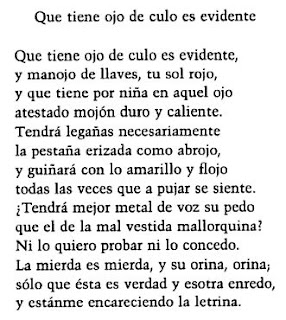
from Six Masters of the Spanish Sonnet
So would it make any difference to you if I told you that the published translation helped win this particular translator the "PEN American Center / Book of the Month Club Translation Award"? Would you give the translator a break if one notable critic said that this is the translator's "most remarkable translation thus far" and that "it is, in fact, more an act of wizardry than of translation"? What if you knew that the translator was also a poet, who was "[t]wice nominated for the Pulitzer Prize in poetry"?
What else might matter to you? That the translator is not a woman, but a man? Does he need to be a theologian? A linguist? If he's translated the New Testament, does he need to be a Greek scholar? A Christian? Part of a team of men scholars of theology and of Greek language and of translation science? Would those things then make it okay for him to use ass, fart, whore, piss, and shit in his translation?
What I'm trying to get at is what counts for you.
Yesterday, I started in on a post by quoting a feminist, a woman feminist saying "pissed off." But I said that this was Jesus speaking. Immediately, you began to protest. "Gloria Steinem is no Jesus." And some of you were thinking, "Cuss words are not the Word of God."
What I'm trying to get at is how the Bible can immediately make seemingly unequal things equal.
What I'm trying to get at is how translation, likewise, makes things that don't at first seem to count as the same really, nonetheless, the same.
What I'm trying to get at is how literature, even a poem, a sonnet for instance, makes seemingly unequal things equal.
"Now, just wait a minute," some of you are saying. "The Bible in the original language(s) is not translation. And a translation is not the original by any stretch. Don't you know much gets lost in translation? And, since you're bringing up literature, and poetry, don't you even remember how Poet Robert Frost wisely noted that 'Poetry is what gets lost in translation'?"
What I'm trying to get at is how you can make things you think are unequal equal. Men and women? Yes, equal. Jesus and a feminist? Yes, equal again. The original spoken word of Jesus and it's written translation by someone claiming to be his student named John? Right, equal. A bit of history and a possibly fictional, late-added episode of narrative complexity? Of course. Equals.
What I'm trying to get at is how the Western mode of thinking that is binary really is what scholars Andrea Lunsford and Lisa Ede rightly refer to as the "logic-chopping automaton."
But none of us has to be that much of a scholar to see this. Let me just turn things around and come at it from another direction. What if you yourself are not really making unequal things -- say, males and females -- equal? What if they really are equal but it's just your use of Western, Aristotelian logic that makes them un-equal? What if the Bible, translation, and literature in general really free you to reconsider difference?
Okay. I suppose you're dying to know. Who is this Bible translator mentioned at the beginning of the post? It's Willis Barnstone. "What?!" some of you are exclaiming. "He's not a real translator of the Bible. He's only translated the New Testament and not anything else. Well, okay. He's translated the New Testament, but not the one I grew up with. He's not gotten to any of the Hebrew books, or any of what may be called the Old Testament. And he's thrown in a whole bunch of Greek books that are not canonical. The best and top-most-ranked Bible bloggers didn't know much about him until you started mentioning him here. Yes, we know you mentioned him yesterday in a post. Yes, we saw how you quoted from his translation. But where did he use the bad words, the unbiblical English, that you quote in this post today?"
Please let me answer. What I'm trying to get at is that Barnstone is the equal of any other Bible translator, dead or alive. He's a poet, a historian, a theoretician, and a practitioner of translation. Here's his complete, to date, bibliography. If that's not impressive enough, then do know that he does have his critics. Even literary types are good critics, somewhat severely critical critics, of his New Testament translation. And those who know some of the original languages better than Barnstone does perhaps, even though these might still be students, can be good critics, somewhat severely critical critics.
Now if you've stayed with me this far, anticipating Willis Barnstone's translation that uses those words I mentioned earlier, then do know you're going to get to read it (and them). I'm not going to say a thing really about the passage that Barnstone has translated other than this: it really is an award winning translation, but it really isn't from the Bible. It really is a sonnet, perhaps equal to the Spanish sonnet Barnstone is rendering. Thus, if you believe me that Barnstone is equal to a translator of the Bible, then here's a translation of something else by "a Bible translator who uses these "bad words":


from Six Masters of the Spanish Sonnet
Sunday, August 14, 2011
Classics Greek Scholars translate Ephesians 5
------------------------
-- Richmond Lattimore
------------------------
" Be submissive to each other in awe and fear of the Mashiah.
Husbands, wives, and rules of the household
Wives, submit to your husbands as to the lord.*
*Few passages have aroused more controversy and ire, on both sides, than these instructions about wives and husbands. As an apology for the commanding position of the husband, it is argued that there is a reciprocal agreement of responsibility that affects both husband and wife, especially with regard to love and loyalty. However, in the end [by this "complementarian" argument] the wife must obey her husband, and given his CEO position (financial images, from wages to redemption are favorite metaphors in New Testament persuasion), there is no question [in the minds of "complementarians"] where ultimate authority lies: 'Wives, submit to your husbands as to the lord.' ...
Between the initial and end verses that prescribe a wife's position in the household, it should be seen [contra the hierarchical argument] that there is also a core of idealized love between man and woman, with emphasis on the mystery of caring for person and flesh. After the diatribe against ill use of the body, an idealized love appears immediately in verses 31-32, ending with 'This is a great mystery.' However, the author immediately catches himself and warns inconsolably in verse 33, 'and a wife should be in awe and fear of her husband.'"
-- Willis Barnstone
------------------------
"... while you are supporting one another out of love and respect for the Anointed One, wives, with your own husbands, as with the Lord.*
*ὑποτασσω, hupotasso, support. The oft-quoted verse, "Wives, submit to your husbands" does not occur in any known Greek text, yet has made its way into nearly every Bible version. The word, erroneously appearing as an imperative (in verse 22 where no verb appears), is in fact a participle and is in verse 21: 'supporting one another'. Even if mistranslated [in this context as] 'submitting', it would be 'submitting to one another'...."
-- Ann Nyland
------------------------
Of all three scholars, Nyland is the one whose English translation follows the Greek syntax and phrasing in such a way that the participial verbal ὑποτασσω, hupotasso, is part of a subordinate clause running down from an important main-clause imperative right through to expectations of one positioning oneself to one's others, under those others, always keeping the holy spirit and Jesus and God-as-Master in view. The main verbs for Paul and his readers in Ephesus are further away from the "submit" verbal, the commanding imperatives much much earlier in what we call verse 18. These main verbs are a negative and a positive put in contrast well before the subordinating verbs. So pardon my pun, my looking at how subordinate is submitted below what's truly more important, start to finish:
μὴ μεθύσκεσθε οἴνῳ,
ἐν ᾧ ἐστὶν ἀσωτία,
ἀλλὰ πληροῦσθε
ἐν πνεύματι,
...
ὑποτασσόμενοι ἀλλήλοις
ἐν φόβῳ χριστοῦ
αἱ γυναῖκες τοῖς ἰδίοις ἀνδράσιν
ὡς τῷ κυρίῳ
"Don't be intoxicated with wine,
in a way that's unsavory,
Do instead be filled up
in Spirit...
positioning oneself under one's others
in fearful awe of Messiah
the women to their own men
as to Master."
The phrasing is clearly ambiguous, allowing the Greek reader and the English translator to interpret according to his or her own viewpoint. Where one breaks the section headers, the verses, the sentences, the clauses, and the phrases matters. Whether one sees women as inherently and naturally equal ontologically and functionally with men matters.
In Viet Nam, when I grew up there, left handers were seen as naturally and inherently inferior to right handers. Get this; lefties were ontologically equal with righties. But, functionally, they were not equal. Hence, left handers were not accommodated in the school classrooms. Left handers had to sit in desks made for right handers. Left handers had to hold their pencils and chalk in their right hands to write. This was actually prescribed in the school code and also in the culture. If you were born a lefty, as all of my siblings were, then nothing else about you mattered; you had to submit yourself to the right handers and their world. When my mother started teaching my siblings and me, however, she threw these rules right out. She was our schoolmaster. We submitted ourselves to new rules that allowed for my siblings to learn to write with their left hands. There was a new school code of freedom for each and all of us. None of us could feel or act superior to the other because of which hand we used naturally. Turns out, one of my sibs found out he was ambidextrous. The point? Our new school master made all the difference, gave new freedom, didn't give room for superiority because of default or majority biology.
Monday, August 8, 2011
My Asian Stories, Feminisms, Bibles, Artworks

Here I am. Yep, it's me you're looking at. My Mom, one of my brothers, our friend Ông Siew, and then, on the right, me. Well, it's me when I was younger. Or, to be even more "accurate," and "precise," and "literal," and so forth and so on, it's just a picture of me, a photo graph, a digitized one now, on a blog on your PC or smartphone screen, or maybe printed on some paper or shined up on a screen. So is it me? Yes, there I am. I'm the same person as in the re-presentation you're looking at above.
My Dad was telling me stories of Ông Siew as I spent this weekend with him and my Mom. Many of the stories I hadn't heard. Most I was a part of. In fact, what got us looking at this picture was the fact that Dad was telling me a story of going to visit Mr. Siew's village in the highlands of central South Viet Nam. And he told this particular story as if I wasn't there. In fact, he'd forgotten how often he'd take us with him to the village, sometimes with Mom, most of the time without her. The photo doesn't really "prove" anything to him or to me. Except we were people who we still may be today. And yet, we're different some too. And we wouldn't be who we are today if we hadn't been where we were or who we were. [I think you may want to hear that Ông Siew is what the French called "Montagnard." Literally, that may mean to you that he is a "Mountain Person." Figurally, that may mean to you that he is of an indigenous people of Viet Nam. Doubtfully, you know something of the discriminations his people experienced and still experience because they have darker skin and different languages than those who are now officially Vietnamese by race and by language. To call him Ông is just to refer to him by one of his two mother tongues. So the stories get told and the representations go beyond western logic. They are personal, and you can tell your stories too.]
The framing of the photo, the framing of the stories, is key. I write at this blog oftentimes because I am this uncommon mix of the West and of the East, of what Edward Said reframed as Orientalism when having no idea really how he, then, was reframing his own Occidentalism, as a mixture. This is very unlike Aristotle, whom many of us here in the West get our epistemology from, as if it's the only or at least the default way of understanding our world, and who we are.
While in my parents' home this weekend, I read the forward to the book, The Story Bible, by Pearl S. Buck. Let me see if I can come to some point of what this blogpost might be about. If you get it at all, then you might need to know how I always take too many books with me when I visit my parents alone (that is, without my siblings or without my nuclear family), because my parents are often interrupted by visitors making house calls to see Dad, who has cancer in its final stage. They call him Mục Sư Gayle or Pendeta Gayle or Pastor Gayle because he is a missionary, or was when we in South Viet Nam and in Indonesia. They don't care to see me, usually, and it's usually a mutual feeling. So I do have a little time to read. Maybe some day, here at this blog, I'll read more of the book Pearl wrote, and more from her forward. Today, let me tell you how she starts it and finishes that forward, the last couple of paragraphs coming as if she's trying to let you know what the Bible as told in her Story Bible is about. This isn't a difficult thing if you just go with it a little. She recalls:
"When I was a child growing up in China in the household of my American parents, I was not encouraged to read the Bible."
"The Bible . . . may be read in many ways. For some it constitutes divine teaching, and it does contain that element. For others it is the purest literature we have in the English language. For still others it is a compendium of information on suffering, struggling, rejoicing human nature. For children, it is a story book. May they read it as I read it long ago in a Chinese house on a Chinese hillside!Yet stay--as I write it occurs to me that the bible has another meaning. It is an Asian book, for Christianity [as the religion of my parents] came out of the East. It seems a contradiction that today the West, facing conflict with the East, should nevertheless find its own source of spiritual life in a volume of Asia, centering about the Jews, who, though they have wandered far, nevertheless remain in many ways true to their ancient history which is Asian. It may be that in this very fact we shall find the means of a common understanding, a basic agreement on the constitution for a peaceful world."
"In Sappho we hear for the first time in the Western world the direct words of an individual woman. It cannot be said that her song has ever been surpassed. In a Greek dialect of eastern Mediterranean, she became our first Tang dynasty poet, akin to one of those Chinese of the eight century C.E. whose songs were overheard thought and conversation, in strict form, and who were said to 'dance in chains....."
"Time with its strange appetite has modernized these ancient voices, making the Tang writer Wang Wei and the Aiolic Sappho fashionable and intimate. The East has preserved a ton of the Tang poets, or, as the Chinese would say, 'ten thousand' of those golden birds in the Middle Kingdom. Despite early losses due to the fires of the book-burning emperor Qin Shi Huangdi (ruled 221-210 B.C.E.), China thereafter zealously preserved the work of its poets. But Sappho suffered from book-burning religious authorities who left us largely scraps of torn papyrus found in waterless wastes of North Africa...."Some other day at this blog we might read together how Willis turns to Chinese pinyinization for analogies to what we might do -- and some what he does -- with the Greek letters of Sappho and of her poetry burned and in fragments. We might see how in the Glossary of his book he writes of HADES and of Tartaros (thinking of how Rob Bell and John Piper might differently think of these words in the Greek new testament written by Jewish writers, translating Jewish rhetors). We might see how Willis characterizes HARAXOS and then HEKTOR (HECTOR) and then HELEN (Eléna), noting especially how the Sicilian poet Stisihoros (Stesichorus) writes lines as "counters to the story about Helen's venture to Troy" and how Plato, or at least his Socrates, "picks up on 'the false accusation of Helen'." Sappho, we would hear Willis say, does something altogether different with Helen in her poetry.
The lines are not always so straight, or so sharply divided, in stories and in poetry and in art. The lines of the East don't always seem so direct. The women, whom we may call feminists, like Pearl S. Buck and Sappho, whether because of early lack of encouragement or because of later book-burnings or because they do get to what they want to say, do not always tell us what we first expect.
In a book on my parents' shelf, I saw more of this. It is Hidden Art, by Edith Schaeffer. She starts in these ways:
"What is Art? Authorities do not agree. Definitions differ.On her second page, Edith continues her questions. Maybe some day at this blog we'll read more of them. Today, I just want you to believe me when I tell you the story that she also goes on to talk about hidden art, of God as artist, of the Creation as art, of the Bible as art.
Who draws the line that separates
Art from Design?
Sculpture from Ornaments?
Poetry from Jingle?
Great Music from Pooh's Hums?
Great Literature from Daily News?"
Today, I'd like to end here by pointing you to a Daily News piece, yes an op-ed essay. It's something that one of my blogger friends pointed us all to:
"Theophrastus said...What you shouldn't miss if you go reading that essay is this: that there's this allusion to Aristotle, a great credit given to him:

"The main idea — that efforts at paraphrasing poetry into prose fail in ways that parallel attempts for prose do not — was not new. It has been generally agreed upon since Aristotle."Oh, but then I'd love for you to notice how the writer, Ernie, is trying to get us thinking about his thesis, which is how to answer this question, which appears as the up-front point of the whole essay:
"So what is your poem about?"I hope you're gathering a bit what you think this blogpost of mine is about.
Think about this when you hear or read men saying things like "Rachel Held Evans is not writing Biblical blog posts" or "Well, at least she's not doing biblical scholarship at her blog" or "Oh, Come on. You've got to at least agree that she isn't doing real scholarship. Or else she'd be part of the biblioblogging Top community with us." The logic of the West demands such parsing, doesn't it? As if nature itself demands sharp distinctions and definitions that would exclude by rule. What's not very clear to those propagating such logic is how there are hidden reasons which in public they don't very much like to admit. And who can define poetry? Who is the king of prose?
"So what is my blogpost about?"
Maybe stories another day can help us answer. I believe I can say some of this gets very personal, but we shouldn't always be so afraid of telling such stories, should we? For now, I'm out of time to tell any more.
Subscribe to:
Posts (Atom)